
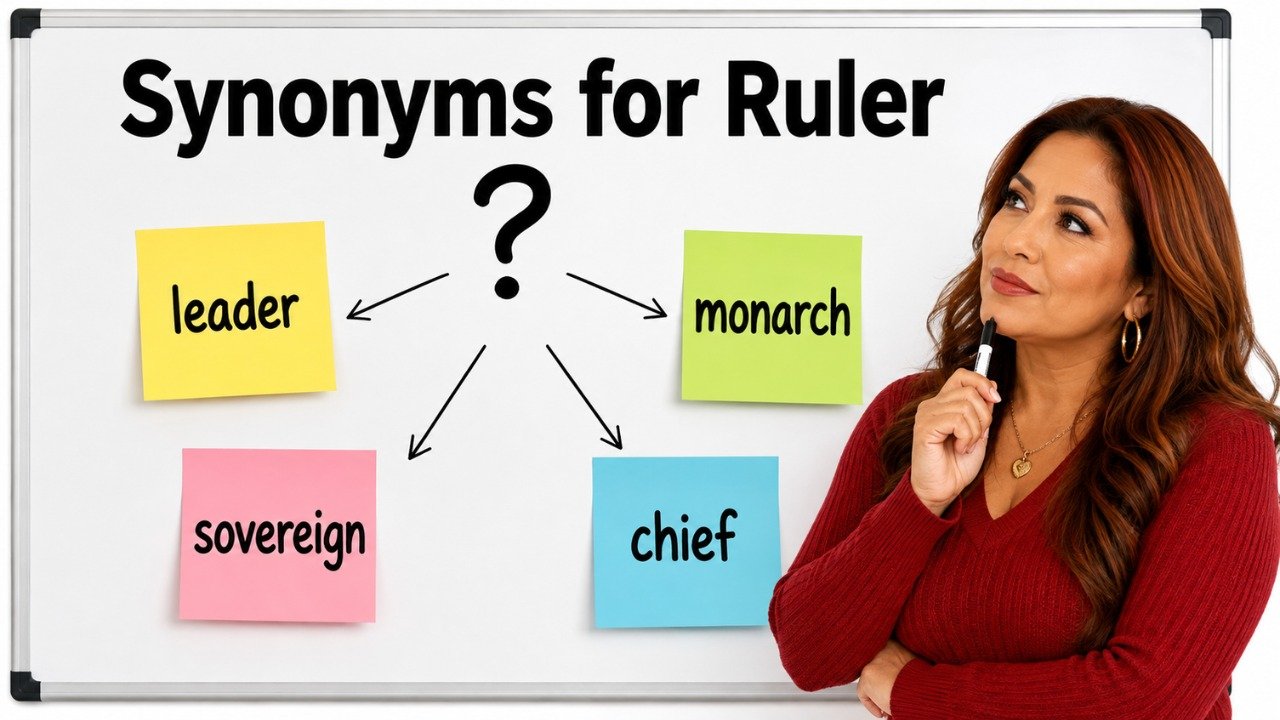
Quick Answer: The best synonyms for ruler include monarch, sovereign, king, queen, emperor, empress, leader, governor, potentate, and straightedge. When ruler means a person who governs a country or territory, monarch and sovereign are strong neutral choices, while king, queen, emperor, and empress describe specific royal positions. Leader works in broader or less formal contexts, and governor fits certain political settings. When ruler means a tool used for measuring or drawing straight lines, straightedge, measuring rule, and scale are more appropriate alternatives.
Pronunciation and Word Details
Word: Ruler.
Pronunciation: /ˈruːlər/
Part of Speech: Noun.
Meaning: A ruler is a person who governs a country, kingdom, or territory, or a straight tool used for measuring distances and drawing lines.
US Pronunciation:
UK Pronunciation:
What Does “Ruler” Mean?
Ruler means either a person who exercises authority over a country or territory or a tool used to measure length and draw straight lines.
As a noun referring to a person, ruler commonly describes someone who has political, royal, or supreme authority. A king, queen, emperor, empress, monarch, or sovereign can all be described as a ruler depending on the system of government.
The word can refer to historical figures as well as present or fictional leaders. In historical writing, ruler often works as a broad term because it does not require the writer to specify a particular royal title.
Ruler can also describe a measuring instrument. In this sense, it usually refers to a long, narrow object marked with units such as centimeters or inches. It is used for measurement or for drawing straight lines.
Context therefore determines the correct meaning. A sentence about an ancient ruler almost certainly refers to a governing person, while a sentence about measuring a page refers to the physical tool.
Meaning, Tone, and Context of “Ruler”
Ruler is generally a neutral word, but its tone changes according to context.
When referring to government or royalty, ruler can sound formal, historical, political, or academic. It is common in discussions of kingdoms, empires, dynasties, states, political authority, and historical leadership.
The word itself does not necessarily suggest whether a person governed fairly or harshly. A ruler may be democratic, hereditary, absolute, ceremonial, powerful, weak, popular, or unpopular depending on the situation.
Monarch and sovereign often sound more formal than ruler. King and queen are more specific because they identify the person’s royal title. Leader is broader and may refer to someone without supreme political authority.
When referring to a measuring instrument, ruler is neutral and practical. It appears naturally in education, mathematics, design, drawing, construction, crafts, and technical instructions.
Because ruler has two major meanings, choosing the right synonym requires understanding whether the sentence concerns authority or measurement.
When and How to Use “Ruler”
For Political Authority
Use ruler when referring generally to someone who governs a country, kingdom, state, or territory.
Example: The ruler introduced several changes to the kingdom’s legal system.
For Royal Leadership
Ruler is useful when the person’s exact royal title is unnecessary or unknown.
Example: The ancient ruler expanded the kingdom through diplomacy and military campaigns.
For Historical Writing
Use ruler as a broad term when discussing kings, queens, emperors, or other people with supreme authority.
Example: Each ruler left a different mark on the empire.
For Supreme Power
Ruler can describe a person who has the highest level of authority within a political system.
Example: The ruler controlled important decisions concerning taxation and defense.
For Measurement
Use ruler for the straight instrument marked with units of length.
Example: Use a ruler to measure the width of the paper.
For Drawing Straight Lines
Ruler is also appropriate when the tool is being used as a straight guide rather than simply for measurement.
Example: She used a ruler to draw a straight border around the diagram.
Best Synonyms for Ruler
Monarch
Synonym: A king, queen, emperor, or empress who serves as the sovereign head of a monarchy.
Example: The monarch addressed the nation during the ceremony.
Sovereign
Synonym: A person possessing supreme authority, especially a monarch.
Example: The sovereign formally approved the new law.
King
Synonym: A male monarch who rules a kingdom.
Example: The king governed the kingdom for several decades.
Queen
Synonym: A female monarch who rules a kingdom.
Example: The queen became known for supporting education and public works.
Emperor
Synonym: A male ruler of an empire.
Example: The emperor expanded his influence across several regions.
Empress
Synonym: A female ruler of an empire.
Example: The empress played an important role in governing the vast territory.
Leader
Synonym: A person who guides, directs, or governs others.
Example: The leader worked to unite several competing groups.
Governor
Synonym: A person who officially governs a region, territory, or political division.
Example: The governor was responsible for administering the province.
Potentate
Synonym: A powerful ruler, especially one with extensive political authority.
Example: The wealthy potentate controlled a strategically important territory.
Straightedge
Synonym: A straight tool or edge used for drawing straight lines.
Example: The architect used a straightedge to create precise lines.
50 Synonyms for Ruler with Short Meanings
- Monarch: A sovereign head of a monarchy.
- Sovereign: A person possessing supreme governing authority.
- King: A male ruler of a kingdom.
- Queen: A female ruler of a kingdom.
- Emperor: A male ruler of an empire.
- Empress: A female ruler of an empire.
- Leader: A person who directs or governs others.
- Governor: A person who governs a region or territory.
- Potentate: A powerful sovereign or ruler.
- Regent: A person who governs temporarily for a monarch.
- Prince: A male royal ruler or member of a ruling family.
- Princess: A female royal who may govern a principality.
- Chief: A person who leads a group, community, or territory.
- Head: The person holding the highest position of authority.
- Commander: A person with authority over others, especially in military contexts.
- Overlord: A ruler exercising authority over subordinate rulers or territories.
- Autocrat: A ruler possessing extensive personal power.
- Despot: A ruler who exercises absolute or oppressive authority.
- Dictator: A political ruler holding concentrated and often unrestricted power.
- Tyrant: A cruel or oppressive ruler.
- Czar: A traditional title for certain emperors or supreme rulers.
- Tsar: An alternative spelling of czar for an imperial ruler.
- Sultan: A sovereign ruler in certain historical and political traditions.
- Caliph: A historical title for a political and religious leader in an Islamic state.
- Khan: A title historically used by rulers and leaders in parts of Asia.
- Pharaoh: The title traditionally used for rulers of ancient Egypt.
- Shah: A traditional title for certain Persian monarchs.
- Chieftain: The leader or ruler of a tribe or clan.
- Warlord: A powerful leader controlling territory through military strength.
- Dynast: A member of a ruling dynasty, especially one who exercises authority.
- Crown: The monarchy or sovereign authority represented collectively.
- Royal: A member of a royal family, especially one holding authority.
- Head of State: The highest formal representative of a state.
- Head of Government: The person responsible for directing a government.
- Supreme Leader: A leader holding the highest level of authority.
- Reigning Monarch: A monarch currently exercising the royal office.
- Crowned Head: A monarch or sovereign ruler.
- Master: A person exercising control or authority in a particular context.
- Lord: A person holding authority, rank, or historical territorial power.
- Liege: A feudal lord to whom loyalty or service is owed.
- Administrator: A person responsible for governing or managing an area.
- Authority: A person or institution possessing governing power.
- Straightedge: A straight tool used to guide the drawing of lines.
- Measuring Rule: A marked instrument used for measuring length.
- Rule: A measuring instrument marked with units of length.
- Scale: A graduated measuring device used in certain technical contexts.
- Measuring Stick: A straight object marked or used for measuring distance.
- Yardstick: A measuring stick one yard long or a standard of comparison.
- Meter Stick: A measuring instrument one meter long.
- Measuring Instrument: A general tool used to determine dimensions or length.
Read Also:
Synonyms for Birth

Synonyms for Ruler by Context
When Ruler Means a Monarch
When ruler refers to the hereditary or royal head of a state, strong alternatives include monarch, sovereign, king, queen, emperor, empress, and crowned head.
Example: The ruler inherited the throne at a young age.
Alternative: The monarch inherited the throne at a young age.
Monarch is especially useful when the person’s gender or exact royal title is not important.
When Ruler Means a Male Monarch
King, emperor, prince, sultan, shah, khan, pharaoh, and czar may fit depending on the particular historical or political system.
Example: The ruler expanded the empire into neighboring territories.
Alternative: The emperor expanded the empire into neighboring territories.
Emperor is more accurate when the person specifically governs an empire.
When Ruler Means a Female Monarch
Queen and empress are the clearest alternatives when the person’s title is known.
Example: The ruler introduced important reforms during her reign.
Alternative: The queen introduced important reforms during her reign.
Queen usually refers to a female monarch of a kingdom, while empress refers to a female ruler of an empire.
When Ruler Means an Authoritarian Leader
Autocrat, dictator, despot, and tyrant may be appropriate when the context involves concentrated or oppressive political power.
Example: The ruler allowed almost no opposition.
Alternative: The autocrat allowed almost no opposition.
These words carry stronger meanings than the neutral word ruler and should only be used when the context supports them.
When Ruler Means a Regional Leader
Governor, chief, chieftain, administrator, and leader can describe people who govern particular regions or communities.
Example: The ruler was responsible for the northern province.
Alternative: The governor was responsible for the northern province.
Governor is more precise when the office involves formal administration of a region.
When Ruler Means a Measuring Tool
Straightedge, measuring rule, rule, yardstick, meter stick, and measuring stick are useful alternatives.
Example: Place the ruler along the edge of the paper.
Alternative: Place the straightedge along the edge of the paper.
Straightedge is particularly suitable when the tool is being used to guide a line rather than measure distance.
Another Word for Ruler
The best general replacement for ruler is monarch when the word refers to a royal person governing a state. However, the most accurate alternative depends on the political system, the person’s title, and the meaning of the sentence.
If the ruler governs a kingdom, king or queen may be clearer. For an empire, emperor or empress is more precise. When ruler refers to a measuring tool, straightedge or measuring rule is usually appropriate.
Original: The ruler governed the kingdom for thirty years.
Better Option: The monarch governed the kingdom for thirty years.
Original: The ruler expanded his empire rapidly.
Better Option: The emperor expanded his empire rapidly.
Original: The ruler exercised complete personal control over the state.
Better Option: The autocrat exercised complete personal control over the state.
Original: She used a ruler to draw the border.
Better Option: She used a straightedge to draw the border.
When Not to Use “Ruler”
Ruler is useful when a broad term is needed, but it can be less precise when the person’s official title or type of authority is known.
When a Specific Royal Title Is Known
Weak: The ruler became king at the age of twenty.
Better: The king took the throne at the age of twenty.
King is more direct because the person’s title is already known.
When Referring to an Empire
Weak: The ruler controlled a vast empire.
Better: The emperor controlled a vast empire.
Emperor provides more specific information about the form of rule.
When Describing Temporary Royal Authority
Weak: The ruler governed until the young king became old enough to rule.
Better: The regent governed until the young king became old enough to rule.
Regent communicates that the authority was temporary.
When Describing Oppressive Government
Weak: The ruler violently suppressed every political opponent.
Better: The tyrant violently suppressed every political opponent.
Tyrant adds an important negative meaning that ruler alone does not convey.
When Discussing a Drawing Tool
Weak: Use the ruler as a guide if measurement is unnecessary.
Better: Use the straightedge as a guide if measurement is unnecessary.
Straightedge is more exact when the main purpose is drawing straight lines.
When Repetition Becomes Distracting
Weak: The ruler succeeded the previous ruler and became an influential ruler.
Better: The monarch succeeded the previous sovereign and became an influential leader.
Varying precise terms can improve readability as long as the meaning remains accurate.
Words Commonly Confused With Ruler
Ruler vs Monarch: Ruler is a broad term for a person who governs, while monarch specifically refers to the sovereign head of a monarchy.
Ruler vs Sovereign: A ruler governs or controls a territory. Sovereign emphasizes supreme independent authority and is often used for monarchs.
Ruler vs King: King is a specific title for a male monarch, while ruler can describe kings, queens, emperors, and other governing figures.
Ruler vs Leader: Leader is broader than ruler. A person can lead a company, movement, group, or team without governing a country.
Ruler vs Governor: Governor usually refers to someone responsible for governing a particular region or administrative territory rather than an independent kingdom or empire.
Ruler vs Dictator: Ruler is neutral, while dictator usually suggests highly concentrated political power and limited political opposition.
Ruler vs Tyrant: Ruler does not automatically imply cruelty. Tyrant specifically describes a ruler who uses power harshly or oppressively.
Ruler vs Straightedge: A ruler usually contains measurement markings, while a straightedge primarily provides a straight edge for drawing or checking lines.
Which Synonym Should You Choose?
Choose monarch when writing generally about the royal head of a monarchy.
Choose sovereign when you want to emphasize supreme political or royal authority.
Choose king when referring specifically to a male monarch of a kingdom.
Choose queen when referring specifically to a female monarch of a kingdom.
Choose emperor when the male ruler governs an empire.
Choose empress when the female ruler governs an empire.
Choose regent when someone temporarily exercises royal authority on behalf of a monarch.
Choose leader in general writing or conversation when exact constitutional status is not important.
Choose governor when discussing the official leader or administrator of a province, state, or territory.
Choose autocrat when emphasizing concentrated personal authority.
Choose dictator when discussing a political system in which one individual holds extensive unchecked power.
Choose tyrant only when the person’s rule is cruel, oppressive, or abusive.
Choose monarch or sovereign for formal essays and historical discussions when the exact title is less important.
Choose straightedge when the physical ruler is mainly being used for drawing straight lines.
Choose measuring rule when measurement is the central purpose of the tool.
Real Life Examples of “Ruler” in Sentences
Original: The ruler remained popular throughout much of her reign.
Better Option: The monarch remained popular throughout much of her reign.
Original: The ruler of the kingdom introduced new laws.
Better Option: The sovereign of the kingdom introduced new laws.
Original: The ruler commanded an enormous empire.
Better Option: The emperor commanded an enormous empire.
Original: The young ruler inherited the throne from his father.
Better Option: The young king inherited the throne from his father.
Original: The ruler governed temporarily because the monarch was still a child.
Better Option: The regent governed temporarily because the monarch was still a child.
Original: The ruler controlled every major political institution.
Better Option: The autocrat controlled every major political institution.
Original: The cruel ruler punished anyone who criticized him.
Better Option: The tyrant punished anyone who criticized him.
Original: The ruler of the province supervised local administration.
Better Option: The governor of the province supervised local administration.
Original: Use a ruler to make the line perfectly straight.
Better Option: Use a straightedge to make the line perfectly straight.
Original: The student measured the rectangle with a ruler.
Better Option: The student measured the rectangle with a measuring rule.
Synonym Groups and Usage Differences
Royal Authority Group
Monarch, sovereign, king, queen, emperor, empress, and crowned head belong to the royal authority group.
Monarch is broad and gender neutral. Sovereign emphasizes supreme authority. King and queen identify particular royal titles, while emperor and empress specifically relate to empires.
Example: The monarch formally opened the new legislative session.
General Leadership Group
Leader, chief, head, governor, administrator, and commander describe people who direct, govern, or control others.
These words vary considerably in scope. Leader is broad, governor has an administrative meaning, and commander usually relates to military authority.
Example: The governor supervised the administration of the territory.
Absolute Power Group
Autocrat, dictator, despot, tyrant, and potentate can describe rulers with extensive personal authority.
These terms should not be treated as identical. Autocrat emphasizes concentrated power, dictator has a strong political meaning, despot suggests absolute control, and tyrant strongly suggests oppressive rule.
Example: The autocrat concentrated political authority in his own office.
Historical Title Group
Czar, tsar, sultan, caliph, khan, pharaoh, shah, and chieftain are titles associated with particular historical, cultural, or political traditions.
These should only be used when the title accurately matches the historical setting.
Example: The pharaoh ordered the construction of major monuments.
Measurement Group
Straightedge, measuring rule, rule, yardstick, meter stick, and measuring stick relate to the physical meaning of ruler.
Straightedge focuses on creating straight lines, while measuring rule emphasizes determining length.
Example: She placed a straightedge against the paper before drawing the line.
Antonyms of Ruler
The opposite of ruler depends on whether the word refers to authority or a measuring object.
Subject: A person governed by a monarch or sovereign.
Citizen: A member of a state who does not necessarily hold governing authority.
Follower: A person who follows the direction or leadership of another.
Subordinate: Someone occupying a lower position of authority.
Servant: A person serving another rather than exercising supreme authority.
Dependent: Someone whose position relies on the authority or support of another.
Commoner: A person who does not belong to the hereditary ruling nobility or monarchy.
Private Citizen: A person without an official governing role.
Vassal: A person historically subordinate to a feudal lord.
Inferior: A person occupying a lower rank in a hierarchy.
There is no simple direct antonym for ruler when it means a measuring instrument. In that context, contrast depends on function rather than opposition.
Comparison: Ruler vs Related Words
Ruler vs Monarch
Ruler is a general term for someone who governs, while monarch specifically describes the sovereign head of a monarchy.
Example With Ruler: The ruler strengthened the kingdom’s defenses.
Example With Monarch: The monarch attended the annual state ceremony.
Ruler vs Sovereign
Ruler emphasizes the act or position of governing. Sovereign emphasizes supreme and independent authority.
Example With Ruler: The ruler appointed several new officials.
Example With Sovereign: The sovereign exercised the formal powers of the crown.
Ruler vs King
Ruler can describe many types of governing figures, while king specifically refers to a male monarch.
Example With Ruler: The ruler inherited political authority.
Example With King: The king inherited the throne from his father.
Ruler vs Leader
Ruler normally suggests governmental or territorial authority. Leader can refer to anyone who guides a group, organization, movement, or community.
Example With Ruler: The ruler governed a large kingdom.
Example With Leader: The leader encouraged the group to cooperate.
Ruler vs Governor
Ruler can imply supreme authority, while governor commonly describes someone officially responsible for administering a particular region.
Example With Ruler: The ruler controlled the entire kingdom.
Example With Governor: The governor administered the northern province.
Ruler vs Autocrat
Ruler is neutral regarding the amount of political power held. Autocrat specifically describes someone who possesses concentrated personal authority.
Example With Ruler: The ruler approved the reforms.
Example With Autocrat: The autocrat made major decisions without meaningful opposition.
Ruler vs Tyrant
Ruler does not express a moral judgment. Tyrant has a strongly negative meaning and describes a cruel or oppressive ruler.
Example With Ruler: The ruler governed for twenty years.
Example With Tyrant: The tyrant punished citizens who challenged his authority.
Ruler vs Straightedge
A ruler normally has measurement markings and can be used for both measuring and drawing. A straightedge primarily provides a straight guiding edge and may not contain measurement markings.
Example With Ruler: He measured the paper with a ruler.
Example With Straightedge: He used a straightedge to draw a clean line.
Common Phrases and Expressions With “Ruler”
Absolute Ruler: A ruler possessing extensive or unrestricted authority.
Powerful Ruler: A person with considerable political or territorial influence.
Supreme Ruler: A person regarded as holding the highest governing authority.
Wise Ruler: A ruler known for thoughtful or effective decisions.
Cruel Ruler: A governing person known for harsh or oppressive actions.
Ancient Ruler: A king, queen, emperor, or other governing figure from ancient history.
Former Ruler: Someone who previously held supreme governing authority.
Reigning Ruler: A ruler currently holding the throne or governing position.
Hereditary Ruler: A ruler whose position is obtained through family succession.
Use a Ruler: A common instruction meaning to measure something or create a straight line with the measuring tool.
Common Mistakes to Avoid
One common mistake is treating every synonym for ruler as interchangeable. The words monarch, king, dictator, governor, and tyrant describe different forms or qualities of authority.
Do not call every ruler a king.
Incorrect: The female ruler became king after her mother’s death.
Better: The female ruler became queen after her mother’s death.
Do not use emperor when the person governs a kingdom rather than an empire unless that is the person’s actual title.
Unclear: The emperor ruled the small kingdom.
Better: The king ruled the small kingdom.
Avoid using dictator merely as a stronger synonym for ruler. Dictator has a specific political meaning involving concentrated power.
Weak Choice: The constitutional monarch was a dictator.
Better Choice: The constitutional monarch was a ruler with limited formal powers.
Do not use tyrant unless cruelty or oppression is genuinely part of the intended meaning.
Unfair Choice: The respected ruler was a tyrant.
Better Choice: The respected ruler was a monarch.
Writers should also distinguish between ruler and leader. Every ruler may function as a leader, but not every leader is a ruler.
Incorrect: The captain was the ruler of the football team.
Better: The captain was the leader of the football team.
When discussing measuring tools, avoid assuming straightedge and ruler always mean exactly the same thing. A ruler normally includes measurement markings, while a straightedge may simply provide a straight guiding edge.
Repetition can also make historical writing sound dull.
Repetitive: The ruler replaced the previous ruler, and the new ruler changed many laws.
Better: The monarch succeeded the previous sovereign and changed many laws.
Choose precise vocabulary according to political structure, title, historical setting, and intended tone.
Conclusion
Understanding synonyms for ruler makes it easier to choose precise vocabulary for politics, history, leadership, and measurement. Monarch and sovereign are strong general alternatives for royal authority, while king, queen, emperor, and empress describe specific titles. Governor fits regional administration, while autocrat, dictator, and tyrant carry stronger meanings about power or oppression. When ruler refers to a measuring tool, straightedge, measuring rule, or yardstick may work better. Always choose the synonym that accurately matches the person’s role, authority, tone, or intended function.
FAQs About Synonyms for Ruler
What Is the Best Synonym for Ruler?
Monarch is one of the best general synonyms when ruler refers to the royal head of a state. Sovereign is another strong formal alternative.
What Is Another Word for a Powerful Ruler?
Potentate, sovereign, monarch, or supreme leader may work. Autocrat is appropriate when the person’s power is highly concentrated.
Is Monarch the Same as Ruler?
A monarch is a type of ruler. Ruler is broader because it can describe monarchs as well as other people who govern territories or states.
What Is a Synonym for a Cruel Ruler?
Tyrant and despot are common alternatives for a cruel or oppressive ruler. These words have strongly negative meanings and should only be used when justified by context.
What Is a Formal Synonym for Ruler?
Sovereign and monarch are strong formal choices. Potentate can also be used in historical or literary contexts for a powerful ruler.
What Is Another Word for Ruler as a Measuring Tool?
Straightedge, measuring rule, rule, yardstick, meter stick, and measuring stick are useful alternatives. The best choice depends on whether the tool is being used for measuring or drawing.
What Is the Difference Between a Ruler and a Leader?
A ruler usually possesses political or territorial authority. A leader is anyone who guides or directs others, so the term can apply to governments, communities, organizations, teams, and many other groups.
