
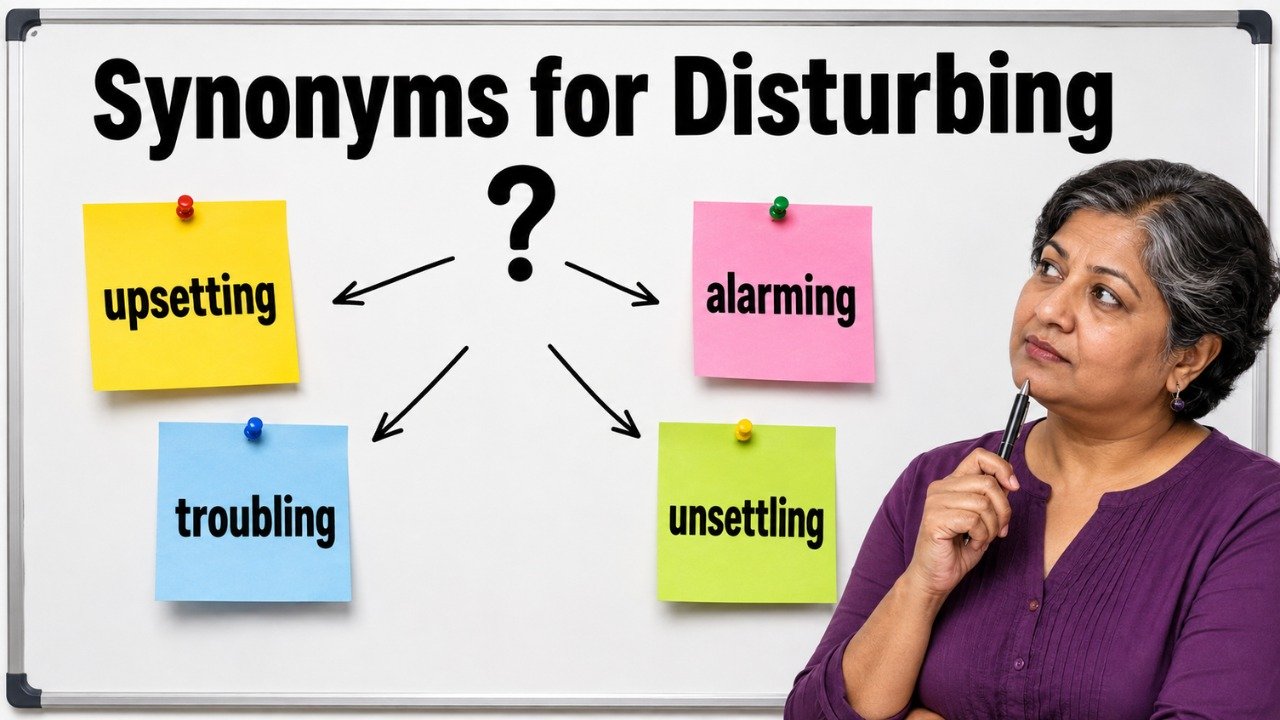
Quick Answer: The best synonyms for disturbing include troubling, unsettling, distressing, alarming, upsetting, disturbing, disquieting, shocking, unnerving, and concerning. Among these synonyms for disturbing, troubling works well in formal and general writing, unsettling describes something that creates unease, distressing suits emotionally painful situations, alarming emphasizes danger or serious concern, shocking suggests strong surprise or horror, and unnerving is useful when something causes nervousness or discomfort.
Pronunciation and Word Details
Word: Disturbing.
Pronunciation: /dɪˈstɜːrbɪŋ/
Part of Speech: Adjective.
Meaning: Causing worry, discomfort, fear, emotional upset, or a feeling that something is wrong.
US Pronunciation:
UK Pronunciation:
What Does “Disturbing” Mean?
Disturbing means causing worry, discomfort, fear, emotional upset, or uneasiness.
As an adjective, disturbing describes something that affects a person’s sense of calm or emotional security. It can refer to information, behavior, images, events, sounds, trends, memories, or situations.
Example: The report contained disturbing details about the incident.
The word often suggests that something feels wrong, unpleasant, frightening, or difficult to ignore.
Example: She noticed a disturbing change in his behavior.
Disturbing can also describe information that raises serious concerns without necessarily causing fear.
Example: The researchers identified a disturbing decline in participation.
In emotional contexts, disturbing may describe something that stays in a person’s mind because it is upsetting or uncomfortable.
Example: The film included several disturbing scenes.
The best synonym depends on the type and strength of the reaction. Troubling emphasizes concern, distressing focuses on emotional pain, alarming suggests possible danger, unsettling creates unease, and shocking describes something strongly surprising or upsetting.
Meaning, Tone, and Context of “Disturbing”
Disturbing usually has a negative and moderately strong tone. It is more serious than mildly uncomfortable but does not always imply extreme horror or danger.
In everyday conversation, disturbing commonly describes behavior, stories, images, events, or discoveries that make someone uncomfortable.
Conversational Use: His comments were deeply disturbing.
In formal writing, disturbing can describe trends, findings, statistics, developments, or patterns that raise concern.
Formal Use: The report revealed a disturbing increase in safety complaints.
In academic or analytical writing, troubling, concerning, or alarming may sometimes sound more precise.
Academic Use: Researchers identified a troubling pattern in the results.
In emotional writing, distressing and upsetting may be more suitable when the focus is sadness, fear, or emotional pain.
Emotional Use: The news was extremely distressing for the family.
When something creates nervous uncertainty rather than direct sadness, unsettling or unnerving may be stronger choices.
Example: The unexplained silence was unsettling.
Disturbing can therefore range from serious concern to fear, emotional discomfort, shock, or unease.
When and How to Use “Disturbing”
For Troubling Information
Use disturbing when information creates worry or suggests that something may be wrong.
Example: The investigation uncovered several disturbing facts.
For Alarming Trends
Disturbing works well when a pattern or development deserves serious attention.
Example: The study revealed a disturbing decline in reading ability.
For Upsetting Events
Use disturbing for events that cause emotional discomfort or distress.
Example: Witnesses described the incident as disturbing.
For Unsettling Behavior
The word can describe behavior that makes other people feel uneasy or concerned.
Example: His sudden change in attitude was disturbing.
For Frightening Images or Scenes
Use disturbing when visual material creates fear, discomfort, or strong emotional unease.
Example: Some of the images were too disturbing for younger viewers.
For Concerning Discoveries
Disturbing can describe findings that suggest a serious problem.
Example: The inspection produced several disturbing discoveries.
For Uncomfortable Memories
The word can describe memories or thoughts that continue to create emotional unease.
Example: She struggled to forget the disturbing memory.
For Serious Social Issues
In essays and reports, disturbing can emphasize that a condition or trend deserves attention.
Example: The figures show a disturbing rise in preventable accidents.
Best Synonyms for Disturbing
Troubling: Causing worry, concern, or serious thought.
Example: The report revealed a troubling pattern of repeated errors.
Unsettling: Creating discomfort, uncertainty, or unease.
Example: The strange silence was deeply unsettling.
Distressing: Causing emotional pain, anxiety, or sadness.
Example: The family received distressing news.
Alarming: Causing fear or concern because something appears dangerous or serious.
Example: Officials reported an alarming increase in accidents.
Upsetting: Causing sadness, worry, anger, or emotional discomfort.
Example: She found the conversation extremely upsetting.
Disquieting: Creating unease, worry, or a sense that something is wrong.
Example: The sudden change was disquieting.
Shocking: Causing strong surprise, horror, or disbelief.
Example: The investigation uncovered shocking evidence.
Unnerving: Making someone nervous, anxious, or less confident.
Example: The unexplained footsteps were unnerving.
Concerning: Causing worry or requiring attention.
Example: The decline in attendance is concerning.
Perturbing: Causing anxiety, unease, or mental discomfort.
Example: The unexplained results were perturbing to the researchers.
50 Synonyms for Disturbing with Short Meanings
- Troubling: Causing worry or concern.
- Unsettling: Creating unease or discomfort.
- Distressing: Causing emotional pain or anxiety.
- Alarming: Creating fear or serious concern.
- Upsetting: Causing sadness, worry, or emotional discomfort.
- Disquieting: Producing uneasiness or worry.
- Shocking: Causing strong surprise or horror.
- Unnerving: Making someone feel nervous or uneasy.
- Concerning: Giving reason for worry.
- Perturbing: Causing anxiety or mental unease.
- Worrying: Making someone feel concerned.
- Frightening: Causing fear.
- Scary: Informally causing fear or nervousness.
- Terrifying: Causing extreme fear.
- Horrifying: Causing horror or intense distress.
- Horrific: Extremely unpleasant, frightening, or shocking.
- Appalling: Causing shock, disgust, or strong disapproval.
- Dreadful: Extremely unpleasant or distressing.
- Awful: Very unpleasant, upsetting, or bad.
- Grim: Serious, depressing, or worrying.
- Sinister: Suggesting danger, evil, or harmful intent.
- Ominous: Suggesting that something bad may happen.
- Threatening: Suggesting danger or possible harm.
- Menacing: Creating a feeling of approaching danger.
- Eerie: Strange and frightening in an unusual way.
- Creepy: Informally causing uncomfortable fear or unease.
- Chilling: Producing strong fear or emotional unease.
- Haunting: Remaining emotionally powerful or difficult to forget.
- Disconcerting: Causing confusion, discomfort, or loss of confidence.
- Discomfiting: Making someone feel uneasy or embarrassed.
- Uncomfortable: Creating emotional or physical unease.
- Disagreeable: Unpleasant or difficult to experience.
- Unpleasant: Causing discomfort or dislike.
- Painful: Causing emotional or physical suffering.
- Heartbreaking: Causing deep sadness.
- Depressing: Causing sadness or loss of hope.
- Discouraging: Reducing confidence or hope.
- Disheartening: Making someone lose hope or enthusiasm.
- Agitating: Making someone worried, nervous, or emotionally restless.
- Aggravating: Increasing irritation, difficulty, or distress.
- Distracting: Taking attention away in an unwanted way.
- Disruptive: Interrupting normal order or activity.
- Intrusive: Unwanted and disturbing to privacy or concentration.
- Bothersome: Causing mild annoyance or discomfort.
- Irritating: Causing annoyance or frustration.
- Vexing: Causing annoyance, difficulty, or worry.
- Disconcerting: Making someone uncertain or uncomfortable.
- Foreboding: Creating a feeling that something bad may happen.
- Disturbing to behold: Difficult or upsetting to look at.
- Emotionally troubling: Causing serious emotional unease.
Read Also:
Synonyms for Ruler

Synonyms for Disturbing by Context
When Disturbing Means Troubling
When disturbing describes something that creates concern rather than fear, useful alternatives include troubling, concerning, worrying, disquieting, perturbing, and disconcerting.
Example: The report revealed a disturbing pattern.
Alternative: The report revealed a troubling pattern.
Troubling is particularly useful in formal writing because it communicates concern without sounding overly dramatic.
Example: The committee identified several troubling weaknesses in the process.
Concerning is direct and neutral.
Example: The increase in errors is concerning.
When Disturbing Means Frightening
When something causes fear, useful synonyms include frightening, scary, terrifying, horrifying, chilling, eerie, and sinister.
Example: The sound coming from the empty building was disturbing.
Alternative: The sound coming from the empty building was eerie.
Frightening is a broad choice for something that causes fear.
Example: The sudden noise was frightening.
Terrifying is much stronger and should be reserved for intense fear.
Example: The experience was terrifying.
When Disturbing Means Emotionally Upsetting
When disturbing refers to emotional pain or sadness, distressing, upsetting, heartbreaking, painful, depressing, and disheartening may be more precise.
Example: The family received disturbing news.
Alternative: The family received distressing news.
Distressing emphasizes emotional suffering.
Example: The details of the accident were distressing.
Upsetting is more conversational and can describe sadness, anger, or worry.
Example: She found the remarks upsetting.
When Disturbing Means Unsettling
When something creates uncertainty or discomfort rather than direct fear, unsettling, unnerving, disconcerting, eerie, and disquieting are useful.
Example: His unexplained behavior was disturbing.
Alternative: His unexplained behavior was unsettling.
Unnerving suggests that something affects a person’s confidence or emotional calm.
Example: The long silence was unnerving.
When Disturbing Means Shocking
For information or events that cause strong surprise and disapproval, shocking, appalling, horrific, dreadful, and awful may fit.
Example: The investigation uncovered disturbing details.
Alternative: The investigation uncovered shocking details.
Appalling often adds a sense of moral disapproval.
Example: The conditions inside the building were appalling.
When Disturbing Suggests Danger
When disturbing information signals possible danger, alarming, ominous, threatening, menacing, sinister, and foreboding can be stronger choices.
Example: The sudden rise in temperatures was disturbing.
Alternative: The sudden rise in temperatures was alarming.
Ominous suggests that something bad may happen.
Example: The dark clouds looked ominous.
Another Word for Disturbing
The best general replacement for disturbing is troubling because it works naturally in formal writing, essays, reports, and everyday language. However, the best alternative depends on the emotional reaction being described.
Use unsettling for unease, distressing for emotional pain, alarming for danger, and shocking for intense surprise.
Original: The report revealed a disturbing pattern.
Better Option: The report revealed a troubling pattern.
Original: There was something disturbing about the empty hallway.
Better Option: There was something unsettling about the empty hallway.
Original: The family received disturbing news.
Better Option: The family received distressing news.
Original: The figures show a disturbing increase in accidents.
Better Option: The figures show an alarming increase in accidents.
When Not to Use “Disturbing”
Disturbing is versatile, but it can become vague if a more precise emotional word is available.
Avoid disturbing when you know exactly whether something caused fear, sadness, concern, shock, or discomfort.
Weak: The news was disturbing.
Better: The news was distressing for everyone involved.
Do not use disturbing repeatedly in the same paragraph.
Weak: The report contained disturbing findings, disturbing statistics, and disturbing conclusions.
Better: The report contained troubling findings, alarming statistics, and deeply concerning conclusions.
Avoid using a very strong synonym when the situation is only mildly uncomfortable.
Weak: The slightly awkward conversation was horrifying.
Better: The slightly awkward conversation was uncomfortable.
Do not use casual synonyms such as creepy in formal reports unless an informal tone is appropriate.
Weak: The data showed a creepy pattern.
Better: The data showed a troubling pattern.
Avoid disturbing when the issue is simple annoyance rather than emotional concern.
Weak: The buzzing insect was emotionally disturbing.
Better: The buzzing insect was irritating.
Precision makes the sentence stronger and prevents exaggeration.
Words Commonly Confused With Disturbing
Disturbing vs Troubling: Disturbing can describe emotional discomfort, fear, or concern. Troubling focuses more specifically on worry or concern.
Disturbing vs Distressing: Disturbing creates unease or concern, while distressing emphasizes emotional pain, sadness, or anxiety.
Disturbing vs Alarming: Disturbing is broad. Alarming suggests a stronger reason to fear danger or a serious negative development.
Disturbing vs Unsettling: Disturbing can be emotionally strong, while unsettling often describes a quieter feeling of uncertainty or unease.
Disturbing vs Upsetting: Disturbing often suggests that something feels seriously wrong. Upsetting mainly focuses on the emotional reaction of sadness, anger, or worry.
Disturbing vs Shocking: Disturbing creates discomfort or concern. Shocking emphasizes strong surprise, horror, or disbelief.
Disturbing vs Frightening: Disturbing may cause fear, concern, sadness, or discomfort. Frightening specifically focuses on fear.
Disturbing vs Concerning: Disturbing has a stronger emotional tone. Concerning is often more neutral and professional.
Which Synonym Should You Choose?
Choose troubling when writing about problems, findings, patterns, behavior, or situations that create serious concern.
Choose unsettling when something creates unease, uncertainty, or emotional discomfort without direct danger.
Choose distressing when something causes sadness, emotional pain, or anxiety.
Choose alarming when information suggests danger, urgency, or a serious negative trend.
Choose upsetting when writing conversationally about something that causes sadness, anger, or worry.
Choose shocking when something produces strong surprise, horror, or disbelief.
Choose unnerving when something makes a person nervous, uncertain, or less confident.
Choose concerning for professional emails, reports, discussions, or situations where you want to express worry in a measured tone.
Choose disquieting in formal or literary writing when something creates subtle unease.
Choose frightening when fear is the main reaction.
Choose horrifying or terrifying only when the situation is extremely severe.
For formal reports, troubling, concerning, alarming, and disquieting often work well.
For essays, troubling, unsettling, distressing, and shocking provide useful differences in tone.
For professional emails, concerning is usually measured and appropriate.
For casual speech, upsetting, scary, creepy, and worrying may sound more natural depending on the situation.
For detailed descriptions, choose a synonym that identifies the exact emotional effect rather than relying on disturbing every time.
Real Life Examples of “Disturbing” in Sentences
Original: The report contained disturbing information about safety.
Better Option: The report contained alarming information about safety.
Original: She noticed a disturbing change in his behavior.
Better Option: She noticed a troubling change in his behavior.
Original: The strange sound was disturbing.
Better Option: The strange sound was unnerving.
Original: The family received disturbing news.
Better Option: The family received distressing news.
Original: The empty house had a disturbing atmosphere.
Better Option: The empty house had an eerie atmosphere.
Original: The investigation uncovered disturbing evidence.
Better Option: The investigation uncovered shocking evidence.
Original: The latest figures show a disturbing trend.
Better Option: The latest figures show an alarming trend.
Original: His comments were disturbing to several listeners.
Better Option: His comments were deeply troubling to several listeners.
Original: She found the memory disturbing.
Better Option: She found the memory upsetting.
Original: The unexplained silence became increasingly disturbing.
Better Option: The unexplained silence became increasingly unsettling.
Synonym Groups and Usage Differences
Concern Group
Troubling, concerning, worrying, disquieting, and perturbing describe situations that cause concern.
Troubling is flexible and relatively strong, while concerning sounds measured and professional.
Example: The decline in attendance is concerning.
Fear Group
Frightening, scary, terrifying, horrifying, chilling, and eerie relate to fear.
Frightening is broad, while terrifying describes extreme fear. Eerie often combines fear with strangeness.
Example: The unexplained sound was eerie.
Emotional Distress Group
Distressing, upsetting, painful, heartbreaking, depressing, and disheartening focus on emotional pain.
Distressing works well in formal writing, while upsetting is more conversational.
Example: The family received distressing information.
Unease Group
Unsettling, unnerving, disconcerting, discomfiting, and uncomfortable describe a loss of emotional calm.
Unsettling suggests uncertainty, while unnerving often affects confidence or composure.
Example: His sudden silence was unsettling.
Shock Group
Shocking, appalling, horrific, dreadful, and awful describe strong negative reactions.
Shocking emphasizes surprise, while appalling often includes moral disgust or strong disapproval.
Example: The investigation revealed appalling conditions.
Danger Group
Alarming, ominous, threatening, menacing, sinister, and foreboding suggest possible danger.
Alarming indicates immediate concern, while ominous and foreboding suggest that something bad may happen later.
Example: The sudden decline was alarming.
Antonyms of Disturbing
The opposite of disturbing depends on whether the word refers to worry, fear, emotional distress, or discomfort.
Calming: Making someone feel peaceful or relaxed.
Reassuring: Reducing fear or concern.
Comforting: Making someone feel emotionally supported or less worried.
Soothing: Producing calm or relief.
Pleasant: Enjoyable and not upsetting.
Relaxing: Helping someone become calm and comfortable.
Peaceful: Free from disturbance, tension, or conflict.
Encouraging: Giving hope or confidence.
Heartening: Making someone feel hopeful or positive.
Reassuring: Giving confidence that a situation is safe or acceptable.
Cheerful: Positive, happy, and emotionally uplifting.
Delightful: Very pleasant or enjoyable.
Comparison: Disturbing vs Related Words
Disturbing vs Troubling
Disturbing is broader and can refer to fear, discomfort, emotional pain, or serious concern. Troubling focuses mainly on worry.
Example With Disturbing: The witness described several disturbing details.
Example With Troubling: The report revealed a troubling pattern of mistakes.
Disturbing vs Unsettling
Disturbing may create a strong emotional reaction. Unsettling usually describes quieter unease or uncertainty.
Example With Disturbing: The documentary included disturbing images.
Example With Unsettling: The unexplained silence was unsettling.
Disturbing vs Distressing
Disturbing means causing discomfort, worry, or unease. Distressing places greater emphasis on emotional suffering.
Example With Disturbing: The findings were disturbing.
Example With Distressing: The family received distressing news.
Disturbing vs Alarming
Disturbing is general, while alarming suggests that something may be dangerous or urgently serious.
Example With Disturbing: The decline was disturbing.
Example With Alarming: The sudden rise in accidents was alarming.
Disturbing vs Shocking
Disturbing describes something emotionally uncomfortable or troubling. Shocking emphasizes a powerful reaction of surprise, horror, or disbelief.
Example With Disturbing: The article contained disturbing details.
Example With Shocking: The investigation revealed shocking misconduct.
Disturbing vs Upsetting
Disturbing can suggest that something is abnormal, frightening, or deeply troubling. Upsetting focuses more directly on sadness, worry, or anger.
Example With Disturbing: His behavior became increasingly disturbing.
Example With Upsetting: Her comments were upsetting to the family.
Disturbing vs Frightening
Disturbing covers several negative emotional reactions, while frightening specifically means causing fear.
Example With Disturbing: The story raised several disturbing questions.
Example With Frightening: The sudden explosion was frightening.
Disturbing vs Concerning
Disturbing has a stronger emotional effect, while concerning is more restrained and professional.
Example With Disturbing: The images were disturbing.
Example With Concerning: The latest results are concerning.
Common Phrases and Expressions With “Disturbing”
Disturbing News: Information that causes worry, sadness, or emotional discomfort.
Disturbing Trend: A pattern that creates serious concern.
Disturbing Behavior: Actions that appear troubling, inappropriate, frightening, or unusual.
Disturbing Image: A picture or visual scene that causes emotional discomfort.
Disturbing Thought: An idea that produces worry, fear, or unease.
Disturbing Discovery: A finding that causes concern or alarm.
Disturbing Evidence: Information or proof that creates serious concern.
Disturbing Details: Facts that are upsetting, shocking, or uncomfortable.
Disturbing Pattern: A repeated development that raises concern.
Deeply Disturbing: Extremely troubling, upsetting, or emotionally uncomfortable.
Common Mistakes to Avoid
One common mistake is using disturbing as a general replacement for every negative adjective. Disturbing has a specific meaning connected with worry, unease, fear, or emotional discomfort.
Unnatural: The soup tasted disturbing.
Better: The soup tasted unpleasant.
Another mistake is choosing a synonym that is much stronger than the situation requires.
Exaggerated: The small scheduling error was horrifying.
Better: The small scheduling error was concerning.
Avoid using scary in formal reports when alarming, troubling, or concerning would be more suitable.
Too Casual: The figures show a scary increase in costs.
Better: The figures show an alarming increase in costs.
Do not confuse distressing with disturbing. Distressing emphasizes emotional suffering, while disturbing has a broader meaning.
Example: News of a serious personal loss may be distressing, while an unexplained pattern of suspicious behavior may be disturbing.
Repetition can also weaken your writing.
Repetitive: The disturbing report described disturbing behavior and disturbing findings.
Improved: The troubling report described unsettling behavior and alarming findings.
Avoid vague usage when a more exact reaction can be named.
Vague: The situation was disturbing.
Precise: The situation was alarming because it created an immediate safety concern.
Choosing the right synonym makes the emotion, degree, and context much clearer.
Conclusion
The best synonyms for disturbing change according to the reaction you want to describe. Troubling and concerning suit serious concerns, while unsettling and unnerving express unease. Distressing and upsetting focus on emotional pain, alarming signals danger or urgency, and shocking emphasizes strong surprise or horror. Frightening works when fear is central. Understanding these differences helps you choose synonyms for disturbing that sound precise, natural, and appropriate in conversation, essays, reports, professional writing, and descriptive passages.
FAQs About Synonyms for Disturbing
What Is the Best Synonym for Disturbing?
Troubling is one of the best general synonyms because it works naturally for behavior, information, events, patterns, and situations that cause concern.
What Is Another Word for Disturbing?
Useful alternatives include troubling, unsettling, distressing, alarming, upsetting, disquieting, shocking, unnerving, and concerning.
What Is a Formal Synonym for Disturbing?
Troubling, concerning, disquieting, alarming, perturbing, and distressing are useful choices for formal writing.
What Is a Stronger Word Than Disturbing?
Horrifying, terrifying, appalling, or shocking may be stronger, but the correct choice depends on whether the reaction involves fear, horror, disgust, or surprise.
Is Unsettling the Same as Disturbing?
They are similar, but unsettling usually describes a quieter feeling of unease or uncertainty. Disturbing can suggest a stronger or broader emotional reaction.
What Is the Difference Between Disturbing and Distressing?
Disturbing means causing worry, unease, or discomfort. Distressing more specifically describes something that causes emotional pain, sadness, or anxiety.
What Is the Opposite of Disturbing?
Common opposites include calming, reassuring, comforting, soothing, peaceful, pleasant, encouraging, and relaxing.
