
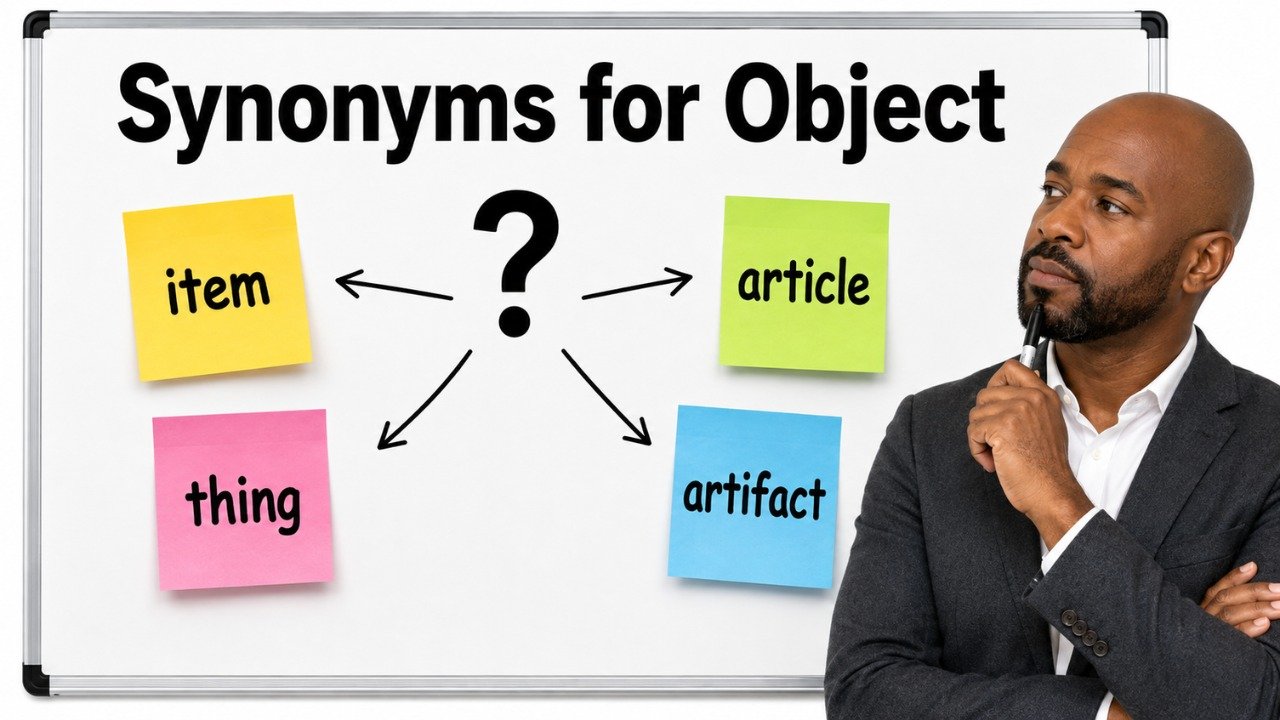
Quick Answer: The best synonyms for object include thing, item, article, entity, goal, purpose, objective, target, oppose, and protest. When object means a physical thing, use thing, item, article, or entity. When it means a purpose or desired result, goal, aim, purpose, or objective works better. When object is used as a verb meaning to express disagreement, oppose, protest, disagree, or challenge may be more precise. The best synonym depends on whether you are describing a physical thing, a goal, a focus of attention, or an act of disagreement.
Pronunciation and Word Details
Word: Object
Pronunciation: Noun /ˈɑːb.dʒekt/, Verb /əbˈdʒekt/
Part of Speech: Noun and verb
Meaning: As a noun, object can mean a physical thing, a purpose, or something receiving attention. As a verb, it means to express opposition or disagreement.
US Pronunciation:
UK Pronunciation:
What Does “Object” Mean?
Object is a flexible English word that can refer to a physical thing, a goal, a focus of attention, or an expression of disagreement.
As a noun, object commonly means something that can be seen, touched, identified, or considered separately. A cup, book, chair, sculpture, and phone can all be described as objects.
Object can also describe a purpose or goal. In a sentence such as “The object of the exercise is to improve accuracy,” object means the intended aim or result.
The word can additionally describe a person or thing toward which an emotion, action, or attention is directed. Someone may be the object of admiration, affection, criticism, or curiosity.
As a verb, object means to express disagreement, opposition, or disapproval. For example, “Several residents objected to the proposal” means they opposed or protested against it.
Because object has several meanings, choosing the right synonym depends heavily on context.
Meaning, Tone, and Context of “Object”
Object is generally a neutral word, but its tone changes according to how it is used.
When referring to a physical thing, object is neutral and widely used in everyday speech, academic writing, science, technical descriptions, and instructions.
When object means a purpose or aim, it sounds slightly more formal. Expressions such as “the object of the activity” or “the main object of the plan” are more common in formal or explanatory writing than in casual conversation.
When describing someone or something receiving attention, object can sound formal or literary. Phrases such as “the object of his admiration” or “the object of public interest” are common in descriptive writing.
As a verb, object is polite but firm. Saying “I object to this decision” sounds more formal and deliberate than simply saying “I disagree.”
The surrounding sentence usually makes the intended meaning clear.
When and How to Use “Object”
For a Physical Thing
Use object when referring generally to something that exists as a separate physical thing.
Example: A strange object was lying beside the road.
For a Specific Item
Use object when the exact name or identity of an item is unknown or unimportant.
Example: Please remove all sharp objects from the table.
For a Goal or Purpose
Object can mean the purpose or intended result of an activity.
Example: The main object of the lesson is to improve reading comprehension.
For a Focus of Attention
Use object when someone or something receives a particular feeling, action, or attention.
Example: The old building became an object of curiosity among visitors.
For Opposition
As a verb, object means to express disagreement with a decision, action, idea, or proposal.
Example: Several members objected to the suggested change.
For Formal Disagreement
Object works well when disagreement needs to sound clear, deliberate, and controlled.
Example: I object to the claim that the results are conclusive.
For Legal or Formal Situations
The verb object can indicate an official challenge or opposition to something being presented or proposed.
Example: The representative objected to the wording of the statement.
Best Synonyms for Object
Thing
Synonym: A general word for any physical or identifiable object.
Example: She noticed a strange thing on the shelf.
Item
Synonym: An individual object within a collection, list, or group.
Example: Each item was carefully checked before packing.
Article
Synonym: A particular physical object, especially one considered individually.
Example: Every article in the display was labeled.
Entity
Synonym: Something that exists separately and can be identified as a distinct unit.
Example: The system treats each entity as an independent record.
Goal
Synonym: A result that someone intends to achieve.
Example: The main goal is to improve customer satisfaction.
Purpose
Synonym: The reason something exists or is done.
Example: The purpose of the meeting is to review progress.
Objective
Synonym: A specific result or outcome someone intends to achieve.
Example: Our primary objective is to reduce unnecessary delays.
Target
Synonym: A particular result, person, or thing toward which effort or attention is directed.
Example: The target of the campaign was greater public awareness.
Oppose
Synonym: To disagree with or resist an idea, decision, or action.
Example: Several members opposed the proposed rule.
Protest
Synonym: To express strong disagreement or disapproval.
Example: Residents protested the sudden change in policy.
50 Synonyms for Object with Short Meanings
- Thing: A general physical or identifiable object.
- Item: One individual thing within a group.
- Article: A particular physical item.
- Entity: Something that exists as a distinct unit.
- Body: A separate physical mass or form.
- Artifact: An object made or shaped by people.
- Piece: An individual object or part of something.
- Unit: A single separate item.
- Element: One distinct part of a larger whole.
- Component: A part that belongs to a larger system.
- Device: An object made for a particular function.
- Implement: A practical object used to perform a task.
- Instrument: A tool or device used for a specific purpose.
- Tool: An object used to perform work or achieve a task.
- Possession: Something owned by a person.
- Belonging: An item owned or carried by someone.
- Commodity: A useful product or item that can be traded.
- Product: Something made or produced for use.
- Material: Physical matter used to create something.
- Substance: A particular kind of physical matter.
- Aim: A result someone hopes to achieve.
- Goal: A desired outcome.
- Purpose: The reason for doing something.
- Objective: A specific intended result.
- Intention: Something a person plans or means to accomplish.
- Target: A result or thing toward which effort is directed.
- End: An intended purpose or final result.
- Point: The main purpose or reason.
- Motive: A reason behind an action.
- Mission: An important purpose or task.
- Focus: The main center of attention or interest.
- Subject: A person or thing being discussed, studied, or observed.
- Recipient: A person or thing receiving an action or effect.
- Oppose: To disagree with or resist something.
- Protest: To express strong disagreement.
- Disagree: To hold a different opinion.
- Resist: To act against or refuse to accept something.
- Challenge: To question or oppose an idea or decision.
- Reject: To refuse to accept or approve something.
- Dispute: To question the truth or validity of something.
- Contest: To formally challenge or oppose something.
- Complain: To express dissatisfaction or objection.
- Remonstrate: To protest or argue against something strongly.
- Demur: To express doubt, hesitation, or objection.
- Dissent: To disagree with an accepted opinion or decision.
- Disapprove: To have or express an unfavorable opinion.
- Balk: To resist or refuse to accept something.
- Question: To express doubt about something.
- Take Exception: To express disagreement or offense.
- Raise an Objection: To formally state opposition or disagreement.
Read Also:
Synonyms for Probably
Synonyms for Object by Context
When Object Means a Physical Thing
When object refers to something physical, the best alternatives include thing, item, article, entity, piece, artifact, and unit.
Thing: The broadest and most conversational choice.
Example: What is that thing beside the door?
Item: Best when discussing individual things in a collection, inventory, list, or order.
Example: Each item has a separate identification number.
Article: Useful for a particular item considered individually.
Example: The article was placed inside a protective case.
Artifact: Best for a human made object, especially one with historical or cultural importance.
Example: The museum displayed an ancient artifact.
Entity: Useful when emphasizing that something exists as a distinct and separate unit.
Example: Each entity is represented independently in the model.
When Object Means a Goal or Purpose
When object means something someone is trying to achieve, use goal, aim, purpose, objective, target, or end.
Goal: Natural in both everyday and professional contexts.
Example: Her goal is to complete the project before Friday.
Aim: Useful for a general intended outcome.
Example: The aim of the program is to improve literacy.
Purpose: Best when explaining why something exists or is done.
Example: The purpose of the exercise is to improve coordination.
Objective: More formal and specific than goal.
Example: The primary objective is to increase accuracy.
Target: Useful when the desired result is measurable or clearly defined.
Example: The team reached its monthly target.
When Object Means the Focus of Attention
Object can describe someone or something toward which feelings, interest, criticism, or action are directed.
Useful alternatives include focus, subject, target, recipient, and center.
Focus: Best when attention or interest is concentrated on something.
Example: The new proposal became the focus of the discussion.
Subject: Appropriate when something is being studied, discussed, photographed, or examined.
Example: The painting was the main subject of the lecture.
Target: Useful when attention or criticism is directed toward someone or something.
Example: The policy became the target of widespread criticism.
Recipient: Best when someone receives an action, feeling, award, or benefit.
Example: She became the recipient of several awards.
When Object Means to Disagree
When object is a verb meaning to express disagreement, alternatives include oppose, protest, disagree, challenge, reject, dissent, and dispute.
Oppose: Best for direct resistance to a plan, idea, or decision.
Example: Several members opposed the new rule.
Protest: Stronger and often more emotional than object.
Example: Local residents protested the proposed development.
Disagree: The most natural choice for ordinary differences of opinion.
Example: I disagree with that conclusion.
Challenge: Useful when questioning the validity or correctness of something.
Example: The researcher challenged the earlier interpretation.
Reject: Best when refusing to accept an idea, proposal, or claim.
Example: The committee rejected the recommendation.
Another Word for Object
The best single replacement for object depends on its meaning in the sentence. If object means a physical thing, item is often a clear alternative. If it means a desired result, goal or objective is usually better. When object is a verb expressing disagreement, oppose is one of the strongest replacements.
Original: She placed the object on the desk.
Better Option: She placed the item on the desk.
Original: The main object of the exercise is greater accuracy.
Better Option: The main purpose of the exercise is greater accuracy.
Original: Their object was to complete the work before noon.
Better Option: Their goal was to complete the work before noon.
Original: Several employees objected to the change.
Better Option: Several employees opposed the change.
When Not to Use “Object”
Object is useful, but a more specific synonym can sometimes make a sentence clearer.
When the Exact Thing Is Known
Object can sound unnecessarily vague when you know the name of the thing being described.
Weak: She placed the object on the table.
Better: She placed the vase on the table.
When Describing a Clear Goal
In modern everyday writing, goal, purpose, or objective can sound clearer than object when referring to an intended result.
Weak: The object of our project is better communication.
Better: The goal of our project is better communication.
When Expressing Casual Disagreement
Object may sound overly formal in relaxed conversation.
Weak: I object to your choice of restaurant.
Better: I disagree with your choice of restaurant.
When Opposition Is Strong
Object may not fully communicate strong resistance.
Weak: Residents objected to the destruction of the park.
Better: Residents strongly opposed the destruction of the park.
When the Sentence Needs Precision
Avoid object when a specific term is available.
Weak: The scientist studied the object.
Better: The scientist studied the specimen.
Words Commonly Confused With Object
Object vs Subject: A subject is usually the person or thing performing an action or being discussed. An object often receives the action of a verb. In “Maya opened the door,” Maya is the subject and door is the object.
Object vs Objective: Object can mean a thing, purpose, or expression of disagreement. Objective commonly means a specific goal or something based on facts rather than personal feelings.
Object vs Thing: Thing is broader and more conversational. Object usually refers more clearly to something identifiable as a separate physical item.
Object vs Item: Item often refers to one thing in a group, list, order, or collection. Object is broader and can refer to almost any physical thing.
Object vs Oppose: Object is often followed by “to,” while oppose normally takes a direct object. You can say “They objected to the proposal” or “They opposed the proposal.”
Object vs Protest: Object usually expresses clear disagreement, while protest may suggest stronger, more public, or more emotional opposition.
Object vs Disagree: Disagree focuses on having a different opinion. Object usually involves actively expressing opposition to something.
Which Synonym Should You Choose?
Choose thing when speaking casually about an object whose exact identity is unimportant.
Choose item when referring to one object in a collection, list, order, inventory, or group.
Choose article when referring to a particular physical item in more formal writing.
Choose artifact when discussing a human made object with historical, archaeological, or cultural importance.
Choose entity when describing something as a separate and identifiable unit, especially in academic or technical contexts.
Choose goal when describing something a person or group hopes to achieve.
Choose purpose when explaining why something exists or why an activity is performed.
Choose objective when writing about a formal, specific, or measurable desired result.
Choose target when the result is clearly defined or measurable.
Choose disagree for ordinary differences of opinion in conversation.
Choose oppose when someone actively resists a plan, rule, proposal, decision, or idea.
Choose protest when opposition is stronger or more openly expressed.
Choose challenge when questioning the accuracy, validity, fairness, or authority of something.
Choose reject when refusing to accept a proposal, claim, idea, or recommendation.
Choose dissent in formal writing when someone holds or expresses a different opinion from the majority.
Real Life Examples of “Object” in Sentences
Original: She noticed a shiny object near the window.
Better Option: She noticed a shiny item near the window.
Original: The police found an unfamiliar object beside the gate.
Better Option: The police found an unfamiliar item beside the gate.
Original: The object of the training is to improve communication.
Better Option: The purpose of the training is to improve communication.
Original: Our main object is to reduce unnecessary expenses.
Better Option: Our main goal is to reduce unnecessary expenses.
Original: The monument became an object of public interest.
Better Option: The monument became a focus of public interest.
Original: She was the object of considerable admiration.
Better Option: She was the recipient of considerable admiration.
Original: Several employees objected to the new schedule.
Better Option: Several employees opposed the new schedule.
Original: I object to the assumption that everyone agrees.
Better Option: I challenge the assumption that everyone agrees.
Original: The residents objected to the construction plan.
Better Option: The residents protested the construction plan.
Original: He objected to being excluded from the discussion.
Better Option: He protested being excluded from the discussion.
Synonym Groups and Usage Differences
Physical Thing Group
Thing, item, article, artifact, piece, unit, device, and entity belong to the physical thing group.
Thing is broad and informal. Item is more specific and commonly used for things in lists or groups. Article is somewhat more formal. Artifact is especially useful for human made historical objects. Device refers to an object designed for a practical function.
Example: Each item in the collection was carefully documented.
Purpose Group
Aim, goal, purpose, objective, target, end, and intention describe something someone wants to achieve.
Goal is broad and natural. Aim emphasizes direction or intention. Purpose explains why something is done. Objective often describes a specific formal result. Target suggests a clearly defined outcome.
Example: The primary objective is to improve reading ability.
Attention Group
Focus, subject, target, and recipient describe something toward which attention, action, feeling, or interest is directed.
Focus emphasizes concentrated attention. Subject describes something being discussed or studied. Target often suggests directed attention, criticism, or action.
Example: The proposal became the focus of the meeting.
Opposition Group
Oppose, protest, resist, challenge, reject, contest, and dispute all express some form of resistance.
Oppose is a strong general alternative. Protest suggests openly expressed disagreement. Resist emphasizes refusing to accept or comply. Challenge questions validity or authority. Reject means refusing acceptance.
Example: The committee opposed the proposed change.
Disagreement Group
Disagree, dissent, demur, question, and take exception describe differences of opinion.
Disagree is neutral and conversational. Dissent is more formal. Demur is formal and often suggests hesitation or objection. Take exception can express disagreement or offense.
Example: Several experts disagreed with the conclusion.
Antonyms of Object
The antonym of object depends on which meaning is intended.
Opposites of Object as a Verb
Agree: To share the same opinion or accept a proposal.
Accept: To receive or approve something willingly.
Approve: To officially or personally support something.
Support: To favor or help an idea, person, or plan.
Consent: To give permission or agreement.
Endorse: To publicly or formally support something.
Welcome: To receive an idea or development positively.
Allow: To permit something to happen.
Comply: To act according to a request, rule, or requirement.
Acquiesce: To accept something without further resistance.
Opposites Related to Object as a Goal
When object means a clear purpose or goal, there is no exact single antonym. Depending on the sentence, ideas such as aimlessness, purposelessness, or lack of direction may express the opposite.
Aimlessness: A lack of clear purpose or direction.
Purposelessness: The absence of a meaningful objective.
Indifference: Lack of interest in achieving a particular outcome.
Comparison: Object vs Related Words
Object vs Thing
Object usually refers to something physically identifiable and separate. Thing is broader and more conversational and can refer to physical objects, ideas, events, or situations.
Example With Object: A metal object was found in the garden.
Example With Thing: The strangest thing happened this morning.
Object vs Item
Object is a broad term for a physical thing. Item usually refers to one member of a collection, list, group, inventory, or order.
Example With Object: A small object was blocking the pipe.
Example With Item: The final item on the list is a notebook.
Object vs Entity
Object often describes a physical thing. Entity emphasizes independent existence and is more common in formal, technical, philosophical, or organizational contexts.
Example With Object: The object was clearly visible through the glass.
Example With Entity: Each organization operates as a separate entity.
Object vs Goal
Object can mean an intended result, but goal is more natural in modern everyday English.
Example With Object: The object of the activity is to build confidence.
Example With Goal: The goal of the activity is to build confidence.
Object vs Objective
Object has several meanings, while objective usually refers to a specific desired result or something free from personal bias.
Example With Object: The object of the exercise is better concentration.
Example With Objective: The main objective is to improve concentration.
Object vs Oppose
As a verb, object means to express opposition. Oppose directly means to resist or disagree with something.
Example With Object: They objected to the proposed change.
Example With Oppose: They opposed the proposed change.
Object vs Disagree
Object normally expresses active opposition to a specific idea or action. Disagree simply means having a different opinion.
Example With Object: I object to this interpretation of the rule.
Example With Disagree: I disagree with your interpretation of the rule.
Object vs Protest
Object can be calm and formal. Protest often suggests stronger or more visible disagreement.
Example With Object: The residents objected to the decision.
Example With Protest: The residents protested the decision.
Common Phrases and Expressions With “Object”
Object To Something: To express disagreement or opposition.
Object Strongly: To express firm disagreement.
Physical Object: A material thing that exists in physical form.
Foreign Object: Something present in a place where it does not normally belong.
Object of Interest: A person or thing receiving special attention.
Object of Attention: Someone or something being closely noticed or considered.
Object of Affection: A person or thing toward which affection is directed.
Object of Desire: Something strongly wanted or desired.
Object of Discussion: The main subject being discussed.
Main Object: The primary purpose or intended result.
Common Mistakes to Avoid
Using Object When a More Specific Noun Is Available
Object can make writing vague if the exact noun is known.
Weak: He picked up the object.
Better: He picked up the screwdriver.
Specific nouns usually create clearer and more vivid writing.
Confusing Object and Objective
Object and objective are related in some contexts, but they are not always interchangeable.
Incorrect: The objective on the table was made of glass.
Correct: The object on the table was made of glass.
Objective normally refers to a goal or to impartial judgment, not an ordinary physical thing.
Using the Wrong Preposition After Object
The verb object is normally followed by to when introducing the thing someone opposes.
Incorrect: They objected against the new rule.
Correct: They objected to the new rule.
Using Object to Before a Base Verb
After object to, use a noun, pronoun, or a verb ending in ing.
Incorrect: She objected to pay the additional fee.
Correct: She objected to paying the additional fee.
Confusing Object With Oppose
Object and oppose use different sentence structures.
Correct With Object: They objected to the proposal.
Correct With Oppose: They opposed the proposal.
Do not automatically copy the same preposition when replacing one word with the other.
Repeating Object Too Often
Repeated use can make a paragraph sound mechanical.
Weak: The object was placed beside another object, and the second object was larger than the first object.
Better: The item was placed beside another piece, and the second object was larger than the first.
Choosing a Synonym Without Checking the Meaning
Not every synonym works for every sense of object.
You can replace object with goal when it means a purpose, but goal cannot replace object when referring to a chair, box, or other physical thing.
Likewise, oppose can replace object when it is a verb, but it cannot replace the noun object.
Always identify the intended meaning before choosing an alternative.
Using Very Formal Alternatives in Casual Writing
Words such as demur and remonstrate can sound unnatural in ordinary conversation.
Unnatural: I remonstrate against your choice of pizza.
Natural: I disagree with your choice.
Choose a synonym that matches both meaning and tone.
Conclusion
Understanding synonyms for object becomes easier once you identify the meaning intended in the sentence. For a physical thing, useful choices include thing, item, article, entity, and artifact. When object means a desired result, goal, purpose, aim, and objective are clearer alternatives. As a verb, object can often be replaced by oppose, disagree, protest, challenge, or reject. Choosing by context helps make writing more precise, natural, and appropriate for conversation, academic work, professional communication, and everyday English.
FAQs About Synonyms for Object
What Is the Best Synonym for Object?
The best synonym depends on meaning. Item works well for a physical object, goal for an intended result, and oppose when object is used as a verb.
What Is Another Word for a Physical Object?
Thing, item, article, entity, artifact, piece, device, and possession can describe physical objects in different contexts.
What Is Another Word for Object Meaning Goal?
Goal, aim, purpose, objective, target, intention, and end are useful alternatives when object refers to something someone wants to achieve.
What Is a Synonym for Object as a Verb?
Oppose, protest, disagree, challenge, resist, dispute, reject, and dissent can replace object when it means to express disagreement.
Is Item the Same as Object?
Not always. An item is usually one individual thing within a group, list, collection, or inventory. Object is broader and can refer to almost any separate physical thing.
Is Object the Same as Objective?
No. Object can mean a physical thing, purpose, focus, or act of opposition. Objective usually means a specific goal or something based on facts rather than personal feelings.
What Is the Difference Between Object and Oppose?
Both can express disagreement, but their grammar differs. Object is normally followed by “to,” as in “They objected to the plan.” Oppose takes the thing directly, as in “They opposed the plan.”
