
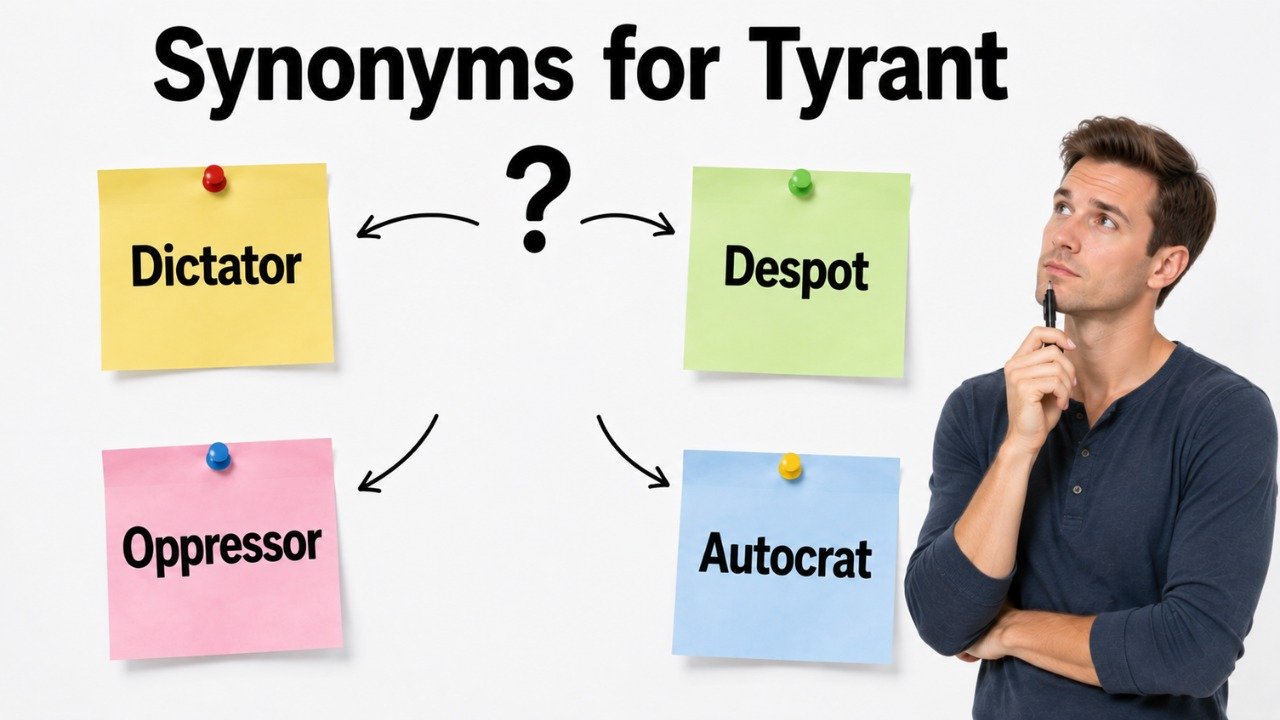
Quick Answer: Common synonyms for tyrant include dictator, despot, autocrat, oppressor, authoritarian, strongman, absolute ruler, overlord, taskmaster, and bully. The best synonyms for tyrant depend on context. Use dictator for a ruler with concentrated political power, despot for a cruel or unrestricted ruler, autocrat for someone exercising absolute authority, oppressor for someone who treats people unjustly, and bully for an informal description of a controlling or intimidating person.
Pronunciation and Word Details
Word: Tyrant.
Pronunciation: /ˈtaɪrənt/
Part of Speech: Noun.
Meaning: A ruler or powerful person who uses authority in a cruel, unfair, or oppressive way.
US Pronunciation:
UK Pronunciation:
What Does “Tyrant” Mean?
Tyrant means a ruler or person in authority who uses power harshly, unfairly, or oppressively.
The word is mainly a noun. It most often describes a political ruler who exercises excessive control and gives people little freedom. However, tyrant can also describe a controlling person in a family, workplace, organization, or other social setting.
In political writing, tyrant may refer to a ruler who governs through fear, coercion, punishment, or unrestricted authority.
In everyday speech, the word may be used more broadly for a person who behaves in an extremely controlling or domineering way.
Because tyrant carries a strongly negative meaning, it should be used carefully. It describes more than ordinary strictness or authority. It usually suggests abuse of power.
Meaning, Tone, and Context of “Tyrant”
Tyrant has a strong, negative, and emotionally charged tone.
It is common in political, historical, literary, academic, and conversational contexts. The word often conveys criticism of someone who controls others without fairness, restraint, or respect for their freedom.
In historical or political writing, tyrant can describe a ruler associated with oppressive or arbitrary rule. In literature, it can characterize a cruel king, leader, or powerful figure.
In everyday conversation, tyrant may be used figuratively for someone who dominates other people. However, this use can sound dramatic if the person is merely strict rather than genuinely abusive or controlling.
Tyrant is generally stronger than words such as boss, leader, ruler, or authority figure. It suggests that power is being misused.
When and How to Use “Tyrant”
For an Oppressive Ruler
Use tyrant when describing a ruler who governs harshly and restricts the freedom of others.
Example: The citizens feared the tyrant who punished anyone who challenged his authority.
For Absolute Political Power
Tyrant can describe someone who holds broad power without meaningful limits.
Example: The novel tells the story of a tyrant who controlled every part of public life.
For Cruel Leadership
Use tyrant when cruelty or abuse is central to the description.
Example: The ruler became known as a tyrant because of his brutal treatment of opponents.
For a Controlling Person
Tyrant can also describe a person outside politics who behaves in a domineering way.
Example: Employees described the supervisor as a tyrant who demanded complete obedience.
For Historical Writing
The word is useful when discussing rulers remembered for oppressive or arbitrary conduct.
Example: The historian examined how fear allowed the tyrant to maintain control.
For Literary Description
Tyrant is common in fiction when a writer wants to create a strong image of abusive authority.
Example: The story follows villagers attempting to escape the rule of a cruel tyrant.
For Figurative Emphasis
In casual speech, tyrant can exaggerate how controlling someone seems.
Example: He jokingly called his older brother a tyrant for controlling the television remote.
Use this figurative meaning carefully because the word normally carries serious negative associations.
Best Synonyms for Tyrant
Dictator: A ruler who holds extensive political power, often with few legal restraints.
Example: The dictator eliminated most challenges to his authority.
Despot: A ruler who exercises absolute power, especially in a cruel or oppressive way.
Example: The people lived in fear under the despot.
Autocrat: A person who governs with unrestricted personal authority.
Example: The autocrat refused to share power with any governing body.
Oppressor: A person who treats others cruelly or denies them freedom.
Example: The community resisted the oppressor who had controlled their lives for years.
Authoritarian: A person who demands strict obedience and favors concentrated authority.
Example: The authoritarian expected complete loyalty from everyone around him.
Strongman: A powerful leader who maintains control through personal authority, force, or influence.
Example: The strongman dominated the political system for decades.
Absolute Ruler: A ruler whose authority is largely unrestricted.
Example: The absolute ruler made major decisions without consulting others.
Overlord: A powerful person who exercises control over others, often in a harsh or dominating way.
Example: The fictional overlord demanded obedience from every village.
Taskmaster: A person who imposes demanding or severe expectations on others.
Example: The manager had a reputation as a strict taskmaster.
Bully: A person who uses power, fear, or intimidation against weaker people.
Example: The bully controlled others through threats rather than respect.
50 Synonyms for Tyrant with Short Meanings
- Dictator: A ruler with concentrated and often unrestricted power.
- Despot: A cruel ruler with absolute authority.
- Autocrat: A person who rules through personal absolute power.
- Oppressor: Someone who treats others unjustly or cruelly.
- Authoritarian: A person who demands strict obedience to authority.
- Strongman: A powerful leader who relies heavily on personal control.
- Absolute Ruler: A ruler with few meaningful limits on authority.
- Overlord: A powerful person who dominates others.
- Taskmaster: Someone who imposes severe demands on others.
- Bully: A person who intimidates weaker people.
- Dictatorial Ruler: A ruler who exercises highly concentrated authority.
- Despotic Ruler: A ruler who governs cruelly and without restraint.
- Autocratic Ruler: A ruler who makes decisions through personal authority.
- Oppressive Ruler: A leader who governs through unfair control.
- Cruel Ruler: A ruler known for harsh or brutal treatment.
- Harsh Ruler: A leader who governs with excessive severity.
- Arbitrary Ruler: A ruler who exercises power without consistent principles.
- Repressive Leader: A leader who restricts freedom or opposition.
- Dominating Leader: A leader who exercises excessive control.
- Domineering Leader: A leader who aggressively controls others.
- Absolute Monarch: A monarch whose authority is not meaningfully limited.
- Sole Ruler: A person who governs without sharing significant authority.
- Supreme Ruler: A ruler who holds the highest level of authority.
- Iron Fisted Ruler: A ruler who governs with severe control.
- Master: A person exercising control over others.
- Controller: Someone who attempts to direct or dominate others.
- Dominating Person: Someone who seeks excessive control.
- Domineer: A person who controls others arrogantly.
- Intimidator: Someone who uses fear to influence others.
- Persecutor: Someone who repeatedly mistreats or punishes others.
- Abuser: A person who misuses power to harm others.
- Tormentor: Someone who causes repeated suffering.
- Opressor: A variant spelling sometimes seen for oppressor, though oppressor is standard.
- Enforcer: Someone who imposes rules through pressure or force.
- Coercer: A person who forces others to act against their will.
- Subjugator: Someone who brings others under forceful control.
- Suppressor: A person who restrains freedom or opposition.
- Peremptory Ruler: A ruler who acts as though obedience is unquestionable.
- Imperious Leader: A leader who behaves arrogantly and commandingly.
- High Handed Leader: A leader who acts without considering others.
- Power Seeker: Someone strongly driven to gain or retain control.
- Power Holder: A person possessing substantial authority.
- Commanding Figure: A person who exercises strong authority.
- Ruthless Leader: A leader willing to act without mercy.
- Heavy Handed Leader: A leader who uses excessive control.
- Oppressive Authority: A person or power that restricts others unfairly.
- Despotic Authority: Someone exercising cruel and unrestricted control.
- Totalitarian Ruler: A ruler seeking extensive control over public and private life.
- Unrestrained Ruler: A ruler whose power faces few effective limits.
- Power Abuser: Someone who uses authority unfairly or harmfully.
Read Also:
Synonyms for Protection
Synonyms for Tyrant by Context
When Tyrant Means Dictator
Dictator, autocrat, strongman, sole ruler, absolute ruler, and authoritarian are strong alternatives when discussing political power.
Example: The dictator controlled the government with little opposition.
Example: The autocrat refused to allow independent decision making.
When Tyrant Means Cruel Ruler
Despot, oppressive ruler, cruel ruler, ruthless leader, and harsh ruler emphasize cruelty or abuse.
Example: The despot punished anyone who openly disagreed with him.
Example: The cruel ruler became feared throughout the kingdom.
When Tyrant Means Oppressor
Oppressor, persecutor, subjugator, suppressor, and coercer work when the focus is on denying freedom or mistreating others.
Example: The people organized resistance against their oppressor.
Example: The persecutor used intimidation to silence criticism.
When Tyrant Means Controlling Person
Bully, controller, domineer, taskmaster, intimidator, and dominating person suit nonpolitical settings.
Example: The supervisor behaved like a bully whenever employees questioned him.
Example: The demanding taskmaster expected everyone to work without complaint.
When Tyrant Means Absolute Ruler
Absolute ruler, absolute monarch, autocrat, sole ruler, and supreme ruler emphasize unrestricted authority.
Example: The absolute ruler made every major decision personally.
Example: The sole ruler tolerated no independent source of power.
Another Word for Tyrant
Despot is one of the best single replacements for tyrant when describing a cruel ruler with unchecked authority. However, the most accurate choice depends on context.
Use dictator when political control is central, oppressor when unfair treatment is central, autocrat when personal authority matters most, and bully when referring informally to a controlling individual.
Original: The people rose against the tyrant.
Better Option: The people rose against the despot.
Original: The tyrant controlled every major political institution.
Better Option: The dictator controlled every major political institution.
Original: Workers considered their supervisor a tyrant.
Better Option: Workers considered their supervisor a bully.
Original: The tyrant denied the population basic freedoms.
Better Option: The oppressor denied the population basic freedoms.
When Not to Use “Tyrant”
Avoid tyrant when the person is merely strict, demanding, authoritative, or unpopular. The word strongly implies misuse of power.
Weak: The teacher was a tyrant because she required students to submit assignments on time.
Better: The teacher was strict about assignment deadlines.
Tyrant may also sound exaggerated when describing ordinary disagreements.
Weak: My roommate is a tyrant because he prefers the kitchen to stay clean.
Better: My roommate is very particular about keeping the kitchen clean.
In formal political writing, tyrant can sometimes sound judgmental unless the context clearly supports the description. A more specific term such as autocrat, dictator, authoritarian ruler, or repressive leader may communicate the intended meaning more precisely.
Weak: The country was governed by a tyrant.
Better: The country was governed by an autocratic ruler who concentrated political authority.
Avoid using tyrant as a general synonym for leader. Many leaders exercise authority without behaving oppressively.
Words Commonly Confused With Tyrant
Tyrant vs Dictator: Tyrant emphasizes cruel or abusive use of power. Dictator emphasizes concentrated political authority.
Tyrant vs Despot: Both words can describe oppressive rulers, but despot strongly emphasizes absolute and often cruel authority.
Tyrant vs Autocrat: An autocrat rules through personal authority. A tyrant additionally suggests that this authority is exercised harshly or unjustly.
Tyrant vs Authoritarian: Authoritarian can describe a person, style of government, or political system that demands obedience. Tyrant specifically refers to a person.
Tyrant vs Oppressor: Tyrant usually describes someone who exercises controlling authority. Oppressor focuses more directly on the suffering and restriction imposed on others.
Tyrant vs Bully: Tyrant is stronger and often political or literary. Bully is more common in everyday situations involving intimidation.
Tyrant vs Taskmaster: A taskmaster is demanding and strict, but not necessarily oppressive. Tyrant carries a much stronger accusation of abuse.
Which Synonym Should You Choose?
Choose dictator when writing about a ruler who concentrates political power.
Choose despot when cruelty and unrestricted authority are central to the meaning.
Choose autocrat for formal, political, or academic writing about rule by one person.
Choose oppressor when focusing on injustice, mistreatment, or denial of freedom.
Choose authoritarian when emphasizing strict obedience and concentrated authority.
Choose strongman when describing a leader whose power depends heavily on personal control and influence.
Choose absolute ruler when you want a clear and neutral description of unrestricted authority.
Choose bully in casual conversation when describing someone who intimidates others.
Choose taskmaster when the person is demanding rather than politically oppressive.
Choose domineer or controller when describing excessive control in personal or workplace relationships.
For essays and reports, dictator, despot, autocrat, oppressor, and authoritarian are usually clearer than figurative alternatives.
For literary writing, despot, overlord, cruel ruler, and ruthless leader can create a stronger dramatic effect.
Real Life Examples of “Tyrant” in Sentences
Original: The citizens feared the tyrant who controlled the government.
Better Option: The citizens feared the dictator who controlled the government.
Original: The tyrant punished anyone who challenged his authority.
Better Option: The despot punished anyone who challenged his authority.
Original: The novel describes a tyrant who ruled without consultation.
Better Option: The novel describes an autocrat who ruled without consultation.
Original: The workers viewed the supervisor as a tyrant.
Better Option: The workers viewed the supervisor as a domineering boss.
Original: The tyrant denied people the freedom to speak openly.
Better Option: The oppressor denied people the freedom to speak openly.
Original: The tyrant expected complete obedience from his advisers.
Better Option: The authoritarian expected complete obedience from his advisers.
Original: The villagers united against the tyrant.
Better Option: The villagers united against the cruel ruler.
Original: The tyrant controlled every important decision.
Better Option: The absolute ruler controlled every important decision.
Original: Employees complained that the manager acted like a tyrant.
Better Option: Employees complained that the manager acted like a bully.
Original: The story ends with the defeat of the tyrant.
Better Option: The story ends with the defeat of the despot.
Synonym Groups and Usage Differences
Political Power Group
Dictator, autocrat, authoritarian, strongman, sole ruler, and absolute ruler focus mainly on political authority.
These words work best in government, history, politics, and academic writing.
Example: The autocrat concentrated decision making in his own hands.
Oppression Group
Oppressor, persecutor, suppressor, subjugator, and coercer focus on harm, restriction, and forced obedience.
Example: The population eventually resisted its oppressor.
Cruel Rule Group
Despot, cruel ruler, ruthless leader, oppressive ruler, and harsh ruler emphasize severity and mistreatment.
Example: The despot became notorious for punishing political rivals.
Control Group
Controller, domineer, dominating person, intimidator, and bully describe excessive personal control.
Example: His coworkers viewed him as a domineer who refused to listen to anyone.
Absolute Authority Group
Absolute ruler, absolute monarch, sole ruler, supreme ruler, and unrestrained ruler emphasize the absence of meaningful limits on power.
Example: The absolute ruler had the final say in every major decision.
Demanding Authority Group
Taskmaster, strict authority, heavy handed leader, and commanding figure can describe demanding behavior without always implying full political tyranny.
Example: The director was a strict taskmaster who expected excellent work.
Antonyms of Tyrant
The opposite of tyrant depends on whether the contrast concerns leadership style, fairness, freedom, or use of power.
Democrat: A person who supports government based on popular participation.
Liberator: Someone who helps free others from oppression or control.
Protector: Someone who safeguards the rights or welfare of others.
Benefactor: A person who helps or supports others.
Humanitarian: Someone concerned with human welfare and humane treatment.
Fair Leader: A leader who exercises authority impartially.
Just Ruler: A ruler who governs according to fairness and justice.
Benevolent Ruler: A ruler who uses authority kindly and responsibly.
Servant Leader: A leader who emphasizes helping and supporting others.
Peacemaker: Someone who seeks cooperation instead of coercion.
Defender: A person who protects others from harm or oppression.
Representative Leader: A leader who acts on behalf of the people represented.
Comparison: Tyrant vs Related Words
Tyrant vs Dictator
A tyrant is defined mainly by cruel or oppressive use of power. A dictator is defined mainly by concentrated political authority.
A dictator may also be a tyrant if that authority is exercised brutally or unjustly.
Example With Tyrant: The tyrant punished citizens for questioning his decisions.
Example With Dictator: The dictator controlled the government without meaningful political opposition.
Tyrant vs Despot
Tyrant and despot are very close in meaning. Despot often emphasizes absolute authority, while tyrant strongly emphasizes harsh or unjust use of power.
Example With Tyrant: The tyrant ruled through intimidation.
Example With Despot: The despot exercised nearly unlimited authority.
Tyrant vs Autocrat
Autocrat is often more neutral and technical than tyrant. It describes someone who holds absolute personal power. Tyrant adds a strong negative judgment.
Example With Tyrant: The tyrant used fear to maintain control.
Example With Autocrat: The autocrat made major decisions without consulting elected institutions.
Tyrant vs Oppressor
Tyrant emphasizes the person exercising abusive authority. Oppressor emphasizes the suffering experienced by those under that control.
Example With Tyrant: The tyrant demanded unquestioning loyalty.
Example With Oppressor: The oppressor restricted the community’s basic freedoms.
Tyrant vs Authoritarian
Tyrant is a noun for a cruel or oppressive ruler or authority figure. Authoritarian can be a noun or adjective and emphasizes obedience and concentrated authority.
Example With Tyrant: The citizens opposed the tyrant.
Example With Authoritarian: The authoritarian demanded strict obedience.
Tyrant vs Bully
Tyrant is stronger and often refers to political or serious abuse of authority. Bully usually refers to a person who intimidates others in ordinary social settings.
Example With Tyrant: The tyrant controlled the population through fear.
Example With Bully: The bully intimidated younger students.
Common Phrases and Expressions With Tyrant
Cruel Tyrant: A ruler who treats others harshly or brutally.
Brutal Tyrant: A ruler who uses severe cruelty or violence.
Ruthless Tyrant: A ruler who shows little mercy when maintaining power.
Oppressive Tyrant: A ruler who severely restricts freedom.
Power Hungry Tyrant: A ruler or person obsessed with gaining or maintaining control.
Absolute Tyrant: A ruler exercising unchecked authority.
Despotic Tyrant: A ruler whose control is both absolute and oppressive.
Political Tyrant: A ruler who abuses governmental power.
Petty Tyrant: A person who abuses a limited amount of authority in an unnecessarily controlling way.
Overthrow a Tyrant: Remove an oppressive ruler from power.
Common Mistakes to Avoid
One common mistake is treating tyrant as a neutral synonym for ruler. Tyrant carries a clear negative meaning and implies oppressive, cruel, or abusive authority.
Another mistake is using dictator and tyrant as though they always mean exactly the same thing. Dictator describes concentrated political power, while tyrant adds the idea of cruelty or injustice.
Writers also sometimes use tyrant for anyone who is strict. A demanding teacher, parent, manager, or coach is not necessarily a tyrant. Consider strict, demanding, controlling, domineering, or authoritarian if those words are more accurate.
Avoid repeating tyrant too often in historical or literary writing. Alternatives such as despot, autocrat, oppressor, absolute ruler, or cruel ruler can improve variety while preserving meaning.
Be careful with vague usage. Instead of simply calling someone a tyrant, explain what behavior makes the term appropriate, such as suppressing opposition, exercising arbitrary authority, or denying freedom.
Finally, match the synonym to the specific context. Use oppressor for mistreatment, dictator for concentrated political control, despot for cruel absolute power, and bully for everyday intimidation.
Conclusion
Synonyms for tyrant include dictator, despot, autocrat, oppressor, authoritarian, strongman, absolute ruler, overlord, taskmaster, and bully. The best choice depends on the type of power being described. Dictator fits concentrated political control, despot emphasizes cruel absolute authority, autocrat suits formal descriptions of personal rule, and oppressor highlights unjust treatment. Tyrant is a strong negative word, so choosing a precise alternative can make historical, political, literary, and everyday writing clearer and more accurate.
FAQs About Synonyms for Tyrant
What is the best synonym for tyrant?
Despot is one of the closest synonyms for tyrant because both words describe a ruler who exercises power harshly or oppressively.
Is dictator another word for tyrant?
Yes, dictator can be a synonym for tyrant in political contexts, but dictator focuses on concentrated authority while tyrant emphasizes abuse or cruelty.
What is a formal synonym for tyrant?
Autocrat, despot, authoritarian, oppressor, and absolute ruler are useful formal alternatives depending on context.
What is a less harsh synonym for tyrant?
Authoritarian, strict ruler, demanding leader, or taskmaster may sound less severe, depending on the situation.
What is the difference between a tyrant and a despot?
Both describe oppressive rulers. Despot often emphasizes absolute authority, while tyrant strongly emphasizes cruel or unjust use of power.
Can tyrant describe someone who is not a political ruler?
Yes. Tyrant can figuratively describe a controlling employer, family member, supervisor, or other person who abuses authority.
What is the opposite of tyrant?
Possible opposites include fair leader, just ruler, benevolent ruler, liberator, protector, and humanitarian, depending on the context.
