
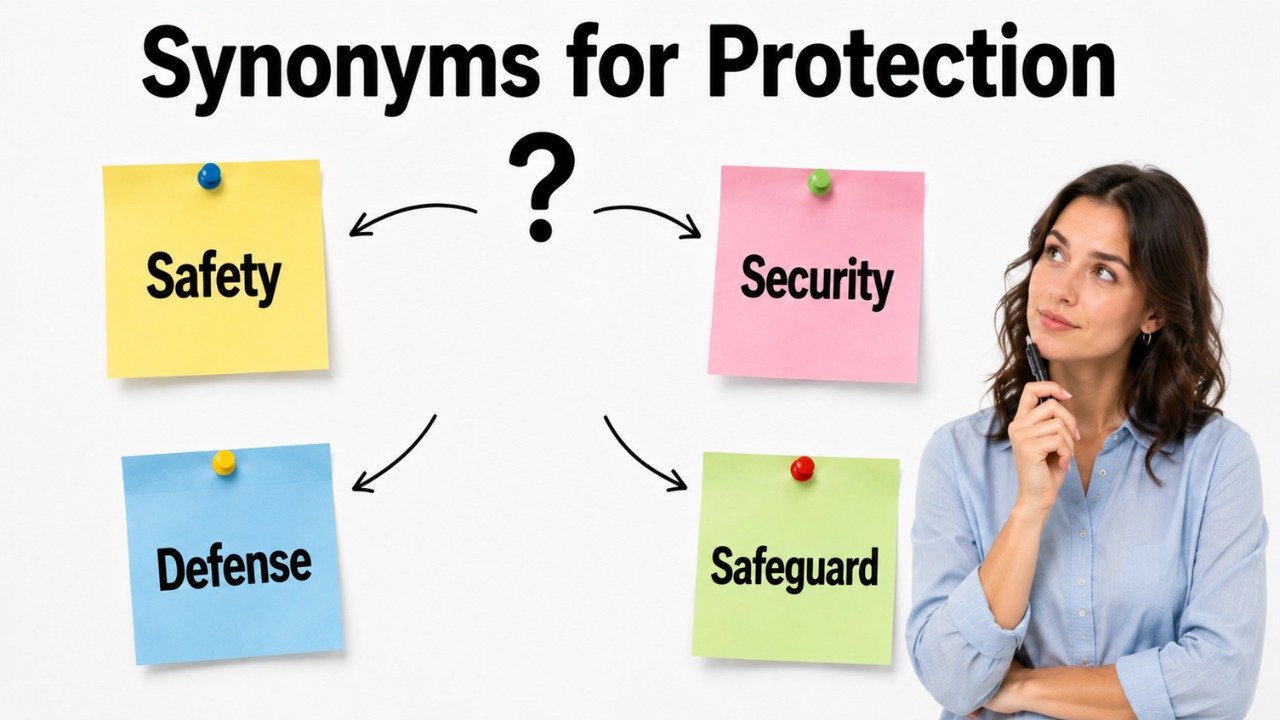
Quick Answer: Common synonyms for protection include safety, security, defense, safeguarding, shelter, preservation, guardianship, shielding, care, and refuge. The best choice depends on context. Use security for freedom from danger or unauthorized access, defense for resistance against attack, safeguarding in formal writing about preventing harm, shelter for physical cover, preservation for keeping something safe from damage or loss, guardianship for responsible care, and refuge for a safe place from danger.
Pronunciation and Word Details
Word: Protection.
Pronunciation: /prəˈtekʃən/
Part of Speech: Noun.
Meaning: The act, condition, or means of keeping someone or something safe from harm, danger, damage, loss, or attack.
US Pronunciation:
UK Pronunciation:
What Does “Protection” Mean?
Protection means keeping a person, object, place, right, system, or resource safe from harm, danger, damage, loss, or unwanted interference.
Protection is a noun. It can describe the action of defending something, the condition of being safe, or something that provides safety.
In everyday language, protection often refers to physical safety.
Example: The thick roof provides protection from heavy rain.
In legal or formal contexts, protection can refer to measures that defend rights, information, property, or vulnerable people.
Example: The policy provides protection for confidential records.
It can also describe something worn or used to reduce the risk of injury.
Example: The gloves offer protection for the hands.
Protection may therefore involve prevention, defense, care, shelter, preservation, supervision, or security depending on the context.
Meaning, Tone, and Context of “Protection”
Protection is a neutral and widely used word. It appears naturally in casual conversation, professional writing, legal language, academic discussion, safety instructions, environmental writing, technical communication, and public policy.
The tone changes according to the situation.
Security often sounds practical or technical.
Example: Strong passwords improve account security.
Defense can sound stronger because it suggests resistance to attack or threat.
Example: The wall formed a defense against invading forces.
Safeguarding has a formal and preventive tone. It is often used when discussing people, rights, resources, information, or important interests.
Example: Safeguarding personal information requires careful procedures.
Shelter is more physical and usually refers to protection from weather, danger, or exposure.
Example: The cave provided shelter from the storm.
Preservation emphasizes preventing decay, destruction, or loss over time.
Example: Careful storage supports the preservation of historic documents.
Guardianship suggests responsibility for the care and protection of another person or valuable interest.
When and How to Use “Protection”
For Personal Safety
Use: Protection is appropriate when discussing measures that reduce danger or injury to people.
Example: Protective clothing gives workers protection from sharp materials.
For Physical Defense
Use: Defense is often stronger when someone or something actively resists attack or harm.
Example: The barrier provides defense against falling debris.
For Security
Use: Security works well when discussing buildings, information, possessions, systems, or access.
Example: Additional locks improved the security of the storage area.
For Preventing Harm
Use: Safeguarding is useful in formal writing when the focus is preventing harm before it occurs.
Example: Safeguarding sensitive information is an important responsibility.
For Shelter
Use: Shelter describes physical protection from weather, exposure, or immediate danger.
Example: The trees provided shelter from the strong wind.
For Long Term Preservation
Use: Preservation is best when something must be protected from deterioration, destruction, or disappearance.
Example: Proper temperature control helps with the preservation of old photographs.
For Responsible Care
Use: Guardianship or care works when protection involves responsibility for another person, animal, place, or valuable resource.
Example: The organization assumed guardianship of the protected land.
For Covering or Shielding
Use: Shielding is suitable when a physical or figurative barrier blocks harmful effects.
Example: The screen provides shielding from excessive heat.
Best Synonyms for Protection
Safety: The condition of being free from danger, injury, or serious risk.
Example: Regular inspections improve workplace safety.
Security: Protection from danger, theft, attack, loss, or unauthorized access.
Example: Strong locks increased the building’s security.
Defense: Action taken to resist attack, threat, criticism, or harm.
Example: The wall served as a defense against flooding.
Safeguarding: The act of preventing harm, damage, abuse, or loss.
Example: Safeguarding private information requires careful handling.
Shelter: Cover or a place that provides protection from weather or danger.
Example: The hikers found shelter beneath a rocky overhang.
Preservation: Protection from destruction, decay, deterioration, or loss.
Example: Careful restoration supports the preservation of historic buildings.
Guardianship: Responsibility for protecting, caring for, or supervising someone or something.
Example: The land remained under responsible guardianship.
Shielding: Protection created by blocking or reducing exposure to something harmful.
Example: The material provides shielding from intense heat.
Care: Attention given to keep someone or something safe and well.
Example: The fragile plants require special care during winter.
Refuge: A safe place or condition offering protection from danger or difficulty.
Example: The building became a refuge during the severe storm.
50 Synonyms for Protection with Short Meanings
- Safety: Freedom from danger or injury.
- Security: Protection from danger, loss, theft, or attack.
- Defense: Resistance against threat, attack, or harm.
- Safeguarding: Prevention of harm, damage, or loss.
- Shelter: Cover or safety from danger or weather.
- Preservation: Protection from decay, destruction, or loss.
- Guardianship: Responsible care and protection.
- Shielding: Blocking exposure to something harmful.
- Care: Attention that keeps someone or something safe.
- Refuge: A safe place away from danger.
- Safekeeping: Careful protection of something valuable.
- Cover: Something that protects by hiding or shielding.
- Guarding: Watching or defending against danger.
- Defense Measure: An action used to prevent or resist harm.
- Security Measure: A step taken to improve safety or protection.
- Precaution: An action taken before danger occurs.
- Prevention: Action that stops harm or damage from happening.
- Conservation: Protection of resources from loss or damage.
- Custody: Responsible control and care of someone or something.
- Supervision: Careful observation intended to maintain safety.
- Watchfulness: Alert attention to possible danger.
- Vigilance: Careful awareness of threats or risks.
- Guard: Something or someone that provides protection.
- Barrier: Something that blocks danger, movement, or harmful contact.
- Shield: Something that protects against harm or attack.
- Armor: Protective covering against physical attack or damage.
- Covering: Material placed over something for protection.
- Screening: Blocking or reducing harmful exposure.
- Insulation: Material or separation that protects from heat, cold, or other effects.
- Fortification: Strengthening something against attack or damage.
- Restraint: A measure that prevents harmful action or movement.
- Support: Help that reduces danger, difficulty, or vulnerability.
- Assistance: Help given to protect or support someone.
- Aid: Help provided during danger or difficulty.
- Caregiving: Providing care and protection to another person.
- Superintendence: Formal oversight and protective management.
- Stewardship: Responsible care and protection of something valuable.
- Custodianship: Responsibility for preserving and protecting something.
- Sanctuary: A safe or protected place.
- Haven: A place offering safety and comfort.
- Safe Haven: A place protected from danger.
- Defense System: An organized means of resisting threats.
- Protective Cover: Material or structure that prevents harm.
- Protective Measure: An action intended to reduce risk.
- Risk Reduction: Action that lowers the chance of harm.
- Damage Prevention: Measures used to stop physical harm or loss.
- Loss Prevention: Measures used to avoid theft, waste, or loss.
- Preservation Measure: An action that prevents deterioration or destruction.
- Guardianship Care: Protective responsibility for another person or resource.
- Protective Custody: Care or control intended to maintain safety.
Read Also:
Synonyms for Working Together

Synonyms for Protection by Context
When Protection Means Safety
Safety, security, safeguarding, precaution, prevention, and risk reduction are useful when the main idea is avoiding danger.
Example: The new procedure provides greater protection for workers.
Alternative: The new procedure improves worker safety.
Security is especially useful when danger involves theft, unauthorized access, attack, or loss.
Example: Additional lighting increased security around the building.
When Protection Means Defense
Defense, guarding, fortification, armor, shield, and barrier are appropriate when protection involves resisting attack or harmful force.
Example: The stone wall gave the village protection against attack.
Alternative: The stone wall provided a strong defense against attack.
Defense usually suggests a direct threat, while protection can be broader.
When Protection Means Shelter
Shelter, refuge, haven, sanctuary, cover, and safe haven describe a protected place or condition.
Example: The building offered protection from the storm.
Alternative: The building offered shelter from the storm.
Refuge and haven can describe physical safety as well as emotional or figurative safety.
When Protection Means Preservation
Preservation, conservation, safekeeping, stewardship, and custodianship are useful when something must be protected over time.
Example: Proper storage ensures the protection of rare manuscripts.
Alternative: Proper storage supports the preservation of rare manuscripts.
Preservation is especially suitable when preventing deterioration, decay, or destruction.
When Protection Means Care
Care, guardianship, caregiving, supervision, custody, and support work when protection involves looking after someone or something.
Example: Young children require constant protection.
Alternative: Young children require constant care and supervision.
When Protection Means Preventive Action
Precaution, prevention, safeguarding, protective measure, security measure, and risk reduction describe actions taken before harm occurs.
Example: Wearing suitable equipment is an important form of protection.
Alternative: Wearing suitable equipment is an important precaution.
Another Word for Protection
Another word for protection is safety, especially when the main idea is freedom from danger or harm. However, the best alternative depends on context.
Use security for protecting property or information, defense for resisting attack, shelter for physical cover, preservation for preventing deterioration, and safeguarding for formal preventive measures.
Original: The helmet provides protection for the head.
Better Option: The helmet provides safety for the head during risky activities.
Original: The system offers protection against unauthorized access.
Better Option: The system provides security against unauthorized access.
Original: The wall gave the town protection from attack.
Better Option: The wall gave the town defense against attack.
Original: Special storage ensures the protection of old documents.
Better Option: Special storage ensures the preservation of old documents.
When Not to Use “Protection”
Protection is broad and useful, but it can sound vague when a more precise synonym explains exactly what kind of safety is involved.
Use security when discussing information, property, access, or theft.
Weak: The system provides protection for confidential files.
Better: The system provides security for confidential files.
Use preservation when discussing historic objects, cultural materials, or resources that need to survive over time.
Weak: The museum focuses on the protection of fragile paintings from deterioration.
Better: The museum focuses on the preservation of fragile paintings.
Use shelter when referring specifically to physical cover from weather.
Weak: The roof gives protection from the rain.
Better: The roof provides shelter from the rain.
Use defense when there is a clear attack or hostile threat.
Weak: The fortress gave protection against enemy forces.
Better: The fortress provided defense against enemy forces.
Avoid repeating protection several times in the same paragraph.
Weak: The policy provides protection for records, protection for users, and protection against unauthorized access.
Better: The policy safeguards records, supports user safety, and strengthens security against unauthorized access.
Words Commonly Confused With Protection
Protection vs Safety: Protection refers to actions, conditions, or things that prevent harm. Safety usually refers to the state of being free from danger.
Protection vs Security: Security often focuses on preventing threats such as theft, attack, unauthorized access, or loss. Protection is broader.
Protection vs Defense: Defense suggests resisting an active threat or attack. Protection may include prevention, care, shelter, or preservation without an active attack.
Protection vs Prevention: Prevention focuses on stopping an unwanted event before it happens. Protection includes both preventive and defensive measures.
Protection vs Preservation: Preservation means protecting something from deterioration, disappearance, or destruction over time.
Protection vs Safeguarding: Safeguarding usually emphasizes deliberate preventive action and often sounds more formal.
Protection vs Shelter: Shelter normally means physical cover or a safe place, while protection includes many other forms of safety.
Protection vs Care: Care includes attention, support, and maintenance. Protection focuses more specifically on preventing harm.
Which Synonym Should You Choose?
Choose safety when writing about freedom from injury, danger, or risk.
Choose security when discussing buildings, property, information, systems, personal belongings, or unauthorized access.
Choose defense when an attack, threat, criticism, or hostile force must be resisted.
Choose safeguarding in formal writing, policies, reports, essays, and professional communication about preventing harm.
Choose shelter when protection comes from a place, structure, roof, or natural cover.
Choose preservation when something must be protected from damage, decay, destruction, or loss over time.
Choose guardianship when someone has responsibility for protecting another person, place, resource, or interest.
Choose shielding when protection involves blocking harmful heat, light, radiation, force, or exposure.
Choose precaution when discussing an action taken before a possible problem occurs.
Choose refuge or haven in descriptive or conversational writing about a safe place.
Real Life Examples of “Protection” in Sentences
Original: The gloves provide protection against sharp edges.
Better Option: The gloves provide a safeguard against sharp edges.
Original: Strong locks provide protection for the building.
Better Option: Strong locks improve the building’s security.
Original: The wall offered protection against attack.
Better Option: The wall provided defense against attack.
Original: The trees gave us protection from the wind.
Better Option: The trees gave us shelter from the wind.
Original: Special containers provide protection for old documents.
Better Option: Special containers support the preservation of old documents.
Original: Young animals need protection from danger.
Better Option: Young animals need careful guarding from danger.
Original: The screen provides protection from intense heat.
Better Option: The screen provides shielding from intense heat.
Original: The emergency building provided protection during the storm.
Better Option: The emergency building served as a refuge during the storm.
Original: Extra checks provide protection against avoidable mistakes.
Better Option: Extra checks act as a precaution against avoidable mistakes.
Original: The rules were created for the protection of valuable resources.
Better Option: The rules were created for the conservation of valuable resources.
Synonym Groups and Usage Differences
Safety Group
Safety, security, safeguarding, precaution, prevention, and risk reduction focus on reducing danger.
Safety describes freedom from harm, while safeguarding and precaution emphasize actions taken to create that safety.
Example: Regular inspections improve safety by identifying problems early.
Defense Group
Defense, guarding, fortification, armor, shield, and barrier suggest resistance against a threat.
These words are useful when danger comes from attack, physical force, harmful contact, or outside interference.
Example: The reinforced barrier provides defense against falling material.
Shelter Group
Shelter, refuge, haven, sanctuary, cover, and safe haven describe protection through a safe location or physical covering.
Example: The hikers found refuge inside a sturdy shelter.
Preservation Group
Preservation, conservation, safekeeping, stewardship, custodianship, and care relate to keeping something valuable in good condition.
Example: Careful storage supports the preservation of historic objects.
Supervision Group
Guardianship, custody, supervision, watchfulness, vigilance, and caregiving involve active responsibility for safety.
Example: Constant supervision helps protect children near deep water.
Preventive Measures Group
Precaution, prevention, security measure, protective measure, damage prevention, and loss prevention describe steps taken to reduce the possibility of harm.
Example: Routine maintenance is an effective preventive measure.
Antonyms of Protection
The opposite of protection depends on whether protection means safety, defense, care, or preservation.
Danger: Exposure to possible injury or harm.
Risk: The possibility that something harmful may happen.
Exposure: A state of being unprotected from danger or harmful conditions.
Vulnerability: Susceptibility to harm, attack, or damage.
Neglect: Failure to provide necessary care or attention.
Endangerment: The act of placing someone or something at risk.
Harm: Physical, emotional, or material damage.
Damage: Injury or loss that reduces value or usefulness.
Destruction: Severe damage that causes something to cease existing or functioning.
Attack: Aggressive action against someone or something.
Threat: Something capable of causing harm or danger.
Insecurity: Lack of adequate safety or protection.
Deterioration: Gradual decline or damage over time.
Abandonment: Leaving someone or something without necessary care or support.
Comparison: Protection vs Related Words
Protection vs Safety
Protection refers to measures, actions, or conditions that prevent harm. Safety describes the resulting state of being free from danger.
Example With Protection: The helmet gives protection against head injuries.
Example With Safety: Wearing a helmet improves rider safety.
Protection vs Security
Protection is a broad word covering many kinds of safety. Security is especially associated with threats, theft, access, property, information, and personal safety.
Example With Protection: The cover provides protection from dust.
Example With Security: The new lock improves door security.
Protection vs Defense
Protection may be preventive or passive. Defense usually involves resisting an active threat.
Example With Protection: The canopy offers protection from sunlight.
Example With Defense: The fortifications formed a defense against attack.
Protection vs Safeguarding
Protection is general, while safeguarding emphasizes deliberate preventive action.
Example With Protection: The rules provide protection for vulnerable people.
Example With Safeguarding: The procedures focus on safeguarding vulnerable people from harm.
Protection vs Preservation
Protection can refer to immediate or general safety. Preservation is more specific to preventing deterioration, destruction, or loss over time.
Example With Protection: The case provides protection for the photograph.
Example With Preservation: Controlled storage supports the preservation of the photograph.
Protection vs Shelter
Protection covers many types of safety. Shelter specifically refers to cover or a safe place.
Example With Protection: Thick clothing provides protection from cold conditions.
Example With Shelter: The cabin provides shelter from severe weather.
Protection vs Precaution
Protection is the broader idea of staying safe. A precaution is a particular action taken in advance to avoid danger.
Example With Protection: Gloves provide protection while handling rough materials.
Example With Precaution: Wearing gloves is a sensible precaution.
Common Phrases and Expressions With Protection
Personal Protection: Measures used to keep an individual safe from harm.
Legal Protection: Rights or measures provided through law to prevent unfair treatment or harm.
Environmental Protection: Actions intended to preserve natural environments and resources.
Data Protection: Measures used to keep information safe from loss, misuse, or unauthorized access.
Consumer Protection: Measures intended to defend buyers from harmful or unfair practices.
Fire Protection: Equipment and procedures designed to prevent or reduce fire damage.
Protection From Harm: Measures that prevent injury, damage, or danger.
Protection Against Loss: Steps intended to prevent financial, physical, or material loss.
Protective Protection Measure: A measure intended to reduce exposure to danger, though protective measure is usually the more natural expression.
Protection Plan: An organized set of measures designed to reduce risk or damage.
Common Mistakes to Avoid
A common mistake is using protection when a more specific noun would make the sentence clearer.
Vague: The building needs better protection.
Clearer: The building needs better security against unauthorized entry.
Avoid treating protection and safety as exact synonyms in every sentence. Protection often describes the means, while safety often describes the condition.
Awkward: The helmet creates protection for cyclists.
Better: The helmet provides protection for cyclists.
Another mistake is using defense when no attack or active threat exists.
Unnatural: The umbrella provides defense from rain.
Better: The umbrella provides protection from rain.
Do not use preservation when discussing immediate physical danger.
Unnatural: The fence provides preservation from falling rocks.
Better: The fence provides protection from falling rocks.
Avoid unnecessary repetition of protection.
Repetitive: The equipment gives protection to workers and protection against heat while improving protection from sparks.
Improved: The equipment safeguards workers by shielding them from heat and sparks.
Be careful with prepositions. Protection commonly appears with from, against, for, or of, depending on meaning.
Example: The gloves provide protection from cold weather.
Example: The barrier offers protection against impact.
Example: The policy provides protection for employees.
Example: The protection of wildlife requires consistent effort.
Choose the synonym that identifies the exact source, type, or purpose of safety rather than replacing protection mechanically.
Conclusion
The best synonyms for protection depend on the kind of safety being described. Safety is useful for freedom from danger, security suits property and information, defense fits active threats, and safeguarding works well in formal preventive contexts. Shelter and refuge describe safe places, while preservation is best for preventing deterioration or loss. Guardianship emphasizes responsible care, and shielding describes a protective barrier. Choosing the right alternative makes writing more precise and clearly shows whether the context involves prevention, defense, care, security, or preservation.
FAQs About Synonyms for Protection
What is the best synonym for protection?
Safety is one of the broadest alternatives. Security, defense, safeguarding, shelter, and preservation are better when the context is more specific.
What is a formal synonym for protection?
Safeguarding is a strong formal alternative. Preservation, guardianship, security, and defense may also fit formal writing depending on the meaning.
What is another word for protection from danger?
Safety, security, defense, safeguarding, and refuge can all describe protection from danger. The best choice depends on whether the danger is immediate, physical, or preventive.
What is the difference between protection and security?
Protection is a broad concept involving prevention of harm. Security more specifically refers to freedom from threats such as theft, attack, unauthorized access, or loss.
Is defense a synonym for protection?
Yes. Defense is a synonym when protection involves resisting an attack or active threat. It is less suitable for contexts involving care, preservation, or shelter.
What synonym for protection means keeping something safe over time?
Preservation is usually the best choice. Conservation, safekeeping, stewardship, and custodianship can also work in appropriate contexts.
What word means a safe place that offers protection?
Refuge, shelter, haven, sanctuary, and safe haven all describe places that provide safety from danger or difficult conditions.
