
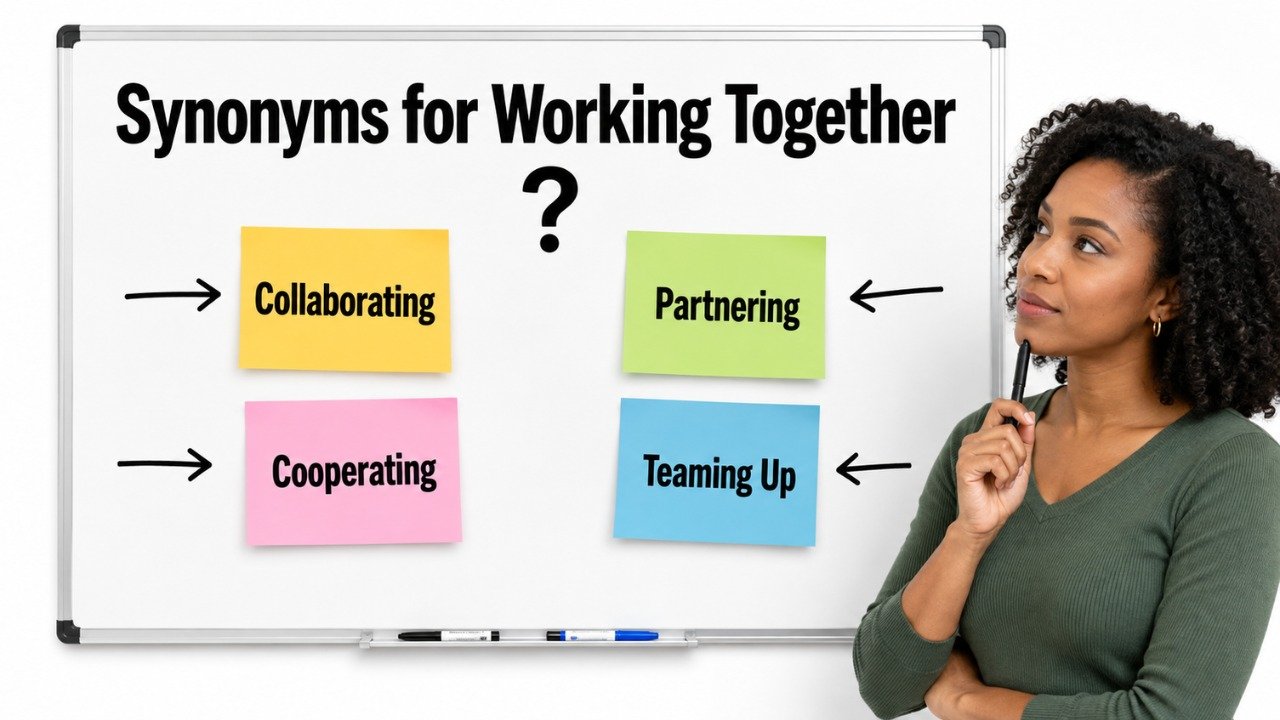
Quick Answer: Common synonyms for working together include collaborating, cooperating, coordinating, partnering, teaming up, joining forces, combining efforts, contributing jointly, acting collectively, and working in partnership. Use collaborating for professional, academic, and creative projects, cooperating when people willingly help one another, coordinating when activities must be organized, partnering for formal relationships, teaming up in casual speech, and joining forces when people unite around a shared goal.
Pronunciation and Word Details
Word: Working together.
Pronunciation: /ˈwɜːrkɪŋ təˈɡeðər/
Part of Speech: Verb phrase.
Meaning: Working together means combining effort, knowledge, skills, or resources with other people to achieve a shared purpose.
US Pronunciation:
UK Pronunciation:
What Does “Working Together” Mean?
Working together means two or more people, groups, or organizations combining their efforts to complete a task, solve a problem, or achieve a common goal.
The expression functions mainly as a verb phrase. It describes cooperative action rather than individual effort.
Example: The designers and engineers are working together to improve the product.
The phrase can describe many kinds of cooperation. People may work together professionally, academically, socially, creatively, or practically.
Example: The students worked together to complete the research project.
Working together can also describe departments, communities, specialists, or teams sharing responsibilities.
Example: Several departments are working together to improve the service.
The phrase usually emphasizes shared participation, communication, responsibility, and effort.
Meaning, Tone, and Context of “Working Together”
Working together is a neutral, positive, and widely understood expression. It works naturally in both conversation and writing.
In casual speech, it sounds friendly and direct.
Example: We are working together to finish the room before the guests arrive.
In professional communication, the phrase is acceptable, although words such as collaborating, coordinating, cooperating, and partnering may sound more precise.
Example: The two departments are collaborating on the new training program.
In academic writing, collaborating and cooperating often provide greater precision because they indicate the nature of the shared effort.
In business or organizational contexts, partnering can describe a more formal relationship between separate groups.
Working together usually has a cooperative and constructive tone. However, the phrase itself does not explain exactly how people are sharing responsibility. Choosing a more specific synonym can make the relationship clearer.
When and How to Use “Working Together”
For Team Projects: Use working together when several people contribute to the same task or objective.
Example: The team is working together to complete the project before the deadline.
For Professional Collaboration: Use it when colleagues combine knowledge, responsibilities, or skills.
Example: The researchers are working together to analyze the results.
For Shared Problem Solving: The phrase works well when people cooperate to overcome a challenge.
Example: Local groups are working together to reduce waste.
For Coordinated Activities: Use it when different people perform connected tasks as part of one larger effort.
Example: The departments are working together to organize the event.
For Partnerships: Working together can describe cooperation between separate groups or organizations.
Example: The two organizations are working together on a community program.
For Creative Work: It can describe artists, writers, designers, or other creators combining ideas.
Example: The writers are working together on the final draft.
For Learning: The phrase is useful when students or learners complete activities collectively.
Example: The students worked together to solve the difficult problem.
Best Synonyms for Working Together
Collaborating: Working jointly with others to create, develop, or accomplish something.
Example: The researchers are collaborating on a detailed study.
Cooperating: Helping one another willingly to achieve a shared result.
Example: Everyone cooperated to complete the work on time.
Coordinating: Organizing separate activities so they function effectively together.
Example: The departments are coordinating their schedules.
Partnering: Forming a cooperative relationship to pursue a shared goal.
Example: The two groups are partnering on a training initiative.
Teaming Up: Joining another person or group to accomplish something together.
Example: The designers are teaming up with the developers.
Joining Forces: Combining abilities, resources, or influence to achieve something.
Example: Several community groups joined forces to improve the park.
Combining Efforts: Bringing separate contributions together toward the same objective.
Example: The volunteers are combining their efforts to support the project.
Acting Collectively: Taking action as a group rather than individually.
Example: The members acted collectively to solve the issue.
Contributing Jointly: Sharing responsibility and adding individual contributions to one common effort.
Example: Both teams are contributing jointly to the research.
Working in Partnership: Cooperating through an organized and usually continuing relationship.
Example: The two departments are working in partnership to improve customer support.
50 Synonyms for Working Together with Short Meanings
- Collaborating: Sharing effort to create or achieve something.
- Cooperating: Helping one another toward a shared goal.
- Coordinating: Organizing connected activities effectively.
- Partnering: Forming a cooperative working relationship.
- Teaming Up: Joining with others for a shared task.
- Joining Forces: Combining strength, skills, or resources.
- Combining Efforts: Bringing separate contributions together.
- Working Jointly: Performing work together with shared responsibility.
- Working Collectively: Acting together as a group.
- Working Cooperatively: Performing tasks through mutual support.
- Working Collaboratively: Sharing ideas and responsibilities while working.
- Working in Partnership: Cooperating through an organized relationship.
- Acting Together: Taking action with other people.
- Acting Collectively: Taking united action as a group.
- Acting Jointly: Sharing responsibility for an action.
- Contributing Together: Providing effort or resources toward one goal.
- Contributing Jointly: Making shared contributions to a task.
- Pooling Resources: Combining available materials, money, knowledge, or skills.
- Pooling Efforts: Combining individual work toward one purpose.
- Sharing Responsibilities: Dividing duties among several people.
- Sharing the Work: Dividing tasks so several people contribute.
- Combining Skills: Bringing different abilities together.
- Combining Strengths: Using different advantages collectively.
- Uniting Efforts: Bringing separate activities together toward one objective.
- Uniting: Coming together for a common purpose.
- Working as a Team: Completing tasks through coordinated group effort.
- Operating as a Team: Functioning together as one organized group.
- Functioning Together: Performing connected roles successfully.
- Working Side by Side: Working closely with another person or group.
- Working in Tandem: Performing connected actions together.
- Working in Unison: Acting together in a coordinated way.
- Working in Concert: Acting together according to a shared plan.
- Coacting: Acting jointly with another person or group.
- Assisting One Another: Giving mutual help during a task.
- Supporting One Another: Providing mutual help, encouragement, or resources.
- Helping Each Other: Giving assistance mutually.
- Sharing Ideas: Exchanging thoughts to improve shared work.
- Sharing Expertise: Combining specialized knowledge.
- Exchanging Knowledge: Sharing information for mutual benefit.
- Coordinating Efforts: Organizing different contributions toward one goal.
- Combining Resources: Bringing available resources together.
- Building Together: Creating or developing something through shared effort.
- Solving Together: Addressing a problem through joint effort.
- Planning Together: Developing plans collectively.
- Creating Together: Producing something through shared creative effort.
- Developing Together: Improving or building something jointly.
- Contributing as a Team: Adding individual effort to a group task.
- Sharing a Common Effort: Participating in the same undertaking.
- Pursuing a Common Goal: Working toward the same desired result.
- Making a Joint Effort: Combining work to accomplish something together.
Read Also:
Synonyms for Shenanigans

Synonyms for Working Together by Context
When Working Together Means Collaborating
Collaborating is one of the closest replacements for working together when people share ideas, skills, knowledge, or responsibilities.
It is especially useful for projects, research, writing, design, planning, and problem solving.
Collaborating: Sharing knowledge and effort to produce a result.
Example: The researchers are collaborating on a new study.
Working Collaboratively: Completing work through active cooperation.
Example: The departments are working collaboratively to develop the new process.
Creating Together: Producing something through shared creative effort.
Example: The artists enjoyed creating together.
When Working Together Means Cooperating
Cooperating emphasizes willingness to help and support one another.
It is often used when successful results depend on people following shared expectations or assisting each other.
Cooperating: Willingly helping toward a common objective.
Example: Everyone cooperated during the emergency exercise.
Helping Each Other: Providing mutual assistance.
Example: The students finished quickly by helping each other.
Supporting One Another: Offering mutual practical or emotional assistance.
Example: Team members succeeded by supporting one another.
When Working Together Means Coordinating
Coordinating focuses on organizing different tasks, schedules, actions, or responsibilities so they fit together effectively.
Coordinating: Arranging connected activities in an organized way.
Example: The managers are coordinating the different stages of the project.
Coordinating Efforts: Organizing several contributions toward one result.
Example: The groups are coordinating their efforts to improve efficiency.
Working in Tandem: Performing related tasks together.
Example: The two specialists worked in tandem throughout the project.
When Working Together Means Forming a Partnership
Partnering is useful when two people, teams, or groups establish a more deliberate relationship.
Partnering: Forming a working relationship for mutual benefit.
Example: The two organizations are partnering on a skills program.
Working in Partnership: Cooperating through a structured relationship.
Example: The departments are working in partnership to improve training.
Joining Forces: Combining abilities or resources for a shared purpose.
Example: Several groups joined forces to organize the event.
When Working Together Means Teamwork
When people function as one unit, terms such as teaming up, working as a team, sharing responsibilities, and combining strengths work naturally.
Teaming Up: Joining another person or group for a task.
Example: The two specialists are teaming up to solve the problem.
Working as a Team: Sharing tasks and responsibilities to achieve one objective.
Example: Everyone worked as a team during the busy period.
Combining Strengths: Bringing different abilities together.
Example: They succeeded by combining their strengths.
Another Word for Working Together
The best single replacement for working together is collaborating in many professional, creative, educational, and academic contexts. However, the most accurate alternative depends on the relationship and type of shared effort.
Original: The researchers are working together on the study.
Better Option: The researchers are collaborating on the study.
Original: The departments are working together to arrange the conference.
Better Option: The departments are coordinating the conference.
Original: The two groups are working together on a community project.
Better Option: The two groups are partnering on a community project.
Original: Everyone is working together to solve the problem.
Better Option: Everyone is cooperating to solve the problem.
When Not to Use “Working Together”
Working together is clear, but it can sometimes be too general. More precise language can explain the exact type of cooperation.
In formal writing, collaborating may sound stronger when people are sharing professional knowledge.
Weak: The researchers are working together on several experiments.
Better: The researchers are collaborating on several experiments.
When the main idea is organization, coordinating is more precise.
Weak: The departments are working together on their schedules.
Better: The departments are coordinating their schedules.
When two separate groups form a formal relationship, partnering may communicate the meaning more accurately.
Weak: The two organizations are working together on the program.
Better: The two organizations are partnering on the program.
Avoid repeating working together several times in the same paragraph.
Weak: The teams are working together because working together helps them solve problems while working together on shared goals.
Better: The teams collaborate closely because coordinated effort helps them solve problems and achieve shared goals.
Working together can also sound vague when the reader needs to know what each person is actually doing. In instructions, reports, and formal documents, describe specific responsibilities whenever possible.
Words Commonly Confused With Working Together
Working Together vs Collaborating: Working together is broad and can describe almost any shared effort. Collaborating usually involves active sharing of ideas, skills, knowledge, or responsibilities.
Working Together vs Cooperating: Working together emphasizes joint effort. Cooperating emphasizes willingness to help, follow shared expectations, or avoid interfering with others.
Working Together vs Coordinating: Working together describes shared action generally, while coordinating focuses on organizing different actions so they fit together efficiently.
Working Together vs Partnering: Partnering usually suggests an intentional relationship between people, teams, or organizations. Working together may be temporary or informal.
Working Together vs Teamwork: Working together is an action, while teamwork is the noun used for effective cooperative group effort.
Working Together vs Teaming Up: Teaming up often describes the moment people join for a specific activity. Working together describes the continuing action.
Working Together vs Joining Forces: Joining forces suggests combining strength or resources, often for an important challenge or common objective.
Which Synonym Should You Choose?
Choose collaborating for professional projects, academic research, creative work, writing, design, and shared problem solving.
Choose cooperating when willingness, mutual assistance, or following shared expectations is important.
Choose coordinating when schedules, tasks, departments, responsibilities, or activities must be organized.
Choose partnering when separate people or groups establish a structured working relationship.
Choose teaming up in casual conversation when two or more people join for a particular task.
Choose joining forces when people combine strength, influence, resources, or expertise.
Choose working jointly in formal reports when shared responsibility needs emphasis.
Choose working collaboratively in professional communication when active exchange of ideas is central.
Choose pooling resources when people contribute money, materials, information, tools, or expertise.
Choose working as a team when cooperation and shared responsibility are more important than individual roles.
Real Life Examples of “Working Together” in Sentences
Original: The designers and engineers are working together on the new product.
Better Option: The designers and engineers are collaborating on the new product.
Original: The two departments are working together to organize the event.
Better Option: The two departments are coordinating the event.
Original: The students are working together on their presentation.
Better Option: The students are collaborating on their presentation.
Original: Several community groups are working together to improve the park.
Better Option: Several community groups are joining forces to improve the park.
Original: The two organizations are working together on the training program.
Better Option: The two organizations are partnering on the training program.
Original: Everyone worked together during the difficult situation.
Better Option: Everyone cooperated during the difficult situation.
Original: The specialists are working together to find a solution.
Better Option: The specialists are combining their expertise to find a solution.
Original: Both teams are working together to meet the deadline.
Better Option: Both teams are coordinating their efforts to meet the deadline.
Original: The volunteers worked together to prepare the venue.
Better Option: The volunteers worked as a team to prepare the venue.
Original: The researchers are working together to understand the results.
Better Option: The researchers are sharing their expertise to understand the results.
Synonym Groups and Usage Differences
Collaboration Group
Collaborating, working collaboratively, creating together, developing together, and sharing ideas belong to this group.
These expressions emphasize active participation and the exchange of ideas, knowledge, or creative input.
Example: The writers collaborated closely on the final chapter.
Cooperation Group
Cooperating, helping each other, assisting one another, and supporting one another emphasize mutual help.
These alternatives are useful when people willingly contribute to a positive shared result.
Example: The neighbors cooperated to clean the shared area.
Coordination Group
Coordinating, coordinating efforts, working in tandem, functioning together, and working in concert focus on organization.
These expressions are useful when different roles or activities must fit together.
Example: The teams coordinated their efforts throughout the project.
Partnership Group
Partnering, working in partnership, joining forces, and acting jointly describe a stronger or more deliberate relationship.
These expressions are often appropriate for organizations, departments, specialists, and separate groups.
Example: The two groups partnered to develop the program.
Teamwork Group
Teaming up, working as a team, combining strengths, sharing responsibilities, and contributing as a team emphasize collective performance.
Example: The staff worked as a team during the busiest part of the day.
Shared Resources Group
Pooling resources, combining resources, sharing expertise, and exchanging knowledge focus on what participants contribute to the shared effort.
Example: The researchers pooled their resources to complete the study.
Antonyms of Working Together
The opposite of working together depends on whether the contrast involves separation, disagreement, competition, or independent action.
Working Separately: Completing tasks without joining efforts.
Working Independently: Performing work without relying on other participants.
Acting Alone: Taking action without assistance from others.
Competing: Attempting to outperform others rather than cooperate with them.
Opposing: Acting against another person, group, or objective.
Conflicting: Having goals, interests, or actions that do not agree.
Disagreeing: Holding different opinions or positions.
Dividing: Separating people, responsibilities, or efforts.
Withdrawing: Removing participation from a shared activity.
Working Against Each Other: Taking actions that interfere with another person or group.
Comparison: Working Together vs Related Words
Working Together vs Collaborating
Working together is the broader expression. Collaborating usually suggests active sharing of knowledge, ideas, responsibilities, or skills.
Example With Working Together: The employees are working together to complete the project.
Example With Collaborating: The researchers are collaborating on a detailed analysis.
Working Together vs Cooperating
Working together emphasizes shared action. Cooperating emphasizes willingness to help and contribute positively.
Example With Working Together: The students are working together on the assignment.
Example With Cooperating: The students cooperated with the teacher during the activity.
Working Together vs Coordinating
Working together simply means sharing effort, while coordinating emphasizes organization and alignment.
Example With Working Together: Several departments are working together on the event.
Example With Coordinating: Several departments are coordinating their schedules for the event.
Working Together vs Partnering
Working together may describe informal or temporary cooperation. Partnering often suggests a planned relationship with mutual responsibilities.
Example With Working Together: The two groups are working together on the project.
Example With Partnering: The two groups are partnering to develop a long term program.
Working Together vs Teaming Up
Working together describes an ongoing action. Teaming up often emphasizes joining another person or group for a particular purpose.
Example With Working Together: The two designers have been working together throughout the project.
Example With Teaming Up: The two designers are teaming up for the new project.
Working Together vs Joining Forces
Working together is neutral and general. Joining forces sounds stronger and suggests combining abilities or resources for an important shared goal.
Example With Working Together: The groups are working together to improve the neighborhood.
Example With Joining Forces: The groups are joining forces to address the major problem.
Common Phrases and Expressions With Working Together
Working Together Closely: Cooperating with frequent communication and shared involvement.
Example: The two teams are working together closely on the project.
Working Together Effectively: Cooperating in a way that produces successful results.
Example: Clear communication helps people work together effectively.
Working Together Successfully: Cooperating and achieving the intended outcome.
Example: Both groups have been working together successfully.
Working Together as a Team: Sharing responsibilities and supporting one another.
Example: Everyone completed the task by working together as a team.
Working Together Toward a Goal: Combining efforts to achieve the same objective.
Example: The students are working together toward a common goal.
Working Together on a Project: Cooperating to complete a specific piece of work.
Example: Several specialists are working together on the project.
Working Together to Solve a Problem: Combining knowledge and effort to find a solution.
Example: The departments are working together to solve the problem.
Working Together in Partnership: Cooperating through a structured relationship.
Example: The two groups are working together in partnership.
Working Together for a Common Purpose: Sharing effort because participants want the same result.
Example: Volunteers from different areas are working together for a common purpose.
Working Together in Harmony: Cooperating smoothly without unnecessary conflict.
Example: The different teams worked together in harmony throughout the event.
Common Mistakes to Avoid
One common mistake is assuming that every synonym for working together has exactly the same meaning.
Collaborating, cooperating, coordinating, and partnering all describe shared effort, but each emphasizes a different type of relationship.
Use collaborating when people actively share ideas, knowledge, or creative input.
Use coordinating when the important point is organizing schedules, tasks, or activities.
Use partnering when there is a more structured relationship between separate participants.
Another mistake is unnecessary repetition.
Repetitive: The departments are working together, and they will continue working together because working together improves communication.
Improved: The departments are collaborating closely and will continue coordinating their efforts to improve communication.
Avoid using an overly formal synonym in casual conversation.
Unnatural: My brother and I are engaging in coordinated collaborative activity to clean the kitchen.
Natural: My brother and I are working together to clean the kitchen.
Writers should also avoid vague wording when specific responsibilities matter.
Vague: Several teams are working together on the project.
Clearer: The design team is creating the materials while the research team is providing the supporting information.
Another common mistake is confusing cooperation with collaboration. Cooperation may involve helping someone complete their own task, while collaboration usually involves greater shared ownership of the same work.
Choose synonyms according to the actual relationship rather than simply replacing working together with a more formal expression.
Conclusion
The best synonyms for working together include collaborating, cooperating, coordinating, partnering, teaming up, joining forces, combining efforts, and working as a team. Choose collaborating when people share ideas or expertise, cooperating for mutual assistance, coordinating for organized activities, and partnering for structured relationships. Teaming up works naturally in casual conversation, while joining forces emphasizes combined strength or resources. Choosing the right alternative makes the exact type of shared effort clearer and gives your writing greater precision.
FAQs About Synonyms for Working Together
What is the best synonym for working together?
Answer: Collaborating is one of the best general synonyms, especially when people share knowledge, ideas, responsibilities, or skills.
What is a professional synonym for working together?
Answer: Collaborating, coordinating, partnering, working collaboratively, and working jointly are strong professional alternatives.
What is another word for working together as a team?
Answer: Teaming up, collaborating, cooperating, combining efforts, and working collectively can all express working together as a team.
What is a formal way to say working together?
Answer: Working collaboratively, cooperating, coordinating efforts, acting jointly, and working in partnership are suitable formal expressions.
What is the difference between collaborating and working together?
Answer: Working together is a broad phrase for shared effort. Collaborating more specifically suggests exchanging ideas, expertise, or responsibilities while pursuing the same result.
Can cooperating replace working together?
Answer: Yes, when the sentence emphasizes mutual help or willingness to support a common objective. It may be less precise when the focus is creative or professional collaboration.
What phrase means several groups working together?
Answer: Joining forces, coordinating efforts, working collectively, collaborating, and working in partnership are natural choices for several groups combining their efforts.
