
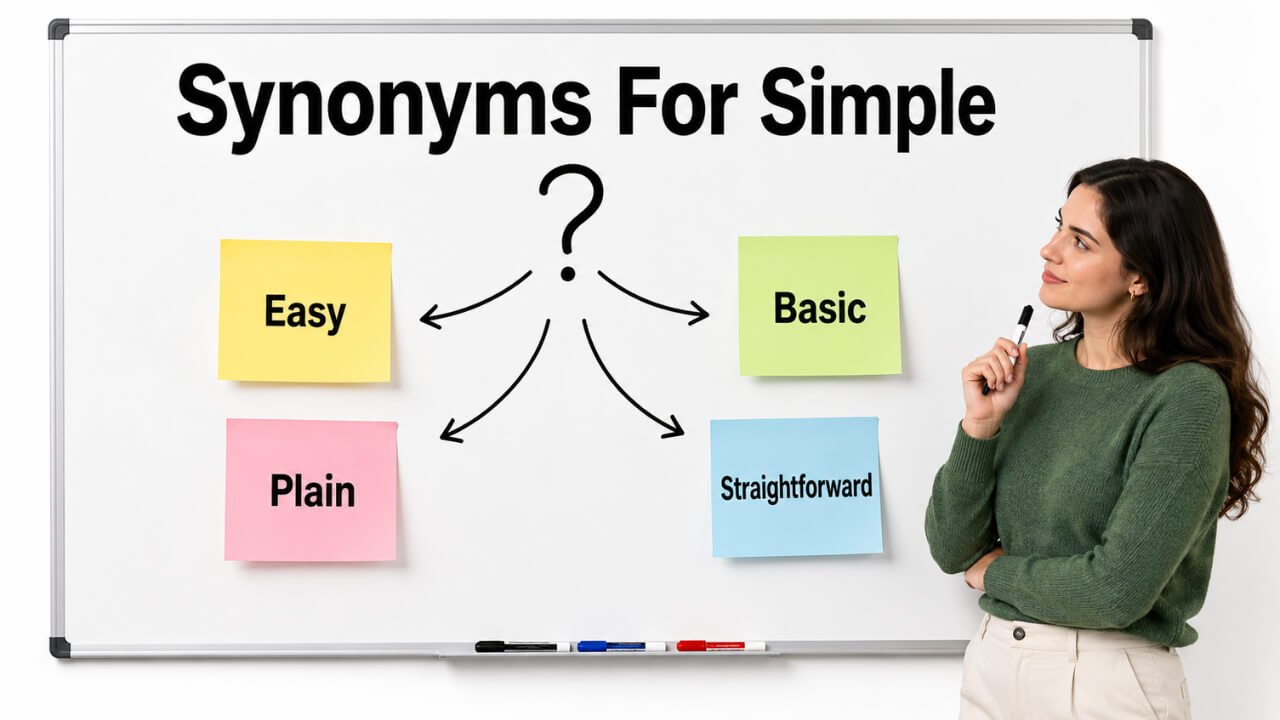
Quick Answer: The best synonyms for simple include easy, plain, clear, basic, straightforward, uncomplicated, effortless, modest, ordinary, and minimal. Use easy when something is not difficult, clear when something is easy to understand, plain for a basic appearance, straightforward for direct instructions or explanations, uncomplicated for processes, and modest when simple means not fancy or excessive.
Pronunciation and Word Details
Word: Simple
Pronunciation: /ˈsɪm.pəl/
Part of Speech: Adjective
Meaning: Easy to understand, do, use, or recognize because it is not complicated.
US Pronunciation:
UK Pronunciation:
What Does “Simple” Mean?
Simple means easy, plain, basic, or not complicated. It is mainly used as an adjective to describe ideas, tasks, designs, words, explanations, instructions, lifestyles, tools, and choices.
The word can describe something that is easy to understand, such as a simple explanation. It can describe something easy to do, such as a simple task. It can also describe appearance, such as a simple dress, or lifestyle, such as a simple way of living.
Meaning, Tone, and Context of “Simple”
Simple is a common, neutral, and flexible word. It usually sounds clear and helpful when describing something easy, direct, or plain.
In everyday conversation, simple often means easy or not difficult. In formal writing, words like straightforward, clear, uncomplicated, and basic can sound more precise. In design, fashion, writing, and lifestyle contexts, simple can mean plain, minimal, modest, or unadorned.
Sometimes simple can sound negative if it means too basic, lacking depth, or not intelligent. That is why context matters.
When and How to Use “Simple”
For Ease: Use simple when something is not difficult to do.
Example: The recipe is simple enough for beginners.
For Clarity: Use simple when something is easy to understand.
Example: The teacher gave a simple explanation.
For Design: Use simple when something looks clean, plain, or not decorated.
Example: She chose a simple white table for the room.
For Instructions: Use simple when steps are direct and easy to follow.
Example: The guide gives simple instructions for setup.
For Lifestyle: Use simple when describing a modest or less complicated way of living.
Example: They prefer a simple life in a quiet town.
For Language: Use simple when words or sentences are clear and not complex.
Example: Write the answer in simple language.
Best Synonyms for Simple
Easy: Not difficult to do, understand, or use.
Example: The question was easy for most students.
Plain: Basic in appearance, style, or detail.
Example: He wore a plain shirt to the meeting.
Clear: Easy to understand or recognize.
Example: Her message was clear and helpful.
Basic: Containing only the most important parts.
Example: The course starts with basic grammar rules.
Straightforward: Direct, honest, and easy to follow.
Example: The process is straightforward from start to finish.
Uncomplicated: Not difficult, confusing, or complex.
Example: The form has an uncomplicated layout.
Effortless: Requiring little or no effort.
Example: She made the performance look effortless.
Modest: Simple and not excessive or showy.
Example: They live in a modest home.
Ordinary: Common, usual, or not special in appearance.
Example: It was an ordinary meal, but it tasted good.
Minimal: Using very few details, parts, or decorations.
Example: The room has a minimal design.
50 Synonyms for Simple with Short Meanings
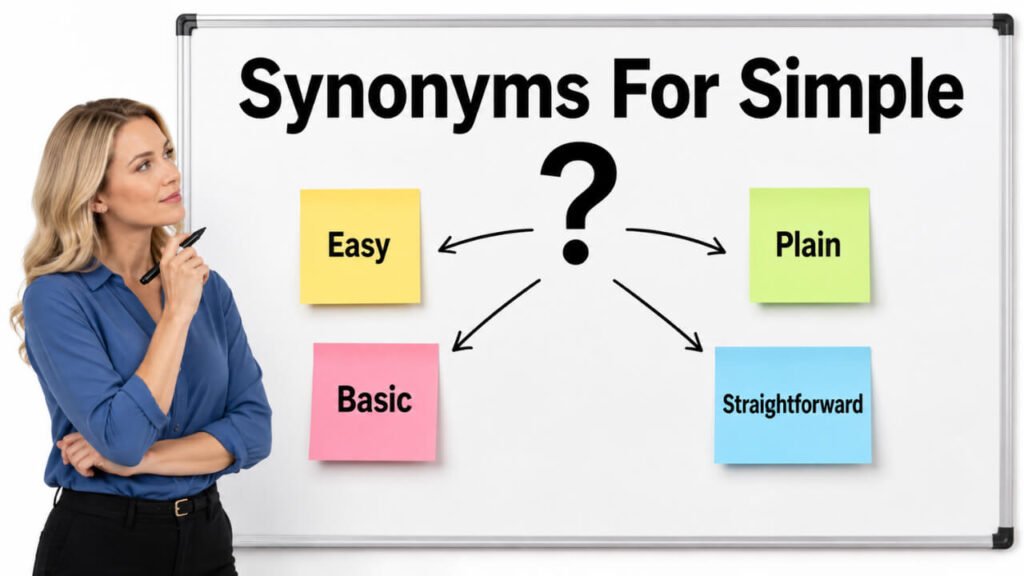
- Easy: Not difficult to do or understand.
- Plain: Basic and not decorated.
- Clear: Easy to understand.
- Basic: Including only the main parts.
- Straightforward: Direct and easy to follow.
- Uncomplicated: Not complex or confusing.
- Effortless: Requiring little effort.
- Modest: Not fancy, excessive, or showy.
- Ordinary: Common and usual.
- Minimal: Using very little detail or decoration.
- Elementary: Related to the first or easiest level.
- Fundamental: Basic and important.
- Essential: Containing what is most necessary.
- Clear cut: Easy to understand or decide.
- Direct: Straight to the point.
- Understandable: Easy to comprehend.
- Readable: Easy to read and follow.
- Accessible: Easy for people to understand or use.
- Manageable: Easy enough to handle.
- Doable: Possible and not too difficult.
- Practical: Useful and simple to apply.
- User friendly: Easy for people to use.
- Neat: Simple, clean, and orderly.
- Clean: Simple and free from clutter.
- Spare: Very plain and without extra detail.
- Unadorned: Not decorated or embellished.
- Bare: Having only the necessary parts.
- Minimalist: Based on simplicity and few details.
- Humble: Simple and not proud or grand.
- Low key: Calm, simple, and not showy.
- Natural: Simple in an honest or unforced way.
- Pure: Simple and not mixed with unnecessary parts.
- Simplex: Having one part or a basic structure.
- Rudimentary: Basic and not fully developed.
- Introductory: Suitable for beginners.
- Beginner friendly: Easy for new learners.
- Plain spoken: Clear and direct in speech.
- Lucid: Very clear and easy to understand.
- Coherent: Clear, logical, and easy to follow.
- Transparent: Easy to understand or see through.
- Obvious: Easy to notice or understand.
- Self evident: Clear without needing much explanation.
- Unpretentious: Simple and not trying to impress.
- Down to earth: Practical, simple, and realistic.
- No frills: Simple and without extras.
- Functional: Simple and useful.
- Streamlined: Made simpler and more efficient.
- Simplified: Made easier or less complicated.
- Reduced: Made smaller or simpler.
- Undemanding: Not requiring much effort or skill.
Read Also:
Synonyms for Resilience
Synonyms for Simple by Context
When Simple Means Easy
Use these synonyms when something is not difficult to do, learn, or complete.
Easy: The exercise was easy for beginners.
Doable: The plan is doable with enough time.
Manageable: The workload is manageable this week.
Undemanding: The task is undemanding and quick.
When Simple Means Clear
Use these words when something is easy to understand, read, or explain.
Clear: The instructions were clear.
Understandable: The answer was understandable for new learners.
Lucid: The speaker gave a lucid explanation.
Coherent: The paragraph was coherent and well organized.
When Simple Means Plain
Use these synonyms when something has a basic or undecorated appearance.
Plain: She selected a plain notebook.
Unadorned: The wall looked unadorned but neat.
Spare: The room had a spare design.
Minimal: The cover used a minimal layout.
When Simple Means Basic
Use these words when something includes only the main or first level ideas.
Basic: The lesson explains basic sentence structure.
Elementary: The book covers elementary grammar.
Fundamental: The rule is fundamental to clear writing.
Rudimentary: He has rudimentary knowledge of the subject.
When Simple Means Modest
Use these synonyms when something is not fancy, rich, excessive, or showy.
Modest: They planned a modest celebration.
Humble: The home was humble but comfortable.
Unpretentious: The meal was unpretentious and satisfying.
Low key: The event had a low key style.
Another Word for Simple
Easy is the best single replacement for simple in many everyday sentences. It works when the meaning is not difficult. However, the best alternative depends on context. Use clear for explanations, plain for appearance, basic for first level ideas, and straightforward for direct instructions or processes.
Original: The problem is simple.
Better Option: The problem is easy.
Original: She gave a simple answer.
Better Option: She gave a clear answer.
Original: He wore a simple jacket.
Better Option: He wore a plain jacket.
Original: The method is simple.
Better Option: The method is straightforward.
When Not to Use “Simple”
Do not use simple when another word gives a more exact meaning. The word can sound too general if the sentence needs detail. It can also sound negative when describing a person, because it may suggest limited intelligence in some contexts.
Weak: The instructions are simple and simple to follow.
Better: The instructions are clear and easy to follow.
Weak: She is a simple person.
Better: She is a modest and down to earth person.
Weak: The design is simple.
Better: The design is minimal and clean.
Weak: The topic is simple.
Better: The topic is basic but important.
Words Commonly Confused With Simple
Simple vs Easy: Simple means not complex, while easy means not difficult. A process can be simple in structure but still hard to complete.
Simple vs Plain: Plain usually describes appearance, style, or decoration. Simple can describe appearance, ideas, tasks, and explanations.
Simple vs Basic: Basic means at the first or most necessary level. Simple means easy or not complicated.
Simple vs Clear: Clear means easy to understand. Simple can mean clear, but it can also mean plain or basic.
Simple vs Simplistic: Simplistic often means too simple and missing important detail. Simple is usually neutral or positive.
Simple vs Minimal: Minimal means using very little detail, decoration, or material. Simple is broader and can describe many kinds of ease.
Simple vs Modest: Modest often means not showy or excessive. Simple can mean modest, but it can also mean easy or basic.
Which Synonym Should You Choose?
Choose easy when writing about tasks, questions, lessons, or actions that are not difficult.
Choose clear when writing about explanations, instructions, answers, or messages that are easy to understand.
Choose plain when describing appearance, clothing, design, food, or style with little decoration.
Choose basic when writing about first level knowledge, simple rules, foundations, or essential parts.
Choose straightforward when describing a direct process, honest answer, or easy method.
Choose uncomplicated when writing about systems, plans, forms, or situations that are not confusing.
Choose modest when writing about homes, lifestyles, celebrations, or choices that are not fancy.
Choose minimal when writing about design, layout, decoration, or style with few elements.
Choose lucid when writing in a formal or academic context about clear explanation.
Choose beginner friendly when writing about lessons, guides, tools, or activities for new learners.
Real Life Examples of “Simple” in Sentences
Original: The teacher gave a simple explanation.
Better Option: The teacher gave a clear explanation.
Original: The recipe is simple.
Better Option: The recipe is easy.
Original: He chose a simple shirt.
Better Option: He chose a plain shirt.
Original: The plan is simple.
Better Option: The plan is straightforward.
Original: The room has a simple style.
Better Option: The room has a minimal style.
Original: The course starts with simple ideas.
Better Option: The course starts with basic ideas.
Original: Their home is simple.
Better Option: Their home is modest.
Original: The app has a simple layout.
Better Option: The app has a user friendly layout.
Original: The instructions are simple.
Better Option: The instructions are understandable.
Original: The problem looks simple.
Better Option: The problem looks uncomplicated.
Synonym Groups and Usage Differences
Ease Group
This group includes words that describe something not difficult. Use easy, doable, manageable, and undemanding for tasks, activities, and questions.
Example: The assignment is manageable with a clear plan.
Clarity Group
This group focuses on understanding. Use clear, lucid, coherent, and understandable for explanations, writing, speech, and instructions.
Example: Her answer was lucid and helpful.
Basic Level Group
This group describes first level or essential knowledge. Use basic, elementary, fundamental, and introductory for learning, teaching, and guides.
Example: The lesson begins with fundamental grammar rules.
Plain Style Group
This group describes appearance without extra decoration. Use plain, minimal, unadorned, and spare for design, clothing, rooms, and objects.
Example: The kitchen has a clean and minimal look.
Modest Living Group
This group describes something not rich, showy, or excessive. Use modest, humble, unpretentious, and low key for lifestyle, events, and personal choices.
Example: They enjoyed a modest dinner with close family.
Antonyms of Simple
Complex: Made of many parts and difficult to understand.
Complicated: Hard to understand, use, or solve.
Difficult: Requiring effort, skill, or thought.
Confusing: Not clear or easy to follow.
Advanced: Beyond the basic level.
Elaborate: Full of detail, decoration, or planning.
Ornate: Highly decorated or detailed.
Fancy: Stylish, decorative, or more than basic.
Sophisticated: Complex, refined, or advanced.
Demanding: Requiring much effort, time, or skill.
Comparison: Simple vs Related Words
Simple vs Easy
Simple means not complicated, while easy means not difficult. Something may be simple in design but not easy to use.
Example With Simple: The tool has a simple design.
Example With Easy: The tool is easy to use.
Simple vs Plain
Plain usually refers to appearance or style. Simple can refer to appearance, ideas, tasks, instructions, or lifestyle.
Example With Simple: She likes simple explanations.
Example With Plain: She likes plain dresses.
Simple vs Basic
Basic means essential or first level. Simple means not complex or not difficult.
Example With Simple: The answer is simple.
Example With Basic: The lesson teaches basic grammar.
Simple vs Clear
Clear focuses on understanding. Simple may mean clear, but it can also mean plain, modest, or basic.
Example With Simple: The rule is simple.
Example With Clear: The rule is clear.
Simple vs Simplistic
Simplistic often has a negative meaning because it suggests something is too simple and ignores important details. Simple is usually positive or neutral.
Example With Simple: The guide gives a simple overview.
Example With Simplistic: The argument is simplistic and leaves out key facts.
Simple vs Minimal
Minimal means using the fewest details or parts. Simple is more general and can describe ease, clarity, or appearance.
Example With Simple: The room feels simple.
Example With Minimal: The room has minimal furniture.
Common Phrases and Expressions With Simple
Simple Answer: A clear and direct answer.
Simple Explanation: An explanation that is easy to understand.
Simple Question: A question that is not difficult or complex.
Simple Task: A task that is easy to complete.
Simple Steps: Easy actions to follow in order.
Simple Design: A clean or plain design without many details.
Simple Life: A modest and less complicated way of living.
Simple Choice: A decision that is easy to make.
Simple Truth: A clear fact that is easy to recognize.
Plain And Simple: Used to emphasize that something is clear and direct.
Common Mistakes to Avoid
Repeating Simple Too Often: Repetition makes writing sound weak. Use more exact words like easy, clear, basic, or plain.
Weak: The simple lesson has simple steps and a simple answer.
Better: The basic lesson has clear steps and an easy answer.
Using Simple For People Carelessly: Describing a person as simple can sometimes sound rude or unclear.
Weak: He is a simple man.
Better: He is a modest and down to earth man.
Confusing Simple With Simplistic: Simple can be positive, but simplistic often means too basic and incomplete.
Weak: The article gives a simplistic guide for beginners.
Better: The article gives a simple guide for beginners.
Using Plain When You Mean Easy: Plain is better for appearance, while easy is better for difficulty.
Weak: The test was plain.
Better: The test was easy.
Using Basic When You Mean Clear: Basic means first level, while clear means easy to understand.
Weak: Her answer was basic and helpful.
Better: Her answer was clear and helpful.
Conclusion
Synonyms for simple help you choose clearer words for ease, design, learning, instructions, and everyday communication. Use easy when something is not difficult, clear when something is understandable, plain when appearance is not decorated, and basic when referring to first level ideas. For more polished writing, choose straightforward, uncomplicated, minimal, or modest based on context. The best synonym depends on whether you mean easy, clear, plain, basic, or not fancy.
FAQs About Synonyms for Simple
What is the best synonym for simple?
The best synonym for simple is easy when you mean not difficult. Use clear when you mean easy to understand.
What is a formal synonym for simple?
A formal synonym for simple is straightforward. You can also use uncomplicated, clear, or fundamental depending on the sentence.
What is another word for simple design?
Another word for simple design is minimal design. You can also use plain, clean, unadorned, or spare.
Is simple the same as basic?
No, simple means not complicated, while basic means related to the first or most necessary level. They can overlap, but they are not always the same.
Is simplistic a synonym for simple?
Simplistic is related to simple, but it often has a negative meaning. It means something is too simple and missing important detail.
What is a better word than simple in writing?
A better word depends on the meaning. Use clear for explanations, easy for tasks, plain for appearance, and straightforward for processes.
What is the opposite of simple?
The opposite of simple can be complex, complicated, difficult, advanced, elaborate, or confusing, depending on the context.
