
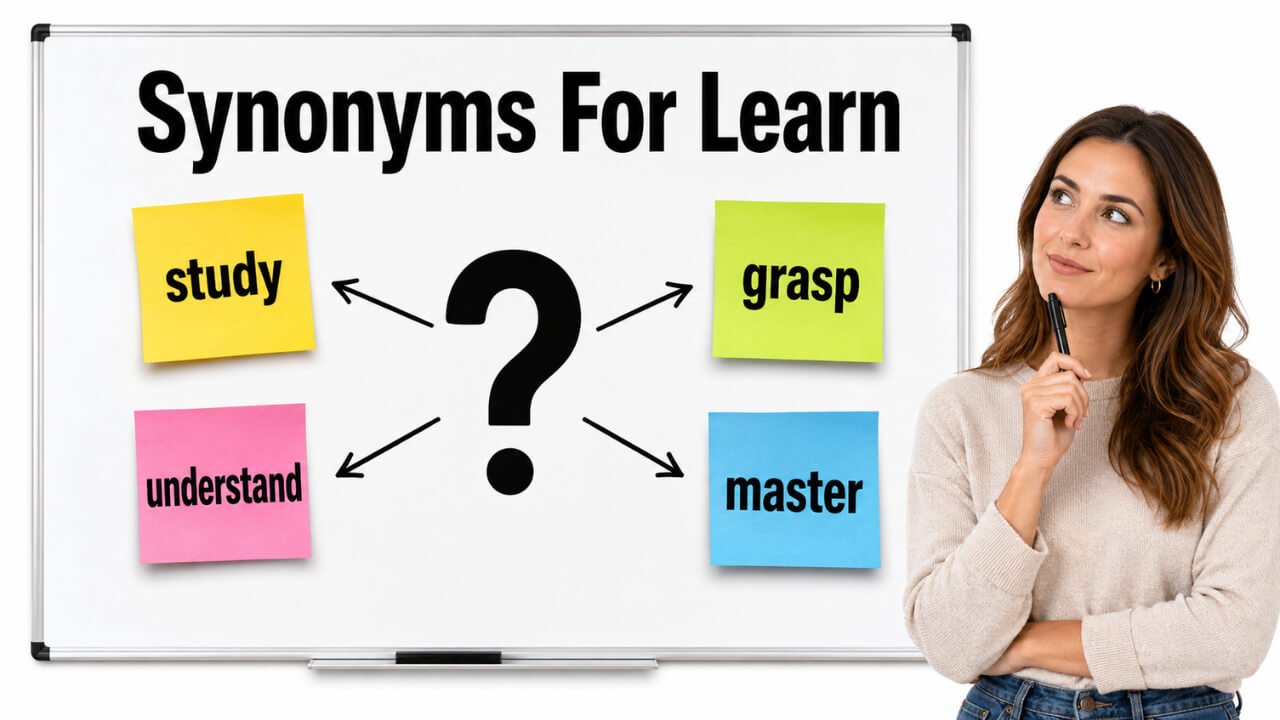
Quick Answer: The best synonyms for learn include study, discover, understand, grasp, comprehend, master, absorb, acquire, memorize, and pick up. Use study for formal education, discover for finding new information, understand for clear meaning, master for skill development, absorb for deep knowledge, memorize for remembering facts, and pick up for casual learning through experience or practice.
Pronunciation and Word Details
Word: Learn.
Pronunciation: /lɜːrn/.
Part of Speech: Verb.
Meaning: To gain knowledge, skill, information, or understanding through study, experience, teaching, or practice.
US Pronunciation:
UK Pronunciation:
What Does “Learn” Mean?
Direct Answer: Learn means to gain knowledge, skill, information, or understanding.
Learn is a verb that describes the process of taking in something new. A person can learn a subject, learn a language, learn a rule, learn a skill, learn from an error, or learn that something is true.
The word works in many sentence contexts. In education, it means to study and understand. In daily life, it means to find out or realize. In skill building, it means to improve through practice. In emotional or personal growth, it means to gain wisdom from experience.
Meaning, Tone, and Context of “Learn”
Meaning: Learn means to receive, understand, or develop knowledge and ability.
Tone: Learn is neutral, natural, and suitable for almost every type of writing.
Formality: It works in formal writing, casual speech, academic content, workplace communication, and everyday conversation.
Academic Context: Students learn grammar, science, history, vocabulary, and critical thinking through lessons and practice.
Professional Context: Workers learn procedures, systems, safety rules, and job skills through training.
Personal Context: People learn from mistakes, relationships, travel, reading, observation, and life experience.
Conversational Context: In casual speech, learn often means to find out, pick up, or understand something new.
When and How to Use “Learn”
For Education: Use learn when talking about school, lessons, subjects, courses, or training.
Example: Students learn new vocabulary through reading and speaking.
For Skill Development: Use learn when someone gains ability through practice.
Example: She learned how to cook traditional dishes by practicing every weekend.
For Discovery: Use learn when someone finds out new information.
Example: We learned that the event had been moved to a different hall.
For Understanding: Use learn when someone begins to understand an idea, rule, or process.
Example: He learned how the system works after reading the instructions carefully.
For Personal Growth: Use learn when someone gains wisdom from experience.
Example: They learned to be more patient after facing difficult situations.
For Memory: Use learn when someone stores facts, lines, names, or details in the mind.
Example: The child learned the poem before the school program.
Best Synonyms for Learn
Study: To spend time gaining knowledge about a subject.
Example: She studied English grammar before writing the essay.
Discover: To find out something new or previously unknown.
Example: They discovered a simple method for solving the problem.
Understand: To know the meaning, reason, or idea behind something.
Example: He understood the lesson after the teacher explained it clearly.
Grasp: To understand something, especially after thinking about it.
Example: She quickly grasped the main idea of the discussion.
Comprehend: To understand something fully or clearly.
Example: The students comprehended the topic after several examples.
Master: To learn something so well that you can use it with skill and confidence.
Example: He mastered the piano after years of regular practice.
Absorb: To take in knowledge, ideas, or information deeply.
Example: She absorbed the information by listening carefully during the lecture.
Acquire: To gain knowledge, skill, or ability over time.
Example: He acquired strong writing skills through reading and practice.
Memorize: To learn something so that you can remember it exactly.
Example: The actor memorized the complete speech before the performance.
Pick Up: To learn something casually or naturally.
Example: She picked up basic French while living abroad.
50 Synonyms for Learn with Short Meanings
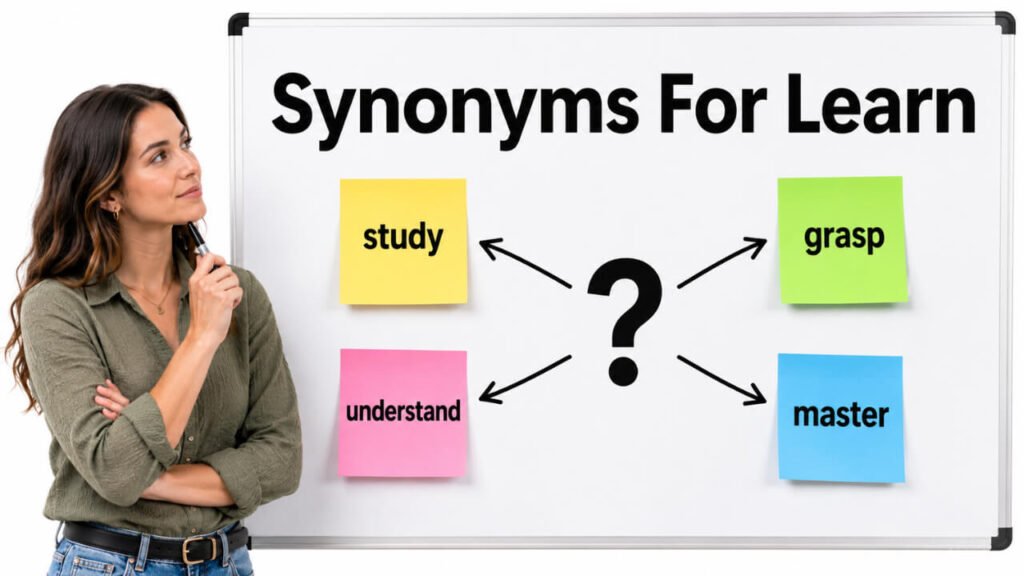
- Study: Gain knowledge through reading, practice, or instruction.
- Discover: Find out something new or unknown.
- Understand: Know the meaning or reason behind something.
- Grasp: Understand an idea clearly.
- Comprehend: Understand something fully.
- Absorb: Take in knowledge or information deeply.
- Acquire: Gain knowledge, skill, or ability over time.
- Master: Learn something completely and use it well.
- Memorize: Learn something so it can be remembered exactly.
- Pick Up: Learn something naturally or informally.
- Find Out: Learn information through discovery or inquiry.
- Become Aware Of: Start knowing or noticing something.
- Get To Know: Learn about a person, place, subject, or situation.
- Gain: Receive knowledge, skill, or understanding.
- Develop: Build knowledge or ability gradually.
- Train In: Learn through guided practice or instruction.
- Practice: Repeat an action to improve skill.
- Read Up On: Study a topic by reading about it.
- Research: Learn through careful investigation.
- Investigate: Examine something to learn the facts.
- Explore: Learn by examining, trying, or studying.
- Observe: Learn by watching carefully.
- Experience: Learn through direct involvement.
- Uncover: Discover hidden or unknown information.
- Detect: Notice and learn something through attention.
- Perceive: Become aware of something through the senses or mind.
- Realize: Suddenly understand or become aware of something.
- Recognize: Identify something already known or understood.
- Identify: Learn what something is.
- Retain: Keep learned information in memory.
- Internalize: Learn something deeply until it becomes part of thinking.
- Assimilate: Take in and understand information fully.
- Educate Oneself: Teach oneself through study or practice.
- Be Taught: Learn from a teacher, guide, or instructor.
- Be Trained: Learn through structured instruction.
- Get The Hang Of: Learn how to do something through practice.
- Catch On To: Begin to understand something.
- Become Skilled In: Learn until ability improves.
- Familiarize Oneself With: Learn enough to become comfortable with something.
- Take In: Understand or absorb information.
- Figure Out: Learn by thinking, solving, or reasoning.
- Work Out: Learn or solve something after effort.
- Review: Study something again to improve memory.
- Revise: Study again, especially before a test or task.
- Drill: Practice repeatedly to learn well.
- Rehearse: Practice something before performing it.
- Apprentice: Learn a trade or skill from an experienced person.
- Advance In: Improve knowledge or ability in a subject.
- Improve At: Become better through learning and practice.
- Broaden Knowledge Of: Increase understanding of a subject.
Read Also:
Synonyms for Success
Synonyms for Learn by Context
When Learn Means Study
Use these synonyms when learn means to gain knowledge through lessons, reading, education, or training.
Study: She studied grammar before writing the final paper.
Read Up On: He read up on the topic before the meeting.
Research: They researched the subject before preparing the report.
Review: Students reviewed the chapter before the test.
Revise: She revised the lesson to remember the main points.
When Learn Means Discover
Use these synonyms when learn means to find out new information.
Discover: We discovered the reason for the delay.
Find Out: I found out that the class starts earlier tomorrow.
Uncover: The team uncovered new details during the investigation.
Realize: She realized that her answer was incomplete.
Become Aware Of: He became aware of the rule after reading the notice.
When Learn Means Understand
Use these synonyms when learn means to understand meaning, logic, or purpose.
Understand: He understood the instructions after reading them twice.
Grasp: She grasped the main point quickly.
Comprehend: They comprehended the lesson after the examples.
Figure Out: I figured out how to fix the error.
Take In: The audience took in the message clearly.
When Learn Means Master a Skill
Use these synonyms when learn means to become skilled through practice.
Master: She mastered the technique after months of effort.
Become Skilled In: He became skilled in public speaking.
Get The Hang Of: They got the hang of the new process.
Train In: She trained in digital design for several months.
Improve At: He improved at writing by practicing every day.
When Learn Means Memorize
Use these synonyms when learn means to remember facts, words, dates, or lines.
Memorize: She memorized the poem for the event.
Retain: He retained the important rules after regular revision.
Review: They reviewed the list until they remembered every item.
Drill: The class drilled the vocabulary before the exam.
Rehearse: The speaker rehearsed the introduction many times.
When Learn Means Gain Experience
Use these synonyms when learn means to gain wisdom from life, work, or direct action.
Experience: She experienced the challenge and learned patience.
Observe: He observed the experts and improved his technique.
Practice: They practiced daily and learned better control.
Internalize: She internalized the lesson after facing the problem herself.
Assimilate: He assimilated the advice and changed his approach.
Another Word for Learn
Direct Answer: Another word for learn is study, but the best single replacement depends on context.
Use study when you mean formal education. Use discover when you mean finding out information. Use understand when you mean knowing the meaning of something. Use master when you mean becoming very skilled.
Original: I want to learn English grammar.
Better Option: I want to study English grammar.
Original: We learned that the office was closed.
Better Option: We found out that the office was closed.
Original: She learned the meaning of the phrase.
Better Option: She understood the meaning of the phrase.
Original: He learned the guitar after years of practice.
Better Option: He mastered the guitar after years of practice.
When Not to Use “Learn”
Do not use learn when a more exact synonym gives better meaning. The word can sound weak if the sentence needs a specific idea such as memorize, discover, study, understand, or master.
Weak: I learned the whole speech.
Better: I memorized the whole speech.
Weak: She learned the answer by accident.
Better: She discovered the answer by accident.
Weak: He learned the subject for three hours.
Better: He studied the subject for three hours.
Weak: They learned the skill completely.
Better: They mastered the skill completely.
Weak: I learned what the teacher meant.
Better: I understood what the teacher meant.
Use learn when the general idea is enough. Choose a stronger synonym when the sentence needs accuracy, detail, education, memory, discovery, or skill level.
Words Commonly Confused With Learn
Learn vs Teach: Learn means to receive knowledge, while teach means to give knowledge.
Learn vs Study: Learn is the result or process of gaining knowledge, while study means to spend time reading, practicing, or reviewing.
Learn vs Understand: Learn means to gain knowledge, while understand means to know the meaning or reason behind it.
Learn vs Memorize: Learn can include understanding, while memorize means to remember exact words, facts, or details.
Learn vs Discover: Learn can happen through study, teaching, or experience, while discover means to find out something new.
Learn vs Know: Learn is the process of gaining knowledge, while know is the state of already having knowledge.
Learn vs Grasp: Learn is broader, while grasp means to understand an idea clearly, often after explanation or thought.
Which Synonym Should You Choose?
Choose study when writing about school, courses, lessons, exams, or academic subjects.
Choose discover when writing about new facts, hidden details, findings, or information that was not known before.
Choose understand when the sentence focuses on meaning, logic, reason, or explanation.
Choose grasp when someone understands an idea quickly or clearly.
Choose comprehend when writing in a more formal or academic style about full understanding.
Choose master when the person has learned a skill deeply and can perform it well.
Choose absorb when someone takes in information carefully or deeply.
Choose acquire when knowledge, language, or skill develops over time.
Choose memorize when someone learns exact words, numbers, names, dates, or facts.
Choose pick up when the tone is casual and the learning happens naturally through exposure or practice.
Real Life Examples of “Learn” in Sentences
Original: I want to learn Spanish this year.
Better Option: I want to study Spanish this year.
Original: She learned the answer after checking the document.
Better Option: She found out the answer after checking the document.
Original: He learned the meaning of the rule.
Better Option: He understood the meaning of the rule.
Original: They learned the dance after many rehearsals.
Better Option: They mastered the dance after many rehearsals.
Original: The child learned the alphabet at home.
Better Option: The child memorized the alphabet at home.
Original: We learned several useful facts from the report.
Better Option: We discovered several useful facts from the report.
Original: She learned the process after watching the trainer.
Better Option: She grasped the process after watching the trainer.
Original: He learned new ideas during the seminar.
Better Option: He absorbed new ideas during the seminar.
Original: They learned basic cooking skills from their parents.
Better Option: They acquired basic cooking skills from their parents.
Original: I learned how to use the tool by trying it myself.
Better Option: I picked up how to use the tool by trying it myself.
Synonym Groups and Usage Differences
Study Group
This group includes study, review, revise, read up on, and research. Use these when learning happens through books, lessons, notes, practice, or academic work.
Example: She studied the topic carefully before the exam.
Discovery Group
This group includes discover, find out, uncover, realize, and become aware of. Use these when learning means receiving new information or noticing something previously unknown.
Example: He discovered the reason for the mistake after checking the file.
Understanding Group
This group includes understand, grasp, comprehend, figure out, and take in. Use these when the focus is meaning, clarity, logic, or comprehension.
Example: The class grasped the concept after a simple explanation.
Skill Group
This group includes master, train in, practice, get the hang of, and become skilled in. Use these when someone improves ability through repetition or instruction.
Example: She mastered the skill after months of daily practice.
Memory Group
This group includes memorize, retain, drill, review, and rehearse. Use these when learning means remembering exact information.
Example: He memorized the speech before the ceremony.
Experience Group
This group includes experience, observe, internalize, assimilate, and develop. Use these when learning comes from life, work, action, or repeated exposure.
Example: She internalized the lesson after handling the situation herself.
Antonyms of Learn
Forget: To lose knowledge or memory of something.
Ignore: To choose not to notice, study, or understand something.
Misunderstand: To understand something incorrectly.
Overlook: To fail to notice or learn an important detail.
Neglect: To fail to give attention to learning or improvement.
Unlearn: To stop using or believing something previously learned.
Disregard: To pay no attention to information, advice, or instruction.
Dismiss: To reject information without learning from it.
Remain Unaware: To continue not knowing something.
Confuse: To mix up information instead of understanding it clearly.
Comparison: Learn vs Related Words
Learn vs Study
Difference: Learn means to gain knowledge or skill, while study means to spend time trying to gain that knowledge.
Example With Learn: I learned three new grammar rules today.
Example With Study: I studied grammar for two hours today.
Learn vs Understand
Difference: Learn is the process of receiving knowledge, while understand means the knowledge is clear in your mind.
Example With Learn: She learned the rule in class.
Example With Understand: She understood why the rule is important.
Learn vs Memorize
Difference: Learn can include meaning and skill, while memorize focuses on remembering exact information.
Example With Learn: He learned how to solve the equation.
Example With Memorize: He memorized the formula for the test.
Learn vs Discover
Difference: Learn is general, while discover means to find out something new or hidden.
Example With Learn: We learned about the change in schedule.
Example With Discover: We discovered the reason for the change in schedule.
Learn vs Master
Difference: Learn can mean beginning to understand something, while master means reaching a high level of skill or control.
Example With Learn: She learned the basics of painting.
Example With Master: She mastered advanced painting techniques.
Learn vs Grasp
Difference: Learn is broader, while grasp means to understand an idea clearly, often after explanation.
Example With Learn: The students learned the topic in class.
Example With Grasp: The students grasped the topic after the teacher gave examples.
Common Phrases and Expressions With Learn
Learn By Heart: Memorize something completely.
Learn The Ropes: Understand how a job, task, or system works.
Learn From Experience: Gain knowledge through real situations.
Learn The Hard Way: Understand something after difficulty or a mistake.
Learn By Doing: Gain skill through direct practice.
Learn A Lesson: Gain wisdom after an event or mistake.
Learn Something New: Gain fresh knowledge or information.
Learn From Mistakes: Improve after errors or poor decisions.
Learn Quickly: Understand or gain skill in a short time.
Learn At Your Own Pace: Study or improve at a comfortable speed.
Common Mistakes to Avoid
Repeating Learn Too Often: Do not use learn in every sentence when synonyms can make the writing clearer.
Weak Example: Students learn grammar, learn vocabulary, and learn pronunciation.
Better Example: Students study grammar, build vocabulary, and practice pronunciation.
Choosing The Wrong Synonym: Do not use memorize when the sentence means understand.
Weak Example: She memorized the reason for the rule.
Better Example: She understood the reason for the rule.
Confusing Learn And Teach: Learn means receive knowledge. Teach means give knowledge.
Weak Example: The teacher learned the students grammar.
Better Example: The teacher taught the students grammar.
Using Discover For Formal Study: Discover works best when something is found out, not when someone studies a subject.
Weak Example: I discovered math for two hours.
Better Example: I studied math for two hours.
Using Master Too Early: Master means deep skill, not basic learning.
Weak Example: She mastered the alphabet today.
Better Example: She learned the alphabet today.
Making The Sentence Vague: Add the object of learning when clarity matters.
Weak Example: He learned yesterday.
Better Example: He learned how to write a formal email yesterday.
Conclusion
The best synonyms for learn depend on meaning, tone, and context. Use study for education, discover for new information, understand for meaning, grasp for quick comprehension, memorize for exact recall, acquire for gradual development, and master for strong skill. In casual speech, pick up sounds natural. In formal writing, comprehend, acquire, and study often work better. Choosing the right synonym helps your writing sound clearer, more accurate, and more natural.
FAQs About Synonyms for Learn
What is the best synonym for learn?
The best synonym for learn is study when talking about education, but understand, discover, master, or memorize may be better depending on the sentence.
What are simple synonyms for learn?
Simple synonyms for learn include study, understand, discover, find out, grasp, pick up, and memorize.
What is a formal synonym for learn?
Formal synonyms for learn include comprehend, acquire, study, research, assimilate, and become aware of.
What is a casual synonym for learn?
Casual synonyms for learn include pick up, get the hang of, find out, and catch on to.
Is discover the same as learn?
Discover is close to learn, but it usually means finding out something new, hidden, or previously unknown. Learn is more general.
Is memorize a synonym for learn?
Memorize is a synonym for learn only when the meaning is to remember exact words, facts, numbers, or details.
What is another word for learning a skill?
Another word for learning a skill is mastering, training in, practicing, developing, or becoming skilled in, depending on the level of ability.
