
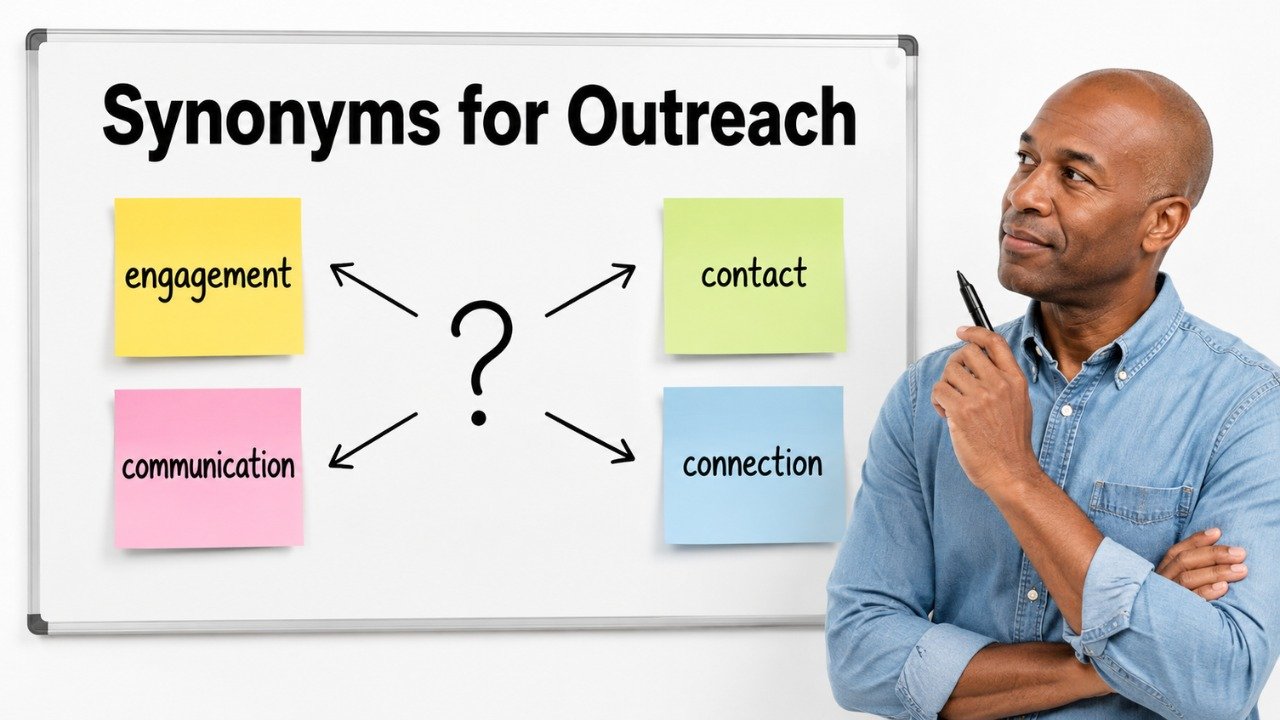
Quick Answer: The best synonyms for outreach include engagement, communication, contact, connection, involvement, extension, assistance, advocacy, promotion, and community service. Engagement is the strongest general alternative when an organization connects with people and encourages participation. Communication works best for sharing information. Assistance and support fit programs that provide help. Promotion suits marketing and awareness campaigns. Advocacy is appropriate when outreach supports a cause, while recruitment fits efforts to attract volunteers, workers, members, students, or participants.
Pronunciation and Word Details
Word: Outreach.
Pronunciation: /ˈaʊtriːtʃ/
Part of Speech: Noun, adjective, and occasionally a verb.
Meaning: An organized effort to contact, inform, support, involve, or provide services to people.
US Pronunciation:
UK Pronunciation:
What Does “Outreach” Mean?
Outreach means an organized effort to connect with people, share information, offer help, build relationships, or encourage participation.
The word is most commonly used as a noun. It often describes programs, activities, communication, or services designed to reach people outside an organization’s usual location or audience.
Example: The library created an outreach program for older residents.
Outreach can also function as an adjective before another noun.
Example: The outreach team visited several rural communities.
Less commonly, outreach may be used as a verb meaning to extend farther or reach more people than someone or something else. However, phrases such as reach out to, contact, or engage are usually more natural in everyday writing.
Example: The new campaign reached more families than the previous effort.
Outreach appears in many contexts. Community outreach connects organizations with local residents. Educational outreach provides learning opportunities. Public health outreach shares health information and services. Business outreach contacts potential customers or partners. Volunteer outreach attracts people who may wish to participate.
The exact meaning depends on the goal. Outreach may focus on communication, awareness, assistance, recruitment, relationship building, access, or public participation.
Meaning, Tone, and Context of “Outreach”
Outreach has a neutral, positive, and moderately formal tone. It usually suggests an intentional effort to include, inform, assist, or communicate with people.
The word is common in community programs, education, health services, charities, public institutions, professional organizations, businesses, and government communication.
In community contexts, outreach often means meeting residents, listening to concerns, offering services, or encouraging participation.
Example: Community outreach helped residents understand the new housing program.
In education, outreach may involve workshops, school visits, public lessons, mentoring, or access to learning materials.
Example: The college expanded its educational outreach to nearby towns.
In health contexts, outreach can describe information campaigns, screenings, mobile services, or direct support for people who may not visit a clinic.
Example: The health outreach team provided information about preventive care.
In business writing, outreach often refers to contacting potential customers, partners, applicants, or investors.
Example: The sales team improved its outreach to small businesses.
In public communication, outreach may include consultation, public meetings, information sharing, and efforts to collect feedback.
Example: The council began public outreach before changing the local transport plan.
Outreach sounds more organized than simple contact. Contact may be one message or conversation, while outreach usually involves a planned effort directed toward a group or audience.
The word can sometimes sound vague. Strong writing should explain who is being reached, why the outreach is happening, and what action is involved.
When and How to Use “Outreach”
For Community Engagement
Use outreach when an organization connects with local residents, neighborhood groups, families, or underserved communities.
Explanation: This use often includes meetings, visits, information sessions, support services, and public participation.
Example: The center increased its outreach to families living in remote areas.
For Public Communication
Use outreach when information must be shared with a wider audience.
Explanation: Outreach may include announcements, educational materials, public events, direct contact, and question sessions.
Example: The agency developed an outreach plan to explain the new rules.
For Support Services
Use outreach when help is taken directly to people who may not seek it independently.
Explanation: This may involve food assistance, housing guidance, counseling, health services, or educational support.
Example: The outreach workers connected residents with emergency assistance.
For Education
Use outreach when schools, colleges, libraries, museums, or training groups provide learning opportunities beyond their usual location.
Explanation: Educational outreach can include workshops, demonstrations, mentoring, visits, and public lessons.
Example: The science outreach program introduced children to practical experiments.
For Health Information
Use outreach when health professionals provide information, screenings, referrals, or preventive services to the public.
Explanation: The purpose is often to improve access and reach people who face barriers to care.
Example: The clinic organized outreach for residents who could not travel easily.
For Recruitment
Use outreach when an organization contacts possible employees, volunteers, students, members, or participants.
Explanation: Recruitment outreach is intended to create interest and encourage applications or involvement.
Example: The volunteer outreach campaign attracted more than one hundred applicants.
For Marketing
Use outreach when a business contacts potential customers, industry contacts, or professional partners.
Explanation: Marketing outreach may involve introductions, information, offers, and relationship building.
Example: The company focused its outreach on independent retailers.
For Advocacy
Use outreach when a group informs people about an issue and encourages awareness, support, or action.
Explanation: Advocacy outreach often combines education, public discussion, and community involvement.
Example: The organization used outreach to raise awareness about safe drinking water.
For Partnership Development
Use outreach when one group approaches another to explore cooperation.
Explanation: This may involve introductions, meetings, proposals, and shared planning.
Example: The director began outreach to local organizations interested in the project.
For Public Feedback
Use outreach when decision makers seek opinions, concerns, or recommendations from the people affected by a plan.
Explanation: Consultation and engagement may be more precise when two way discussion is the main goal.
Example: Public outreach allowed residents to comment on the development proposal.
Best Synonyms for Outreach
Engagement: Active communication and involvement with a group or audience.
Example: Community engagement increased attendance at local meetings.
Communication: The sharing of information, ideas, instructions, or messages.
Example: Clear communication helped residents understand the program.
Contact: Direct communication with a person or group.
Example: The team made contact with several community leaders.
Connection: A relationship or link created between people or organizations.
Example: The event built a stronger connection between volunteers and residents.
Involvement: Participation in an activity, program, or decision.
Example: Parent involvement improved the success of the school project.
Extension: The delivery of knowledge, services, or resources beyond a central institution.
Example: The university’s extension program offered classes in rural areas.
Assistance: Practical help provided to someone in need.
Example: The outreach center offered housing assistance to local families.
Advocacy: Public support for a cause, policy, or group.
Example: Her advocacy encouraged more people to support the campaign.
Promotion: Activities intended to increase awareness, interest, or participation.
Example: Event promotion brought many new visitors to the workshop.
Community Service: Organized work intended to help people in a local area.
Example: The volunteers completed several community service projects.
50 Synonyms for Outreach with Short Meanings
- Engagement: Active interaction with people or groups.
- Communication: The exchange or sharing of information.
- Contact: Direct connection with a person or audience.
- Connection: A relationship or link between people.
- Interaction: Communication involving two or more parties.
- Involvement: Active participation in an activity or cause.
- Participation: Taking part in a program, event, or decision.
- Liaison: Communication and cooperation between groups.
- Extension: Services or knowledge provided beyond a central organization.
- Reach: The number or range of people contacted.
- Assistance: Practical help offered to others.
- Support: Help, encouragement, or resources provided to someone.
- Aid: Help given to people who need it.
- Service: Work performed for the benefit of others.
- Advocacy: Public support for a cause or community.
- Education: The sharing of knowledge and useful information.
- Awareness: Increased public understanding of an issue.
- Promotion: Activity intended to attract attention or participation.
- Publicity: Public attention created for an event, service, or cause.
- Recruitment: Efforts to attract workers, members, or volunteers.
- Canvassing: Directly contacting people to seek support or information.
- Campaigning: Organized activity supporting a goal or cause.
- Networking: Building useful personal or professional relationships.
- Relationship Building: Developing trust and lasting connections.
- Community Engagement: Active communication with local residents.
- Public Engagement: Efforts to involve the wider public.
- Community Service: Organized work performed to help a community.
- Public Service: Work intended to benefit the public.
- Consultation: Seeking opinions, advice, or feedback.
- Collaboration: Working jointly toward a shared goal.
- Partnership: A cooperative relationship between people or groups.
- Cooperation: Working together willingly and effectively.
- Dialogue: A two way exchange of ideas or views.
- Correspondence: Communication through written messages.
- Messaging: The planned communication of key information.
- Dissemination: The organized distribution of information.
- Information Sharing: Providing facts, knowledge, or updates to others.
- Public Relations: Managing communication with the public.
- Extension Service: A program that brings knowledge or help to communities.
- Fieldwork: Practical work carried out directly in a community.
- Mobilization: Organizing people to participate or take action.
- Inclusion: Making people feel welcomed and able to participate.
- Access: The opportunity to receive services, information, or support.
- Intervention: Planned action intended to improve a situation.
- Visitation: Personal visits made to provide contact or support.
- Prospecting: Searching for possible customers, members, or opportunities.
- Solicitation: Requesting support, donations, participation, or business.
- Introduction: The first contact between people or organizations.
- Connection Building: Creating useful and lasting relationships.
- Audience Development: Expanding and strengthening a group of participants.
Read Also:
Synonyms for Advance

Synonyms for Outreach by Context
When Outreach Means Community Engagement
Community engagement is the strongest alternative when the goal is to communicate with residents and involve them in local programs or decisions.
Public engagement is broader and may include people from several communities. Involvement emphasizes participation. Interaction focuses on direct exchanges between people.
Example With Community Engagement: Community engagement helped planners understand local concerns.
Example With Public Engagement: The project included several months of public engagement.
Example With Involvement: Resident involvement improved the final design.
Example With Interaction: Regular interaction created trust between staff and families.
When Outreach Means Communication
Communication is the best broad synonym when outreach involves sharing information.
Contact refers to direct communication with particular people. Messaging focuses on how information is presented. Correspondence usually describes written communication. Information sharing emphasizes the distribution of useful facts.
Example With Communication: Clear communication reduced confusion about the application process.
Example With Contact: The team established contact with local teachers.
Example With Messaging: Consistent messaging helped explain the campaign.
Example With Information Sharing: Information sharing improved coordination between the groups.
When Outreach Means Providing Help
Assistance, support, aid, service, and intervention fit outreach programs that respond to people’s needs.
Assistance is practical and neutral. Support may be practical, financial, educational, or emotional. Aid often refers to urgent or charitable help. Intervention describes planned action taken to improve a difficult situation.
Example With Assistance: The center provided financial assistance to affected families.
Example With Support: Families received support throughout the process.
Example With Aid: Emergency aid was delivered to isolated communities.
Example With Intervention: Early intervention helped prevent the problem from becoming worse.
When Outreach Means Education
Education, extension, extension service, dissemination, and awareness are suitable when outreach shares knowledge.
Education emphasizes learning. Extension is common when an institution brings expertise to people outside its main location. Dissemination is formal and focuses on distributing information widely. Awareness refers to improving public understanding.
Example With Education: Public education increased understanding of water conservation.
Example With Extension: The agricultural extension program offered practical training.
Example With Dissemination: The report recommended wider dissemination of safety information.
Example With Awareness: The campaign increased awareness of local support services.
When Outreach Means Promotion
Promotion, publicity, campaigning, and audience development fit outreach intended to attract attention or participation.
Promotion is the broadest alternative. Publicity focuses on public attention. Campaigning suggests organized activity over a period of time. Audience development focuses on attracting and retaining participants.
Example With Promotion: Event promotion increased registrations.
Example With Publicity: Additional publicity brought more visitors to the exhibition.
Example With Campaigning: Months of campaigning encouraged residents to participate.
Example With Audience Development: Audience development helped the theater attract younger visitors.
When Outreach Means Recruitment
Recruitment is the strongest term when the goal is to attract people to a role, program, organization, or event.
Prospecting is more common in business when searching for potential customers or opportunities. Canvassing involves direct contact. Solicitation means asking for applications, support, donations, or business.
Example With Recruitment: Volunteer recruitment began six weeks before the event.
Example With Prospecting: The team used prospecting to identify possible clients.
Example With Canvassing: Door to door canvassing helped the group reach more households.
Example With Solicitation: The organization began solicitation of donations for the community fund.
When Outreach Means Building Partnerships
Networking, liaison, collaboration, partnership, and cooperation describe outreach intended to build professional or community relationships.
Networking focuses on creating contacts. Liaison involves maintaining communication between groups. Collaboration means working together. Partnership suggests a more established cooperative relationship.
Example With Networking: Professional networking introduced the team to several specialists.
Example With Liaison: A community liaison maintained contact with neighborhood leaders.
Example With Collaboration: Collaboration allowed both organizations to share resources.
Example With Partnership: The new partnership expanded access to training.
When Outreach Means Seeking Public Feedback
Consultation, dialogue, engagement, and participation work best when outreach is designed to gather opinions.
Consultation is formal and focuses on asking for views. Dialogue emphasizes a two way exchange. Participation means people take an active role in discussion or decision making.
Example With Consultation: Public consultation revealed strong support for the proposal.
Example With Dialogue: Open dialogue helped resolve several concerns.
Example With Participation: Community participation improved the planning process.
Another Word for Outreach
Engagement is often the best single replacement for outreach because it includes communication, interaction, and participation. However, the best alternative depends on the purpose of the activity.
Use communication when sharing information, assistance when providing help, recruitment when attracting participants, promotion when increasing awareness, and advocacy when supporting a cause.
Original: The organization improved its outreach to local families.
Better Option: The organization improved its engagement with local families.
Original: The clinic began outreach in rural areas.
Better Option: The clinic began providing health assistance in rural areas.
Original: The team increased outreach to potential volunteers.
Better Option: The team increased volunteer recruitment.
Original: The museum planned outreach for its new exhibition.
Better Option: The museum planned promotion for its new exhibition.
When Not to Use “Outreach”
Outreach is useful, but it can sound vague, repetitive, or overly formal when a more precise word would explain the activity.
When You Mean a Single Message
Outreach usually suggests an organized effort rather than one email, call, or conversation.
Weak: I completed outreach to her this morning.
Better: I contacted her this morning.
When You Mean Advertising
Promotion or publicity may be clearer when the only purpose is attracting public attention.
Weak: The event needs more outreach.
Better: The event needs more promotion.
When You Mean Direct Assistance
Support, aid, or assistance is more precise when help is the main activity.
Weak: The center offers outreach to homeless residents.
Better: The center offers housing assistance to homeless residents.
When You Mean Recruitment
Recruitment clearly describes efforts to attract applicants, members, volunteers, or workers.
Weak: The team began outreach for new volunteers.
Better: The team began recruiting new volunteers.
When You Mean Public Discussion
Consultation or dialogue may be better when the main goal is collecting opinions.
Weak: The council held outreach about the development plan.
Better: The council held a public consultation about the development plan.
When You Mean an Established Relationship
Partnership, collaboration, or liaison may be clearer when groups already work together.
Weak: The schools continued their outreach with the training center.
Better: The schools continued their partnership with the training center.
When the Audience Is Unclear
Outreach becomes empty language when the sentence does not identify who is being contacted.
Weak: The organization plans to expand its outreach.
Better: The organization plans to contact more rural families and local teachers.
When the Action Is Unclear
Explain what the outreach actually includes.
Weak: The team conducted outreach throughout the month.
Better: The team visited neighborhoods, distributed information, and answered residents’ questions throughout the month.
When the Word Is Repeated Too Often
Use specific alternatives to improve clarity and sentence variety.
Weak: The outreach team created an outreach plan to improve outreach.
Better: The engagement team created a communication plan to reach more residents.
Words Commonly Confused With Outreach
Outreach vs Engagement: Outreach means making an effort to reach people. Engagement includes deeper interaction, participation, and relationship building.
Outreach vs Communication: Communication is any exchange of information. Outreach is planned communication directed toward a particular audience or community.
Outreach vs Contact: Contact may be one call, message, meeting, or introduction. Outreach usually involves a broader or continuing effort.
Outreach vs Marketing: Marketing is intended to attract customers and increase demand. Outreach may also provide education, support, access, advocacy, or public service.
Outreach vs Promotion: Promotion focuses on increasing interest or awareness. Outreach may include promotion, but it can also involve assistance, consultation, or relationship building.
Outreach vs Publicity: Publicity creates public attention. Outreach usually involves more direct communication with a selected audience.
Outreach vs Advocacy: Advocacy supports a cause or group. Outreach is the process used to contact, inform, or involve people.
Outreach vs Recruitment: Recruitment specifically attracts people to apply, join, volunteer, or participate. Outreach may have many other goals.
Outreach vs Community Service: Community service is work performed to help a community. Outreach is the effort to connect people with that work or service.
Outreach vs Extension: Extension usually refers to knowledge or services delivered beyond an institution’s main location. Outreach is broader and may include communication, support, promotion, or recruitment.
Which Synonym Should You Choose?
Choose engagement when writing about active communication, participation, and relationship building.
Choose communication when the main goal is sharing information, instructions, or updates.
Choose contact in emails and everyday conversation when referring to a direct message, call, or meeting.
Choose connection when emphasizing a relationship rather than a campaign or program.
Choose involvement when people take part in an activity, project, or decision.
Choose participation when describing attendance or an active role in a program.
Choose liaison when a person or team maintains communication between organizations.
Choose extension in academic, agricultural, educational, or institutional writing about services delivered beyond a main location.
Choose assistance when the program provides practical help.
Choose support when the help may be practical, emotional, financial, or educational.
Choose aid when assistance is urgent or intended for people in serious need.
Choose advocacy when supporting a cause, right, policy, or community.
Choose education when the main purpose is teaching the public.
Choose awareness when the goal is increasing knowledge of an issue.
Choose promotion when encouraging interest in an event, service, program, or product.
Choose publicity when seeking wider public attention.
Choose recruitment when attracting employees, students, members, volunteers, or participants.
Choose canvassing when people are contacted directly for opinions, support, or participation.
Choose networking in professional writing about building contacts.
Choose collaboration when two or more groups work together on a shared activity.
Choose partnership when the cooperative relationship is formal or continuing.
Choose consultation when asking the public or a group for opinions and feedback.
Choose dialogue when emphasizing a two way discussion.
Choose dissemination in formal reports when information is distributed widely.
Choose mobilization when organizing people to act or participate.
Choose inclusion when the aim is to remove barriers and welcome more people.
Choose intervention when planned action is taken to improve a difficult situation.
Choose prospecting in business writing when searching for possible customers or opportunities.
Choose audience development when attracting and retaining participants over time.
Real Life Examples of “Outreach” in Sentences
Original: The school improved its outreach to parents.
Better Option: The school improved its communication with parents.
Original: The hospital began outreach in remote communities.
Better Option: The hospital began providing health assistance in remote communities.
Original: The organization increased outreach before the public meeting.
Better Option: The organization increased community engagement before the public meeting.
Original: The team used outreach to find new volunteers.
Better Option: The team used recruitment to find new volunteers.
Original: More outreach is needed for the new program.
Better Option: More promotion is needed for the new program.
Original: The council completed outreach with local residents.
Better Option: The council completed public consultation with local residents.
Original: The charity’s outreach helped families access food.
Better Option: The charity’s support helped families access food.
Original: Business outreach created several new opportunities.
Better Option: Professional networking created several new opportunities.
Original: The campaign focused on youth outreach.
Better Option: The campaign focused on youth engagement.
Original: The center expanded its educational outreach.
Better Option: The center expanded its public education program.
Synonym Groups and Usage Differences
Communication Group
This group includes communication, contact, correspondence, messaging, dissemination, and information sharing.
Communication is broad and neutral. Contact describes direct connection. Correspondence usually refers to written exchanges. Messaging focuses on planned wording. Dissemination is formal and emphasizes wide distribution.
Example: Clear information sharing helped families understand the application process.
Engagement Group
This group includes engagement, interaction, involvement, participation, dialogue, and consultation.
Engagement suggests an active relationship. Interaction refers to direct exchanges. Involvement and participation emphasize taking part. Consultation focuses on seeking views.
Example: Resident participation gave planners a better understanding of local needs.
Community Service Group
This group includes assistance, support, aid, service, public service, community service, and intervention.
Assistance means practical help. Support is broader and may continue over time. Aid is often connected with urgent need. Intervention is a planned response to a problem.
Example: The program provided practical support to families facing financial difficulty.
Awareness Group
This group includes education, awareness, promotion, publicity, advocacy, campaigning, and dissemination.
Education shares knowledge. Awareness increases understanding. Promotion attracts interest. Advocacy encourages support for a cause. Campaigning involves organized activity over time.
Example: Public education improved awareness of available services.
Recruitment Group
This group includes recruitment, canvassing, prospecting, solicitation, mobilization, and audience development.
Recruitment attracts people to a role or program. Canvassing uses direct contact. Prospecting searches for potential opportunities. Mobilization organizes people to participate or act.
Example: Volunteer recruitment brought new skills into the program.
Partnership Group
This group includes networking, liaison, collaboration, partnership, cooperation, and relationship building.
Networking creates contacts. Liaison keeps groups connected. Collaboration describes shared work. Partnership suggests a stable cooperative arrangement.
Example: The partnership allowed both centers to offer additional services.
Access and Inclusion Group
This group includes access, inclusion, extension, extension service, fieldwork, and visitation.
Access focuses on the ability to receive help or information. Inclusion focuses on participation without unfair barriers. Extension takes knowledge or services outside an institution. Visitation involves personal visits.
Example: The mobile service improved access for residents in distant villages.
Antonyms of Outreach
The opposite of outreach depends on whether the word means communication, involvement, access, support, or public connection.
Isolation: Separation from other people or communities.
Withdrawal: Moving away from communication or participation.
Disengagement: Ending or reducing active involvement.
Exclusion: Preventing people from participating or receiving access.
Neglect: Failing to provide necessary attention or support.
Silence: A lack of communication or public response.
Secrecy: Deliberately keeping information hidden.
Inaccessibility: The condition of being difficult or impossible to reach.
Disconnection: The absence or loss of a relationship.
Detachment: A lack of involvement or emotional connection.
Avoidance: Deliberately refusing contact or engagement.
Nonparticipation: Choosing not to take part in an activity.
Comparison: Outreach vs Related Words
Outreach vs Engagement
Outreach is the effort to reach people. Engagement is the deeper process of interacting with them and encouraging participation.
Example With Outreach: The center began outreach to new residents.
Example With Engagement: Community engagement allowed residents to influence the program.
Outreach vs Communication
Communication refers to any exchange of information. Outreach is planned communication aimed at a specific audience or goal.
Example With Outreach: The campaign used outreach to contact rural families.
Example With Communication: Clear communication explained how families could apply.
Outreach vs Contact
Contact may be a single interaction. Outreach is usually broader, organized, and repeated.
Example With Outreach: The organization conducted outreach throughout the region.
Example With Contact: A staff member made contact with the village leader.
Outreach vs Marketing
Outreach may educate, support, recruit, or involve people. Marketing mainly aims to attract customers and increase interest in products or services.
Example With Outreach: The clinic organized outreach about free health checks.
Example With Marketing: The business used marketing to attract new customers.
Outreach vs Promotion
Promotion increases attention or interest. Outreach may involve direct assistance, conversation, or public participation.
Example With Outreach: Staff visited neighborhoods to explain the program.
Example With Promotion: Posters were used for event promotion.
Outreach vs Advocacy
Outreach is the act of contacting and informing people. Advocacy is the act of supporting a cause, policy, or community.
Example With Outreach: The group organized outreach in several schools.
Example With Advocacy: The group continued its advocacy for safer roads.
Outreach vs Recruitment
Outreach has many possible goals. Recruitment specifically aims to attract people to join, apply, work, volunteer, or participate.
Example With Outreach: The center shared information with local residents.
Example With Recruitment: The center recruited twenty new volunteers.
Outreach vs Extension
Outreach is a broad communication and service effort. Extension usually describes education, knowledge, or technical help delivered outside an institution.
Example With Outreach: The university organized outreach for local families.
Example With Extension: The agricultural extension team trained farmers in soil management.
Outreach vs Community Service
Outreach connects people with services or opportunities. Community service is the actual work performed to benefit a community.
Example With Outreach: Volunteers contacted older residents who needed help.
Example With Community Service: Volunteers delivered meals and repaired damaged homes.
Common Phrases and Expressions With Outreach
Community Outreach: Organized efforts to connect with and support local residents.
Public Outreach: Communication intended to inform or involve the general public.
Educational Outreach: Learning activities offered beyond a school or institution.
Health Outreach: Services and information provided to improve access to health support.
Youth Outreach: Programs intended to contact, support, educate, or involve young people.
Outreach Program: An organized plan for contacting or assisting a target group.
Outreach Campaign: A coordinated effort to build awareness, participation, or support.
Outreach Team: A group responsible for contacting and assisting an audience.
Outreach Services: Support or information delivered directly to people who need it.
Outreach Efforts: Actions taken to communicate with, support, or involve people.
Common Mistakes to Avoid
Using Outreach Without Naming the Audience
Readers should know who the effort is intended to reach.
Vague: The organization expanded its outreach.
Clearer: The organization expanded its outreach to rural families and older residents.
Using Outreach Without Explaining the Goal
State whether the purpose is education, support, promotion, recruitment, or consultation.
Vague: The team is planning outreach.
Clearer: The team is planning outreach to recruit volunteers for the literacy program.
Treating Outreach as a Replacement for Every Type of Communication
A single phone call or message is usually contact, not an entire outreach effort.
Unnatural: I performed outreach to my supervisor.
Natural: I contacted my supervisor.
Confusing Outreach With Engagement
Reaching people does not always mean they are actively involved.
Incorrect: Sending one notice guaranteed public engagement.
Better: Sending the notice was outreach, while the later discussion created engagement.
Confusing Outreach With Marketing
Not all outreach is commercial. Many programs focus on education, access, assistance, or public service.
Incorrect: Every community outreach activity is marketing.
Better: Community outreach may provide information or support without selling anything.
Using Outreach as an Unclear Verb
Reach out to, contact, engage, or support is often more natural.
Unnatural: We will outreach local residents next week.
Better: We will contact local residents next week.
Using Reach Out When Contact Is Enough
Reach out can sound wordy in formal reports.
Wordy: Staff members reached out to applicants by email.
Clearer: Staff members contacted applicants by email.
Repeating Outreach in One Paragraph
Use precise alternatives to improve readability.
Repetitive: The outreach department created an outreach campaign to improve community outreach.
Improved: The engagement department created a campaign to improve communication with residents.
Choosing Promotion When Support Is Intended
Promotion attracts attention. It does not necessarily provide help.
Incorrect: The center offered housing promotion to struggling families.
Better: The center offered housing assistance to struggling families.
Choosing Recruitment When Participation Is Voluntary and Broad
Recruitment may sound too focused on filling roles when the aim is simply to involve the public.
Weak: The council began resident recruitment for the discussion.
Better: The council encouraged resident participation in the discussion.
Using Publicity for Two Way Communication
Publicity mainly sends information outward. Consultation and dialogue involve listening to responses.
Incorrect: The meeting provided publicity for residents to express concerns.
Better: The meeting provided a forum for public consultation.
Making Claims Without Specific Results
Avoid saying outreach was successful without showing what changed.
Weak: The outreach campaign was highly successful.
Better: The campaign increased workshop attendance and connected fifty families with support services.
Conclusion
The best synonyms for outreach depend on the purpose of the effort. Engagement suits active community participation, while communication and contact fit information sharing. Assistance, support, and aid describe services that help people. Promotion and publicity work when increasing awareness, while recruitment attracts volunteers, members, or applicants. Advocacy supports a cause, and consultation collects public feedback. Choosing a precise alternative makes your writing clearer and shows exactly how an organization connects with, informs, involves, or serves its audience.
FAQs About Synonyms for Outreach
What Is the Best General Synonym for Outreach?
Engagement is the best broad synonym when outreach includes communication, interaction, and participation. Contact is better for a single conversation or message.
What Is a Formal Synonym for Outreach?
Public engagement, consultation, liaison, dissemination, extension, and community engagement are useful formal alternatives.
What Is Another Word for Community Outreach?
Community engagement is the closest alternative. Community service, public engagement, support, assistance, and local involvement may also fit.
What Is Another Word for Marketing Outreach?
Promotion, prospecting, publicity, customer contact, audience development, and relationship building are useful alternatives.
Are Outreach and Engagement the Same?
Not exactly. Outreach is the effort to reach people, while engagement involves deeper interaction, participation, and relationship building.
What Is Another Word for Educational Outreach?
Public education, extension, extension service, information sharing, awareness, and community learning are suitable alternatives.
Can Outreach Be Used as a Verb?
It can occasionally be used as a verb, but contact, engage, assist, or reach out to usually sounds more natural.
