
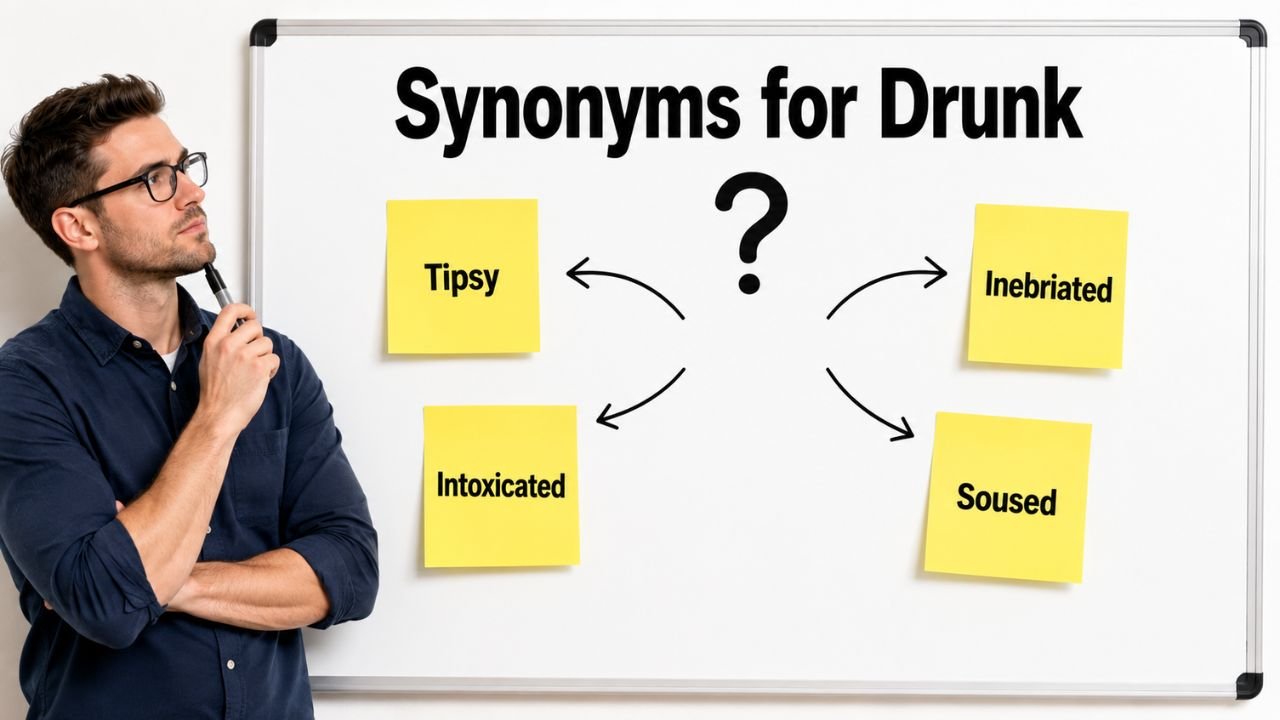
Quick Answer: The best synonyms for drunk include intoxicated, inebriated, tipsy, impaired, under the influence, buzzed, wasted, plastered, hammered, and sloshed. Use intoxicated or impaired in formal writing, reports, and safety related contexts. Use tipsy for mild drunkenness and buzzed for a small noticeable effect. In casual speech, wasted, plastered, hammered, and sloshed describe a much stronger condition, but these words are informal. The best synonym depends on how much alcohol was consumed, the tone of the sentence, and whether the context is formal, neutral, humorous, or conversational.
Pronunciation and Word Details
Word: Drunk.
Pronunciation: /drʌŋk/
Part of Speech: Adjective, noun, and past participle of the verb drink.
Meaning: Affected by alcohol so that normal judgment, speech, movement, or behavior may be changed.
US Pronunciation:
UK Pronunciation:
What Does “Drunk” Mean?
Drunk usually means affected by alcohol after drinking more than the body can comfortably manage. As an adjective, it describes a person whose judgment, coordination, speech, mood, or behavior has changed because of alcohol.
Example: He appeared drunk when he left the celebration.
The word can describe different levels of intoxication. Someone may be slightly drunk, very drunk, or too drunk to walk safely. More precise words such as tipsy, impaired, or heavily intoxicated can help readers understand the degree more clearly.
Drunk is also the past participle of the verb drink. In this grammatical use, it does not necessarily refer to alcohol.
Example: She has drunk three glasses of water.
The word can occasionally be used as a noun for a person who regularly becomes intoxicated. This use often sounds insulting or judgmental. In respectful writing, it is usually better to describe the person or situation without using drunk as a personal label.
Drunk can also be used figuratively to describe someone overwhelmed by power, success, happiness, or another strong feeling.
Example: The leader became drunk on power.
Meaning, Tone, and Context of “Drunk”
Drunk has a direct, conversational, and sometimes blunt tone. It is common in everyday speech, stories, informal descriptions, and conversations about alcohol.
In neutral or formal writing, intoxicated, impaired, or under the influence may sound more appropriate. These alternatives focus on the person’s condition without adding a humorous or insulting tone.
Formal Context: The individual appeared intoxicated and unable to answer clearly.
Neutral Context: The driver seemed impaired.
Conversational Context: He was drunk by the end of the evening.
Mild Context: She felt slightly tipsy after the meal.
Strong Informal Context: They were completely wasted.
Some synonyms for drunk are strongly informal. Words such as hammered, smashed, plastered, and sloshed can sound humorous among friends, but they may be unsuitable in reports, essays, professional emails, or serious safety discussions.
The word drunk may also sound judgmental when it is used as a noun.
Harsh: The drunk was sitting outside.
Respectful: The intoxicated man was sitting outside.
In figurative writing, drunk can suggest that a strong emotion or advantage has affected someone’s judgment.
Figurative Example: She was drunk with success and ignored every warning.
When and How to Use “Drunk”
For a General Description
Use: Drunk is suitable when you need a direct everyday word for someone affected by alcohol.
Example: He became drunk after consuming several drinks in a short period.
For Mild Alcohol Effects
Use: Use slightly drunk when the effect is noticeable but not extreme. Tipsy or buzzed may be more precise.
Example: She felt slightly drunk and decided to stop drinking.
For Strong Intoxication
Use: Add words such as very, extremely, or heavily when the person is strongly affected.
Example: He was too drunk to walk without assistance.
For Formal Writing
Use: In reports, essays, workplace communication, or safety information, intoxicated and impaired are usually better choices.
Example: The report stated that the individual appeared intoxicated.
For Driving and Safety
Use: Impaired and under the influence are useful when the focus is reduced judgment, reaction time, or physical control.
Example: No one should operate a vehicle while impaired.
For Casual Conversation
Use: Tipsy, buzzed, wasted, hammered, and plastered can appear in relaxed conversation. The strength and tone of each word differ.
Example: He said he was only buzzed, but his speech was unclear.
For Descriptive Writing
Use: Words such as unsteady, staggering, glassy eyed, or reeling can show visible signs instead of simply stating that someone was drunk.
Example: The unsteady guest held the wall as he crossed the room.
For Figurative Meaning
Use: Drunk can describe someone overwhelmed by power, praise, success, or excitement.
Example: The sudden attention left him drunk with confidence.
For Grammar
Use: Drunk is the past participle of drink and normally follows has, have, or had.
Example: They had drunk all the available water before noon.
Best Synonyms for Drunk
1. Intoxicated
Synonym: A formal and neutral word for being affected by alcohol.
Example: The guest appeared intoxicated and was offered a safe ride home.
2. Inebriated
Synonym: A formal word meaning drunk, often used in careful or descriptive writing.
Example: The inebriated passenger struggled to speak clearly.
3. Tipsy
Synonym: Slightly drunk, often with mild changes in mood or balance.
Example: She felt tipsy after a single strong drink.
4. Impaired
Synonym: Having reduced judgment, coordination, or ability because of alcohol.
Example: His reactions were clearly impaired.
5. Under the Influence
Synonym: A neutral phrase for being affected by alcohol or another substance.
Example: The employee was suspected of being under the influence.
6. Buzzed
Synonym: Mildly affected by alcohol but not necessarily fully drunk.
Example: He felt buzzed and chose not to drive.
7. Wasted
Synonym: Very drunk, expressed in strongly informal language.
Example: He was completely wasted by the end of the night.
8. Plastered
Synonym: Extremely drunk, usually in humorous or informal conversation.
Example: The character became plastered during the celebration scene.
9. Hammered
Synonym: Very drunk, with noticeably reduced control or awareness.
Example: He arrived home hammered and immediately fell asleep.
10. Sloshed
Synonym: Heavily drunk, usually used in casual and humorous speech.
Example: They were sloshed before the evening had ended.
50 Synonyms for Drunk with Short Meanings
- Intoxicated: Formally described as affected by alcohol.
- Inebriated: Drunk, especially in formal or literary writing.
- Tipsy: Slightly drunk and mildly unsteady.
- Impaired: Having reduced judgment or physical control.
- Under the Influence: Affected by alcohol or another substance.
- Affected by Alcohol: Showing mental or physical changes after drinking.
- Alcohol Impaired: Less able to think, react, or move normally because of alcohol.
- Buzzed: Mildly affected by alcohol.
- Merry: Cheerfully affected by alcohol in a mild way.
- Lightheaded: Feeling slightly dizzy or mentally unclear.
- Woozy: Dizzy, weak, or unsteady after drinking.
- Unsteady: Unable to stand or move with normal balance.
- Dazed: Mentally unclear or slow to understand surroundings.
- Muddled: Confused in thought or speech.
- Befuddled: Unable to think clearly.
- Disoriented: Confused about place, time, or surroundings.
- Stupefied: Extremely dazed and unable to respond normally.
- Stuporous: In a state of greatly reduced awareness.
- Insensible: Almost or completely unconscious.
- Drunken: Affected by alcohol, usually placed before a noun.
- Loaded: Very drunk in informal speech.
- Wasted: Extremely drunk and lacking normal control.
- Plastered: Very heavily intoxicated.
- Smashed: Extremely drunk in casual language.
- Hammered: Strongly affected by alcohol.
- Sloshed: Very drunk, often with poor coordination.
- Tanked: Heavily drunk in informal speech.
- Lit: Drunk or strongly affected in modern informal speech.
- Soused: Thoroughly drunk.
- Blotto: Extremely drunk and barely aware.
- Legless: So drunk that walking is difficult.
- Pickled: Humorously described as heavily drunk.
- Tight: An older informal word for drunk.
- Half Cut: Noticeably drunk but not completely overcome.
- Far Gone: So drunk that clear thought or control is difficult.
- Reeling: Moving unsteadily because of intoxication.
- Staggering: Walking with poor balance after drinking.
- Glassy Eyed: Having an unfocused look often associated with intoxication.
- Bleary Eyed: Having tired, watery, or unfocused eyes.
- Falling Down Drunk: So intoxicated that standing is difficult.
- Blind Drunk: Extremely intoxicated and lacking awareness.
- Dead Drunk: Completely overcome by alcohol.
- Roaring Drunk: Very drunk and often loud or uncontrolled.
- Heavily Intoxicated: Strongly affected by alcohol.
- Severely Impaired: Having greatly reduced judgment and physical ability.
- Overcome by Drink: Unable to function normally because of alcohol.
- The Worse for Drink: Noticeably affected by drinking alcohol.
- Having Had Too Much to Drink: A polite phrase for being drunk.
- Unable to Walk Straight: Showing poor balance because of intoxication.
- Three Sheets to the Wind: An idiom meaning extremely drunk.
Read Also:
Synonyms for Boss
Synonyms for Drunk by Context
When Drunk Means Slightly Intoxicated
Tipsy, buzzed, merry, lightheaded, and half cut describe mild or moderate effects.
Tipsy: Suggests a mild loss of balance or control.
Example: She became tipsy after drinking on an empty stomach.
Buzzed: Suggests a small but noticeable effect.
Example: He felt buzzed but remained aware of his surroundings.
Merry: Suggests cheerful behavior after drinking.
Example: The guests became merry during the long dinner.
Lightheaded: Focuses on dizziness rather than behavior.
Example: She felt lightheaded after finishing the drink.
When Drunk Means Formally Intoxicated
Intoxicated, inebriated, impaired, alcohol impaired, and under the influence are suitable in neutral or formal contexts.
Intoxicated: The strongest general formal replacement.
Example: The individual appeared intoxicated.
Inebriated: Formal and sometimes literary.
Example: An inebriated guest interrupted the speech.
Impaired: Focuses on reduced ability or judgment.
Example: His coordination was impaired by alcohol.
Under the Influence: A neutral phrase used when the exact level is not stated.
Example: She appeared to be under the influence.
When Drunk Means Very Intoxicated
Wasted, plastered, hammered, smashed, sloshed, tanked, and loaded describe a strong level of drunkenness.
Wasted: Strong informal language for extreme intoxication.
Example: He was too wasted to understand the conversation.
Plastered: Often sounds humorous but describes heavy intoxication.
Example: The fictional character was plastered after the party.
Hammered: Suggests greatly reduced control.
Example: He became hammered and could barely stand.
Smashed: Very informal and strong.
Example: They were completely smashed before midnight.
When Drunk Means Unable to Walk Properly
Legless, staggering, reeling, unsteady, and falling down drunk focus on physical coordination.
Legless: Suggests that walking has become extremely difficult.
Example: He was nearly legless when his friends helped him leave.
Staggering: Describes uneven and uncontrolled walking.
Example: The staggering man reached for the nearest chair.
Reeling: Suggests swaying or losing balance.
Example: She came reeling through the doorway.
Unsteady: A neutral descriptive choice.
Example: He looked unsteady on his feet.
When Drunk Means Mentally Confused
Muddled, befuddled, dazed, disoriented, and stupefied focus on unclear thought or awareness.
Muddled: Suggests confused speech or thinking.
Example: His explanation became muddled after several drinks.
Befuddled: Describes difficulty thinking clearly.
Example: The befuddled guest could not remember where he had left his coat.
Disoriented: Suggests confusion about surroundings.
Example: She appeared disoriented and needed assistance.
When Drunk Is Used Figuratively
Overwhelmed, carried away, intoxicated by success, drunk on power, and drunk with excitement can describe a strong nonalcoholic influence.
Drunk on Power: Controlled by a strong desire for authority.
Example: The ruler became drunk on power and refused to listen.
Intoxicated by Success: Overexcited or overconfident because of achievement.
Example: He became intoxicated by success after his first major victory.
Carried Away: Overcome by excitement or emotion.
Example: She became carried away by the praise.
Another Word for Drunk
The best general replacement for drunk is intoxicated. It is clear, neutral, and suitable for formal writing, reports, essays, and serious descriptions. However, the best alternative depends on the level of intoxication and the tone of the sentence.
Use tipsy for a mild condition, impaired when ability or judgment is reduced, and wasted or hammered only in informal conversation.
Original: The man appeared drunk when he entered the building.
Better Option: The man appeared intoxicated when he entered the building.
Original: She was a little drunk after dinner.
Better Option: She was slightly tipsy after dinner.
Original: He was too drunk to react quickly.
Better Option: He was too impaired to react quickly.
Original: The character became extremely drunk at the celebration.
Better Option: The character became heavily intoxicated at the celebration.
When Not to Use “Drunk”
Do not use drunk when the context requires a precise, professional, respectful, or less judgmental description. The word can sound too casual in reports and too harsh when used as a label for a person.
In Formal Reports
Weak: The customer was drunk and causing problems.
Better: The customer appeared intoxicated and behaved disruptively.
Intoxicated creates a more neutral and professional tone.
When Describing Mild Effects
Weak: She was drunk after taking two small sips.
Better: She felt slightly lightheaded after taking two small sips.
Drunk may exaggerate a very mild effect.
When Ability Is the Main Focus
Weak: He was drunk and unable to make a safe decision.
Better: He was impaired and unable to make a safe decision.
Impaired clearly connects alcohol with reduced judgment.
When Respectful Language Is Needed
Weak: A drunk was sleeping near the doorway.
Better: An intoxicated person was sleeping near the doorway.
Using drunk as a noun can sound insulting or dismissive.
When the Cause Is Unknown
Weak: She looked drunk because she was walking unsteadily.
Better: She looked unsteady and appeared to need assistance.
Unsteady movement can have many causes, so it is better not to make an unsupported assumption.
When Using the Verb Drink
Weak: He drunk two glasses of water.
Better: He drank two glasses of water.
Drank is the simple past form. Drunk is normally used with has, have, or had.
Words Commonly Confused With Drunk
Drunk vs Drank: Drank is the simple past tense of drink. Drunk is the past participle and normally follows has, have, or had. Drunk is also an adjective meaning intoxicated.
Example With Drank: She drank a glass of water.
Example With Drunk: She has drunk a glass of water.
Example as an Adjective: She appeared drunk.
Drunk vs Drunken: Drunk usually comes after a linking verb, while drunken commonly comes before a noun.
Example With Drunk: The guest was drunk.
Example With Drunken: A drunken guest interrupted the conversation.
Drunk vs Intoxicated: Drunk is direct and conversational. Intoxicated is more formal, neutral, and suitable for professional writing.
Drunk vs Tipsy: Drunk can describe many levels of intoxication. Tipsy normally means only slightly drunk.
Drunk vs Impaired: Drunk describes the general condition. Impaired emphasizes reduced ability, coordination, reaction, or judgment.
Drunk vs Buzzed: Buzzed usually suggests a mild effect. Drunk suggests a clearer or stronger level of intoxication.
Drunk vs Wasted: Wasted is much more informal and normally describes severe intoxication.
Drunk vs Dazed: Drunk identifies alcohol as the cause. Dazed describes mental confusion but may result from shock, tiredness, injury, or another cause.
Which Synonym Should You Choose?
Choose intoxicated for formal writing, reports, essays, and neutral descriptions.
Choose inebriated when you want a formal or slightly literary alternative.
Choose impaired when reduced judgment, reaction, balance, or ability is the main point.
Choose under the influence when you need a neutral phrase without stating the exact level.
Choose tipsy for mild drunkenness after a small or moderate amount of alcohol.
Choose buzzed in casual speech when the person feels an early or mild effect.
Choose merry when the person is mildly drunk and cheerful.
Choose woozy or lightheaded when dizziness is the main symptom.
Choose unsteady, staggering, or reeling when poor balance is visible.
Choose wasted, plastered, hammered, smashed, or sloshed only in informal conversation or creative dialogue.
Choose stuporous or insensible when the person has greatly reduced awareness. These are strong descriptions and should not be used for mild intoxication.
Choose drunken before a noun, especially when describing behavior, speech, movement, or an event.
Choose drank as the simple past form of the verb drink.
Choose drunk after has, have, or had when using the past participle.
Real Life Examples of “Drunk” in Sentences
Original: He looked drunk when he left the restaurant.
Better Option: He looked intoxicated when he left the restaurant.
Original: She felt a little drunk after the celebration.
Better Option: She felt slightly tipsy after the celebration.
Original: The drunk passenger could not answer clearly.
Better Option: The inebriated passenger could not answer clearly.
Original: He was too drunk to react safely.
Better Option: He was too impaired to react safely.
Original: They became drunk before the meal was finished.
Better Option: They became heavily intoxicated before the meal was finished.
Original: The character was extremely drunk and could barely walk.
Better Option: The character was plastered and could barely walk.
Original: She appeared drunk and held the wall for support.
Better Option: She appeared unsteady and held the wall for support.
Original: He sounded drunk during the conversation.
Better Option: He sounded muddled during the conversation.
Original: The drunk guest knocked over a chair.
Better Option: The drunken guest knocked over a chair.
Original: He had drank too much before arriving.
Better Option: He had drunk too much before arriving.
Synonym Groups and Usage Differences
Formal Group
Intoxicated, inebriated, impaired, under the influence, and alcohol impaired suit reports, essays, safety discussions, and neutral descriptions.
Intoxicated describes the overall condition. Impaired focuses on reduced ability, while under the influence avoids specifying the exact degree.
Example: The individual appeared intoxicated and displayed impaired coordination.
Mild Intoxication Group
Tipsy, buzzed, merry, lightheaded, and half cut describe lower levels of intoxication.
Tipsy is the clearest mild synonym. Buzzed is more casual, while merry often suggests cheerful behavior.
Example: She felt tipsy but remained aware of everything around her.
Strong Informal Group
Wasted, plastered, smashed, hammered, sloshed, loaded, and tanked describe heavy intoxication in casual language.
These words should be avoided in formal reports because they may sound humorous, exaggerated, or judgmental.
Example: The character became completely hammered during the celebration.
Movement Group
Unsteady, staggering, reeling, legless, and falling down drunk describe visible difficulty with balance or walking.
Unsteady is neutral. Legless and falling down drunk are much stronger and more informal.
Example: The unsteady guest needed help reaching the door.
Confusion Group
Dazed, muddled, befuddled, disoriented, stupefied, and stuporous focus on thought, awareness, or speech.
These terms do not always mean drunk by themselves. The sentence must make the cause clear.
Example: Alcohol left him dazed and unable to follow the conversation.
Appearance Group
Glassy eyed, bleary eyed, slack faced, and unfocused describe visible appearance rather than the condition itself.
These descriptions are useful in stories because they show the effect instead of merely naming it.
Example: He stared at the doorway with a glassy eyed expression.
Extreme Intoxication Group
Blind drunk, dead drunk, roaring drunk, blotto, insensible, and severely impaired suggest an extreme condition.
These choices are much stronger than tipsy or buzzed and should only describe serious intoxication.
Example: He was so severely impaired that he could not stand safely.
Figurative Group
Drunk on power, drunk with success, intoxicated by praise, overwhelmed, and carried away describe someone strongly influenced by emotion, authority, or achievement.
These expressions do not involve alcohol.
Example: She became drunk with success and stopped accepting useful advice.
Antonyms of Drunk
The opposite of drunk depends on whether the sentence refers to alcohol, clear thinking, physical balance, or personal behavior. Sober is the clearest and most direct antonym.
- Sober: Not affected by alcohol.
- Clear Headed: Able to think calmly and logically.
- Alert: Fully aware and able to respond quickly.
- Unimpaired: Not affected in judgment, movement, or ability.
- Abstinent: Choosing not to consume alcohol.
- Temperate: Moderate and controlled in drinking habits.
- Steady: Balanced and physically controlled.
- Coherent: Able to speak and think clearly.
- Lucid: Mentally clear and easy to understand.
- Composed: Calm and in control of behavior.
- Aware: Conscious of surroundings and actions.
- Rational: Thinking in a sensible and logical way.
- Focused: Able to direct attention clearly.
- Clear Eyed: Alert, realistic, and mentally clear.
- Self Controlled: Able to manage actions and emotions.
Comparison: Drunk vs Related Words
Drunk vs Intoxicated
Drunk is a common conversational word. Intoxicated is more formal and neutral. Both can describe a person affected by alcohol, but intoxicated is usually better in reports and professional writing.
Example With Drunk: He was drunk when he arrived home.
Example With Intoxicated: The individual appeared intoxicated when he arrived.
Drunk vs Tipsy
Drunk is a broad word that can describe moderate or strong intoxication. Tipsy specifically describes a mild level.
Example With Drunk: She became drunk after consuming several strong drinks.
Example With Tipsy: She felt tipsy after one drink.
Drunk vs Inebriated
Both words have similar meanings. Drunk sounds ordinary and direct, while inebriated sounds formal or literary.
Example With Drunk: The guest was drunk.
Example With Inebriated: The inebriated guest required assistance.
Drunk vs Impaired
Drunk describes a condition caused by alcohol. Impaired emphasizes reduced judgment, balance, reaction, or performance.
Example With Drunk: He looked drunk.
Example With Impaired: His coordination and judgment were impaired.
Drunk vs Buzzed
Buzzed normally means mildly affected by alcohol. Drunk suggests a more noticeable level, although the exact strength can vary.
Example With Drunk: He was drunk and speaking unclearly.
Example With Buzzed: He felt buzzed but remained coherent.
Drunk vs Wasted
Wasted is stronger and much more informal than drunk. It often suggests severe intoxication and a major loss of control.
Example With Drunk: The guest became drunk during the evening.
Example With Wasted: The guest became completely wasted and could not stand properly.
Drunk vs Drunken
Drunk generally follows a linking verb. Drunken usually appears before a noun and often describes behavior or appearance.
Example With Drunk: The man was drunk.
Example With Drunken: The man began a drunken argument.
Drunk vs Drank
Drunk is an adjective and a past participle. Drank is only the simple past form of drink.
Example With Drunk: He has drunk all the water.
Example With Drank: He drank all the water yesterday.
Common Phrases and Expressions With Drunk
Get Drunk: To become affected by alcohol.
Example: He did not intend to get drunk.
Feel Drunk: To experience the mental or physical effects of intoxication.
Example: She began to feel drunk and stopped drinking.
Look Drunk: To appear affected by alcohol.
Example: He looked drunk because his eyes were unfocused.
Sound Drunk: To speak in a way that suggests intoxication.
Example: She sounded drunk during the late conversation.
Blind Drunk: Extremely intoxicated and lacking normal awareness.
Example: The character became blind drunk during the celebration.
Dead Drunk: Completely overcome by alcohol.
Example: He was dead drunk and could not respond.
Falling Down Drunk: So intoxicated that standing or walking is difficult.
Example: The guest was falling down drunk and needed assistance.
Drunk on Power: Overwhelmed by authority and unable to use it responsibly.
Example: The official became drunk on power.
Drunk With Success: Overexcited or overconfident because of achievement.
Example: He became drunk with success after winning the competition.
Too Drunk to Drive: So impaired that driving would be unsafe.
Example: She recognized that she was too drunk to drive and arranged another way home.
Common Mistakes to Avoid
Confusing Drunk and Drank
Use drank for the simple past. Use drunk after has, have, or had.
Incorrect: She drunk a glass of juice.
Correct: She drank a glass of juice.
Incorrect: She has drank a glass of juice.
Correct: She has drunk a glass of juice.
Using Drunken After a Linking Verb
Drunken usually appears before a noun. Drunk normally appears after is, was, became, seemed, or looked.
Unnatural: He was drunken.
Natural: He was drunk.
Natural: His drunken behavior upset the guests.
Calling Mild Intoxication Wasted
Wasted, smashed, and hammered describe a strong condition. Use tipsy or buzzed for a mild effect.
Too Strong: She was wasted after one small drink.
Better: She felt slightly tipsy after one small drink.
Using Slang in Formal Writing
Informal synonyms may weaken a professional report.
Informal: The customer was totally hammered.
Formal: The customer appeared heavily intoxicated.
Using Drunk as a Personal Label
Using drunk as a noun can sound insulting and reduce a person to one behavior or condition.
Harsh: The drunk was removed from the room.
Neutral: The intoxicated person was escorted from the room.
Assuming Someone Is Drunk
Unsteady movement, unclear speech, or confusion can have causes unrelated to alcohol. Describe what you can observe unless the cause is known.
Assumption: She was drunk.
Observation: She appeared unsteady and had difficulty speaking clearly.
Repeating Drunk Too Often
Repeated use makes writing sound limited. Choose synonyms that match the exact degree and effect.
Repetitive: He was drunk, looked drunk, and spoke like he was drunk.
Improved: He was intoxicated, appeared unsteady, and spoke unclearly.
Using a Synonym With the Wrong Strength
Tipsy is mild, while plastered, blind drunk, and insensible are extreme. Matching the strength of the word to the situation improves accuracy.
Inaccurate: He was tipsy and completely unconscious.
Better: He was severely intoxicated and unconscious.
Forgetting the Figurative Meaning
Drunk does not always refer to alcohol. Phrases such as drunk on power and drunk with success describe someone overwhelmed by an influence or emotion.
Example: The sudden authority left him drunk on power.
Conclusion
The best synonyms for drunk depend on tone, strength, and context. Intoxicated, inebriated, impaired, and under the influence are suitable for formal or neutral writing. Tipsy and buzzed describe mild effects, while wasted, hammered, plastered, and sloshed are strong informal choices. Descriptive words such as unsteady, reeling, muddled, and glassy eyed can show visible effects more clearly. Choosing a precise alternative makes writing more respectful, natural, and accurate.
FAQs About Synonyms for Drunk
What Is the Best Synonym for Drunk?
Intoxicated is the best general synonym. It is clear, neutral, and suitable for formal and informal explanations.
What Is a Polite Word for Drunk?
Having had too much to drink is a polite phrase. Intoxicated and under the influence are also neutral alternatives.
What Is a Formal Synonym for Drunk?
Intoxicated, inebriated, and impaired are useful formal choices. Impaired is best when reduced ability or judgment is important.
What Is a Word for Slightly Drunk?
Tipsy is the clearest word for slightly drunk. Buzzed and merry are more casual alternatives.
What Is a Stronger Word Than Drunk?
Wasted, plastered, hammered, smashed, and blind drunk describe stronger levels of intoxication. These choices are mostly informal.
What Is the Difference Between Drunk and Drunken?
Drunk usually appears after a linking verb, as in “He was drunk.” Drunken usually comes before a noun, as in “His drunken behavior caused concern.”
Is Drunk or Drank Grammatically Correct?
Both are correct in different structures. Drank is the simple past form, while drunk is the past participle used after has, have, or had.
