
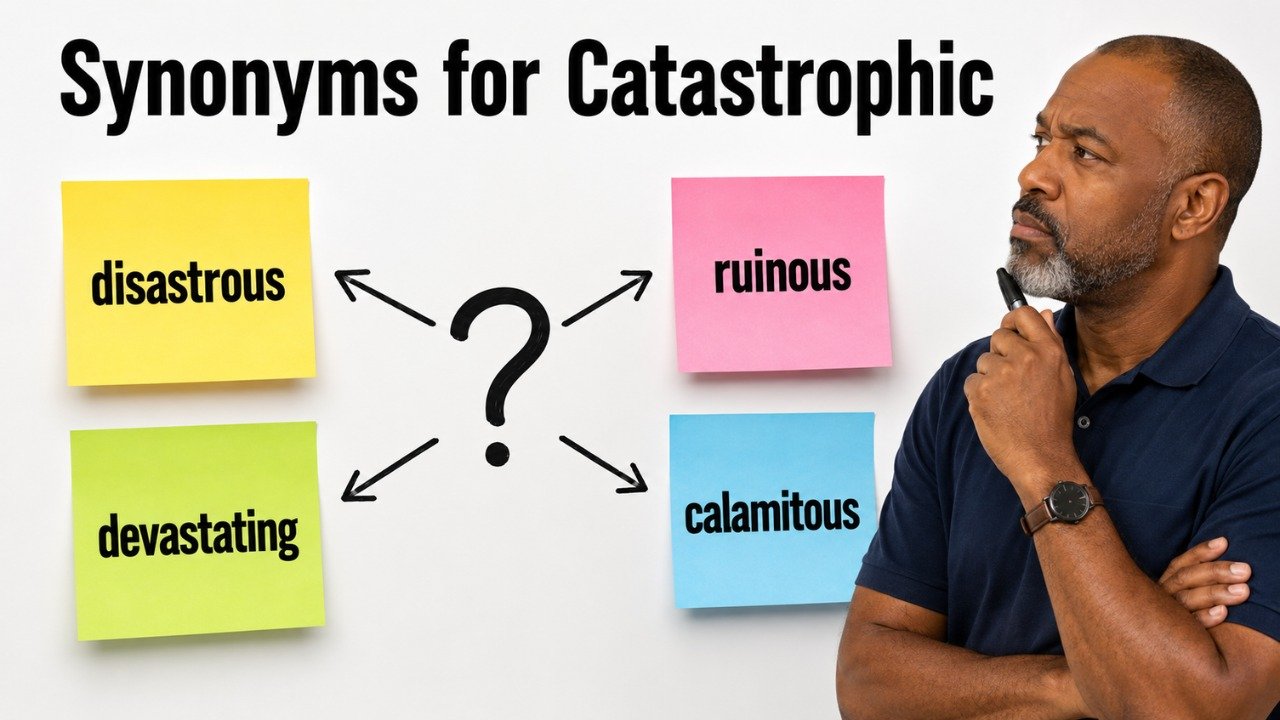
Quick Answer: Synonyms for catastrophic include disastrous, devastating, calamitous, cataclysmic, ruinous, destructive, tragic, dire, severe, and fatal. Use disastrous for a major failure or harmful event, devastating for intense damage or emotional pain, calamitous for formal descriptions of serious misfortune, and cataclysmic for sudden destruction on a massive scale. Ruinous emphasizes financial or structural destruction, while dire describes an extremely serious situation that requires urgent action.
Pronunciation and Word Details
Word: Catastrophic.
Pronunciation: /ˌkæt.əˈstrɑː.fɪk/
Part of Speech: Adjective.
Meaning: Causing or involving extremely serious damage, suffering, failure, or destruction.
US Pronunciation:
UK Pronunciation:
What Does “Catastrophic” Mean?
Catastrophic means causing extremely serious damage, destruction, suffering, or failure. It is an adjective used to describe events, consequences, mistakes, conditions, and losses that are far worse than ordinary problems.
The word is often connected with disasters such as earthquakes, floods, fires, accidents, wars, and system failures. It can also describe financial collapse, serious medical complications, environmental damage, or a decision that produces terrible results.
In a sentence, catastrophic usually appears before a noun.
Example: The region suffered catastrophic flooding.
It can also appear after a linking verb.
Example: The consequences of the failure were catastrophic.
The word communicates an extreme level of seriousness. A catastrophic problem is not merely inconvenient or disappointing. It causes widespread harm, permanent loss, complete failure, or consequences that are extremely difficult to repair.
Meaning, Tone, and Context of “Catastrophic”
Catastrophic has a strong, serious, and often emotional tone. It is more intense than words such as bad, harmful, serious, or unfortunate.
Formal Context: Catastrophic is common in reports, academic discussions, scientific writing, risk assessments, emergency planning, and professional analysis.
Technical Context: Engineers, doctors, researchers, environmental specialists, and safety experts may use catastrophic to describe the highest level of failure, damage, or risk.
Emotional Context: The word can express shock, fear, grief, or alarm when an event causes overwhelming suffering.
Conversational Context: People sometimes use catastrophic informally to exaggerate an ordinary mistake or disappointment. However, this use may sound dramatic when the situation is not genuinely severe.
Neutrality: Catastrophic is not a neutral adjective. It always communicates extreme seriousness and strongly negative consequences.
Common Uses: It frequently describes damage, failure, loss, injury, collapse, consequences, events, weather, accidents, and environmental change.
When and How to Use “Catastrophic”
For Major Disasters
Use catastrophic when a natural or human caused disaster produces widespread destruction, death, displacement, or long term harm.
Example: The coastal communities experienced catastrophic damage after the storm.
For Severe Consequences
Use catastrophic when an action, policy, or decision could produce extremely harmful results.
Example: Ignoring the safety warnings could have catastrophic consequences.
For Complete System Failure
Use catastrophic when machinery, technology, infrastructure, or an organization fails completely.
Example: A catastrophic engine failure forced the crew to make an emergency landing.
For Financial Destruction
Use catastrophic when financial losses threaten the survival of a person, business, institution, or economy.
Example: The sudden loss of funding had a catastrophic effect on the project.
For Environmental Harm
Use catastrophic when environmental damage is extensive, lasting, or difficult to reverse.
Example: The chemical spill caused catastrophic harm to the river ecosystem.
For Serious Health Outcomes
Use catastrophic when an injury, illness, or medical complication has extreme consequences.
Example: Delaying treatment could lead to catastrophic complications.
For Emotional Emphasis
Use catastrophic to emphasize that a situation caused overwhelming distress or irreversible loss.
Example: The loss of the historic archive was catastrophic for local researchers.
For Risk Assessment
Use catastrophic in formal analysis when describing the most serious possible outcome.
Example: The safety review identified several low probability but catastrophic risks.
Best Synonyms for Catastrophic
Disastrous
Synonym: Disastrous means causing great damage, failure, or suffering.
Example: The poorly planned operation produced disastrous results.
Devastating
Synonym: Devastating means causing severe destruction, shock, sadness, or loss.
Example: The wildfire had a devastating effect on the community.
Calamitous
Synonym: Calamitous means involving a major disaster or serious misfortune.
Example: The country struggled to recover from the calamitous conflict.
Cataclysmic
Synonym: Cataclysmic means causing sudden, violent, and extremely large scale destruction.
Example: Scientists examined evidence of a cataclysmic geological event.
Ruinous
Synonym: Ruinous means causing complete destruction or severe financial loss.
Example: The legal costs proved ruinous for the small organization.
Destructive
Synonym: Destructive means causing physical, social, emotional, or environmental damage.
Example: The destructive winds damaged hundreds of buildings.
Tragic
Synonym: Tragic means involving great suffering, loss, or death.
Example: The rescue mission ended in a tragic accident.
Dire
Synonym: Dire means extremely serious, urgent, or dangerous.
Example: The hospital faced a dire shortage of essential supplies.
Severe
Synonym: Severe means extremely serious, harsh, intense, or damaging.
Example: The region experienced severe water shortages.
Fatal
Synonym: Fatal means causing death, complete failure, or an unavoidable negative outcome.
Example: A fatal design flaw caused the structure to collapse.
50 Synonyms for Catastrophic with Short Meanings
- Disastrous: Causing great damage, suffering, or failure.
- Devastating: Producing severe destruction, shock, or emotional pain.
- Calamitous: Involving a major disaster or terrible misfortune.
- Cataclysmic: Causing sudden and enormous destruction or change.
- Ruinous: Leading to complete destruction or serious financial loss.
- Destructive: Causing significant physical, emotional, or social damage.
- Tragic: Involving profound suffering, loss, or death.
- Dire: Extremely serious, dangerous, or urgent.
- Severe: Very intense, harsh, or damaging.
- Fatal: Causing death or complete failure.
- Disastrous: Producing an extremely unsuccessful or damaging result.
- Horrific: Shockingly terrible, frightening, or painful.
- Terrible: Extremely bad, harmful, or unpleasant.
- Dreadful: Causing great fear, concern, or suffering.
- Appalling: Shockingly bad or deeply disturbing.
- Grievous: Causing serious pain, injury, or sorrow.
- Deadly: Likely to cause death or extreme harm.
- Lethal: Capable of causing death or total destruction.
- Crippling: Severely limiting normal movement, activity, or progress.
- Overwhelming: Too powerful or extensive to manage easily.
- Shattering: Causing complete destruction or intense emotional distress.
- Ravaging: Causing widespread and violent damage.
- Disastrous: Bringing extensive loss and serious negative consequences.
- Fateful: Having serious and often unfortunate consequences.
- Momentous: Extremely important and capable of creating major change.
- Disruptive: Interrupting normal systems, activities, or progress.
- Damaging: Causing harm, loss, or reduced effectiveness.
- Harmful: Producing injury, loss, or negative effects.
- Critical: Extremely serious and requiring immediate attention.
- Grave: Very serious, worrying, or dangerous.
- Extreme: Reaching an unusually high degree of severity.
- Acute: Highly serious, intense, or urgent.
- Alarming: Causing strong fear or concern.
- Perilous: Full of serious danger or risk.
- Hazardous: Likely to cause damage, injury, or danger.
- Doomed: Certain or highly likely to end in failure or destruction.
- Irreparable: Impossible to repair or restore completely.
- Irreversible: Impossible to change back to the previous condition.
- Irremediable: Impossible to correct, cure, or improve.
- Terminal: Leading toward an unavoidable ending or complete failure.
- Annihilating: Destroying something completely.
- Obliterating: Removing or destroying every visible trace.
- Decimating: Destroying or severely reducing a large part of something.
- Wrecking: Ruining the structure, condition, or success of something.
- Crushing: Causing severe defeat, pressure, or emotional pain.
- Overpowering: Too strong or intense to resist successfully.
- Earth shattering: Causing enormous change, shock, or destruction.
- World changing: Producing consequences that transform society or life.
- Far reaching: Affecting many people, places, or future events.
- Consequential: Producing important and serious results.
Read Also:
Synonyms for Spicy

Synonyms for Catastrophic by Context
When Catastrophic Means Causing a Disaster
Disastrous, calamitous, cataclysmic, devastating, and tragic are strong choices when discussing major disasters.
Disastrous is broad and natural. Calamitous sounds more formal and literary. Cataclysmic suggests sudden destruction on an enormous scale.
Example: The earthquake had a cataclysmic effect on the entire region.
When Catastrophic Means Extremely Damaging
Devastating, destructive, ruinous, ravaging, and crippling describe severe damage.
Devastating can refer to physical destruction or emotional pain. Ruinous is especially useful for financial damage. Crippling describes harm that prevents normal activity or recovery.
Example: The prolonged shutdown caused crippling losses for local businesses.
When Catastrophic Means Complete Failure
Fatal, terminal, disastrous, doomed, and critical can describe a failure that ends a process, plan, or system.
Fatal often identifies the single problem that causes complete failure. Terminal suggests that recovery is no longer possible.
Example: A fatal calculation error caused the mission to fail.
When Catastrophic Means Extremely Serious
Dire, grave, critical, severe, acute, and alarming work well for urgent situations.
Dire emphasizes urgent need or danger. Grave sounds formal and serious. Critical suggests that immediate action is necessary.
Example: The community is facing a dire shortage of clean drinking water.
When Catastrophic Means Impossible to Repair
Irreparable, irreversible, irremediable, ruinous, and obliterating describe permanent or nearly permanent harm.
Irreparable focuses on damage that cannot be fixed. Irreversible describes a change that cannot be undone.
Example: The fire caused irreparable damage to the historical records.
When Catastrophic Means Emotionally Painful
Devastating, shattering, crushing, tragic, and grievous describe extreme emotional suffering.
Devastating is the most versatile choice. Shattering suggests that a person feels emotionally broken. Crushing emphasizes heavy disappointment or grief.
Example: The unexpected news was devastating for the entire family.
When Catastrophic Means Dangerous
Deadly, lethal, perilous, hazardous, dire, and alarming describe conditions that threaten life or safety.
Deadly and lethal focus on the possibility of death. Perilous emphasizes serious danger, while hazardous is common in safety and technical writing.
Example: The rescue team entered extremely hazardous conditions.
When Catastrophic Means Broad in Its Effects
Far reaching, world changing, momentous, overwhelming, and consequential describe events with extensive effects.
These terms do not always mean destructive. They may describe the scale or importance of an event without automatically judging it as negative.
Example: The failure had far reaching consequences for the entire industry.
Another Word for Catastrophic
The best single replacement for catastrophic is often devastating because it communicates severe physical damage, emotional pain, or harmful consequences. However, the strongest alternative depends on the context.
Use disastrous for failed plans, ruinous for financial destruction, cataclysmic for massive sudden events, and dire for urgent conditions.
Original: The storm caused catastrophic damage across the island.
Better Option: The storm caused devastating damage across the island.
Original: The investment decision had catastrophic financial consequences.
Better Option: The investment decision had ruinous financial consequences.
Original: The region experienced a catastrophic geological event.
Better Option: The region experienced a cataclysmic geological event.
Original: The organization is in a catastrophic financial situation.
Better Option: The organization is in a dire financial situation.
When Not to Use “Catastrophic”
Do not use catastrophic when the problem is minor, temporary, easily repaired, or only mildly disappointing. The word may sound exaggerated and reduce the credibility of your writing.
Weak: Forgetting one item at the store was catastrophic.
Better: Forgetting one item at the store was inconvenient.
Avoid catastrophic when a more precise word can explain the actual type of harm.
Weak: The company experienced a catastrophic quarter.
Better: The company experienced severe financial losses during the quarter.
Do not repeat catastrophic several times in the same paragraph. Repetition can make serious writing sound dramatic rather than informative.
Weak: The catastrophic flood caused catastrophic damage and catastrophic losses.
Better: The catastrophic flood caused devastating damage and extensive financial losses.
Avoid using catastrophic for positive transformations. Words such as momentous, historic, revolutionary, or transformative may be more accurate.
Weak: The scientific discovery had a catastrophic influence on medicine.
Better: The scientific discovery had a transformative influence on medicine.
Do not use catastrophic when describing a risk that is serious but not extreme.
Weak: A delayed response could create a catastrophic inconvenience.
Better: A delayed response could create a significant inconvenience.
Words Commonly Confused With Catastrophic
Catastrophic vs Disastrous: Catastrophic usually suggests extreme, widespread, or irreversible damage. Disastrous describes very bad results but does not always imply complete destruction.
Catastrophic vs Devastating: Catastrophic focuses on the scale and seriousness of damage. Devastating can describe both physical destruction and intense emotional pain.
Catastrophic vs Cataclysmic: Catastrophic is a broad term for extreme harm. Cataclysmic usually suggests sudden, violent, and large scale change or destruction.
Catastrophic vs Calamitous: Both describe serious disaster. Calamitous is more formal and often appears in literary, historical, or analytical writing.
Catastrophic vs Tragic: Catastrophic emphasizes damage and consequences. Tragic emphasizes suffering, loss, death, or deep sadness.
Catastrophic vs Fatal: Catastrophic describes extremely severe harm. Fatal specifically refers to death or a flaw that causes complete failure.
Catastrophic vs Critical: Catastrophic describes an extremely harmful result. Critical describes a situation that is extremely serious and may require immediate action.
Catastrophic vs Ruinous: Catastrophic can describe many kinds of destruction. Ruinous is especially appropriate for financial loss, personal downfall, or complete structural damage.
Catastrophic vs Severe: Severe means very serious or intense. Catastrophic is stronger and usually suggests overwhelming or irreversible consequences.
Catastrophic vs Destructive: Destructive means causing damage. Catastrophic suggests that the amount of damage is extreme.
Which Synonym Should You Choose?
Choose disastrous when describing a plan, decision, event, or performance that produces extremely bad results.
Choose devastating when discussing severe physical destruction, emotional pain, shocking news, or community loss.
Choose calamitous in formal, historical, academic, or literary writing about major misfortune.
Choose cataclysmic when an event causes sudden destruction or transformation on an enormous scale.
Choose ruinous when financial costs, debts, legal expenses, or economic losses cause destruction.
Choose destructive when you want a direct and neutral description of something that causes damage.
Choose tragic when suffering, death, grief, or human loss is the main focus.
Choose dire when a situation is urgent, dangerous, or desperately serious.
Choose severe when the situation is serious but may not reach the extreme level suggested by catastrophic.
Choose fatal when a condition causes death or when a mistake guarantees complete failure.
Choose critical in reports, safety reviews, medical discussions, and professional writing when immediate attention is necessary.
Choose irreparable when the most important point is that the damage cannot be fixed.
Choose irreversible when a process or change cannot be undone.
Choose crippling when the harm prevents a person, system, or organization from functioning normally.
Choose terrible or dreadful in casual conversation when a less formal word sounds more natural.
Real Life Examples of “Catastrophic” in Sentences
Original: The bridge suffered catastrophic damage during the earthquake.
Better Option: The bridge suffered devastating damage during the earthquake.
Original: Losing the main contract would be catastrophic for the business.
Better Option: Losing the main contract would be ruinous for the business.
Original: The doctors acted quickly to prevent catastrophic complications.
Better Option: The doctors acted quickly to prevent life threatening complications.
Original: A catastrophic software failure interrupted every service.
Better Option: A critical software failure interrupted every service.
Original: The region is facing a catastrophic shortage of food.
Better Option: The region is facing a dire shortage of food.
Original: The explosion created catastrophic destruction across the facility.
Better Option: The explosion created widespread destruction across the facility.
Original: The policy could have catastrophic environmental consequences.
Better Option: The policy could have devastating environmental consequences.
Original: The team made a catastrophic error during the final stage.
Better Option: The team made a fatal error during the final stage.
Original: The discovery revealed evidence of a catastrophic ancient event.
Better Option: The discovery revealed evidence of a cataclysmic ancient event.
Original: The sudden closure was catastrophic for the surrounding community.
Better Option: The sudden closure had a crippling effect on the surrounding community.
Synonym Groups and Usage Differences
Disaster Group
Disastrous, calamitous, cataclysmic, and tragic describe events connected with serious misfortune or destruction.
Disastrous is the most general. Calamitous is formal. Cataclysmic suggests enormous scale. Tragic focuses on human suffering.
Example: The invasion had calamitous consequences for the population.
Destruction Group
Devastating, destructive, ravaging, annihilating, obliterating, and wrecking focus on physical or structural damage.
Devastating is powerful and versatile. Annihilating and obliterating suggest nearly complete destruction.
Example: The ravaging fire destroyed homes, farms, and wildlife habitats.
Financial Harm Group
Ruinous, crippling, damaging, and disastrous describe serious economic consequences.
Ruinous suggests that the financial burden may cause complete collapse. Crippling means that normal operation becomes extremely difficult.
Example: The unexpected expenses placed a crippling burden on the organization.
Danger Group
Deadly, lethal, perilous, hazardous, and dire emphasize threats to life, safety, or survival.
Deadly and lethal are strongest when death is possible. Hazardous is common in safety instructions and technical reports.
Example: Workers were removed from the hazardous area immediately.
Seriousness Group
Grave, critical, severe, acute, alarming, and extreme describe the level of a problem.
Grave sounds formal. Critical suggests urgency. Acute often describes an intense condition that develops quickly.
Example: Officials described the water shortage as a grave public concern.
Permanent Damage Group
Irreparable, irreversible, irremediable, terminal, and fatal describe damage or failure that cannot be corrected.
Irreparable applies to damage. Irreversible applies to change. Fatal applies to death or complete failure.
Example: Years of neglect caused irreversible damage to the wetland.
Emotional Impact Group
Devastating, crushing, shattering, tragic, and grievous describe deep emotional pain.
Shattering suggests sudden emotional collapse. Crushing often describes disappointment, defeat, or grief.
Example: The cancellation was a crushing disappointment for the athletes.
Scale and Influence Group
Far reaching, overwhelming, consequential, momentous, world changing, and earth shattering describe broad effects.
These words emphasize importance or scale, but they are not always negative. The surrounding sentence must make the harmful meaning clear.
Example: The economic collapse had far reaching effects on public services.
Antonyms of Catastrophic
The opposite of catastrophic depends on whether the word refers to damage, danger, consequences, or failure.
Beneficial: Producing a helpful or positive result.
Favorable: Supporting success or creating a good outcome.
Successful: Achieving the intended result without serious failure.
Harmless: Causing no injury, loss, or damage.
Safe: Free from serious danger or unacceptable risk.
Minor: Small in importance, seriousness, or effect.
Manageable: Possible to control, handle, or correct.
Repairable: Capable of being fixed or restored.
Reversible: Able to return to an earlier condition.
Constructive: Helping to improve, develop, or solve something.
Fortunate: Involving good luck or a positive outcome.
Promising: Showing signs of future success or improvement.
Stable: Firm, controlled, and unlikely to collapse suddenly.
Successful: Ending with a desired or satisfactory result.
Protective: Preventing harm, damage, or danger.
Comparison: Catastrophic vs Related Words
Catastrophic vs Disastrous
Catastrophic is stronger than disastrous. It usually suggests extreme, widespread, or irreversible harm. Disastrous can describe a very poor result without suggesting total destruction.
Example With Catastrophic: The dam collapse caused catastrophic flooding throughout the valley.
Example With Disastrous: The product launch was disastrous because customers could not access the service.
Catastrophic vs Devastating
Catastrophic emphasizes the scale of the damage. Devastating emphasizes the powerful effect of that damage on people, places, emotions, or systems.
Example With Catastrophic: The reactor experienced a catastrophic failure.
Example With Devastating: The loss of the family home was emotionally devastating.
Catastrophic vs Cataclysmic
Catastrophic is suitable for many kinds of extreme damage. Cataclysmic usually refers to a sudden event that causes enormous destruction or fundamental change.
Example With Catastrophic: The company faced catastrophic financial losses.
Example With Cataclysmic: The impact caused a cataclysmic change in the planet’s climate.
Catastrophic vs Calamitous
Both words describe extreme misfortune. Catastrophic is common in modern professional and technical writing. Calamitous sounds more formal, historical, or literary.
Example With Catastrophic: The investigation revealed a catastrophic safety failure.
Example With Calamitous: The kingdom never fully recovered from the calamitous war.
Catastrophic vs Ruinous
Catastrophic has a broad meaning that covers many types of destruction. Ruinous usually focuses on financial collapse, personal downfall, or damage that leaves something in ruins.
Example With Catastrophic: The accident caused catastrophic damage to the transport network.
Example With Ruinous: The continuing legal dispute became ruinous for both parties.
Catastrophic vs Fatal
Catastrophic describes extreme harm but does not always involve death or complete failure. Fatal means causing death or guaranteeing that something will fail.
Example With Catastrophic: The fire caused catastrophic damage to the building.
Example With Fatal: Investigators discovered a fatal weakness in the support structure.
Catastrophic vs Critical
Catastrophic describes the worst outcome. Critical describes a serious stage in which the outcome may still be changed through immediate action.
Example With Catastrophic: A complete cooling system failure would be catastrophic.
Example With Critical: Engineers entered a critical stage of the repair process.
Catastrophic vs Severe
Severe means very serious, intense, or harsh. Catastrophic represents a higher degree of damage and often suggests widespread or permanent consequences.
Example With Catastrophic: The explosion caused catastrophic structural damage.
Example With Severe: The storm caused severe travel delays.
Common Phrases and Expressions With Catastrophic
Catastrophic Failure: A complete breakdown that causes extreme damage or prevents further operation.
Catastrophic Damage: Destruction so serious that repair may be extremely difficult or impossible.
Catastrophic Consequences: Results that cause overwhelming harm, loss, or suffering.
Catastrophic Event: A disaster or incident with extremely serious effects.
Catastrophic Loss: A loss that destroys essential resources, property, income, or stability.
Catastrophic Injury: An injury that causes permanent disability, major impairment, or lasting medical needs.
Catastrophic Risk: A danger that has a low or uncertain probability but could produce extreme harm.
Catastrophic Collapse: A sudden and complete structural, financial, political, or organizational breakdown.
Catastrophic Error: A mistake that causes complete failure or severe consequences.
Catastrophic Climate Change: Extreme environmental change with widespread and potentially irreversible effects.
Common Mistakes to Avoid
Using Catastrophic for Minor Problems
Catastrophic should describe extreme harm. Using it for small mistakes or ordinary disappointments can sound exaggerated.
Incorrect: The small spelling mistake was catastrophic.
Better: The small spelling mistake was embarrassing.
Repeating the Word Too Often
Using catastrophic several times in one passage weakens its impact.
Repetitive: The catastrophic accident caused catastrophic losses and catastrophic disruption.
Improved: The catastrophic accident caused devastating losses and widespread disruption.
Choosing an Inaccurate Synonym
Not every strong negative word has the same meaning. Fatal suggests death or complete failure, while tragic focuses on suffering and loss.
Incorrect: The company reported a tragic decline in monthly sales.
Better: The company reported a severe decline in monthly sales.
Confusing Catastrophic With Cataclysmic
Cataclysmic usually describes a sudden event of enormous scale. It may sound unnatural for a personal inconvenience or routine failure.
Unnatural: The meeting delay created a cataclysmic problem.
Better: The meeting delay created a serious problem.
Using Vague Nouns
Catastrophic becomes more informative when the noun clearly identifies the type of harm.
Vague: The situation was catastrophic.
Clearer: The supply failure had catastrophic consequences for emergency care.
Overusing Emotional Language in Reports
Professional writing should explain why an outcome is catastrophic rather than relying only on dramatic wording.
Weak: The results were absolutely catastrophic and unbelievably terrible.
Better: The failure stopped all operations and caused losses that could not be recovered.
Ignoring the Degree of Severity
Use severe, serious, or damaging when the situation is harmful but not completely destructive.
Exaggerated: The temporary power cut was catastrophic.
Better: The temporary power cut caused serious disruption.
Using Catastrophic for Positive Change
Catastrophic normally carries a negative meaning. Use transformative, revolutionary, momentous, or historic for major positive change.
Incorrect: The new treatment had a catastrophic effect on patient recovery.
Better: The new treatment had a transformative effect on patient recovery.
Conclusion
Synonyms for catastrophic help writers describe different kinds of extreme harm with greater precision. Disastrous suits major failures, devastating emphasizes destruction or emotional pain, and calamitous works well in formal descriptions of misfortune. Cataclysmic is best for sudden events on an enormous scale, while ruinous highlights financial destruction. Dire, severe, critical, tragic, and fatal express different levels or types of seriousness. Choose the alternative that accurately reflects the scale, cause, permanence, and human impact of the situation.
FAQs About Synonyms for Catastrophic
What Is the Best Synonym for Catastrophic?
Devastating is often the best general synonym because it can describe physical destruction, emotional pain, and serious consequences. Disastrous is another versatile choice.
Is Disastrous the Same as Catastrophic?
The words are similar, but catastrophic is usually stronger. It often suggests overwhelming, widespread, or irreversible damage, while disastrous can describe any extremely bad result.
What Is a Formal Synonym for Catastrophic?
Calamitous is a formal synonym for catastrophic. Dire, grave, ruinous, and cataclysmic are also suitable in formal writing, depending on the context.
What Is a Stronger Word Than Disastrous?
Catastrophic or cataclysmic may sound stronger than disastrous. Catastrophic emphasizes extreme damage, while cataclysmic suggests sudden destruction on a massive scale.
Can Devastating Replace Catastrophic?
Devastating can replace catastrophic when describing severe destruction, harmful effects, shocking news, or emotional pain. It may not be as precise when discussing technical system failure.
Is Catastrophic a Formal Word?
Catastrophic is common in formal, academic, scientific, medical, environmental, and technical writing. It is also used in conversation, although casual use can sometimes sound exaggerated.
What Is the Opposite of Catastrophic?
Possible opposites include beneficial, harmless, safe, manageable, successful, favorable, repairable, and constructive. The best antonym depends on the sentence.
What Synonym Should Be Used for Financial Damage?
Ruinous is one of the best choices for financial damage. Crippling, devastating, disastrous, and severe may also fit depending on the size and permanence of the loss.
