
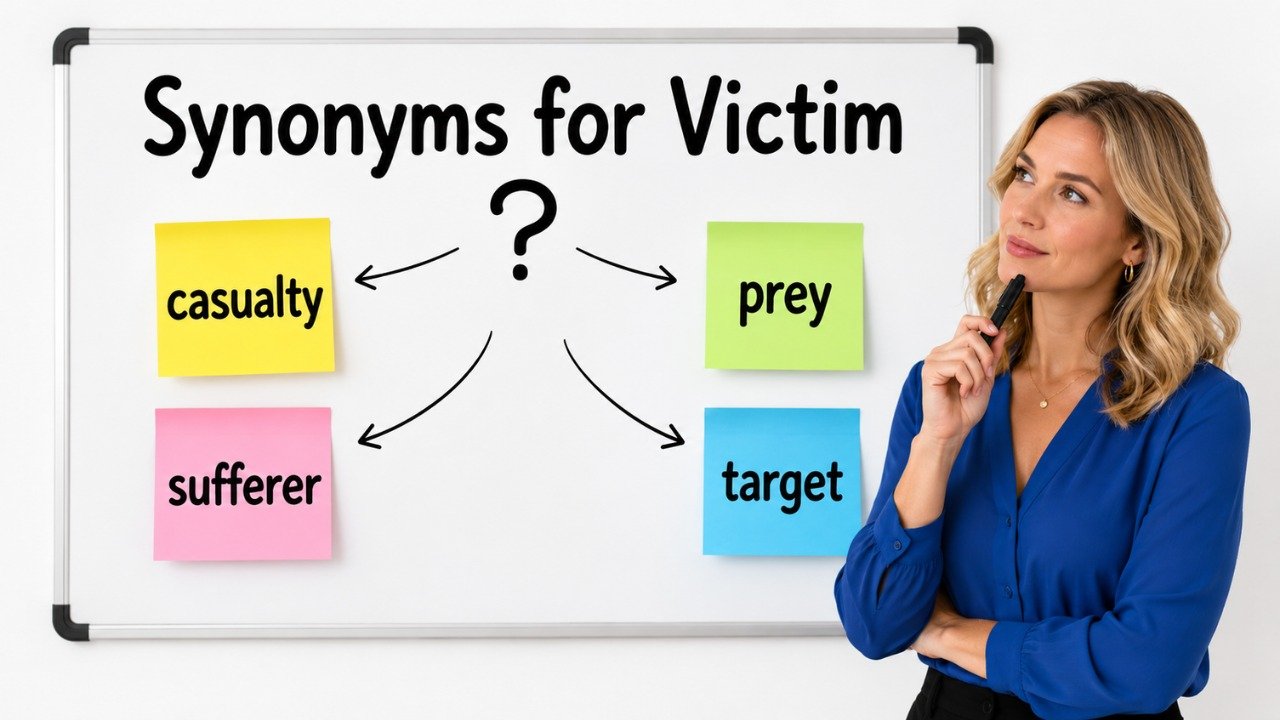
Quick Answer: Common synonyms for victim include sufferer, casualty, target, prey, injured party, harmed person, affected person, survivor, dupe, and scapegoat. The best choice depends on context. Use injured party in formal or legal writing, casualty for accidents, disasters, or conflict, target for deliberate attacks or harassment, prey for exploitation, dupe for deception, and sufferer when someone experiences pain, loss, or hardship.
Pronunciation and Word Details
Word: Victim.
Pronunciation: /ˈvɪktɪm/
Part of Speech: Noun.
Meaning: A person who is harmed, injured, deceived, attacked, or negatively affected by an event, action, crime, or circumstance.
US Pronunciation:
UK Pronunciation:
What Does “Victim” Mean?
A victim is a person who suffers harm, injury, loss, abuse, deception, or another negative effect because of someone, something, or an unfortunate event.
The word victim is mainly used as a noun. It may describe someone harmed by a crime, accident, disaster, illness, dishonest scheme, unfair treatment, or deliberate attack.
Crime Context: A person harmed by theft, violence, fraud, or another offense may be called a victim.
Accident Context: Someone injured or killed in an accident may be described as a victim or casualty.
Deception Context: A person tricked by a dishonest scheme may be a victim, dupe, or mark.
Abuse Context: Someone subjected to harmful or controlling behavior may be described as a victim, sufferer, or harmed person.
Disaster Context: People affected by floods, fires, earthquakes, or other emergencies may be called victims, casualties, or affected people.
The exact meaning depends on what caused the harm and what happened to the person.
Meaning, Tone, and Context of “Victim”
The word victim is generally neutral in grammar but can carry strong emotional meaning because it refers to suffering, loss, injury, or unfair treatment.
Tone: Serious, neutral, and often emotional.
Formality: Suitable for everyday conversation, journalism, formal writing, legal discussion, academic writing, and reports.
Emotional Use: Victim can emphasize that a person experienced harm or injustice.
Legal Use: In legal contexts, victim often refers to someone who has suffered harm because of an alleged or proven offense.
Medical Use: The word can describe someone harmed by injury, poisoning, disease, or another physical event, although more precise medical terms may sometimes be better.
Conversational Use: In ordinary speech, victim can describe anyone negatively affected by an event or another person.
Some alternatives are more precise. For example, casualty emphasizes injury or death, while target emphasizes that someone was deliberately selected for harmful action.
When and How to Use “Victim”
For Crime: Use victim when referring to someone harmed by criminal activity.
Example: The victim reported the stolen property immediately.
For Physical Harm: Use victim for someone injured or harmed in an accident or violent event.
Example: Emergency workers treated the victim at the scene.
For Fraud: Use victim when someone loses money or information through deception.
Example: She became a victim of an elaborate financial scam.
For Abuse: Use victim when describing someone who has experienced harmful, violent, or controlling treatment.
Example: The program provides assistance to victims of abuse.
For Disasters: Use victim for someone who suffers injury, death, displacement, or loss because of a disaster.
Example: Volunteers provided food to flood victims.
For Targeted Harm: Use victim when a person has been deliberately attacked, harassed, threatened, or exploited.
Example: He was the victim of repeated harassment.
Best Synonyms for Victim
Sufferer
Synonym: Sufferer means someone experiencing pain, illness, hardship, or distress.
Example: The treatment may provide relief for long term pain sufferers.
Casualty
Synonym: Casualty means a person injured or killed in an accident, disaster, or conflict.
Example: The rescue team reported several casualties after the explosion.
Target
Synonym: Target means a person deliberately selected for attack, criticism, harassment, or deception.
Example: The employee became the target of repeated intimidation.
Prey
Synonym: Prey means a person who is vulnerable to exploitation, attack, or manipulation.
Example: Dishonest operators often look for easy prey.
Injured Party
Synonym: Injured party means a person who has suffered harm, loss, or damage, especially in formal or legal contexts.
Example: The injured party requested compensation for the damage.
Harmed Person
Synonym: Harmed person means someone who has experienced physical, emotional, financial, or other damage.
Example: Support should focus on the needs of the harmed person.
Affected Person
Synonym: Affected person means someone who experiences the negative consequences of an event or action.
Example: Every affected person received temporary accommodation.
Survivor
Synonym: Survivor refers to someone who has lived through a dangerous, traumatic, or harmful experience.
Example: The survivor described how she escaped the fire.
Dupe
Synonym: Dupe means a person who has been tricked or deceived.
Example: He realized too late that he had been a dupe in the scheme.
Scapegoat
Synonym: Scapegoat means a person unfairly blamed for a problem caused by others.
Example: The manager became the scapegoat for the entire project failure.
50 Synonyms for Victim with Short Meanings
- Sufferer: A person experiencing pain, hardship, or distress.
- Casualty: Someone injured or killed in an accident, disaster, or conflict.
- Target: A person deliberately selected for attack or harmful attention.
- Prey: Someone vulnerable to attack, manipulation, or exploitation.
- Injured Party: A person who has suffered harm or loss.
- Harmed Person: Someone negatively affected by another person or event.
- Affected Person: Someone experiencing consequences from an event or action.
- Survivor: Someone who lives through a dangerous or harmful experience.
- Dupe: A person who has been tricked or deceived.
- Scapegoat: Someone unfairly blamed for the actions or failures of others.
- Casualty of Circumstance: Someone harmed because of unfortunate conditions.
- Injured Person: Someone who has suffered physical injury.
- Wounded Person: Someone physically injured, especially through violence or conflict.
- Afflicted Person: Someone suffering from pain, illness, or serious hardship.
- Aggrieved Person: Someone who believes they have been wronged or treated unfairly.
- Wronged Person: Someone who has suffered injustice or unfair treatment.
- Damaged Party: A person or party that has experienced damage or loss.
- Affected Party: A person or group influenced negatively by an action or event.
- Innocent Party: Someone harmed despite not being responsible for the problem.
- Complaining Party: A person formally raising a complaint about harm or wrongdoing.
- Claimant: A person seeking compensation or recognition for a loss or injury.
- Complainant: A person who formally reports alleged wrongdoing.
- Accuser: A person who states that another person committed a wrongful act against them.
- Recipient of Harm: Someone who receives the harmful effects of an action.
- Subject of Abuse: A person subjected to abusive behavior.
- Object of Abuse: Someone toward whom abusive treatment is directed.
- Object of Attack: A person deliberately attacked or criticized.
- Target of Abuse: Someone selected for harmful or abusive behavior.
- Target of Harassment: Someone subjected to repeated unwanted behavior.
- Target of Fraud: A person selected for financial or dishonest deception.
- Fraud Victim: Someone harmed through fraudulent activity.
- Scam Victim: Someone deceived by a dishonest scheme.
- Mark: A person selected as the intended target of a trick or scam.
- Patsy: A person easily manipulated, deceived, or blamed.
- Fall Guy: A person made to accept blame for the actions of others.
- Sacrificial Person: Someone deliberately placed at risk or made to suffer for others.
- Sacrifice: A person or living being offered or surrendered for a purpose.
- Offering: A person or thing presented as a sacrifice in historical or ritual contexts.
- Martyr: Someone who suffers or dies because of a belief, cause, or principle.
- Fatality: A person killed in an accident, disaster, or violent event.
- Deceased Person: A person who has died, sometimes used when discussing fatal incidents.
- Injured Casualty: A person injured during an emergency, accident, or conflict.
- Disaster Casualty: Someone injured or killed during a disaster.
- Disaster Sufferer: Someone who experiences loss or hardship because of a disaster.
- Abuse Sufferer: A person experiencing harmful or abusive treatment.
- Person Harmed: A neutral description for someone who has experienced harm.
- Person Affected: Someone whose life or circumstances have been negatively changed.
- Person Wronged: Someone treated unfairly or unlawfully.
- Person Exploited: Someone unfairly used for another person’s advantage.
- Person Deceived: Someone misled, tricked, or cheated.
Read Also:
Synonyms for Exploration

Synonyms for Victim by Context
When Victim Means Someone Who Suffers Harm
Useful alternatives include sufferer, harmed person, injured person, afflicted person, affected person, and person harmed.
Example: Several sufferers required medical care after the incident.
These alternatives work when the main idea is physical, emotional, financial, or personal harm.
When Victim Means Someone Injured in an Accident or Disaster
Useful synonyms include casualty, injured person, wounded person, disaster casualty, and fatality when death has occurred.
Example: Emergency officials confirmed that three casualties needed hospital treatment.
Casualty is often more precise when discussing accidents, emergencies, conflict, or disasters.
When Victim Means the Target of an Attack
Useful alternatives include target, object of attack, target of harassment, target of abuse, and prey.
Example: She became the target of repeated threatening messages.
Use target when the person was deliberately selected.
When Victim Means Someone Who Was Deceived
Useful alternatives include dupe, mark, patsy, scam victim, fraud victim, and person deceived.
Example: The fraudster treated inexperienced investors as easy marks.
Dupe and mark are less formal than victim of fraud.
When Victim Means Someone Treated Unfairly
Useful alternatives include aggrieved person, wronged person, injured party, innocent party, scapegoat, and person wronged.
Example: The wronged employee requested a formal investigation.
These choices emphasize unfairness rather than physical injury.
When Victim Means Someone Unfairly Blamed
Useful alternatives include scapegoat, fall guy, and patsy.
Example: He refused to become the scapegoat for decisions made by the entire team.
A scapegoat is specifically someone blamed unfairly rather than simply someone who experiences harm.
Another Word for Victim
A strong general replacement for victim is sufferer, but the best alternative always depends on the type of harm being described.
Use casualty for accidents and disasters, target for deliberate attacks, injured party for formal disputes, and dupe for deception.
Original: She was a victim of repeated harassment.
Better Option: She was the target of repeated harassment.
Original: The accident left several victims injured.
Better Option: The accident left several casualties injured.
Original: He became a victim of the dishonest scheme.
Better Option: He became a dupe of the dishonest scheme.
Original: The victim requested financial compensation.
Better Option: The injured party requested financial compensation.
When Not to Use “Victim”
The word victim is useful, but a more precise term may sometimes communicate the situation better.
Weak: Several victims were reported after the train accident.
Better: Several casualties were reported after the train accident.
Casualty is more specific when describing people injured or killed in an accident.
Weak: She was a victim of repeated insults at work.
Better: She was the target of repeated insults at work.
Target makes the deliberate nature of the behavior clearer.
Weak: He was a victim of a fake investment offer.
Better: He was deceived by a fake investment offer.
A direct description may be clearer when the act of deception is more important than the label applied to the person.
Weak: The company made him the victim of its financial mistakes.
Better: The company made him the scapegoat for its financial mistakes.
Scapegoat is more accurate when someone is unfairly blamed.
Avoid using victim automatically when another term communicates the exact type of harm more clearly.
Words Commonly Confused With Victim
Victim vs Survivor: Victim emphasizes the harm experienced. Survivor emphasizes living through, enduring, or moving beyond the harmful experience. A person may accurately be described by either term depending on context.
Victim vs Casualty: Victim is broad and can describe many forms of harm. Casualty usually refers to someone injured or killed in an accident, disaster, emergency, or conflict.
Victim vs Target: Victim describes someone who experiences harm. Target emphasizes that the person was deliberately selected for an attack, criticism, fraud, or harassment.
Victim vs Prey: Victim is neutral and widely applicable. Prey suggests vulnerability and exploitation by someone intentionally seeking advantage.
Victim vs Sufferer: Victim often implies an outside cause of harm. Sufferer focuses more directly on the pain, illness, difficulty, or hardship experienced.
Victim vs Scapegoat: A victim experiences harm, while a scapegoat is specifically blamed unfairly for a problem.
Victim vs Complainant: A victim is someone who has suffered harm. A complainant is someone who formally reports or alleges wrongdoing. The same person may be both, but the terms are not interchangeable.
Which Synonym Should You Choose?
Choose sufferer when emphasizing pain, illness, distress, or hardship.
Choose casualty when discussing accidents, disasters, emergencies, injuries, or conflict.
Choose target when someone was deliberately selected for attack, harassment, criticism, or fraud.
Choose prey when describing exploitation, manipulation, or vulnerability.
Choose injured party in formal, legal, contractual, or compensation related writing.
Choose affected person when you need neutral language for reports, policies, or general explanations.
Choose survivor when the focus is on living through or enduring a dangerous or traumatic event.
Choose dupe or mark in informal descriptions of someone deceived by a trick or scam.
Choose scapegoat when someone is unfairly blamed for a failure or problem.
Choose wronged person when emphasizing injustice or unfair treatment.
Real Life Examples of “Victim” in Sentences
Original: The victim suffered serious injuries in the accident.
Better Option: The casualty suffered serious injuries in the accident.
Original: She became a victim of repeated online harassment.
Better Option: She became the target of repeated harassment.
Original: The victim lost money in the fraudulent scheme.
Better Option: The person deceived by the fraudulent scheme lost money.
Original: Emergency teams assisted the victims of the flood.
Better Option: Emergency teams assisted people affected by the flood.
Original: The victim demanded compensation for the damage.
Better Option: The injured party demanded compensation for the damage.
Original: He became the victim of his coworkers’ blame.
Better Option: He became the scapegoat for his coworkers’ mistakes.
Original: The victim had suffered from the condition for years.
Better Option: The sufferer had experienced the condition for years.
Original: Older customers were often victims of the dishonest sales tactic.
Better Option: Older customers were often targets of the dishonest sales tactic.
Original: The victim survived the dangerous incident.
Better Option: The survivor lived through the dangerous incident.
Original: He was an easy victim for experienced scammers.
Better Option: He was an easy mark for experienced scammers.
Synonym Groups and Usage Differences
Harm and Suffering Group
This group includes sufferer, harmed person, afflicted person, injured person, and person affected.
These terms focus on the negative experience or consequences.
Example: The sufferer needed both medical care and emotional support.
Accident and Disaster Group
This group includes casualty, injured casualty, disaster casualty, fatality, and injured person.
These words are useful when harm results from accidents, emergencies, disasters, or conflict.
Example: The emergency service confirmed one casualty after the crash.
Attack and Harassment Group
This group includes target, prey, object of attack, target of harassment, and target of abuse.
These terms emphasize deliberate harmful attention.
Example: The journalist became the target of repeated threats.
Deception Group
This group includes dupe, mark, patsy, fraud victim, scam victim, and person deceived.
These words describe someone misled or exploited through dishonesty.
Example: The caller searched for an easy mark to deceive.
Unfair Blame Group
This group includes scapegoat, fall guy, patsy, wronged person, and innocent party.
These words are helpful when someone suffers because blame is unfairly directed toward them.
Example: The junior employee became the scapegoat for management’s mistakes.
Formal and Legal Group
This group includes injured party, aggrieved person, claimant, complainant, affected party, and damaged party.
These expressions are more suitable when describing disputes, complaints, compensation, or formal proceedings.
Example: The injured party submitted a claim for compensation.
Antonyms of Victim
There is no single antonym that works in every context because victim can describe many kinds of harm. The opposite depends on the situation.
Perpetrator: A person who carries out a harmful or wrongful act.
Offender: Someone who commits an offense or wrongdoing.
Attacker: A person who physically or verbally attacks someone.
Aggressor: Someone who initiates hostile or harmful action.
Abuser: A person who mistreats or harms another person.
Exploiter: Someone who unfairly uses another person for advantage.
Deceiver: Someone who deliberately misleads another person.
Fraudster: A person who uses deception for dishonest gain.
Wrongdoer: Someone responsible for an improper or harmful action.
Beneficiary: A person who receives an advantage or benefit rather than suffering the loss in a particular situation.
Comparison: Victim vs Related Words
Victim vs Sufferer
Victim emphasizes harm caused by an event, action, crime, or circumstance. Sufferer emphasizes the experience of pain or hardship.
Example With Victim: She was a victim of identity theft.
Example With Sufferer: He is a long term sufferer from severe headaches.
Victim vs Casualty
Victim is broad. Casualty usually relates to injury or death resulting from an accident, disaster, conflict, or emergency.
Example With Victim: The victim lost money through fraud.
Example With Casualty: The accident resulted in one casualty.
Victim vs Target
Victim emphasizes that harm occurred. Target emphasizes that someone was deliberately selected.
Example With Victim: She was a victim of harassment.
Example With Target: She became the target of repeated harassment.
Victim vs Prey
Victim is more neutral. Prey often suggests that someone intentionally exploited another person’s weakness or vulnerability.
Example With Victim: He became a victim of the scheme.
Example With Prey: Vulnerable customers became easy prey for dishonest sellers.
Victim vs Survivor
Victim focuses on harm that was experienced. Survivor focuses on endurance, continued life, or recovery after a harmful event.
Example With Victim: The victim received emergency assistance.
Example With Survivor: The survivor later described the experience.
Victim vs Scapegoat
Victim refers broadly to someone harmed. Scapegoat specifically refers to someone unfairly blamed.
Example With Victim: He was a victim of unfair treatment.
Example With Scapegoat: He became the scapegoat for the team’s failure.
Common Phrases and Expressions With Victim
Crime Victim: A person harmed by criminal activity.
Accident Victim: Someone injured or killed in an accident.
Fraud Victim: Someone who suffers financial or personal loss through fraud.
Scam Victim: A person deceived by a dishonest scheme.
Abuse Victim: Someone subjected to harmful or abusive treatment.
Victim of Circumstance: A person harmed because of events or conditions beyond their control.
Victim of Violence: Someone physically or psychologically harmed through violence.
Victim of Harassment: A person subjected to repeated unwanted or intimidating behavior.
Victim of Identity Theft: Someone whose personal information is unlawfully used by another person.
Innocent Victim: A person who suffers harm despite having no responsibility for the situation.
Common Mistakes to Avoid
One common mistake is treating every synonym for victim as interchangeable. The correct choice depends on how the person was harmed.
Repetition: Avoid repeating victim several times in the same paragraph when a more precise alternative is available.
Wrong Synonym Choice: Do not use casualty for every victim. Casualty is mainly associated with injury or death during accidents, disasters, emergencies, or conflict.
Confusing Victim and Survivor: These words emphasize different aspects of an experience. Victim emphasizes harm, while survivor emphasizes endurance or living through the event.
Using Scapegoat Too Broadly: A scapegoat is not simply anyone who suffers. The person must be unfairly blamed for something.
Using Target Without Intention: Target normally suggests deliberate selection. It may be inaccurate when harm occurred randomly.
Using Prey in Formal Writing: Prey can sound vivid or figurative. In formal writing, affected person, injured party, or victim may be more appropriate.
Vague Usage: When possible, explain the type of harm instead of relying only on the word victim.
Less Clear: He became a victim.
Better: He became a victim of financial fraud.
More specific language gives readers immediate context and makes sentences clearer.
Conclusion
The best synonyms for victim depend on the kind of harm being described. Sufferer works well for pain or hardship, casualty for accidents and disasters, target for deliberate attacks, prey for exploitation, and injured party for formal situations. Dupe fits deception, while scapegoat describes someone unfairly blamed. Choosing a precise alternative makes writing clearer because it shows whether the person experienced injury, fraud, abuse, unfair treatment, deliberate targeting, or another form of harm.
FAQs About Synonyms for Victim
What Is the Best Synonym for Victim?
The best general synonym is sufferer, although casualty, target, injured party, or affected person may be more precise depending on the context.
What Is Another Word for a Victim of a Crime?
Injured party, harmed person, crime victim, and aggrieved person may work. The most suitable choice depends on whether the writing is general, formal, or legal.
What Is Another Word for Someone Who Is Targeted?
Target is the clearest alternative. Prey may also work when the person is deliberately selected for manipulation or exploitation.
What Is Another Word for a Victim of Fraud?
Useful choices include dupe, mark, fraud victim, scam victim, and person deceived. Dupe and mark are more informal.
Is Survivor a Synonym for Victim?
It can be a related alternative in some contexts, but the meanings are not identical. Victim emphasizes harm, while survivor emphasizes living through or enduring the experience.
What Is the Difference Between Victim and Casualty?
A victim can experience any form of harm. A casualty usually refers to someone injured or killed in an accident, disaster, emergency, or conflict.
What Is a Formal Synonym for Victim?
Injured party, aggrieved person, affected party, and harmed person can be useful formal alternatives. The most accurate choice depends on the type of harm and the purpose of the writing.
