
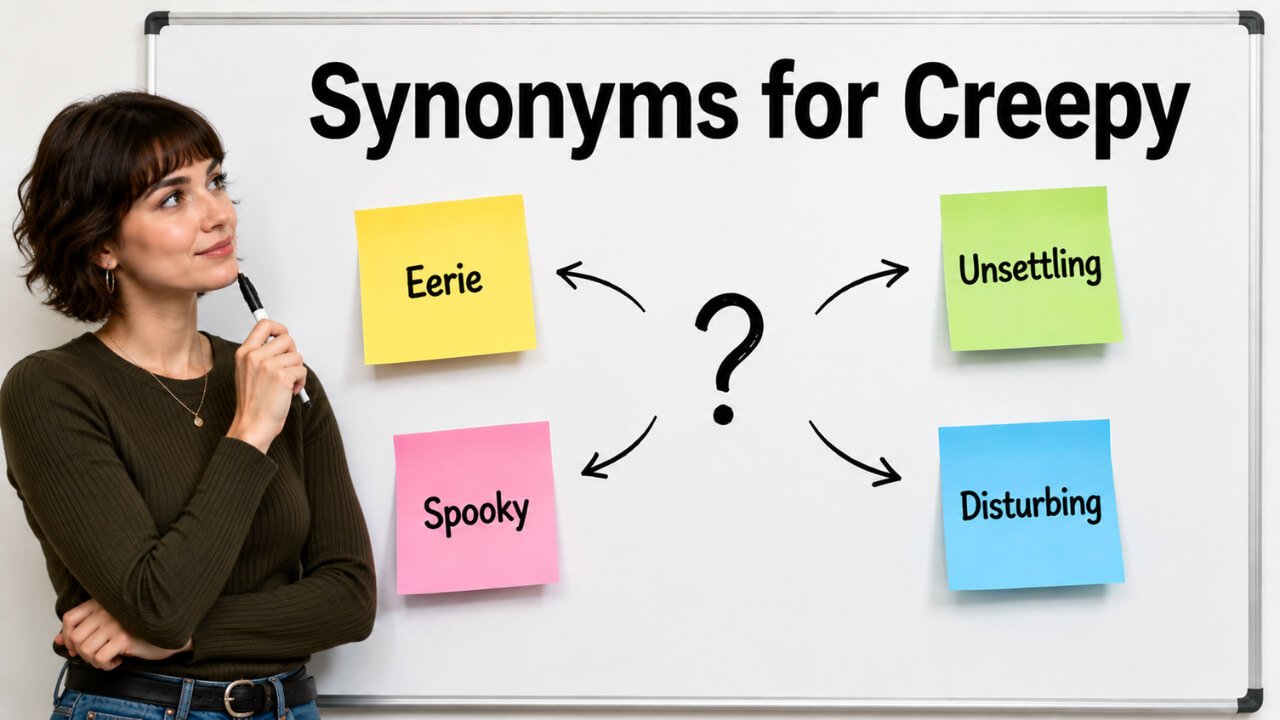
Quick Answer: The best synonyms for creepy include eerie, unsettling, spooky, disturbing, sinister, unnerving, chilling, ominous, frightening, and uncanny. Use eerie for a strange atmosphere, unsettling for something that causes discomfort, and spooky for casual descriptions of places, sounds, or stories. Disturbing is stronger and suits troubling behavior or images, while sinister suggests harmful intent. Unnerving describes something that weakens confidence, and uncanny works when something feels strangely familiar or unnatural. The best choice among synonyms for creepy depends on whether you are describing fear, discomfort, suspicious behavior, a dark setting, or an unusual appearance.
Pronunciation and Word Details
Word: Creepy
Pronunciation: /ˈkriːpi/
Part of Speech: Adjective
Meaning: Causing fear, discomfort, or uneasiness because something seems strange, threatening, or unnatural.
US Pronunciation:
UK Pronunciation:
What Does “Creepy” Mean?
Creepy means making someone feel afraid, uncomfortable, or uneasy because something seems strange, unnatural, suspicious, or threatening.
Creepy is an adjective. It can describe people, behavior, places, sounds, stories, objects, expressions, and situations.
Example: The empty house looked creepy after dark.
When creepy describes a person or behavior, it usually suggests that the person acts in an intrusive, suspicious, or inappropriate way.
Example: His habit of watching people silently felt creepy.
The word can also describe an atmosphere that creates nervousness without presenting an obvious danger.
Example: A creepy silence filled the hallway.
Creepy is sometimes used casually for fictional stories, decorations, or unusual objects. In more serious contexts, it can express genuine concern about someone’s actions or intentions.
Meaning, Tone, and Context of “Creepy”
Creepy is informal, emotional, and strongly negative. It is common in everyday conversation, personal descriptions, storytelling, reviews, and casual writing.
The word usually communicates fear mixed with discomfort. Something creepy may not be openly dangerous, but it creates a feeling that something is wrong.
In casual conversation, creepy can describe a dark room, an unexplained sound, an unusual doll, or a strange message.
Example: That scratching sound was really creepy.
When used for a person, creepy can sound insulting or accusatory. It often suggests inappropriate attention, invasion of privacy, suspicious behavior, or unwanted closeness.
Example: She found his repeated personal questions creepy.
In formal reports, professional communication, or academic writing, words such as disturbing, inappropriate, threatening, suspicious, or unsettling are often clearer than creepy.
When and How to Use “Creepy”
For Strange Atmospheres: Use creepy when a place or situation feels dark, silent, unfamiliar, or uncomfortable.
Example: The abandoned station had a creepy atmosphere.
For Unexplained Sounds: Use creepy for noises that create fear because their cause is unknown.
Example: A creepy whisper came from the empty room.
For Uncomfortable Behavior: Use creepy when someone acts in an intrusive, inappropriate, or suspicious way.
Example: His repeated attempts to follow her were creepy.
For Frightening Appearances: Use creepy when an object, image, or person looks strange and slightly frightening.
Example: The statue had a creepy expression.
For Stories and Entertainment: Use creepy for scenes or stories that create tension without being extremely violent.
Example: The story became creepier as the characters entered the forest.
For Unnatural Situations: Use creepy when something appears normal at first but contains an unusual or disturbing detail.
Example: The empty playground music sounded creepy at midnight.
For Mild Fear: Use creepy when something causes uneasiness rather than immediate terror.
Example: The moving shadow was creepy, but it turned out to be a curtain.
Best Synonyms for Creepy
Eerie
Synonym: Strange and frightening in a mysterious way.
Example: An eerie light appeared above the field.
Unsettling
Synonym: Causing worry, discomfort, or nervousness.
Example: His unexplained disappearance was deeply unsettling.
Spooky
Synonym: Slightly frightening, especially in a mysterious or supernatural way.
Example: The old hotel looked spooky at night.
Disturbing
Synonym: Causing serious worry, discomfort, or emotional concern.
Example: The report revealed a disturbing pattern of behavior.
Sinister
Synonym: Suggesting danger, evil, or harmful intentions.
Example: The stranger gave them a sinister smile.
Unnerving
Synonym: Making someone lose confidence or feel anxious.
Example: The complete silence was unnerving.
Chilling
Synonym: Causing sudden fear or a strong feeling of alarm.
Example: The witness gave a chilling description of the event.
Ominous
Synonym: Suggesting that something bad may happen.
Example: Dark clouds created an ominous mood.
Frightening
Synonym: Causing fear or alarm.
Example: The loud crash was frightening.
Uncanny
Synonym: Strange or mysterious in a way that feels unnatural.
Example: The portrait had an uncanny resemblance to her grandmother.
50 Synonyms for Creepy with Short Meanings
- Eerie: Strange and frightening in a mysterious way.
- Unsettling: Causing discomfort, worry, or nervousness.
- Spooky: Slightly frightening or connected with mysterious events.
- Disturbing: Causing serious discomfort or concern.
- Sinister: Suggesting danger, evil, or harmful intent.
- Unnerving: Making someone feel anxious or less confident.
- Chilling: Producing a sudden feeling of fear.
- Ominous: Suggesting that something bad may happen.
- Frightening: Causing fear or alarm.
- Uncanny: Strangely unfamiliar or unnatural.
- Scary: Causing fear in a direct or general way.
- Haunting: Remaining in the mind because it is sad, strange, or frightening.
- Menacing: Appearing likely to cause harm.
- Threatening: Suggesting possible danger or violence.
- Alarming: Causing sudden worry or fear.
- Disquieting: Creating uneasiness or concern.
- Disconcerting: Making someone feel confused or uncomfortable.
- Foreboding: Creating a feeling that trouble is coming.
- Macabre: Connected with death in a dark or disturbing way.
- Ghastly: Extremely unpleasant, shocking, or frightening.
- Ghostly: Resembling a ghost in appearance or atmosphere.
- Spectral: Having the strange appearance of a spirit.
- Unearthly: Strange or unnatural beyond normal experience.
- Nightmarish: Similar to a frightening or disturbing nightmare.
- Horrifying: Causing intense fear or shock.
- Terrifying: Causing extreme fear.
- Hair raising: So frightening that it creates a strong physical reaction.
- Spine chilling: Causing a sudden and powerful feeling of fear.
- Shadowy: Dark, unclear, secretive, or suspicious.
- Mysterious: Difficult to understand or explain.
- Strange: Unusual or unfamiliar.
- Weird: Unusually strange or uncomfortable.
- Odd: Different from what is expected or normal.
- Peculiar: Noticeably unusual or strange.
- Bizarre: Very unusual and difficult to explain.
- Freakish: Extremely unusual in appearance or behavior.
- Grotesque: Distorted, ugly, or disturbing in appearance.
- Grisly: Causing horror because of unpleasant or violent details.
- Morbid: Focused on death, suffering, or disturbing subjects.
- Dark: Suggesting sadness, danger, evil, or fear.
- Suspicious: Causing doubt about someone’s actions or intentions.
- Intrusive: Entering someone’s privacy or personal space without permission.
- Inappropriate: Unsuitable or unacceptable for the situation.
- Predatory: Appearing to target or exploit another person.
- Leering: Looking at someone in an unpleasant or inappropriate way.
- Sleazy: Morally unpleasant, dishonest, or inappropriate.
- Repulsive: Causing strong dislike or disgust.
- Intimidating: Making someone feel frightened or less confident.
- Discomforting: Creating uneasiness or emotional discomfort.
- Frightful: Very unpleasant, shocking, or frightening.
Read Also:
Synonyms for Transform
Synonyms for Creepy by Context
When Creepy Describes a Strange Atmosphere
Eerie, spooky, haunting, ghostly, spectral, and unearthly work well for places or situations that feel mysterious and frightening.
Eerie: Best for silence, lights, sounds, buildings, or landscapes that create unexplained fear.
Example: An eerie silence covered the entire village.
Spooky: Best for casual descriptions of houses, forests, stories, and mysterious experiences.
Example: The empty cabin looked spooky in the moonlight.
Haunting: Best for an atmosphere, sound, image, or memory that remains in the mind.
Example: A haunting melody came from the old piano.
Ghostly: Best for pale figures, unclear shapes, unusual lights, or supernatural settings.
Example: A ghostly shape appeared behind the curtain.
When Creepy Describes Uncomfortable Behavior
Intrusive, inappropriate, suspicious, predatory, leering, sleazy, and disturbing are more precise when someone’s behavior causes discomfort.
Intrusive: Use this when someone ignores privacy or personal boundaries.
Example: His questions about her private life felt intrusive.
Inappropriate: Use this for behavior that does not suit the setting or relationship.
Example: The manager’s personal comments were inappropriate.
Suspicious: Use this when actions create doubt about a person’s motives.
Example: His repeated visits at unusual hours seemed suspicious.
Predatory: Use this for behavior that appears calculated to exploit or control someone.
Example: The investigation revealed predatory behavior toward vulnerable people.
Leering: Use this for an unpleasant or suggestive way of looking at someone.
Example: She felt uncomfortable when the man began leering at her.
When Creepy Means Frightening
Scary, frightening, terrifying, horrifying, chilling, hair raising, and spine chilling describe different levels of fear.
Scary: Best for general and casual descriptions of fear.
Example: The sudden scream was scary.
Frightening: Best for clear and neutral descriptions of something that causes fear.
Example: Driving through the storm was frightening.
Chilling: Best for information, words, or events that cause a sudden sense of fear.
Example: The recording contained a chilling warning.
Terrifying: Best when the fear is intense.
Example: Being trapped in the tunnel was terrifying.
Horrifying: Best for something that causes fear and shock.
Example: The damage revealed by the fire was horrifying.
When Creepy Suggests Danger
Sinister, ominous, menacing, threatening, foreboding, and alarming suggest possible harm or trouble.
Sinister: Use this when something appears connected with evil or harmful intentions.
Example: There was something sinister about the unsigned letter.
Ominous: Use this when a sign or atmosphere suggests future trouble.
Example: The sudden drop in temperature felt ominous.
Menacing: Use this for a person, expression, voice, or object that appears dangerous.
Example: A menacing figure stood near the gate.
Threatening: Use this when the possibility of harm is more direct.
Example: The caller used threatening language.
Foreboding: Use this for a feeling or atmosphere that suggests trouble ahead.
Example: The empty streets created a sense of foreboding.
When Creepy Describes an Unusual Appearance
Uncanny, grotesque, bizarre, freakish, peculiar, and odd describe appearances that feel strange or unnatural.
Uncanny: Best for something that looks almost normal but contains a strange detail.
Example: The artificial face looked uncannily realistic.
Grotesque: Best for something distorted, ugly, or disturbing.
Example: The mask had a grotesque expression.
Bizarre: Best for something extremely unusual and difficult to explain.
Example: The room contained a bizarre collection of objects.
Freakish: Best for an appearance or event that is extremely unusual.
Example: The tree had a freakish humanlike shape.
Peculiar: Best for mild or noticeable strangeness.
Example: A peculiar smell came from the locked cupboard.
When Creepy Has a Dark or Death Related Meaning
Macabre, morbid, grisly, ghastly, dark, and nightmarish suit scenes connected with death, suffering, or horror.
Macabre: Use this for art, humor, stories, or images focused on death.
Example: The museum displayed a collection of macabre paintings.
Morbid: Use this for an unhealthy interest in death or suffering.
Example: His questions showed a morbid curiosity about the accident.
Grisly: Use this for unpleasant details involving violence or death.
Example: The book contained a grisly description of the crime.
Ghastly: Use this for something extremely unpleasant, pale, or shocking.
Example: His face turned a ghastly shade of white.
Nightmarish: Use this for an experience that feels unreal and terrifying.
Example: The journey through the flooded streets was nightmarish.
Another Word for Creepy
Unsettling is often the best single replacement for creepy because it describes something that causes discomfort without exaggerating the level of danger. However, the best alternative depends on context. Eerie suits mysterious places, disturbing describes serious behavior or content, sinister suggests harmful intent, and uncanny describes strange similarity or unnatural appearance.
Original: The empty hallway felt creepy.
Better Option: The empty hallway felt eerie.
Original: His personal questions were creepy.
Better Option: His personal questions were intrusive.
Original: The message had a creepy tone.
Better Option: The message had a sinister tone.
Original: The doll looked creepy because it seemed almost alive.
Better Option: The doll looked uncanny because it seemed almost alive.
When Not to Use “Creepy”
Avoid creepy when you need to describe a serious safety issue. The word may sound too casual for official reports or professional communication.
Weak: The employee reported creepy messages from a colleague.
Better: The employee reported repeated inappropriate and threatening messages from a colleague.
Do not use creepy when the exact problem is clear. Choose intrusive, suspicious, inappropriate, or menacing when one of those words communicates the concern more precisely.
Weak: His behavior during the meeting was creepy.
Better: His repeated personal comments during the meeting were inappropriate.
Avoid using creepy as a general insult for someone who is merely quiet, shy, unusual, or socially uncomfortable.
Weak: The new student is creepy because he rarely speaks.
Better: The new student is quiet and appears uncomfortable in large groups.
Do not use creepy when you only mean ugly or unattractive. Creepy describes a feeling of fear or uneasiness, not ordinary appearance.
Weak: I dislike that creepy color.
Better: I dislike that dull color.
Avoid repeating creepy several times in one paragraph.
Weak: The creepy house had creepy windows and a creepy garden.
Better: The eerie house had shadowy windows and an unsettling garden.
Words Commonly Confused With Creepy
Creepy vs Scary: Creepy creates slow uneasiness or discomfort. Scary refers more generally to anything that causes fear.
Creepy vs Eerie: Creepy is broad and conversational. Eerie specifically describes a mysterious and unnatural atmosphere.
Creepy vs Spooky: Creepy may describe behavior, appearance, or atmosphere. Spooky is more commonly connected with supernatural settings, stories, and mild fear.
Creepy vs Disturbing: Creepy is informal and may describe mild uneasiness. Disturbing is stronger and suggests serious emotional concern.
Creepy vs Sinister: Creepy creates discomfort. Sinister suggests that someone or something may have harmful or evil intentions.
Creepy vs Uncanny: Creepy describes general uneasiness. Uncanny describes something strangely familiar, accurate, or almost human.
Creepy vs Suspicious: Creepy describes an emotional reaction. Suspicious means there is a reason to doubt someone’s actions or motives.
Creepy vs Weird: Creepy includes fear or discomfort. Weird simply means unusual and does not always have a negative meaning.
Which Synonym Should You Choose?
Choose eerie when writing about strange silence, abandoned places, unexplained sounds, or mysterious lighting.
Choose spooky for casual conversation about stories, decorations, old buildings, forests, or supernatural settings.
Choose unsettling when something creates discomfort without presenting an obvious threat.
Choose disturbing when behavior, information, images, or events cause serious concern.
Choose sinister when someone’s expression, voice, plan, or behavior suggests harmful intent.
Choose unnerving when an experience weakens confidence or makes someone anxious.
Choose chilling when words, evidence, memories, or descriptions create sudden fear.
Choose ominous when signs or events suggest that something bad may happen.
Choose frightening for clear and neutral descriptions of fear in essays, reports, or general writing.
Choose suspicious when actions or circumstances create doubt about a person’s motives.
Choose inappropriate when describing unacceptable comments, attention, or workplace behavior.
Choose intrusive when someone crosses personal boundaries or enters another person’s privacy.
Choose uncanny when something seems strangely familiar, realistic, or unnatural.
Choose macabre when discussing dark art, death related imagery, or disturbing stories.
Choose creepy in casual speech when the exact cause of discomfort is difficult to identify.
Real Life Examples of “Creepy” in Sentences
Original: The old building looked creepy at night.
Better Option: The old building looked eerie at night.
Original: A creepy sound came from the basement.
Better Option: An unsettling sound came from the basement.
Original: His smile was creepy.
Better Option: His smile appeared sinister.
Original: The message she received was creepy.
Better Option: The message she received was disturbing.
Original: The stranger’s questions became creepy.
Better Option: The stranger’s questions became intrusive.
Original: The painting had a creepy resemblance to her face.
Better Option: The painting had an uncanny resemblance to her face.
Original: The dark clouds created a creepy mood.
Better Option: The dark clouds created an ominous mood.
Original: The figure standing near the road looked creepy.
Better Option: The figure standing near the road looked menacing.
Original: The story became creepy near the end.
Better Option: The story became chilling near the end.
Original: The empty playground was creepy after midnight.
Better Option: The empty playground was spooky after midnight.
Synonym Groups and Usage Differences
Mysterious Atmosphere Group
Eerie, spooky, haunting, ghostly, spectral, and unearthly describe places, sounds, figures, or situations that feel mysterious and frightening. Eerie sounds more descriptive, while spooky is more casual. Haunting suggests a lasting emotional effect.
Example: A haunting voice echoed through the empty theater.
Uneasiness Group
Unsettling, unnerving, disquieting, disconcerting, and discomforting describe emotional uneasiness. Unsettling is the most flexible choice. Unnerving suggests a loss of confidence, while disconcerting suggests confusion and discomfort.
Example: The sudden change in his behavior was disconcerting.
Danger Group
Sinister, ominous, menacing, threatening, foreboding, and alarming suggest danger or trouble. Sinister often implies harmful intent. Ominous and foreboding point toward future trouble, while threatening describes more direct danger.
Example: The note contained a threatening warning.
Fear Group
Scary, frightening, chilling, terrifying, horrifying, hair raising, and spine chilling express different degrees of fear. Scary is casual. Frightening is neutral. Terrifying and horrifying indicate much stronger reactions.
Example: The final scene was genuinely terrifying.
Strange Appearance Group
Uncanny, bizarre, freakish, grotesque, peculiar, odd, and weird describe unusual appearances or behavior. Uncanny suggests unnatural familiarity. Grotesque adds distortion or ugliness, while peculiar is milder.
Example: The figure had an uncanny resemblance to the missing traveler.
Inappropriate Behavior Group
Intrusive, inappropriate, suspicious, predatory, leering, and sleazy describe behavior that causes discomfort. Intrusive focuses on privacy. Inappropriate focuses on social boundaries. Predatory suggests possible exploitation.
Example: The repeated attempts to contact her became intrusive.
Dark Subject Group
Macabre, morbid, grisly, ghastly, nightmarish, and dark describe subjects connected with death, suffering, or horror. Macabre often applies to art and stories. Grisly focuses on unpleasant detail, while morbid describes an unhealthy interest in death.
Example: The novel combines mystery with macabre imagery.
Antonyms of Creepy
The opposite of creepy depends on whether the word refers to atmosphere, behavior, appearance, or emotional effect.
Comforting: Creating a feeling of safety and emotional ease.
Reassuring: Reducing fear, doubt, or worry.
Pleasant: Enjoyable, agreeable, or comfortable.
Friendly: Kind, welcoming, and easy to approach.
Inviting: Appearing warm, attractive, and welcoming.
Cheerful: Bright, positive, and happy.
Relaxing: Helping someone feel calm and free from worry.
Safe: Free from danger or threat.
Normal: Familiar and within expected limits.
Natural: Appearing ordinary rather than artificial or strange.
Trustworthy: Deserving confidence and belief.
Respectful: Showing proper care for another person’s feelings and boundaries.
Appropriate: Suitable and acceptable for the situation.
Harmless: Not likely to cause injury, danger, or fear.
Charming: Pleasant, attractive, and likable.
Comparison: Creepy vs Related Words
Creepy vs Eerie
Creepy is a broad, informal word for anything that causes fear or discomfort. Eerie usually describes a mysterious atmosphere, sound, or situation.
Example With Creepy: The man’s repeated staring felt creepy.
Example With Eerie: An eerie silence filled the empty house.
Creepy vs Spooky
Creepy can describe people, behavior, objects, and settings. Spooky usually refers to mild fear connected with mysterious or supernatural situations.
Example With Creepy: The anonymous message was creepy.
Example With Spooky: The old forest looked spooky in the fog.
Creepy vs Disturbing
Creepy often expresses personal uneasiness in casual speech. Disturbing is stronger and better for behavior, information, or images that cause serious concern.
Example With Creepy: His fixed smile was creepy.
Example With Disturbing: The investigation revealed a disturbing pattern of threats.
Creepy vs Sinister
Creepy means uncomfortable or frightening. Sinister suggests danger, evil, or harmful intentions.
Example With Creepy: The empty room felt creepy.
Example With Sinister: The caller spoke in a sinister voice.
Creepy vs Unsettling
Creepy is informal and emotional. Unsettling is more neutral and suitable for formal or thoughtful writing.
Example With Creepy: The sudden silence was creepy.
Example With Unsettling: The sudden silence was deeply unsettling.
Creepy vs Uncanny
Creepy describes general fear or discomfort. Uncanny describes something strange because it appears unusually familiar, realistic, or unnatural.
Example With Creepy: The doll’s moving eyes looked creepy.
Example With Uncanny: The doll had an uncanny resemblance to a real child.
Creepy vs Suspicious
Creepy describes how something makes a person feel. Suspicious describes a reason to doubt someone’s actions, honesty, or intentions.
Example With Creepy: His habit of appearing without warning felt creepy.
Example With Suspicious: His repeated visits at midnight appeared suspicious.
Common Phrases and Expressions With “Creepy”
Creepy Feeling: A sense of fear, discomfort, or uneasiness.
Creepy Person: Someone whose behavior makes others feel unsafe or uncomfortable.
Creepy Place: A location with a frightening or unsettling atmosphere.
Creepy Smile: An expression that appears unnatural, suspicious, or threatening.
Creepy Sound: A noise that causes nervousness or fear.
Creepy Story: A tale designed to create tension, fear, or discomfort.
Creepy Message: A communication that feels intrusive, strange, or threatening.
Creepy Silence: An unnatural quietness that creates uneasiness.
Creepy Atmosphere: A mood that feels mysterious, dark, or frightening.
Creepy Behavior: Actions that appear intrusive, inappropriate, suspicious, or threatening.
Common Mistakes to Avoid
A common mistake is using creepy for every unusual person, object, or situation. Something can be strange without being frightening or inappropriate.
Unclear: Her unusual painting was creepy.
Clearer: Her unusual painting was bizarre and thought provoking.
Avoid describing a quiet or socially uncomfortable person as creepy without a clear reason. The word can unfairly judge someone’s personality.
Use behavior focused language when possible. Describe the specific action rather than making a broad statement about the person.
Vague: He is creepy.
Clearer: He repeatedly ignored requests to stop sending personal messages.
Do not use creepy in formal reports when a precise word is available. Suspicious, intrusive, inappropriate, threatening, or disturbing may communicate the issue more clearly.
Avoid confusing eerie with inappropriate. Eerie usually describes atmosphere, while inappropriate describes unacceptable behavior.
Incorrect: His repeated personal questions were eerie.
Better: His repeated personal questions were intrusive.
Do not confuse creepy with crawly. Creepy describes an uneasy feeling. Crawly describes something that moves by crawling.
Avoid unnecessary repetition.
Repetitive: The creepy hallway had creepy pictures and a creepy smell.
Improved: The eerie hallway contained disturbing pictures and an unpleasant smell.
Choose the synonym according to the level of fear. Spooky may suggest mild fear, while terrifying expresses intense fear. Using a word that is too strong can make a sentence sound exaggerated.
Conclusion
Learning synonyms for creepy helps you describe fear, discomfort, strange appearances, suspicious behavior, and dark atmospheres with greater precision. Eerie and spooky work well for mysterious places, while unsettling and unnerving describe emotional discomfort. Disturbing suits serious concerns, and sinister suggests harmful intent. Use intrusive or inappropriate for unwanted behavior, uncanny for unnatural similarity, and chilling for sudden fear. Choosing the right alternative makes descriptions clearer, more natural, and better suited to casual, formal, or creative writing.
FAQs About Synonyms for Creepy
What is the best synonym for creepy?
Unsettling is one of the best general synonyms because it describes something that causes discomfort or nervousness. Eerie, disturbing, and sinister may be better in specific contexts.
What is another word for a creepy place?
Eerie, spooky, haunting, ghostly, and ominous are useful alternatives for a creepy place.
What is a formal synonym for creepy?
Unsettling, disturbing, disquieting, inappropriate, suspicious, and threatening are suitable formal alternatives, depending on the context.
Is eerie the same as creepy?
The words are similar, but eerie usually describes a mysterious atmosphere or unexplained event. Creepy can also describe people, behavior, objects, and appearances.
What word describes creepy behavior?
Intrusive, inappropriate, suspicious, predatory, leering, or disturbing may describe creepy behavior more precisely.
Is creepy stronger than scary?
Not always. Creepy usually creates slow discomfort or uneasiness, while scary directly describes fear. Something can be creepy without being extremely frightening.
What is the opposite of creepy?
Common opposites include comforting, reassuring, pleasant, friendly, inviting, safe, respectful, and trustworthy.
