
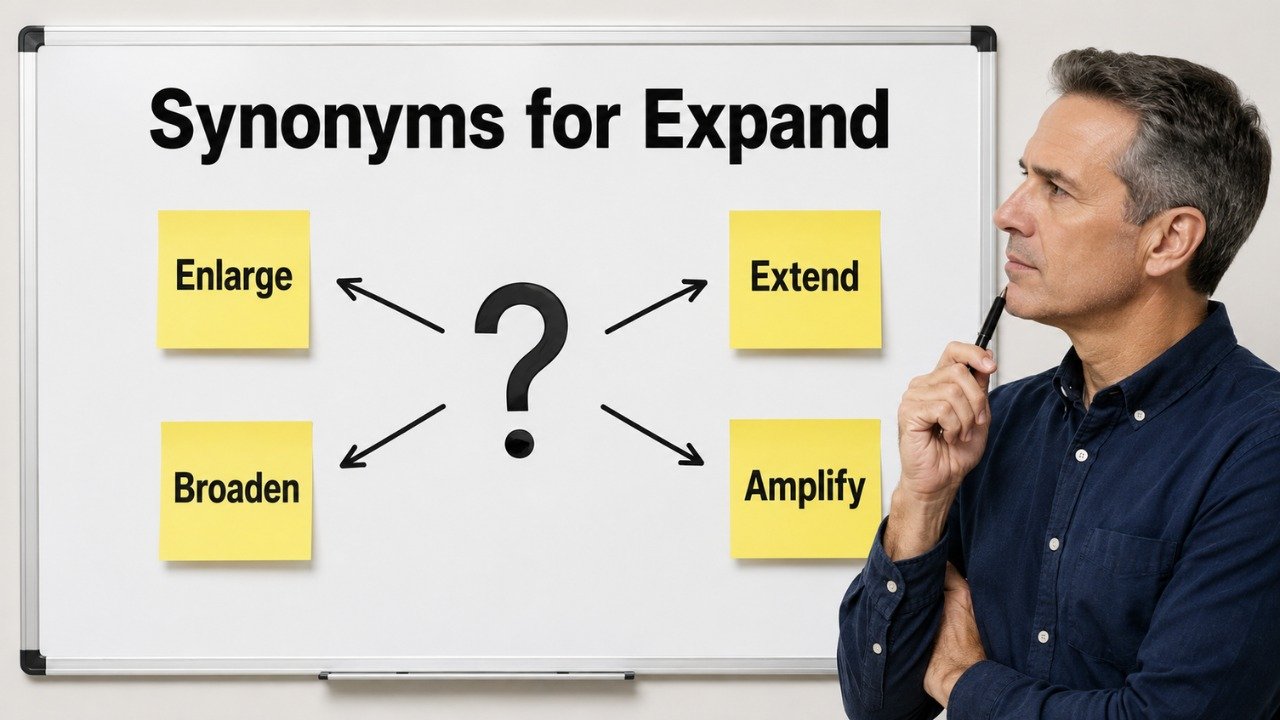
Quick Answer: The best synonyms for expand include enlarge, increase, extend, broaden, widen, grow, develop, amplify, elaborate, and diversify. Use enlarge for physical size, increase for quantity or level, extend for length or reach, broaden for scope or understanding, and widen for distance or variety. Grow and develop work well for businesses, skills, and ideas. Amplify adds strength or effect, elaborate adds explanation and detail, while diversify describes expansion into different areas, products, or activities.
Pronunciation and Word Details
Word: Expand.
Pronunciation: /ɪkˈspænd/
Part of Speech: Verb.
Meaning: To become larger or to make something greater in size, amount, range, detail, or importance.
US Pronunciation:
UK Pronunciation:
What Does “Expand” Mean?
Expand means to become larger or to make something larger in size, amount, range, scope, detail, or influence. It is mainly used as a verb and can describe both physical and abstract growth.
In a physical context, expand can describe an object, material, gas, or space becoming larger.
Example: Metal can expand when it becomes hot.
In a business context, expand means to increase operations, enter new markets, hire more workers, or offer more products.
Example: The company plans to expand its services into neighboring regions.
When discussing ideas or writing, expand means to add explanations, examples, facts, or supporting details.
Example: Please expand your answer with a practical example.
Expand can also describe personal growth, increased knowledge, wider opportunities, or a broader understanding of a subject.
Example: Reading can expand your knowledge of different cultures.
The meaning of expand changes slightly according to the object. A room can expand physically, a business can expand commercially, and a paragraph can expand through additional detail.
Meaning, Tone, and Context of “Expand”
Expand is a neutral and versatile word. It can appear in casual conversation, professional communication, academic writing, technical explanations, business reports, science lessons, essays, and instructions.
In everyday speech, expand often refers to making something larger or adding more detail.
Example: Could you expand on what you said earlier?
In formal writing, expand commonly describes growth in scope, influence, capacity, operations, knowledge, or access.
Example: The program was created to expand access to educational resources.
In scientific and technical language, expand describes a material, liquid, gas, or structure increasing in volume or dimensions.
Example: The gas will expand as the temperature rises.
In business language, expand usually has a positive tone because it suggests progress, development, increased reach, or new opportunities. However, expansion can also create costs, risks, or management challenges.
When expand refers to an idea, argument, or explanation, it means adding useful information rather than simply making the text longer.
Example: The writer expanded the argument by including evidence and examples.
When and How to Use “Expand”
For Physical Size
Use expand when an object, material, area, or space becomes larger.
Example: The balloon will expand as more air enters it.
For Quantity or Capacity
Use expand when the amount, volume, or capacity of something increases.
Example: The school plans to expand its seating capacity.
For Business Growth
Use expand when a business increases its products, locations, workforce, customers, or operations.
Example: The shop hopes to expand into a larger building.
For Ideas and Explanations
Use expand when someone adds more detail, evidence, examples, or clarification.
Example: The student expanded the answer by explaining each step.
For Knowledge and Understanding
Use expand when learning creates a broader awareness of a subject.
Example: The course will expand your understanding of grammar.
For Range and Variety
Use expand when more choices, categories, services, or subjects are added.
Example: The library wants to expand its collection of reference books.
For Reach and Influence
Use expand when an organization, project, or message reaches more people or places.
Example: The campaign was designed to expand public awareness.
For Opportunities
Use expand when new possibilities become available.
Example: Additional training can expand your career opportunities.
For Personal Development
Use expand when someone develops abilities, experiences, interests, or perspectives.
Example: Traveling can expand a person’s view of the world.
For Territory or Coverage
Use expand when an area, service, or activity spreads into new locations.
Example: The delivery service will expand into rural communities.
Best Synonyms for Expand
Enlarge: To make something greater in physical size.
Example: The builder will enlarge the kitchen by removing one wall.
Increase: To make something greater in amount, number, level, or degree.
Example: The team wants to increase production next month.
Extend: To make something longer or allow it to reach farther.
Example: The council plans to extend the walking path.
Broaden: To make something wider in range, scope, knowledge, or influence.
Example: The course helped students broaden their understanding of language.
Widen: To make something physically wider or more varied.
Example: The workers will widen the entrance for easier access.
Grow: To become larger, stronger, more successful, or more developed.
Example: The organization continued to grow throughout the year.
Develop: To become more advanced, complete, useful, or successful.
Example: The writer developed the main idea through clear examples.
Amplify: To increase the strength, volume, importance, or effect of something.
Example: The new evidence amplified public concern.
Elaborate: To add more explanation, information, or detail.
Example: She elaborated on her proposal during the meeting.
Diversify: To expand by adding different products, activities, skills, or areas.
Example: The farm decided to diversify its crops.
50 Synonyms for Expand with Short Meanings
- Enlarge: To make something physically bigger.
- Increase: To make an amount, number, or level greater.
- Extend: To make something longer or farther reaching.
- Broaden: To increase range, scope, or understanding.
- Widen: To make something wider or more varied.
- Grow: To become larger, stronger, or more developed.
- Develop: To become more complete, advanced, or successful.
- Amplify: To increase strength, volume, or effect.
- Augment: To make something greater by adding to it.
- Magnify: To make something appear or become larger.
- Swell: To increase in size, volume, or number.
- Inflate: To fill with air or increase beyond a previous level.
- Stretch: To make something longer, wider, or more extended.
- Lengthen: To increase the physical length or duration.
- Spread: To extend over a wider area.
- Unfold: To open something that was folded or reveal it gradually.
- Open: To make a space, opportunity, or subject more accessible.
- Dilate: To become wider or cause an opening to widen.
- Distend: To expand outward through pressure from within.
- Escalate: To increase rapidly in size, seriousness, or intensity.
- Intensify: To make something stronger or more extreme.
- Strengthen: To increase power, effectiveness, or influence.
- Enhance: To improve quality, value, or effect.
- Elaborate: To add more explanation or detail.
- Explain: To make an idea clearer through additional information.
- Clarify: To develop an idea so it becomes easier to understand.
- Detail: To provide specific facts or information.
- Expound: To explain an idea thoroughly and formally.
- Build Upon: To develop an existing idea or achievement further.
- Add To: To increase something by including more.
- Supplement: To provide extra information, material, or support.
- Enrich: To improve something by adding value or detail.
- Diversify: To expand into different types or areas.
- Branch Out: To begin working in new fields or activities.
- Scale Up: To increase the size, capacity, or output of an operation.
- Advance: To move forward or become more developed.
- Flourish: To grow successfully and strongly.
- Multiply: To increase greatly in number or amount.
- Proliferate: To increase or spread rapidly.
- Propagate: To spread ideas, information, plants, or influence.
- Diffuse: To spread over a broad area.
- Fan Out: To spread outward in different directions.
- Radiate: To extend outward from a central point.
- Deepen: To increase depth, knowledge, seriousness, or understanding.
- Bolster: To strengthen or support further growth.
- Accumulate: To increase gradually through repeated additions.
- Compound: To increase by adding further effects or amounts.
- Evolve: To develop gradually into a more advanced form.
- Advance Upon: To improve or extend an earlier idea or result.
- Enlarge Upon: To explain or discuss something in greater detail.
Read Also:
Synonyms for Favorite

Synonyms for Expand by Context
When Expand Means Become Physically Larger
Enlarge, swell, inflate, stretch, widen, dilate, distend, and magnify can describe physical expansion.
Enlarge is the most general choice when something is intentionally made bigger. Swell often describes natural or temporary growth. Inflate usually involves air or gas. Dilate is commonly used for an opening that becomes wider.
Example: The material will swell when it absorbs water.
When Expand Means Increase in Quantity
Increase, augment, multiply, accumulate, compound, and escalate describe growth in amount, number, level, or intensity.
Increase is neutral and widely useful. Augment sounds more formal and often means improving something by adding to it. Multiply suggests rapid numerical growth. Escalate often describes a problem, cost, conflict, or level becoming greater.
Example: The new equipment should increase production.
When Expand Means Extend in Length or Reach
Extend, lengthen, stretch, spread, radiate, and fan out describe movement or growth across a greater distance.
Extend works well for roads, deadlines, services, reach, and physical objects. Lengthen refers specifically to increased length or duration. Spread suggests covering more space or reaching more people.
Example: The city plans to extend the bus route.
When Expand Means Broaden Scope
Broaden, widen, diversify, branch out, and open describe an increase in variety, subject matter, opportunity, or range.
Broaden is useful for knowledge, understanding, experience, and scope. Diversify means adding different types or categories. Branch out is more conversational and often refers to entering new activities.
Example: The course will broaden your knowledge of sentence structure.
When Expand Means Develop a Business
Grow, develop, scale up, diversify, flourish, advance, and branch out work well for commercial or organizational expansion.
Grow is natural in both formal and casual language. Scale up emphasizes increasing capacity or output. Diversify means adding new products, services, markets, or sources of income.
Example: The business plans to scale up production during the next quarter.
When Expand Means Add More Detail
Elaborate, explain, clarify, detail, expound, enlarge upon, and build upon describe the development of an idea or statement.
Elaborate is the most direct replacement when more information is required. Expound is formal and means explaining a subject thoroughly. Clarify focuses on making the meaning easier to understand.
Example: Please elaborate on the reasons for your decision.
When Expand Means Improve or Strengthen
Enhance, strengthen, amplify, bolster, enrich, and supplement describe expansion that improves quality, influence, or effectiveness.
Enhance focuses on improvement. Amplify increases strength, effect, or attention. Supplement means adding something extra to make the original material more complete.
Example: Additional examples will strengthen the argument.
When Expand Means Spread
Spread, proliferate, propagate, diffuse, radiate, and fan out describe expansion across an area, population, or network.
Proliferate suggests rapid increase. Propagate can refer to plants, beliefs, knowledge, or information. Diffuse describes something spreading widely or becoming distributed.
Example: The plants began to proliferate throughout the garden.
Another Word for Expand
Enlarge is a strong general replacement for expand when discussing physical size. However, the best alternative depends on what is becoming larger.
Use increase for numbers or amounts, extend for length or reach, broaden for scope, grow for businesses, and elaborate for explanations.
Original: They plan to expand the dining area.
Better Option: They plan to enlarge the dining area.
Original: The program will expand the number of available courses.
Better Option: The program will increase the number of available courses.
Original: The speaker expanded the explanation with several examples.
Better Option: The speaker elaborated on the explanation with several examples.
Original: The training can expand your professional knowledge.
Better Option: The training can broaden your professional knowledge.
When Not to Use “Expand”
Avoid using expand when another verb expresses the exact type of growth more clearly.
When Referring Only to Numbers
Increase is usually more precise when the sentence focuses on a measurable quantity, percentage, price, number, or rate.
Weak: The school expanded the number of classes.
Better: The school increased the number of classes.
When Referring to Physical Length
Extend or lengthen is clearer when something becomes longer rather than larger in every direction.
Weak: The workers expanded the road by two miles.
Better: The workers extended the road by two miles.
When Requesting More Explanation
Elaborate is often more natural than expand when asking someone to provide additional detail.
Weak: Can you expand your reason?
Better: Can you elaborate on your reason?
When Referring to Width
Widen is more exact when only the width changes.
Weak: The builders will expand the doorway.
Better: The builders will widen the doorway.
When Discussing Knowledge
Broaden or deepen may be clearer depending on the intended meaning. Broaden adds range, while deepen adds detailed understanding.
Weak: The course will expand your knowledge of poetry.
Better: The course will broaden your knowledge of poetry.
When Describing Business Capacity
Scale up may be more precise when the focus is on producing more goods, serving more customers, or increasing operational capacity.
Weak: The factory will expand its output.
Better: The factory will scale up its output.
When Expand Becomes Repetitive
Repeated use of expand can make writing sound vague and monotonous.
Weak: The company will expand its products, expand its workforce, and expand its market.
Better: The company will diversify its products, increase its workforce, and broaden its market reach.
Words Commonly Confused With Expand
Expand vs Enlarge: Expand can refer to physical size, scope, detail, business, or knowledge. Enlarge usually focuses on making something physically bigger.
Expand vs Increase: Expand describes growth in size, range, or scope. Increase usually describes a measurable rise in amount, number, level, or degree.
Expand vs Extend: Expand means becoming larger in several possible ways. Extend means becoming longer, continuing farther, or reaching beyond a previous point.
Expand vs Broaden: Expand is general. Broaden usually refers to increased range, variety, perspective, knowledge, or scope.
Expand vs Widen: Expand may involve overall growth. Widen specifically means increasing width or creating a greater range of choices.
Expand vs Elaborate: Expand can mean adding detail, but elaborate is more precise when someone explains an idea more fully.
Expand vs Develop: Expand emphasizes growth in size or range. Develop emphasizes gradual progress, improvement, or completion.
Expand vs Amplify: Expand makes something larger or broader. Amplify increases strength, volume, attention, or effect.
Expand vs Inflate: Expand is generally neutral. Inflate often describes filling something with air or increasing a value beyond a reasonable level.
Expand vs Diversify: Expand means grow in general. Diversify specifically means adding different products, services, subjects, activities, or investments.
Which Synonym Should You Choose?
Choose enlarge when describing a room, image, object, opening, or physical area becoming bigger.
Choose increase when referring to quantities, prices, numbers, rates, levels, or measurable results.
Choose extend when describing length, time, deadlines, roads, services, reach, or coverage.
Choose broaden when writing about knowledge, understanding, perspective, appeal, experience, or scope.
Choose widen when discussing physical width, access, gaps, choices, or differences.
Choose grow when discussing a business, audience, skill, organization, plant, or relationship in general language.
Choose develop when something gradually becomes more complete, advanced, useful, or successful.
Choose amplify when increasing volume, influence, emotion, attention, or effect.
Choose elaborate when adding more detail to an idea, answer, argument, report, or explanation.
Choose diversify when entering new markets, adding different products, or developing a wider range of activities.
Choose scale up when increasing production, capacity, staffing, or business operations.
Choose augment in academic, professional, or formal writing when something is strengthened through an addition.
Choose proliferate when something increases or spreads rapidly.
Choose supplement when additional material supports or completes what already exists.
Real Life Examples of “Expand” in Sentences
Original: The family wants to expand the kitchen.
Better Option: The family wants to enlarge the kitchen.
Original: The school will expand the number of science classes.
Better Option: The school will increase the number of science classes.
Original: The city plans to expand the walking trail.
Better Option: The city plans to extend the walking trail.
Original: Reading can expand your understanding of history.
Better Option: Reading can broaden your understanding of history.
Original: The business hopes to expand its product selection.
Better Option: The business hopes to diversify its product selection.
Original: Please expand your answer with more evidence.
Better Option: Please elaborate on your answer with more evidence.
Original: The organization wants to expand its operations.
Better Option: The organization wants to scale up its operations.
Original: Heat causes the metal to expand.
Better Option: Heat causes the metal to enlarge slightly.
Original: The new material will expand the report.
Better Option: The new material will enrich the report.
Original: The service expanded across the entire region.
Better Option: The service spread across the entire region.
Synonym Groups and Usage Differences
Physical Growth Group
Enlarge, swell, inflate, widen, dilate, distend, and stretch all describe physical expansion.
Enlarge is broad and neutral. Swell often describes natural growth caused by pressure, liquid, or injury. Inflate means filling something with air or gas. Dilate refers to an opening becoming wider.
Example: Warm air caused the balloon to inflate.
Quantity Group
Increase, augment, multiply, accumulate, compound, and escalate relate to growth in number, amount, level, or intensity.
Increase is the most flexible choice. Augment is formal and suggests adding something useful. Compound describes repeated growth created by additional effects.
Example: The new process increased daily output.
Length and Reach Group
Extend, lengthen, stretch, spread, and radiate describe expansion over distance or time.
Extend is suitable for roads, deadlines, contracts, services, and reach. Lengthen refers directly to additional length or duration. Radiate describes movement outward from a central point.
Example: The organization extended its services to nearby towns.
Scope and Variety Group
Broaden, widen, diversify, branch out, and open describe expansion into a larger range of ideas, choices, products, or activities.
Broaden is useful in formal and academic writing. Diversify emphasizes variety. Branch out sounds more conversational and suggests trying new areas.
Example: The store diversified its selection of household products.
Business Growth Group
Grow, develop, scale up, flourish, advance, and diversify describe business or organizational progress.
Grow is the broadest term. Scale up focuses on capacity and operations. Flourish suggests strong and successful development.
Example: The small business flourished after moving to a larger location.
Explanation Group
Elaborate, explain, clarify, detail, expound, and enlarge upon describe adding information to an idea.
Elaborate means providing more detail. Clarify makes the meaning easier to understand. Expound is formal and suggests a thorough explanation.
Example: The teacher elaborated on the final point.
Improvement Group
Enhance, strengthen, amplify, bolster, enrich, and supplement describe adding quality, value, power, or support.
Enhance improves something. Bolster gives additional support. Enrich adds depth, value, variety, or interest.
Example: Practical examples enriched the lesson.
Spread Group
Spread, propagate, proliferate, diffuse, radiate, and fan out describe movement across a wider area.
Spread is the most general. Proliferate suggests rapid growth in number. Fan out describes movement in several outward directions.
Example: The search team fanned out across the field.
Antonyms of Expand
The opposite of expand depends on whether the word refers to size, amount, scope, detail, or business activity.
Contract: To become smaller or tighter.
Shrink: To decrease in physical size.
Reduce: To make something smaller in amount, size, or degree.
Decrease: To become lower in number, level, or quantity.
Narrow: To reduce width, range, or scope.
Compress: To press something into a smaller space.
Condense: To make something shorter, denser, or more concentrated.
Shorten: To reduce length or duration.
Restrict: To limit movement, access, range, or activity.
Limit: To prevent something from growing beyond a certain point.
Curtail: To reduce or end an activity earlier than planned.
Constrain: To control or restrict growth, freedom, or development.
Diminish: To become smaller, weaker, or less important.
Decline: To decrease in strength, number, quality, or success.
Collapse: To fall inward or fail suddenly.
Close: To make something unavailable or inaccessible.
Simplify: To reduce detail or complexity.
Summarize: To shorten information to its main points.
Withdraw: To move back from an area, activity, or commitment.
Downsize: To reduce the size, workforce, or operations of an organization.
Comparison: Expand vs Related Words
Expand vs Enlarge
Expand has a broad meaning and can refer to size, business, ideas, knowledge, or scope. Enlarge usually refers to increasing physical size.
Example With Expand: The organization plans to expand its training program.
Example With Enlarge: The workers will enlarge the meeting room.
Expand vs Increase
Expand describes growth in size, scope, or range. Increase is more suitable for amounts, numbers, levels, prices, and measurable quantities.
Example With Expand: The library will expand its services.
Example With Increase: The library will increase its opening hours.
Expand vs Extend
Expand means to become larger. Extend means to become longer, continue farther, or reach beyond an existing point.
Example With Expand: The business expanded its operations.
Example With Extend: The business extended its delivery area.
Expand vs Broaden
Expand is a general verb for growth. Broaden is more precise when discussing range, perspective, knowledge, appeal, or scope.
Example With Expand: The course will expand your knowledge.
Example With Broaden: The course will broaden your knowledge of international literature.
Expand vs Widen
Expand may involve growth in several dimensions. Widen specifically refers to greater width or a broader range.
Example With Expand: The builders expanded the entrance area.
Example With Widen: The builders widened the doorway.
Expand vs Grow
Expand can describe deliberate or natural growth. Grow often emphasizes gradual development over time.
Example With Expand: The organization expanded into three new regions.
Example With Grow: The organization grew steadily over five years.
Expand vs Develop
Expand focuses on increased size, quantity, or scope. Develop focuses on improvement, progress, or becoming more complete.
Example With Expand: The team expanded the training program.
Example With Develop: The team developed a new training program.
Expand vs Elaborate
Expand can describe many types of growth. Elaborate specifically means adding more detail or explanation.
Example With Expand: Please expand your answer.
Example With Elaborate: Please elaborate on the reasons behind your answer.
Expand vs Amplify
Expand means to make something larger or broader. Amplify means to increase its strength, volume, attention, or effect.
Example With Expand: The report expanded the discussion.
Example With Amplify: The report amplified concerns about safety.
Expand vs Diversify
Expand means grow in size or reach. Diversify means grow by adding different types, categories, products, or activities.
Example With Expand: The store expanded its inventory.
Example With Diversify: The store diversified its inventory by adding home and garden products.
Common Phrases and Expressions With Expand
Expand Your Horizons: Gain new knowledge, experiences, or perspectives.
Expand On an Idea: Add more detail, explanation, or evidence to an idea.
Expand a Business: Increase business operations, locations, products, or customers.
Expand Into New Markets: Begin selling or operating in additional regions or customer groups.
Expand the Range: Add more choices, types, or options.
Expand Capacity: Increase the amount that a system, building, or organization can handle.
Expand Access: Make a service, resource, or opportunity available to more people.
Expand Knowledge: Learn more and develop a broader understanding.
Expand the Scope: Include more subjects, activities, goals, or responsibilities.
Expand Rapidly: Grow quickly in size, influence, activity, or reach.
Common Mistakes to Avoid
Using Expand Without a Clear Object
Expand can sound vague when the sentence does not explain what is becoming larger.
Vague: The organization plans to expand.
Clearer: The organization plans to expand its educational services.
Using Expand for Every Type of Increase
Expand is not always the most accurate verb. Choose increase for numbers, widen for width, extend for length, and elaborate for detail.
Weak: The writer expanded the number of examples.
Better: The writer increased the number of examples.
Confusing Expand and Extend
Use expand for overall growth and extend for additional length, time, or reach.
Incorrect: The council expanded the deadline by one week.
Better: The council extended the deadline by one week.
Confusing Expand and Elaborate
Elaborate is usually more natural when asking for further explanation.
Unnatural: Please expand why you disagree.
Better: Please elaborate on why you disagree.
Repeating Expand Too Often
Using expand several times in one paragraph creates weak and repetitive writing.
Repetitive: The company expanded its staff, expanded its services, and expanded its audience.
Improved: The company increased its staff, broadened its services, and grew its audience.
Using Inflate as a Neutral Replacement
Inflate can suggest an unnatural, artificial, or excessive increase, especially with prices, estimates, or achievements.
Weak: The organization inflated its services into new areas.
Better: The organization expanded its services into new areas.
Using Magnify for General Business Growth
Magnify normally relates to making something look larger or increasing its apparent importance.
Incorrect: The company magnified its operations.
Better: The company scaled up its operations.
Confusing Broaden and Deepen
Broaden means adding range or variety. Deepen means increasing detail, intensity, or understanding.
Incorrect: The research broadened our detailed understanding of one issue.
Better: The research deepened our understanding of one issue.
Adding Empty Detail
Expanding an answer does not mean repeating the same idea in different words. Useful expansion adds facts, evidence, examples, reasoning, or explanation.
Weak: The plan is useful because it is a very useful plan.
Better: The plan is useful because it reduces costs and improves access.
Conclusion
The best synonyms for expand depend on the type of growth being described. Use enlarge for physical size, increase for quantities, extend for length or reach, and broaden for knowledge or scope. Grow, develop, and scale up work well for business progress, while elaborate and expound suit detailed explanations. Diversify describes movement into different areas, and amplify increases strength or effect. Learning these distinctions makes synonyms for expand more accurate in essays, reports, conversations, instructions, and professional writing.
FAQs About Synonyms for Expand
What Is the Best Synonym for Expand?
Enlarge is a strong general synonym for physical growth. Increase, extend, broaden, grow, and elaborate may be better in other contexts.
What Is a Formal Synonym for Expand?
Augment is a formal synonym when something is increased through an addition. Broaden, develop, expound, and enlarge upon are also useful formal choices.
What Is Another Word for Expand an Idea?
Elaborate is the best common alternative. Explain, clarify, detail, expound, and build upon can also describe adding information to an idea.
What Is a Synonym for Expand a Business?
Grow, develop, scale up, diversify, branch out, and extend operations are useful alternatives for expanding a business.
What Is the Difference Between Expand and Increase?
Expand usually describes growth in size, range, scope, or detail. Increase usually describes measurable growth in amount, number, level, or degree.
Can Broaden Replace Expand?
Yes, broaden can replace expand when discussing knowledge, understanding, experience, appeal, perspective, range, or scope.
What Is the Opposite of Expand?
Common opposites include contract, shrink, reduce, decrease, narrow, compress, restrict, and downsize. The best antonym depends on the context.
