
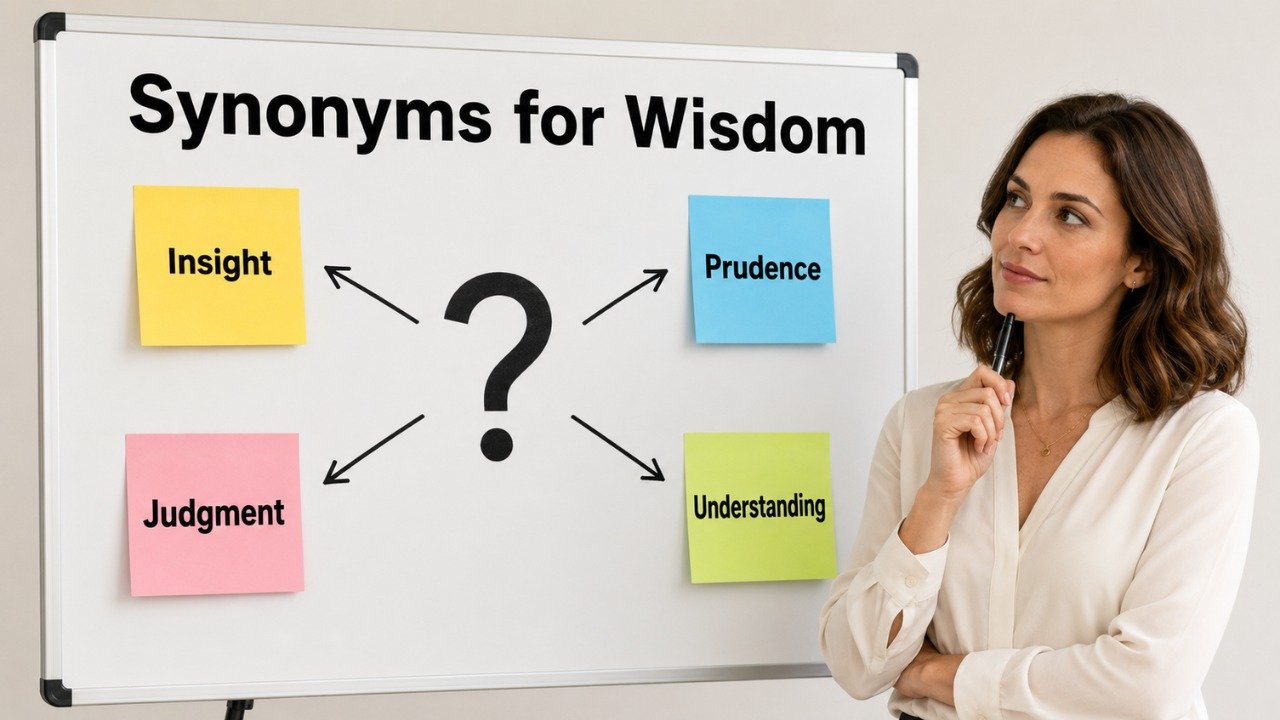
Quick Answer: The best synonyms for wisdom include insight, understanding, knowledge, discernment, judgment, prudence, sagacity, experience, foresight, and common sense. Insight is best when describing a deep understanding of a subject or situation. Discernment and judgment suit decisions and evaluations. Prudence emphasizes careful action, while foresight describes the ability to anticipate future results. Knowledge works well for learned information, experience for lessons gained through life, and common sense for practical decisions in everyday conversation.
Pronunciation and Word Details
Word: Wisdom.
Pronunciation: /ˈwɪz.dəm/.
Part of Speech: Noun.
Meaning: The ability to use knowledge, experience, and sound judgment to make sensible decisions.
US Pronunciation:
UK Pronunciation:
What Does “Wisdom” Mean?
Wisdom means the ability to understand situations deeply and make sensible decisions based on knowledge, experience, and good judgment.
Wisdom is a noun. It can describe practical thinking, emotional maturity, careful judgment, deep understanding, or advice gained through experience.
The word often refers to more than simply knowing facts. A knowledgeable person may have a great deal of information, but a wise person knows how and when to use that information.
Practical Meaning: Wisdom is the ability to make sensible choices in real situations.
Example: Her wisdom helped the team avoid an unnecessary risk.
Emotional Meaning: Wisdom can describe patience, maturity, and an understanding of human behavior.
Example: He responded to the criticism with calm wisdom.
Traditional Meaning: Wisdom may refer to teachings, principles, or lessons passed from one generation to another.
Example: The story contains the wisdom of earlier generations.
Advisory Meaning: Wisdom can describe thoughtful guidance offered to another person.
Example: She shared a few words of wisdom before the interview.
Wisdom can also appear in phrases that question whether a decision is sensible.
Example: They began to question the wisdom of changing the plan so late.
Meaning, Tone, and Context of “Wisdom”
Wisdom has a positive, respectful, and thoughtful tone. It is generally neutral to formal, although it also appears naturally in everyday conversation.
In formal writing, wisdom often describes sound judgment, thoughtful leadership, or the value of a decision.
Example: The committee recognized the wisdom of reviewing the policy regularly.
In personal writing, wisdom may refer to life lessons, emotional growth, or advice from an experienced person.
Example: Her grandmother offered wisdom that remained useful throughout her life.
In academic or philosophical contexts, wisdom can describe deep understanding of life, morality, knowledge, or human behavior.
Example: The essay examines the relationship between knowledge and wisdom.
In professional communication, terms such as judgment, insight, expertise, and prudence may be more precise than wisdom.
Example: His sound judgment helped resolve the disagreement.
Wisdom is not usually technical. It is broad and often combines intelligence, experience, self control, awareness, and careful decision making.
The word may sound emotional when connected to family guidance, personal growth, or life experience. It may sound formal when used to evaluate a policy, strategy, or important decision.
When and How to Use “Wisdom”
For Sensible Decisions: Use wisdom when someone applies knowledge and experience to make a good choice.
Example: She showed wisdom by considering every option before responding.
For Life Experience: Use wisdom to describe understanding gained through years of observation and experience.
Example: His advice reflected the wisdom of a long and varied career.
For Thoughtful Advice: Use wisdom when referring to useful guidance that helps another person.
Example: The mentor shared words of wisdom with the new employees.
For Emotional Maturity: Use wisdom when someone responds calmly, patiently, and thoughtfully.
Example: She handled the difficult conversation with wisdom and kindness.
For Leadership: Use wisdom to describe careful judgment in managing people, plans, or responsibilities.
Example: The director had the wisdom to consult the entire team.
For Future Planning: Use wisdom when a decision considers future risks and consequences.
Example: Saving part of the budget showed financial wisdom.
For Traditional Knowledge: Use wisdom when discussing lessons, customs, or principles passed through generations.
Example: The community valued the wisdom preserved in its stories.
For Questioning a Decision: Use wisdom when evaluating whether an action is sensible.
Example: They questioned the wisdom of beginning the journey during severe weather.
For Moral Understanding: Use wisdom when discussing choices involving values, fairness, responsibility, or human behavior.
Example: True wisdom requires both honesty and compassion.
Best Synonyms for Wisdom
Insight: A deep and accurate understanding of a person, subject, or situation.
Example: Her insight revealed the real cause of the disagreement.
Understanding: Knowledge of how something works, feels, or relates to other things.
Example: His understanding of the problem helped the group find a solution.
Knowledge: Information and awareness gained through study, learning, or experience.
Example: The guide shared extensive knowledge of local history.
Discernment: The ability to recognize important differences and make careful judgments.
Example: Good leadership requires patience and discernment.
Judgment: The ability to form sensible opinions and make responsible decisions.
Example: We trusted her judgment during the negotiations.
Prudence: Careful thinking that avoids unnecessary danger, difficulty, or loss.
Example: Prudence led them to delay the purchase until costs became clearer.
Sagacity: Deep wisdom and the ability to make intelligent decisions.
Example: The leader was respected for her patience and sagacity.
Experience: Knowledge and skill gained through direct involvement in life or work.
Example: Years of experience taught him when to speak and when to listen.
Foresight: The ability to anticipate future needs, risks, or consequences.
Example: Her foresight helped the company prepare for unexpected demand.
Common Sense: Practical judgment based on ordinary experience and clear thinking.
Example: A little common sense prevented the misunderstanding from growing.
50 Synonyms for Wisdom with Short Meanings
- Insight: Deep understanding of a person, subject, or situation.
- Understanding: Clear knowledge of meaning, causes, or relationships.
- Knowledge: Information gained through learning or experience.
- Discernment: The ability to judge differences carefully.
- Judgment: The ability to make sensible decisions.
- Prudence: Careful thinking that avoids unnecessary risk.
- Sagacity: Deep wisdom and intelligent judgment.
- Experience: Understanding gained through direct involvement.
- Foresight: Awareness of likely future needs or consequences.
- Common Sense: Practical judgment in ordinary situations.
- Good Sense: The ability to make reasonable choices.
- Sound Judgment: Reliable and sensible decision making.
- Intelligence: The ability to learn, understand, and solve problems.
- Intellect: The mental ability to think and reason.
- Reason: Logical thinking used to reach a conclusion.
- Rationality: The quality of thinking logically and sensibly.
- Awareness: Knowledge or recognition of a situation.
- Perception: The ability to notice and understand important details.
- Perceptiveness: Skill in recognizing hidden meanings or feelings.
- Perspicacity: Sharp understanding and clear judgment.
- Acumen: The ability to make quick and accurate judgments.
- Astuteness: Clever awareness of situations and opportunities.
- Shrewdness: Practical skill in judging people or circumstances.
- Discretion: Careful judgment about what to do or say.
- Thoughtfulness: Careful consideration of people and consequences.
- Maturity: Developed judgment gained through growth and experience.
- Expertise: Advanced knowledge or skill in a particular area.
- Learning: Knowledge gained through study or instruction.
- Erudition: Extensive knowledge gained through study.
- Scholarship: Deep academic knowledge and careful study.
- Enlightenment: Greater understanding or awareness.
- Comprehension: The ability to understand something fully.
- Clarity: Clear understanding without confusion.
- Intuition: Understanding something without conscious reasoning.
- Tact: Skill in handling sensitive situations carefully.
- Counsel: Thoughtful advice given to guide a decision.
- Guidance: Advice that helps someone choose a direction.
- Wise Counsel: Advice based on experience and sound judgment.
- Practical Knowledge: Understanding that can be applied in real situations.
- Life Experience: Knowledge gained through personal events and challenges.
- Know How: Practical knowledge of how to do something.
- Savvy: Practical understanding of a subject or situation.
- Street Smarts: Practical awareness gained through everyday experience.
- Worldliness: Knowledge of life and human behavior.
- Philosophy: A set of principles guiding thought and behavior.
- Lore: Traditional knowledge passed through a community.
- Judiciousness: The quality of making careful and balanced decisions.
- Circumspection: Careful consideration before taking action.
- Depth: Serious understanding beyond obvious facts.
- Wise Thinking: Thought guided by knowledge, experience, and judgment.
Read Also:
Synonyms for Expand

Synonyms for Wisdom by Context
When Wisdom Means Deep Understanding
Insight, understanding, comprehension, perception, and depth are useful when wisdom refers to seeing beyond obvious facts.
Insight: Describes a clear understanding of the real nature of a problem.
Example: Her insight helped everyone recognize the hidden concern.
Comprehension: Emphasizes a full understanding of information or ideas.
Example: The discussion improved his comprehension of the issue.
Perception: Focuses on noticing and interpreting important details.
Example: Her perception of the changing mood was remarkably accurate.
Depth: Suggests serious, thoughtful understanding.
Example: The essay demonstrates considerable depth.
When Wisdom Means Good Judgment
Judgment, discernment, prudence, good sense, and judiciousness describe the ability to choose wisely.
Judgment: Best for decisions in professional, personal, or formal contexts.
Example: Her judgment remained reliable under pressure.
Discernment: Best when careful evaluation is needed.
Example: Choosing the right adviser requires discernment.
Prudence: Best when avoiding risk or acting cautiously.
Example: Financial prudence helped the family manage its expenses.
Good Sense: Natural in everyday language.
Example: He had the good sense to ask for help.
When Wisdom Means Knowledge
Knowledge, learning, erudition, scholarship, and expertise work when wisdom refers to education or mastery of a subject.
Knowledge: The broadest word for learned information.
Example: Her knowledge of grammar was impressive.
Expertise: Refers to advanced ability in a specific field.
Example: The project benefited from his technical expertise.
Erudition: Describes extensive academic learning.
Example: The professor was admired for her erudition.
Scholarship: Emphasizes serious academic study.
Example: The book reflects years of careful scholarship.
When Wisdom Comes From Experience
Experience, maturity, life experience, worldliness, and street smarts describe practical lessons gained through living.
Experience: The most neutral and versatile choice.
Example: Experience taught her how to manage difficult conversations.
Maturity: Emphasizes emotional growth and responsible judgment.
Example: He showed maturity by accepting the criticism calmly.
Worldliness: Refers to knowledge of people, society, and real life.
Example: Her worldliness helped her understand different viewpoints.
Street Smarts: A casual phrase for practical awareness in everyday situations.
Example: His street smarts helped him recognize the dishonest offer.
When Wisdom Means Future Awareness
Foresight, prudence, circumspection, planning, and anticipation suit decisions involving future results.
Foresight: The strongest choice for anticipating future needs.
Example: Their foresight prevented a serious shortage.
Circumspection: Describes careful thought before acting.
Example: The proposal should be approached with circumspection.
Prudence: Emphasizes avoiding unnecessary risk.
Example: Prudence suggested waiting for more information.
When Wisdom Means Helpful Advice
Counsel, guidance, wise counsel, advice, and direction describe wisdom shared with others.
Counsel: Formal advice given after careful thought.
Example: The board sought legal counsel before proceeding.
Guidance: Support that helps someone make a decision.
Example: Her guidance gave the student greater confidence.
Wise Counsel: Advice based on mature judgment and experience.
Example: He followed his mentor’s wise counsel.
When Wisdom Means Practical Ability
Common sense, good sense, savvy, know how, and practical knowledge describe useful understanding in everyday situations.
Common Sense: Best for basic practical judgment.
Example: Common sense told them to check the weather first.
Savvy: A conversational word for practical knowledge in a particular area.
Example: Her business savvy helped the shop grow steadily.
Know How: Describes practical ability rather than theory.
Example: The task requires technical know how.
Another Word for Wisdom
The best single replacement for wisdom is insight when the sentence emphasizes deep understanding. Judgment is better for decision making, while prudence suits cautious action. Knowledge works when the focus is learned information.
Original: Her wisdom helped us understand the conflict.
Better Option: Her insight helped us understand the conflict.
Original: We relied on his wisdom before making the final choice.
Better Option: We relied on his judgment before making the final choice.
Original: The decision showed financial wisdom.
Better Option: The decision showed financial prudence.
Original: The elder shared the wisdom of many years.
Better Option: The elder shared knowledge gained through many years of experience.
When Not to Use “Wisdom”
Wisdom can sound too broad when a sentence needs a more specific word. Replace it with insight, judgment, knowledge, prudence, or expertise when the exact meaning matters.
Avoid wisdom when you are referring only to factual information.
Weak: Her wisdom of medical terminology was extensive.
Better: Her knowledge of medical terminology was extensive.
Avoid wisdom when you mean professional skill in one subject.
Weak: The engineer provided technical wisdom.
Better: The engineer provided technical expertise.
Avoid wisdom when the focus is a single decision.
Weak: I trust your wisdom about which option to select.
Better: I trust your judgment about which option to select.
Avoid wisdom when you mean careful avoidance of risk.
Weak: It was wisdom to save money before moving.
Better: It was prudent to save money before moving.
Avoid wisdom when the sentence requires a casual and practical tone.
Weak: Use wisdom and take an umbrella.
Better: Use common sense and take an umbrella.
Avoid repeating wisdom several times in the same paragraph.
Weak: Her wisdom guided the plan, and that wisdom helped others appreciate the wisdom of waiting.
Better: Her judgment guided the plan, and her foresight helped others understand the value of waiting.
Wisdom may also sound exaggerated when describing a simple preference or ordinary task.
Weak: He showed great wisdom by choosing the larger cup.
Better: He made a practical choice by selecting the larger cup.
Words Commonly Confused With Wisdom
Wisdom vs Knowledge: Knowledge is information gained through study or experience. Wisdom is the ability to use that information well.
Wisdom vs Intelligence: Intelligence is the ability to learn, reason, and solve problems. Wisdom includes judgment, experience, and awareness of consequences.
Wisdom vs Insight: Insight is a deep understanding of one issue or situation. Wisdom is broader and includes judgment about how to respond.
Wisdom vs Judgment: Judgment is the ability to make decisions. Wisdom may include judgment, experience, knowledge, patience, and moral understanding.
Wisdom vs Prudence: Wisdom is broad understanding and sound judgment. Prudence specifically means acting carefully to avoid risk or harm.
Wisdom vs Experience: Experience is knowledge gained by doing or observing. Wisdom is what a person may develop by reflecting on experience.
Wisdom vs Common Sense: Common sense is practical judgment in ordinary situations. Wisdom can involve deeper understanding, long term thinking, and emotional maturity.
Wisdom vs Expertise: Expertise is advanced knowledge in a specific field. Wisdom is broader and may apply to life, relationships, decisions, and values.
Wisdom vs Maturity: Maturity refers to developed behavior and emotional responsibility. Wisdom refers to sound understanding and judgment, although the two often overlap.
Which Synonym Should You Choose?
Choose insight when describing deep understanding of a problem, person, idea, or situation.
Choose understanding when you need a broad, neutral word for clear awareness.
Choose knowledge when referring to facts, information, education, or learned material.
Choose discernment when someone must identify subtle differences or judge quality carefully.
Choose judgment when discussing decisions, evaluations, leadership, or responsibility.
Choose prudence when the focus is caution, safety, money, risk, or future consequences.
Choose sagacity in formal writing when you want to emphasize exceptional wisdom.
Choose experience when understanding comes from direct involvement over time.
Choose foresight when someone anticipates future needs, difficulties, or opportunities.
Choose common sense for practical decisions in casual speech and everyday writing.
Choose expertise for reports, essays, professional documents, and technical subjects.
Choose maturity when describing responsible behavior or emotional growth.
Choose tact when someone handles a sensitive subject politely.
Choose counsel or guidance when wisdom is offered as advice.
Choose savvy in conversational writing about practical skill in business, technology, media, or another field.
Real Life Examples of “Wisdom” in Sentences
Original: Her wisdom helped the team solve the problem.
Better Option: Her insight helped the team solve the problem.
Original: We trusted his wisdom during the difficult meeting.
Better Option: We trusted his judgment during the difficult meeting.
Original: Saving additional supplies showed wisdom.
Better Option: Saving additional supplies showed foresight.
Original: She gained wisdom from years of teaching.
Better Option: She gained valuable experience from years of teaching.
Original: The manager acted with wisdom when the costs increased.
Better Option: The manager acted with prudence when the costs increased.
Original: His wisdom about human behavior was impressive.
Better Option: His understanding of human behavior was impressive.
Original: The guide shared her wisdom about mountain travel.
Better Option: The guide shared her practical knowledge of mountain travel.
Original: Wisdom told them not to continue during the storm.
Better Option: Common sense told them not to continue during the storm.
Original: The adviser offered wisdom before the final decision.
Better Option: The adviser offered thoughtful counsel before the final decision.
Original: Her wisdom allowed her to notice the hidden risk.
Better Option: Her perceptiveness allowed her to notice the hidden risk.
Synonym Groups and Usage Differences
Understanding Group
Insight, understanding, comprehension, perception, and clarity describe the ability to recognize meaning or see a situation clearly.
Insight often suggests discovering something that was not obvious. Understanding is broader, while comprehension focuses on fully grasping information.
Example: Her insight explained why the plan had failed.
Decision Making Group
Judgment, discernment, good sense, sound judgment, and judiciousness relate to choosing or evaluating wisely.
Judgment is the broadest option. Discernment focuses on subtle differences, while judiciousness suggests balance and care.
Example: Sound judgment prevented an unnecessary argument.
Caution Group
Prudence, discretion, circumspection, tact, and foresight describe careful behavior.
Prudence focuses on avoiding risk. Discretion concerns what should be said or done, while tact applies to sensitive communication.
Example: She used tact when discussing the disappointing results.
Knowledge Group
Knowledge, learning, erudition, scholarship, and expertise relate to education and information.
Knowledge is general. Expertise is specialized, while erudition and scholarship are more formal and academic.
Example: His expertise made the technical explanation easier to understand.
Experience Group
Experience, maturity, worldliness, life experience, and street smarts describe knowledge gained through living and doing.
Experience is neutral and broad. Street smarts is casual, while maturity emphasizes responsible behavior.
Example: Her maturity helped her accept the setback calmly.
Practical Thinking Group
Common sense, good sense, savvy, know how, and practical knowledge refer to useful ability in real situations.
Common sense applies to ordinary choices. Savvy often describes skill in a particular area.
Example: A little practical knowledge made the repair much easier.
Advice Group
Counsel, guidance, wise counsel, direction, and advice describe wisdom communicated to another person.
Counsel is more formal, while guidance is supportive and flexible.
Example: The new employee appreciated her supervisor’s guidance.
Intellectual Group
Intelligence, intellect, reason, rationality, and acumen involve mental ability and logical thought.
Intelligence is broad. Acumen describes sharp practical judgment, while rationality emphasizes logic.
Example: His business acumen allowed him to identify the strongest opportunity.
Antonyms of Wisdom
The opposites of wisdom depend on whether the word refers to knowledge, judgment, maturity, or careful action.
Foolishness: Lack of sensible judgment.
Ignorance: Lack of knowledge or awareness.
Stupidity: Poor understanding or weak reasoning.
Imprudence: Failure to act carefully or consider risk.
Recklessness: Acting without considering danger or consequences.
Thoughtlessness: Failure to consider people or results.
Inexperience: Lack of practical knowledge gained through action.
Naivety: Lack of experience or realistic understanding.
Poor Judgment: An inability to make sensible decisions.
Confusion: Lack of clear understanding.
Irrationality: Thinking or behavior not guided by reason.
Shortsightedness: Failure to consider future consequences.
Indiscretion: Careless behavior or speech.
Immaturity: Lack of developed judgment or responsibility.
Misunderstanding: An incorrect interpretation of a situation or idea.
Unawareness: Lack of knowledge that something exists or is happening.
Carelessness: Failure to give enough attention to risks or details.
Comparison: Wisdom vs Related Words
Wisdom vs Knowledge
Knowledge concerns information and facts. Wisdom concerns using knowledge responsibly and effectively.
Example With Wisdom: Her wisdom helped her choose the right moment to speak.
Example With Knowledge: Her knowledge helped her explain the procedure correctly.
Wisdom vs Intelligence
Intelligence is mental ability. Wisdom combines understanding with experience, judgment, and awareness of consequences.
Example With Wisdom: He showed wisdom by listening before making a decision.
Example With Intelligence: He used his intelligence to solve the complex puzzle.
Wisdom vs Insight
Insight is a deep understanding of a specific matter. Wisdom is broader and helps guide behavior or decisions.
Example With Wisdom: Her wisdom guided the group through the crisis.
Example With Insight: Her insight revealed the cause of the crisis.
Wisdom vs Judgment
Judgment refers directly to forming opinions and making decisions. Wisdom includes judgment but may also include experience and moral awareness.
Example With Wisdom: His wisdom influenced the long term strategy.
Example With Judgment: His judgment determined which proposal was strongest.
Wisdom vs Prudence
Wisdom describes broad understanding and sensible thinking. Prudence emphasizes caution and avoiding unnecessary risk.
Example With Wisdom: She had the wisdom to seek advice from several experts.
Example With Prudence: She showed prudence by reviewing the contract before signing it.
Wisdom vs Experience
Experience is gained through direct involvement. Wisdom develops when a person learns from that experience and applies its lessons.
Example With Wisdom: His wisdom helped him guide younger colleagues.
Example With Experience: His experience taught him how to manage demanding projects.
Wisdom vs Common Sense
Wisdom can involve deep understanding and long term judgment. Common sense concerns practical decisions in ordinary life.
Example With Wisdom: The leader showed wisdom by considering the effects on future generations.
Example With Common Sense: Common sense suggested carrying water during the walk.
Wisdom vs Expertise
Wisdom applies broadly to decisions and life. Expertise refers to advanced knowledge in a specific subject.
Example With Wisdom: Her wisdom helped the group balance competing interests.
Example With Expertise: Her legal expertise clarified the complex agreement.
Common Phrases and Expressions With “Wisdom”
Words of Wisdom: Helpful advice based on knowledge or experience.
Example: The coach offered a few words of wisdom before the match.
Conventional Wisdom: An idea or belief commonly accepted by many people.
Example: Conventional wisdom suggested that the project would take several months.
Practical Wisdom: The ability to make sensible decisions in real situations.
Example: Years of management gave her practical wisdom.
Ancient Wisdom: Knowledge or principles passed down from earlier times.
Example: The book explores ancient wisdom about patience and balance.
Timeless Wisdom: Advice or understanding that remains useful across generations.
Example: The story contains timeless wisdom about friendship.
Collective Wisdom: Understanding created by the combined experience of a group.
Example: The final plan reflected the collective wisdom of the entire team.
Infinite Wisdom: Perfect or unlimited understanding, often used in philosophical or spiritual contexts.
Example: The poem reflects on the idea of infinite wisdom.
Pearl of Wisdom: A short statement containing useful advice or insight.
Example: Her final comment was a genuine pearl of wisdom.
Question the Wisdom: To doubt whether a decision is sensible.
Example: Several members questioned the wisdom of reducing the budget.
Benefit of Wisdom: The advantage gained from sound judgment and experience.
Example: Younger workers benefited from the wisdom of experienced colleagues.
Common Mistakes to Avoid
A common mistake is treating wisdom and knowledge as exact synonyms. Knowledge refers to information, while wisdom refers to using information well.
Incorrect: She memorized the definitions and gained wisdom of the terms.
Better: She memorized the definitions and gained knowledge of the terms.
Another mistake is using wisdom for narrow technical ability.
Incorrect: His wisdom in computer repair is excellent.
Better: His expertise in computer repair is excellent.
Avoid using wisdom when judgment is the clearer word.
Vague: The supervisor used wisdom when selecting the candidate.
Clear: The supervisor used sound judgment when selecting the candidate.
Do not use common sense when the context requires deep insight or formal reasoning.
Weak: The research demonstrates common sense about human behavior.
Better: The research demonstrates insight into human behavior.
Avoid unnecessary repetition of wisdom.
Repetitive: Her wisdom guided the decision, and her wisdom helped everyone recognize the wisdom of changing direction.
Improved: Her judgment guided the decision, and her insight helped everyone recognize the value of changing direction.
Do not assume that intelligence automatically means wisdom. A person can solve complex problems yet still make careless decisions.
Avoid unnatural phrases such as “a wisdom” when wisdom refers to the general quality. Wisdom is usually an uncountable noun.
Incorrect: He gave me a wisdom about patience.
Better: He gave me a piece of advice about patience.
Better: He shared some wisdom about patience.
Use a more specific synonym whenever the reader needs to know whether you mean knowledge, judgment, foresight, caution, experience, or advice.
Conclusion
Synonyms for wisdom describe several related qualities, including understanding, good judgment, knowledge, caution, and experience. Insight works best for deep understanding, while judgment and discernment suit careful decisions. Prudence emphasizes caution, foresight focuses on future consequences, and expertise refers to specialized knowledge. Common sense is ideal for practical everyday choices, while sagacity has a more formal tone. Selecting the right synonym helps clarify whether you mean thoughtful advice, intellectual ability, emotional maturity, or sensible action.
FAQs About Synonyms for Wisdom
What Is the Best Synonym for Wisdom?
Insight is one of the best general synonyms for wisdom. Judgment, understanding, and prudence may be better in specific contexts.
What Is a Formal Synonym for Wisdom?
Sagacity is a formal synonym for wisdom. Discernment, judiciousness, and prudence also work well in formal writing.
What Is Another Word for a Wise Decision?
Sound judgment, prudence, good sense, and discernment can describe the thinking behind a wise decision.
Are Wisdom and Knowledge the Same?
No. Knowledge is information a person has learned. Wisdom is the ability to apply knowledge in a sensible and responsible way.
What Is a Synonym for Wisdom Gained Through Life?
Experience, life experience, maturity, and worldliness describe wisdom developed through real events and personal growth.
What Is a Casual Synonym for Wisdom?
Common sense, savvy, street smarts, and know how are useful casual alternatives, depending on the sentence.
What Is the Opposite of Wisdom?
Common opposites of wisdom include foolishness, ignorance, recklessness, poor judgment, and imprudence.
