
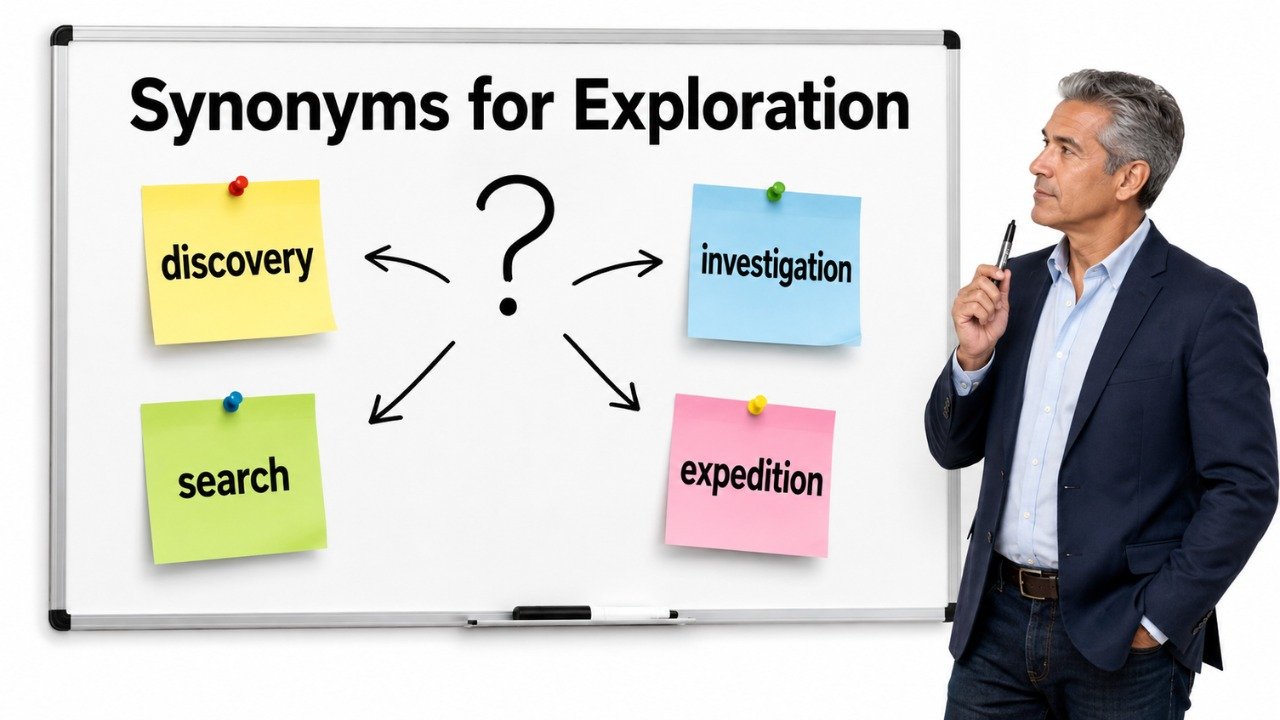
Quick Answer: The best synonyms for exploration include investigation, discovery, research, examination, inquiry, survey, search, expedition, study, and reconnaissance. The best choice depends on context. Investigation works well for formal searches for facts, research suits academic and scientific work, examination emphasizes careful inspection, inquiry describes questioning or investigation, expedition fits organized travel, and discovery highlights finding something new. These synonyms for exploration help express different kinds of searching, learning, travel, and investigation more precisely.
Pronunciation and Word Details
Word: Exploration
Pronunciation: /ˌekspləˈreɪʃən/
Part of Speech: Noun
Meaning: The act of examining, searching, traveling through, or studying something in order to learn more about it.
US Pronunciation:
UK Pronunciation:
What Does “Exploration” Mean?
Exploration means the act of looking into, traveling through, studying, or examining something in order to gain knowledge or discover something new.
Exploration is a noun. It can describe physical travel into unfamiliar places, careful investigation of a subject, scientific research, examination of possibilities, or a personal effort to understand ideas and interests.
In travel contexts, exploration may involve visiting unfamiliar regions or environments. In academic contexts, it can mean studying a question or subject. In business or professional contexts, exploration may refer to considering possibilities before making a decision.
Physical Context: Exploration can describe travel through an unfamiliar area.
Example: The exploration of the remote valley revealed several unusual rock formations.
Academic Context: Exploration can describe thoughtful study of a subject.
Example: Her essay offers an exploration of memory and identity.
Scientific Context: Exploration can involve gathering information about unknown environments.
Example: Ocean exploration continues to reveal unfamiliar species.
Personal Context: Exploration may describe learning about interests, choices, or ideas.
Example: Career exploration helped him understand which fields matched his strengths.
Meaning, Tone, and Context of “Exploration”
Exploration usually has a neutral or positive tone. It often suggests curiosity, learning, discovery, and a willingness to examine something unfamiliar.
The word can sound formal in academic, scientific, technical, and professional writing. It can also sound natural in everyday conversation when discussing travel, hobbies, ideas, or personal interests.
Formal Tone: Exploration works well in reports, essays, research discussions, and professional writing.
Example: The report presents an exploration of several possible solutions.
Academic Tone: It can describe detailed consideration of a topic or question.
Example: The article provides an exploration of language development.
Scientific Tone: Exploration often refers to studying environments, natural systems, or unknown areas.
Example: Deep ocean exploration requires specialized equipment.
Conversational Tone: The word can describe discovering places, hobbies, or possibilities.
Example: Their weekend became an exploration of small towns and local trails.
Creative Tone: Exploration may refer to experimenting with styles, ideas, themes, or methods.
Example: The project encouraged artistic exploration and experimentation.
When and How to Use “Exploration”
For Travel: Use exploration when someone moves through unfamiliar places to learn about them.
Example: Their exploration of the coastline lasted several weeks.
For Research: Use exploration when studying a subject before reaching firm conclusions.
Example: The paper begins with an exploration of the available evidence.
For Investigation: Exploration can describe looking carefully into an issue, idea, or problem.
Example: Further exploration of the complaint revealed several important details.
For Discovery: Use exploration when the process may lead to new knowledge or findings.
Example: Scientific exploration has expanded our understanding of marine life.
For Possibilities: Exploration works when someone is considering different choices or approaches.
Example: The meeting allowed exploration of several possible strategies.
For Personal Growth: The word can describe learning about interests, values, abilities, or goals.
Example: Career exploration can help students make more informed choices.
For Creative Work: Exploration can describe experimenting with ideas, styles, materials, or techniques.
Example: The course encourages exploration of different writing styles.
Best Synonyms for Exploration
Investigation: A careful search for facts, causes, or explanations.
Example: The investigation uncovered the source of the problem.
Discovery: The process or result of finding something previously unknown.
Example: The journey led to the discovery of an isolated waterfall.
Research: Careful study conducted to gain knowledge or answer questions.
Example: Her research focused on changing patterns of migration.
Examination: Detailed inspection or consideration of something.
Example: A close examination of the records revealed several differences.
Inquiry: A process of asking questions or investigating a subject.
Example: The inquiry focused on how the error occurred.
Survey: A broad examination of an area, subject, or group.
Example: The team completed a survey of the surrounding land.
Search: An effort to find information, a place, an object, or an answer.
Example: Their search continued through the forest.
Expedition: An organized journey made for research, discovery, or a specific purpose.
Example: The scientific expedition traveled deep into the mountain region.
Study: Careful consideration or investigation of a subject.
Example: The study examined how weather affects plant growth.
Reconnaissance: Preliminary observation of an area to gather useful information.
Example: The crew conducted reconnaissance before beginning the larger survey.
50 Synonyms for Exploration with Short Meanings
- Investigation: A detailed search for facts or causes.
- Discovery: The process of finding something previously unknown.
- Research: Systematic study used to gain knowledge.
- Examination: Careful inspection or consideration.
- Inquiry: An effort to learn through questions or investigation.
- Survey: A broad inspection or study of something.
- Search: An attempt to find information, answers, or objects.
- Expedition: An organized journey for discovery or research.
- Study: Careful learning or examination of a subject.
- Reconnaissance: Early observation used to gather information.
- Analysis: Detailed examination of parts, patterns, or information.
- Inspection: Close observation to understand or evaluate something.
- Probe: A thorough investigation into a subject or problem.
- Quest: A determined search for something important.
- Journey: Travel from one place to another, sometimes for discovery.
- Voyage: A long journey, especially by sea or through distant areas.
- Adventure: An unusual experience involving discovery or uncertainty.
- Excursion: A short journey made for interest, study, or pleasure.
- Venture: An undertaking involving uncertainty or discovery.
- Foray: A brief attempt to enter or investigate a new area.
- Scouting: Searching an area to gather useful information.
- Prospecting: Searching an area for valuable resources or opportunities.
- Fieldwork: Practical research conducted outside a classroom or office.
- Observation: Careful watching to collect information.
- Scrutiny: Very close and careful examination.
- Assessment: Evaluation used to understand a situation or subject.
- Evaluation: Examination used to judge quality, value, or usefulness.
- Review: Careful consideration of information or evidence.
- Investigation: Systematic examination designed to discover facts.
- Delving: Deep investigation into a subject or issue.
- Probing: Persistent examination intended to uncover information.
- Searching: The process of looking carefully for something.
- Fact finding: Gathering information before reaching a conclusion.
- Experimentation: Trying methods or ideas to learn what happens.
- Testing: Examining something by trying or measuring it.
- Mapping: Recording or studying the features of an area or subject.
- Navigation: Finding and following a route through an area.
- Travel: Movement between places, sometimes for learning or discovery.
- Tour: A journey through several places for observation or interest.
- Trek: A long or demanding journey through an area.
- Pursuit: A continued effort to find or understand something.
- Investigation process: A structured effort to uncover information.
- Information gathering: Collecting facts and details about a subject.
- Data analysis: Examining information to identify patterns or meaning.
- Idea testing: Examining whether an idea or approach works.
- Consideration: Careful thought about a subject or possibility.
- Study process: A planned effort to understand something deeply.
- Investigation work: Practical activity aimed at discovering facts.
- Scientific study: Organized examination using systematic methods.
- Exploratory study: Early research used to understand a subject more clearly.
Read Also:
Synonyms for Lifestyle

Synonyms for Exploration by Context
When Exploration Means Investigation
When exploration involves looking closely into a problem, question, or issue, investigation, inquiry, examination, probe, scrutiny, and analysis are strong choices.
Investigation: Best when searching systematically for facts.
Example: The investigation revealed why the system had failed.
Inquiry: Best when questions and evidence are central.
Example: The inquiry examined how the decision was made.
Examination: Best when something is being inspected carefully.
Example: A detailed examination of the documents followed.
Probe: Best for a focused and often intensive investigation.
Example: The committee began a probe into the unusual transactions.
When Exploration Means Research
For academic, scientific, or intellectual exploration, research, study, analysis, fieldwork, experimentation, and observation are useful alternatives.
Research: Best for organized academic or scientific investigation.
Example: Her research examines how communities adapt to environmental change.
Study: Best for systematic learning or examination.
Example: The study focused on communication patterns.
Fieldwork: Best for research carried out directly in real environments.
Example: The researchers completed several months of fieldwork.
Experimentation: Best when learning occurs by trying different methods.
Example: Experimentation helped the team identify a stronger approach.
When Exploration Means Travel and Discovery
For physical exploration of places, expedition, journey, voyage, trek, excursion, adventure, and reconnaissance may work better.
Expedition: Best for organized travel with a specific purpose.
Example: The expedition crossed a remote section of the desert.
Journey: Best for general travel from one place to another.
Example: Their journey took them through several unfamiliar regions.
Voyage: Best for long travel, especially across water.
Example: The voyage allowed scientists to study distant islands.
Trek: Best for difficult travel over land.
Example: The trek led the group through steep mountain valleys.
When Exploration Means Considering Possibilities
When exploration refers to ideas, options, or opportunities, consideration, inquiry, analysis, testing, experimentation, and evaluation can fit.
Consideration: Best when thinking carefully about choices.
Example: The proposal remains under consideration.
Evaluation: Best when options are being judged.
Example: The evaluation compared several possible approaches.
Testing: Best when an idea is being tried to determine whether it works.
Example: Testing showed which design performed most reliably.
Experimentation: Best for open discovery through repeated trials.
Example: Creative experimentation produced several unexpected solutions.
Another Word for Exploration
Another word for exploration is investigation when the meaning involves carefully looking into a subject, question, or problem. However, the best replacement changes with context. Research is often better for academic work, expedition for organized travel, and discovery when the emphasis is on finding something new.
Original: The team began an exploration of the causes of the failure.
Better Option: The team began an investigation into the causes of the failure.
Original: Her exploration of the topic lasted several months.
Better Option: Her research on the topic lasted several months.
Original: The group prepared for an exploration of the northern region.
Better Option: The group prepared for an expedition into the northern region.
Original: The course encourages exploration of different artistic techniques.
Better Option: The course encourages experimentation with different artistic techniques.
When Not to Use “Exploration”
Exploration is broad, so it may sound vague when the sentence needs a more precise word. Choose a specific synonym when the type of activity is already clear.
Weak: The police began an exploration of the incident.
Better: The police began an investigation of the incident.
Investigation is more precise because the purpose is to uncover facts.
Weak: The scientists completed an exploration about plant growth.
Better: The scientists completed a study of plant growth.
Study sounds more natural in formal research writing.
Weak: The travelers joined an exploration across the desert.
Better: The travelers joined an expedition across the desert.
Expedition clearly communicates an organized journey.
Avoid repeating exploration several times within a short passage.
Weak: The exploration encouraged further exploration of unexplored ideas.
Better: The initial inquiry encouraged further investigation of new ideas.
Choose synonyms carefully because discovery, research, inquiry, and expedition do not express exactly the same meaning.
Words Commonly Confused With Exploration
Exploration vs Investigation: Exploration is broader and often involves open discovery. Investigation usually has a specific question, problem, event, or set of facts to examine.
Exploration vs Research: Exploration can be informal or formal. Research usually follows a more organized process of collecting, studying, and interpreting information.
Exploration vs Discovery: Exploration is the process of searching or examining. Discovery is finding or learning something that was previously unknown.
Exploration vs Expedition: Exploration describes the activity or purpose. Expedition usually describes an organized journey made for a specific goal.
Exploration vs Examination: Exploration can be open and broad. Examination usually involves careful inspection of something already identified.
Exploration vs Survey: Exploration may be detailed or open ended. A survey usually provides a broad view of an area, subject, or group.
Exploration vs Inquiry: Exploration can involve travel, study, or ideas. Inquiry focuses more directly on questioning and investigation.
Which Synonym Should You Choose?
Choose investigation when examining a specific problem, event, cause, or set of facts.
Choose research for academic, scientific, educational, or evidence based writing.
Choose examination when emphasizing careful inspection or detailed consideration.
Choose inquiry when asking questions and seeking explanations.
Choose survey when studying an area or subject broadly.
Choose expedition for organized travel undertaken for research or discovery.
Choose journey for general travel or a broader personal experience.
Choose reconnaissance when gathering preliminary information about an unfamiliar area.
Choose experimentation when trying ideas, techniques, or methods to see what works.
Choose discovery when the focus is on finding something new rather than the process of searching.
Real Life Examples of “Exploration” in Sentences
Original: The exploration of the cave took several days.
Better Option: The expedition into the cave took several days.
Original: The manager encouraged exploration of the problem.
Better Option: The manager encouraged investigation of the problem.
Original: Her exploration of the subject produced several useful insights.
Better Option: Her research on the subject produced several useful insights.
Original: The course includes exploration of different career options.
Better Option: The course includes investigation of different career options.
Original: Their exploration of the coastline revealed several quiet beaches.
Better Option: Their survey of the coastline revealed several quiet beaches.
Original: Scientific exploration improved knowledge of the region.
Better Option: Scientific research improved knowledge of the region.
Original: The project began with exploration of several design ideas.
Better Option: The project began with experimentation with several design ideas.
Original: The exploration of the records revealed an error.
Better Option: The examination of the records revealed an error.
Original: The students completed an exploration of local history.
Better Option: The students completed a study of local history.
Original: Exploration of the area continued after sunrise.
Better Option: Reconnaissance of the area continued after sunrise.
Synonym Groups and Usage Differences
Investigation Group
Investigation, inquiry, probe, examination, scrutiny, and inspection all relate to searching for facts or understanding a specific issue.
Investigation is broad and systematic. Inquiry emphasizes questions. Probe suggests intensive examination. Scrutiny emphasizes close attention.
Example: The investigation uncovered several important details.
Research Group
Research, study, analysis, fieldwork, observation, and experimentation are useful when exploration involves organized learning.
Research is especially suitable for academic and scientific contexts, while fieldwork describes research performed directly in real environments.
Example: The research provided new information about the species.
Travel Group
Expedition, journey, voyage, trek, excursion, adventure, and tour describe different forms of movement and physical exploration.
Expedition suggests organized purpose. Trek suggests difficult land travel. Voyage commonly refers to long distance travel, often by water.
Example: The expedition reached the remote island after several days.
Search Group
Search, quest, pursuit, scouting, prospecting, and reconnaissance describe efforts to find something or gather information.
Quest can suggest a meaningful or difficult goal. Scouting and reconnaissance focus on gathering practical information.
Example: Their search for a safer route continued throughout the morning.
Discovery Group
Discovery, experimentation, testing, observation, and analysis can describe processes that lead to new knowledge.
Discovery focuses on what is found, while experimentation focuses on learning through trials.
Example: Careful observation led to an unexpected discovery.
Antonyms of Exploration
The opposite of exploration depends on whether the word refers to investigation, learning, travel, or curiosity.
Avoidance: Deliberately staying away from a subject or place.
Neglect: Failing to examine or give attention to something.
Ignorance: Lack of knowledge or awareness.
Inattention: Failure to observe or examine carefully.
Disregard: Lack of consideration or concern.
Abandonment: Stopping an effort, search, or journey.
Withdrawal: Moving away instead of continuing investigation or travel.
Stagnation: Lack of development, movement, or new discovery.
Certainty: A settled conclusion that may remove the need for further inquiry.
Confinement: Restriction to a limited area rather than movement through unfamiliar places.
Comparison: Exploration vs Related Words
Exploration vs Investigation
Exploration is broader and can involve travel, ideas, research, or possibilities. Investigation usually seeks answers to a specific question or problem.
Example With Exploration: The course encourages exploration of different career paths.
Example With Investigation: The investigation identified the cause of the accident.
Exploration vs Research
Exploration can be informal or preliminary. Research usually involves a structured process of gathering and analyzing information.
Example With Exploration: Her exploration of the subject began with several basic questions.
Example With Research: Her research included interviews, observations, and detailed analysis.
Exploration vs Discovery
Exploration is the act of searching, studying, or examining. Discovery is the result of finding something new.
Example With Exploration: Exploration of the forest continued throughout the summer.
Example With Discovery: The discovery of the rare plant surprised the researchers.
Exploration vs Expedition
Exploration describes an activity or purpose. Expedition refers to an organized journey made for research, discovery, or another goal.
Example With Exploration: Ocean exploration can reveal unfamiliar ecosystems.
Example With Expedition: The expedition spent six weeks studying the ocean floor.
Exploration vs Examination
Exploration is often broad and open to different directions. Examination is usually more focused and detailed.
Example With Exploration: The book offers an exploration of human creativity.
Example With Examination: The report provides a detailed examination of the evidence.
Common Phrases and Expressions With Exploration
Space Exploration: The study and investigation of space beyond Earth.
Ocean Exploration: The study and investigation of oceans and underwater environments.
Scientific Exploration: Systematic investigation intended to produce new knowledge.
Career Exploration: Learning about occupations, interests, and possible career paths.
Cultural Exploration: Learning about cultures, customs, traditions, and ways of life.
Creative Exploration: Experimenting with ideas, styles, or methods.
Personal Exploration: Learning more about personal interests, values, or goals.
Exploration of Ideas: Careful consideration of different concepts or possibilities.
Exploration of Possibilities: Examining available options before choosing a direction.
Further Exploration: Additional investigation or study of a subject.
Common Mistakes to Avoid
One common mistake is treating every synonym for exploration as interchangeable. The words overlap, but they can carry different meanings.
Mistake: Using expedition for academic research that involves no travel.
Better Choice: Use research, study, or investigation.
Another mistake is using discovery when describing only the process of looking.
Mistake: The discovery continued for several hours before anything was found.
Better Choice: The exploration continued for several hours before anything was found.
Avoid using exploration repeatedly when a more specific word would improve clarity.
Repetitive: The exploration began after an earlier exploration suggested more exploration was necessary.
Better: The investigation began after an earlier survey suggested further research was necessary.
Do not use investigation when you simply mean casual travel or curiosity.
Unnatural: We spent the afternoon conducting an investigation of the old town.
Better: We spent the afternoon exploring the old town.
Pay attention to purpose. Research suits structured study, expedition suits organized travel, reconnaissance suits preliminary observation, and experimentation suits learning by trying different possibilities.
Conclusion
Synonyms for exploration include investigation, research, inquiry, examination, survey, search, expedition, study, discovery, and reconnaissance. The strongest replacement depends on what kind of exploration you mean. Use investigation for fact finding, research for academic study, expedition for organized travel, experimentation for testing ideas, and discovery when something new is found. Choosing a more precise synonym makes your sentences clearer, more natural, and better suited to the specific subject, audience, and purpose.
FAQs About Synonyms for Exploration
What is the best synonym for exploration?
Investigation is one of the best general synonyms when exploration means carefully examining a subject. Research, expedition, inquiry, and discovery may be better in other contexts.
What is another word for exploration in research?
Research, study, investigation, examination, analysis, and inquiry are strong alternatives in academic or scientific contexts.
What is a synonym for exploration when talking about travel?
Expedition, journey, voyage, trek, adventure, and excursion can describe exploration involving travel.
Is discovery the same as exploration?
No. Exploration is usually the process of searching or examining, while discovery is the act or result of finding something new.
What is a formal synonym for exploration?
Investigation, examination, inquiry, research, analysis, and reconnaissance are useful formal alternatives, depending on the context.
What is a synonym for exploring new ideas?
Experimentation, inquiry, investigation, consideration, testing, and creative exploration can all describe examining new ideas.
What is the difference between exploration and research?
Exploration is broader and may be informal, physical, creative, or intellectual. Research usually refers to a more systematic process of gathering and analyzing information.
