
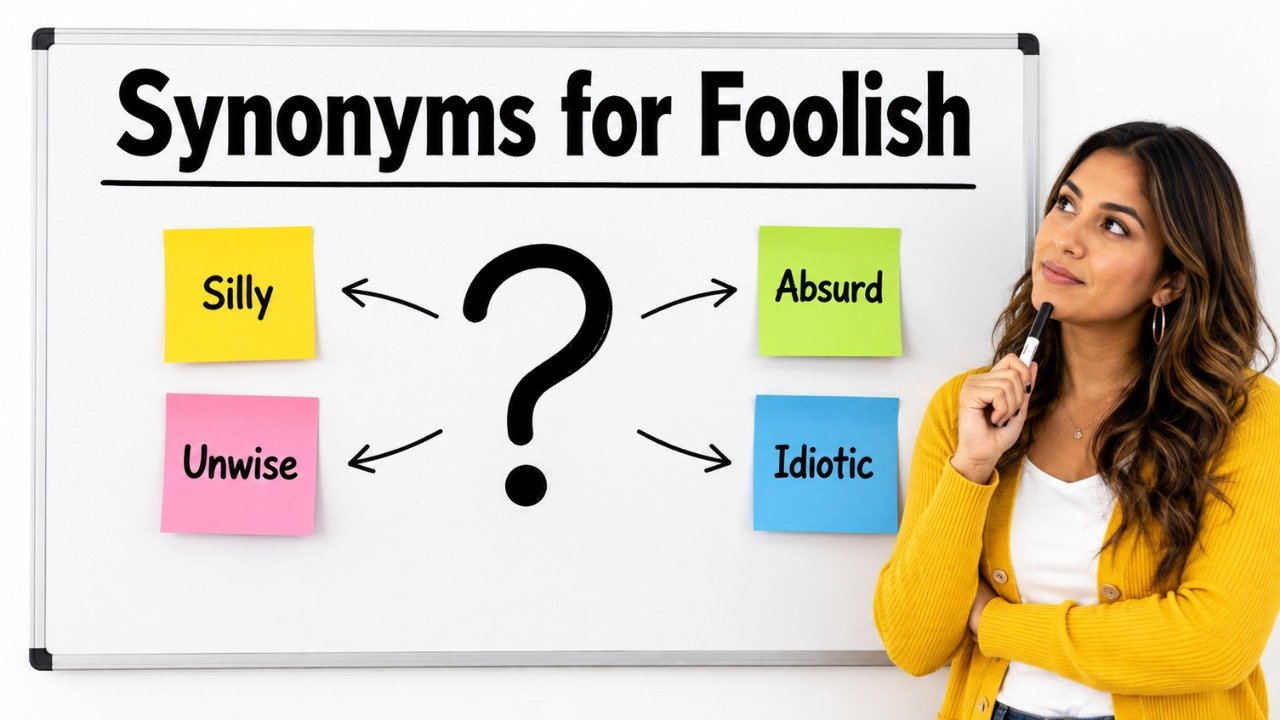
Quick Answer: The best synonyms for foolish include stupid, unwise, silly, senseless, imprudent, irrational, reckless, absurd, thoughtless, and ridiculous. Use unwise or imprudent in formal writing when describing a poor decision. Use silly in casual speech for behavior that is not serious. Choose irrational when a decision lacks logical reasoning, reckless when someone ignores possible danger, and absurd or ridiculous when an idea seems extremely unreasonable.
Pronunciation and Word Details
Word: Foolish.
Pronunciation: /ˈfuːlɪʃ/.
Part of Speech: Adjective.
Meaning: Lacking good judgment, wisdom, or sensible thinking.
US Pronunciation:
UK Pronunciation:
What Does “Foolish” Mean?
Foolish means showing a lack of good judgment, wisdom, or sensible thinking. It is an adjective commonly used to describe a person, decision, action, idea, belief, or behavior that seems unreasonable or likely to cause problems.
Someone may be called foolish when they act without considering the consequences. A decision may also be foolish if it involves unnecessary risk or ignores obvious facts.
The meaning can change slightly depending on the sentence. Foolish may describe harmless silliness, poor judgment, irrational thinking, careless behavior, or a seriously unwise decision.
Example: It was foolish to leave the door unlocked overnight.
Here, foolish means unwise because the action created an unnecessary risk.
Example: They laughed about the foolish mistake later.
In this sentence, foolish has a milder tone and describes a mistake caused by poor judgment rather than serious recklessness.
Meaning, Tone, and Context of “Foolish”
Foolish usually has a negative tone because it suggests that someone has failed to think wisely or sensibly. However, its strength depends on context.
In everyday conversation, foolish can sound less harsh than words such as stupid or idiotic. It often criticizes an action rather than attacking a person’s intelligence.
In formal writing, alternatives such as unwise, imprudent, irrational, or ill considered may sound more precise. These words describe the type of poor judgment involved without sounding overly emotional.
In casual conversation, silly can work when the behavior is harmless or amusing. Reckless is stronger and should be used when the behavior involves danger or serious consequences.
Absurd and ridiculous are useful when an idea, argument, suggestion, or situation appears extremely unreasonable.
When and How to Use “Foolish”
For Poor Decisions: Use foolish when someone makes a choice that shows weak judgment.
Example: It would be foolish to spend all your savings on one purchase.
For Careless Actions: Foolish can describe behavior that ignores obvious consequences.
Example: Driving without checking the weather conditions was foolish.
For Irrational Thinking: Use foolish when an idea lacks reasonable thought.
Example: His foolish belief prevented him from considering the evidence.
For Unnecessary Risk: Foolish can describe actions that expose someone to avoidable danger.
Example: It was foolish to enter the damaged building alone.
For Harmless Silliness: In lighter contexts, foolish can describe playful or embarrassing behavior.
Example: We made foolish faces for the camera.
For Regret: Foolish often appears when someone recognizes that a past action was poorly judged.
Example: She felt foolish for believing the rumor so quickly.
Best Synonyms for Foolish
Unwise: Showing poor judgment or a lack of wisdom.
Example: It would be unwise to make such an important decision without reviewing the facts.
Silly: Lacking seriousness or sensible thought, often in a harmless way.
Example: They laughed at the silly mistake.
Senseless: Lacking a reasonable purpose or logical explanation.
Example: The argument became a senseless waste of time.
Imprudent: Failing to consider the possible consequences of an action.
Example: Making such a large investment without research would be imprudent.
Irrational: Not based on logic or reasonable thinking.
Example: His irrational fear affected his decision.
Reckless: Acting without proper concern for danger or consequences.
Example: Her reckless driving placed everyone at risk.
Absurd: Extremely unreasonable or illogical.
Example: The suggestion that nobody needed preparation was absurd.
Thoughtless: Acting without considering consequences or other people.
Example: It was thoughtless to make that comment in front of everyone.
Ridiculous: So unreasonable or inappropriate that it seems deserving of criticism or laughter.
Example: The demand seemed completely ridiculous.
Stupid: Showing very poor judgment or understanding.
Example: He admitted that ignoring the warning had been a stupid decision.
50 Synonyms for Foolish with Short Meanings
- Stupid: Showing very poor judgment or understanding.
- Unwise: Lacking wisdom or sensible judgment.
- Silly: Not sensible or serious.
- Senseless: Without reasonable purpose or logic.
- Imprudent: Failing to consider possible consequences.
- Irrational: Not guided by reason or logic.
- Reckless: Careless about danger or consequences.
- Absurd: Extremely unreasonable or illogical.
- Thoughtless: Acting without proper consideration.
- Ridiculous: Extremely unreasonable or inappropriate.
- Unreasonable: Not based on fair or sensible judgment.
- Illogical: Not following sound reasoning.
- Mindless: Done without careful thought.
- Brainless: Showing an extreme lack of sensible thought.
- Idiotic: Extremely foolish or unreasonable.
- Moronic: Extremely lacking in good judgment.
- Inane: Empty, pointless, or foolish.
- Asinine: Extremely foolish or unintelligent.
- Daft: Foolish or slightly ridiculous.
- Dumb: Showing poor judgment or understanding.
- Fatuous: Foolish and lacking serious thought.
- Nonsensical: Making little or no logical sense.
- Preposterous: Completely unreasonable or absurd.
- Ludicrous: So unreasonable that it seems laughable.
- Laughable: Too foolish or unreasonable to be taken seriously.
- Unthinking: Acting without careful consideration.
- Careless: Not giving enough attention to consequences.
- Rash: Acting too quickly without considering risks.
- Hasty: Done too quickly and without enough thought.
- Impulsive: Acting suddenly without careful planning.
- Shortsighted: Failing to consider future consequences.
- Misguided: Based on mistaken judgment or beliefs.
- Ill advised: Not wise or sensible.
- Injudicious: Showing poor judgment.
- Indiscreet: Lacking good judgment about what to say or do.
- Naive: Lacking experience or practical judgment.
- Gullible: Too willing to believe what others say.
- Credulous: Too ready to believe something without evidence.
- Childish: Showing immature or unreasonable behavior.
- Immature: Lacking mature judgment or behavior.
- Frivolous: Not serious when seriousness is needed.
- Foolhardy: Taking unnecessary risks because of poor judgment.
- Unthinking: Showing little or no careful consideration.
- Improvident: Failing to plan wisely for the future.
- Scatterbrained: Forgetful or poorly organized in thought.
- Obtuse: Slow to understand something obvious.
- Dense: Slow to understand or recognize something.
- Unintelligent: Showing limited understanding or reasoning.
- Feckless: Lacking good judgment, responsibility, or effectiveness.
- Indiscriminate: Acting without careful judgment or distinction.
Read Also:
Synonyms for Interests
Synonyms for Foolish by Context
When Foolish Means Unwise
Unwise, imprudent, ill advised, injudicious, and shortsighted are strong choices when foolish describes a bad decision.
Example: It would be unwise to sign the agreement before reading it carefully.
Unwise is especially useful in professional, academic, and formal writing because it criticizes the decision without insulting the person.
When Foolish Means Silly
Silly, childish, daft, frivolous, and ridiculous can describe foolish behavior that is amusing, immature, or not especially serious.
Example: We spent the afternoon telling silly jokes.
Silly is generally softer than foolish and works well when the behavior causes little or no harm.
When Foolish Means Irrational
Irrational, illogical, senseless, nonsensical, and absurd work when an idea or belief lacks reasonable support.
Example: Refusing to consider any evidence would be irrational.
These alternatives focus on weak reasoning rather than intelligence.
When Foolish Means Reckless
Reckless, rash, foolhardy, careless, and impulsive describe behavior that ignores possible consequences.
Example: Attempting the climb without proper equipment was foolhardy.
Foolhardy is particularly useful when someone accepts an obvious and unnecessary risk.
When Foolish Means Easily Deceived
Naive, gullible, credulous, and misguided can describe someone whose lack of experience or judgment makes them easy to mislead.
Example: He was too gullible to question the unbelievable promise.
These words should be chosen carefully because each describes a specific weakness in judgment.
Another Word for Foolish
The best single replacement for foolish is often unwise because it clearly describes poor judgment without sounding unnecessarily insulting. However, the strongest alternative depends on what makes the action, person, or idea foolish.
Original: It was foolish to ignore the financial risks.
Better Option: It was unwise to ignore the financial risks.
Original: His foolish reaction was based entirely on fear.
Better Option: His irrational reaction was based entirely on fear.
Original: They made a foolish attempt to cross the river during the storm.
Better Option: They made a reckless attempt to cross the river during the storm.
Original: Her foolish joke interrupted the serious discussion.
Better Option: Her silly joke interrupted the serious discussion.
When Not to Use “Foolish”
Foolish is broad, so it may not always explain exactly what is wrong with a decision or behavior. A more specific synonym can often improve clarity.
Avoid foolish when you need to identify a particular type of poor judgment.
Weak: The company made a foolish financial decision.
Better: The company made an imprudent financial decision.
Imprudent is more precise because it emphasizes failure to consider consequences.
Avoid foolish when the main issue is danger.
Weak: It was foolish to race through the crowded street.
Better: It was reckless to race through the crowded street.
Reckless clearly communicates the risk involved.
Avoid foolish when describing a harmless action that is merely playful.
Weak: We spent the evening doing foolish dances.
Better: We spent the evening doing silly dances.
Silly sounds lighter and more natural in this context.
Avoid repeatedly describing a person as foolish when the real issue is one particular action. Criticizing the action is usually clearer and more precise.
Weak: He is foolish.
Better: His decision to ignore the warning was unwise.
Words Commonly Confused With Foolish
Foolish vs Stupid: Foolish usually focuses on poor judgment, while stupid can criticize intelligence more directly and may sound harsher.
Foolish vs Silly: Foolish often suggests a genuine mistake in judgment, while silly usually describes harmless, playful, or unserious behavior.
Foolish vs Unwise: Both indicate poor judgment, but unwise is more neutral and appropriate for formal writing.
Foolish vs Reckless: Foolish is broad, while reckless specifically describes disregard for danger or serious consequences.
Foolish vs Irrational: Foolish describes poor judgment generally, while irrational emphasizes thinking that is not based on logic or reason.
Foolish vs Naive: Foolish can describe many kinds of bad judgment. Naive specifically suggests limited experience or understanding.
Foolish vs Gullible: Foolish is general, while gullible describes someone who believes people or claims too easily.
Foolish vs Absurd: Foolish often describes actions or decisions. Absurd is especially useful for ideas, claims, situations, or arguments that seem extremely unreasonable.
Which Synonym Should You Choose?
Choose unwise when you want a neutral and professional way to describe poor judgment.
Choose imprudent for formal writing about decisions where consequences were not properly considered.
Choose silly when the behavior is harmless, playful, embarrassing, or unserious.
Choose irrational when emotions, fears, or beliefs override logical reasoning.
Choose reckless when someone ignores danger or acts without concern for serious consequences.
Choose foolhardy when someone knowingly takes an unnecessary risk.
Choose absurd when an idea, argument, claim, or proposal is extremely unreasonable.
Choose senseless when an action or situation has little purpose or reason.
Choose thoughtless when the problem is a lack of consideration for consequences or other people.
Choose misguided when someone’s action comes from mistaken beliefs or poor advice.
In reports and essays, unwise, imprudent, irrational, misguided, and injudicious usually sound more precise than emotional alternatives.
In ordinary conversation, silly, stupid, ridiculous, or foolish may sound more natural, depending on how strong the criticism should be.
Real Life Examples of “Foolish” in Sentences
Original: It was foolish to leave without checking the fuel level.
Better Option: It was unwise to leave without checking the fuel level.
Original: She made a foolish decision because she was angry.
Better Option: She made an irrational decision because she was angry.
Original: Running across the icy road was foolish.
Better Option: Running across the icy road was reckless.
Original: He felt foolish after believing the obvious joke.
Better Option: He felt gullible after believing the obvious joke.
Original: Their foolish argument continued for hours.
Better Option: Their senseless argument continued for hours.
Original: It was foolish to invest without researching the risks.
Better Option: It was imprudent to invest without researching the risks.
Original: The children laughed at their foolish game.
Better Option: The children laughed at their silly game.
Original: Her foolish assumption caused unnecessary confusion.
Better Option: Her misguided assumption caused unnecessary confusion.
Original: The proposal sounded foolish to everyone in the meeting.
Better Option: The proposal sounded absurd to everyone in the meeting.
Original: His foolish attempt to jump the barrier resulted in an injury.
Better Option: His foolhardy attempt to jump the barrier resulted in an injury.
Synonym Groups and Usage Differences
Poor Judgment Group
Unwise, imprudent, injudicious, ill advised, and misguided describe choices made without enough wisdom or careful judgment.
These words are useful when discussing decisions rather than intelligence.
Example: Accepting the offer without reviewing the conditions was imprudent.
Illogical Thinking Group
Irrational, illogical, absurd, nonsensical, and senseless describe thinking that lacks reason or logical support.
These words work especially well with beliefs, arguments, conclusions, and reactions.
Example: His conclusion was illogical because it ignored the strongest evidence.
Risk Taking Group
Reckless, rash, foolhardy, impulsive, and careless describe behavior that fails to consider possible danger or consequences.
Example: Leaving the marked trail during the storm was reckless.
Harmless Silliness Group
Silly, daft, childish, frivolous, and ridiculous can describe behavior that is unserious, immature, or amusing.
Example: They laughed about their silly costumes all evening.
Lack of Awareness Group
Naive, gullible, credulous, obtuse, and shortsighted can describe different weaknesses in understanding or judgment.
Naive suggests limited experience. Gullible and credulous suggest believing things too easily. Shortsighted means failing to consider future consequences.
Example: His shortsighted decision saved money today but created larger costs later.
Antonyms of Foolish
The opposite of foolish depends on whether the word refers to judgment, reasoning, caution, or maturity.
Wise: Showing good judgment and understanding.
Sensible: Acting according to practical and reasonable judgment.
Prudent: Carefully considering possible consequences.
Rational: Guided by reason and logical thinking.
Intelligent: Showing strong understanding and mental ability.
Thoughtful: Giving careful consideration to actions or other people.
Judicious: Showing balanced and sensible judgment.
Cautious: Taking care to avoid unnecessary danger.
Reasonable: Based on sound judgment and logic.
Mature: Showing developed judgment and responsible behavior.
Discerning: Able to judge differences and quality carefully.
Responsible: Acting with proper awareness of duties and consequences.
Comparison: Foolish vs Related Words
Foolish vs Unwise
Foolish and unwise both describe poor judgment, but unwise is usually more neutral and professional. Foolish may sound more personal or critical.
Example With Foolish: It was foolish to ignore every warning.
Example With Unwise: It was unwise to proceed without additional information.
Foolish vs Silly
Foolish usually suggests poor judgment, while silly often describes behavior that is harmless, playful, or amusing.
Example With Foolish: It was foolish to risk your savings on an uncertain plan.
Example With Silly: We made silly faces while waiting for dinner.
Foolish vs Reckless
Foolish can describe almost any poorly judged action. Reckless specifically suggests ignoring danger or serious consequences.
Example With Foolish: His decision to leave early was foolish.
Example With Reckless: His decision to drive at extreme speed was reckless.
Foolish vs Irrational
Foolish refers broadly to poor judgment. Irrational describes behavior or thinking that is not based on reason or logic.
Example With Foolish: She made a foolish assumption about the situation.
Example With Irrational: Her irrational fear stopped her from considering the evidence.
Foolish vs Imprudent
Both words describe poor judgment, but imprudent is more formal and emphasizes failure to think about consequences.
Example With Foolish: Spending the entire budget immediately was foolish.
Example With Imprudent: Spending the entire budget immediately was imprudent.
Foolish vs Absurd
Foolish can describe people, actions, ideas, or decisions. Absurd is particularly strong for ideas or situations that seem completely unreasonable.
Example With Foolish: His decision seemed foolish.
Example With Absurd: His claim that preparation was unnecessary seemed absurd.
Common Phrases and Expressions With Foolish
Foolish Decision: A choice made without enough wisdom or careful thought.
Foolish Mistake: An error caused by poor judgment.
Foolish Behavior: Conduct that lacks good sense or maturity.
Foolish Idea: A suggestion or thought that seems unreasonable.
Foolish Question: A question perceived as lacking sense or careful thought.
Foolish Pride: Excessive pride that causes someone to make poor choices.
Foolish Risk: An unnecessary danger accepted without proper judgment.
Foolish Assumption: A belief accepted without enough evidence or thought.
Feel Foolish: To feel embarrassed because of a mistake or misunderstanding.
Look Foolish: To appear lacking in judgment or awareness.
Common Mistakes to Avoid
One common mistake is using foolish for every type of poor decision. More precise words often make the meaning clearer.
If the problem is danger, reckless may be better. If the problem is faulty reasoning, irrational or illogical may work better. If the behavior is harmless, silly may sound more appropriate.
Another mistake is choosing an unnecessarily insulting synonym. Words such as stupid, idiotic, moronic, and brainless can sound much harsher than foolish. They may be inappropriate in professional or respectful communication.
Avoid confusing naive with foolish. A naive person may make a poor decision because they lack experience, while foolish simply describes poor judgment.
Do not use gullible unless the person is too willing to believe what others say.
Repetition can also weaken writing. Instead of repeating foolish several times in one paragraph, choose alternatives that express the exact reason each action is poorly judged.
Finally, make sure the synonym matches the noun it describes. An absurd argument, reckless action, imprudent investment, irrational fear, and silly joke each communicate a more specific idea than foolish alone.
Conclusion
The most useful synonyms for foolish depend on why a person, action, decision, or idea lacks good judgment. Use unwise or imprudent for poor decisions, irrational for reasoning without logic, reckless or foolhardy for dangerous behavior, and silly for harmless or playful actions. Words such as absurd, senseless, and ridiculous work well for unreasonable ideas or situations. Choosing the most precise alternative makes your writing clearer, more natural, and better suited to the intended tone.
FAQs About Synonyms for Foolish
What Is the Best Synonym for Foolish?
The best general synonym is unwise because it communicates poor judgment clearly without sounding excessively insulting.
What Is a Formal Synonym for Foolish?
Imprudent, injudicious, unwise, and ill advised are useful formal alternatives. Imprudent is especially suitable when someone fails to consider consequences.
What Is a Polite Word for Foolish?
Unwise is usually one of the most polite choices. Misguided can also work when someone’s decision comes from mistaken information or beliefs.
What Is a Stronger Word Than Foolish?
Reckless, absurd, idiotic, or foolhardy can be stronger, but they express different meanings. Reckless emphasizes danger, while absurd emphasizes extreme unreasonableness.
Is Silly the Same as Foolish?
Not exactly. Silly usually describes harmless or unserious behavior, while foolish more often suggests poor judgment that may have negative consequences.
What Is the Difference Between Foolish and Reckless?
Foolish broadly means lacking good judgment. Reckless specifically means acting without enough concern for danger or serious consequences.
Can Foolish Be Used in Formal Writing?
Yes, but more precise words such as unwise, imprudent, irrational, misguided, or injudicious may sound more appropriate in professional, academic, or analytical writing.
