
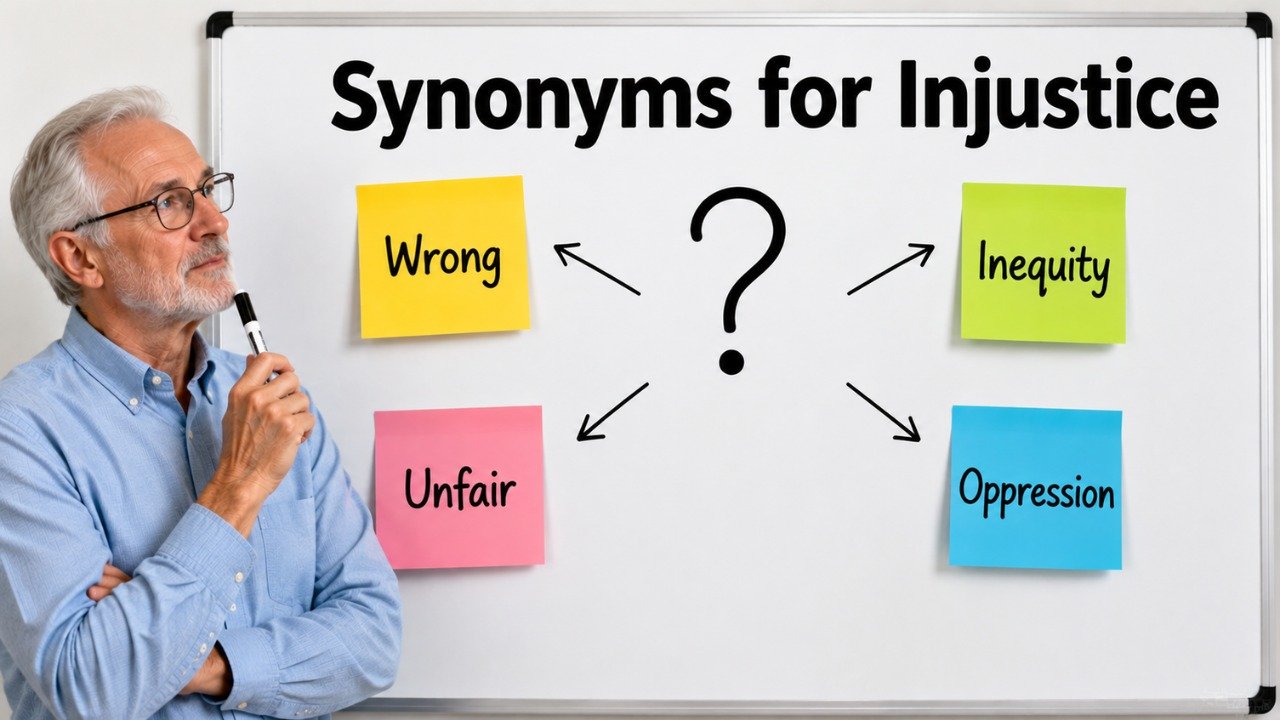
Quick Answer: The best synonyms for injustice include unfairness, inequity, wrongdoing, oppression, discrimination, mistreatment, exploitation, bias, corruption, and abuse. Use unfairness for everyday situations, inequity for unequal systems or outcomes, wrongdoing for immoral conduct, oppression for severe control, discrimination for unequal treatment based on identity or group membership, and abuse for harmful misuse of authority.
Pronunciation and Word Details
Word: Injustice.
Pronunciation: /ɪnˈdʒʌstɪs/
Part of Speech: Noun.
Meaning: Unfair treatment, an unjust action, or a failure to protect someone’s rights.
US Pronunciation:
UK Pronunciation:
What Does “Injustice” Mean?
Injustice means unfair treatment, an unfair decision, or a situation in which people do not receive the rights, protection, or opportunities they deserve.
The word injustice is a noun. It may describe one particular wrong, such as an unfair punishment, or a wider problem, such as unequal access to education, employment, safety, or legal protection.
Injustice can appear in personal, professional, legal, political, educational, and social contexts. A person may experience injustice when a decision is based on prejudice rather than facts. A community may experience injustice when a system repeatedly favors one group over another.
The word can refer to both actions and conditions. An unjust action may be a single injustice, while an unfair system may create continuing injustice.
Personal Context: She felt that being blamed without evidence was an injustice.
Legal Context: The new evidence helped correct an injustice.
Social Context: The campaign focused on reducing injustice in access to education.
Workplace Context: Unequal promotion standards can create a sense of injustice among employees.
Meaning, Tone, and Context of “Injustice”
Injustice has a serious and emotionally powerful tone. It is stronger than the everyday word unfairness because it often suggests a violation of rights, morality, law, or accepted standards of justice.
The word is common in formal writing, essays, reports, speeches, legal discussions, historical writing, and conversations about ethics. It may also appear in everyday speech when someone feels deeply wronged.
Formal Tone: Injustice is appropriate when discussing laws, institutions, rights, policies, or serious ethical problems.
Emotional Tone: The word may express anger, pain, disappointment, or moral concern.
Academic Tone: Researchers and students may use injustice when examining inequality, discrimination, poverty, power, or access to resources.
Legal Tone: In legal contexts, injustice may describe an unfair judgment, improper process, denial of rights, or miscarriage of justice.
Conversational Tone: In everyday conversation, unfairness often sounds more natural unless the situation is especially serious.
Injustice may describe something deliberate, such as discrimination, or something caused by a flawed rule, careless decision, or unequal system. The word does not always prove illegal conduct. It may also refer to actions that are morally or socially unfair.
When and How to Use “Injustice”
Use injustice when you need to describe serious unfairness, denied rights, unequal treatment, or a harmful failure of justice.
For Unfair Treatment: Use injustice when someone is treated according to unequal or unreasonable standards.
Example: Punishing one employee while ignoring the same behavior in others was an injustice.
For Denied Rights: Use injustice when a person or group is prevented from receiving basic rights or protections.
Example: Denying qualified citizens access to public services can create injustice.
For Legal Failures: Use injustice when a legal decision or process produces an unfair result.
Example: The lawyer worked to correct the injustice caused by the mistaken conviction.
For Social Inequality: Use injustice when discussing unfair conditions that affect communities or social groups.
Example: The report examined injustice in housing, education, and employment.
For Abuse of Authority: Use injustice when people in power misuse their position.
Example: The official’s actions were viewed as an injustice against local residents.
For Moral Criticism: Use injustice when judging an action as ethically wrong.
Example: Remaining silent about the injustice would have contradicted her values.
For Historical Discussion: Use injustice when describing harmful treatment or unequal systems from the past.
Example: The memorial recognizes those who suffered historical injustice.
For Personal Grievances: Use injustice when a person believes that a serious wrong has been committed against them.
Example: He considered the false accusation a personal injustice.
Best Synonyms for Injustice
Unfairness
Synonym: A lack of fair or equal treatment.
Example: The students complained about the unfairness of the grading system.
Inequity
Synonym: An unfair difference in treatment, access, resources, or outcomes.
Example: The policy was revised to address inequity in health services.
Wrongdoing
Synonym: Conduct that is immoral, dishonest, or unlawful.
Example: The investigation revealed years of financial wrongdoing.
Oppression
Synonym: Cruel or unjust control over people.
Example: The citizens resisted years of political oppression.
Discrimination
Synonym: Unfair treatment based on a personal trait or group identity.
Example: The organization introduced procedures for reporting discrimination.
Mistreatment
Synonym: Cruel, harmful, or unfair treatment.
Example: The employee reported repeated mistreatment by her supervisor.
Exploitation
Synonym: Unfairly using people or resources for personal advantage.
Example: The new rules were designed to prevent worker exploitation.
Bias
Synonym: An unfair preference for or against a person, group, or idea.
Example: The selection process was reviewed for possible bias.
Corruption
Synonym: Dishonest or improper behavior by people with authority.
Example: Public trust declined after evidence of corruption appeared.
Abuse
Synonym: Harmful treatment or misuse of power.
Example: The inquiry examined allegations of abuse by senior officials.
50 Synonyms for Injustice with Short Meanings
- Unfairness: A lack of fair treatment or judgment.
- Inequity: An unfair difference in opportunity, treatment, or outcome.
- Wrongdoing: Immoral, dishonest, or unlawful behavior.
- Oppression: Cruel or unjust control over others.
- Discrimination: Unequal treatment based on identity or group membership.
- Bias: An unfair preference or judgment.
- Prejudice: An unreasonable negative opinion formed without sufficient facts.
- Mistreatment: Harmful, cruel, or unfair treatment.
- Exploitation: Unfair use of someone for personal benefit.
- Abuse: Harmful treatment or misuse of authority.
- Corruption: Dishonest conduct involving power or responsibility.
- Tyranny: Cruel and unjust rule or control.
- Persecution: Persistent cruel treatment because of beliefs or identity.
- Partiality: Unfair support for one side or person.
- Favoritism: Unfair preference given to selected people.
- Inequality: An unequal condition involving rights, status, or opportunity.
- Wrong: An action that is morally or legally unacceptable.
- Grievance: A complaint caused by unfair treatment.
- Injury: Harm done to a person’s rights, interests, or reputation.
- Violation: An act that breaks a right, rule, law, or agreement.
- Transgression: An action that breaks a moral or legal rule.
- Offense: An action that breaks a rule or causes serious harm.
- Impropriety: Behavior that is dishonest, unsuitable, or morally wrong.
- Malpractice: Improper professional conduct that causes harm.
- Misrule: Bad or unjust government.
- Despotism: Absolute and oppressive control.
- Repression: Forceful restriction of freedom, expression, or action.
- Subjugation: The act of bringing people under unfair control.
- Victimization: Unfairly targeting someone for harmful treatment.
- Marginalization: Pushing people to a less powerful social position.
- Disenfranchisement: Depriving people of rights, power, or participation.
- Exclusion: Preventing someone from participating or receiving access.
- Double Standard: An unfair use of different rules for similar situations.
- Unequal Treatment: Treating comparable people according to different standards.
- Unfair Treatment: Behavior that lacks equality, reason, or justice.
- Denial of Rights: Refusing someone the rights they should receive.
- Breach of Justice: A failure to follow fair and lawful principles.
- Miscarriage of Justice: A seriously incorrect or unfair legal outcome.
- Judicial Error: A legal mistake that may produce an unfair result.
- Legal Wrong: An action that violates a legal right or duty.
- Social Wrong: A harmful condition that damages people or communities.
- Moral Wrong: An action that violates ethical principles.
- Institutional Bias: Unfair preference built into an organization’s practices.
- Systemic Inequality: Unequal treatment or opportunity produced by a system.
- Arbitrary Treatment: Treatment based on personal choice rather than fair rules.
- Abuse of Power: Improper use of authority to control or harm others.
- Violation of Rights: Failure to respect or protect legal or human rights.
- Inequitable Treatment: Treatment that produces an unfair result.
- Unjust Act: A particular action that violates fairness or justice.
- Unfair Practice: A method or policy that disadvantages people without good reason.
Read Also:
Synonyms for Hello
Synonyms for Injustice by Context
When Injustice Means Everyday Unfairness
Unfairness is the most natural replacement when discussing ordinary decisions, rules, punishments, or disagreements. It is less severe than injustice and works well in casual speech.
Useful Synonyms: Unfairness, favoritism, partiality, bias, double standard, unequal treatment.
Example: The players objected to the unfairness of changing the rules during the match.
Example: Giving one department special privileges showed clear favoritism.
When Injustice Means Unequal Opportunity
Inequity and inequality work well when people do not receive equal access, support, resources, rights, or opportunities.
Useful Synonyms: Inequity, inequality, systemic inequality, exclusion, marginalization, disenfranchisement.
Example: The program aims to reduce inequity in access to education.
Example: Poor transportation can deepen inequality between communities.
When Injustice Means Harmful Treatment
Mistreatment and abuse are suitable when someone is treated cruelly, disrespectfully, or harmfully.
Useful Synonyms: Mistreatment, abuse, victimization, persecution, exploitation, unfair treatment.
Example: The investigation examined reports of mistreatment at the facility.
Example: Stronger protections were introduced to prevent exploitation.
When Injustice Means Unfair Control
Oppression is the strongest choice when people are controlled through fear, force, punishment, or severe restrictions.
Useful Synonyms: Oppression, tyranny, repression, subjugation, despotism, persecution.
Example: The population struggled under years of political oppression.
Example: Strict censorship became a tool of repression.
When Injustice Means Dishonest Conduct
Wrongdoing and corruption are appropriate when the unfairness involves dishonesty, misconduct, or misuse of authority.
Useful Synonyms: Wrongdoing, corruption, impropriety, malpractice, abuse of power, violation.
Example: The audit uncovered serious wrongdoing in the department.
Example: The reforms were intended to reduce corruption in public offices.
When Injustice Means a Legal Failure
Miscarriage of justice is the clearest expression for a legal outcome in which an innocent person is punished or a guilty person escapes proper judgment.
Useful Synonyms: Miscarriage of justice, judicial error, legal wrong, violation of rights, breach of justice.
Example: The overturned conviction was described as a miscarriage of justice.
Example: The appeal identified a judicial error in the original hearing.
Another Word for Injustice
The best general replacement for injustice is unfairness. It is simple, familiar, and suitable for many personal and everyday situations. However, the strongest alternative depends on the type and seriousness of the problem.
Use inequity for unequal systems or outcomes. Use oppression for severe and continuing control. Use discrimination for unequal treatment based on identity or group membership. Use wrongdoing when the focus is immoral or unlawful conduct.
Original: The students spoke about the injustice of the new grading rule.
Better Option: The students spoke about the unfairness of the new grading rule.
Original: The study examines injustice in access to medical care.
Better Option: The study examines inequity in access to medical care.
Original: The people resisted years of injustice under the regime.
Better Option: The people resisted years of oppression under the regime.
Original: The inquiry found evidence of injustice in the hiring process.
Better Option: The inquiry found evidence of discrimination in the hiring process.
When Not to Use “Injustice”
Do not use injustice when a simpler word would describe a minor inconvenience or personal disappointment more accurately. The word can sound exaggerated when the problem is small.
Weak: It was an injustice that the café ran out of my favorite cake.
Better: It was disappointing that the café ran out of my favorite cake.
Avoid injustice when you know the precise type of unfairness. A more exact synonym can make the sentence clearer.
Weak: The report discusses injustice in employee salaries.
Better: The report discusses pay inequity among employees.
Do not use injustice when referring specifically to dishonest professional behavior.
Weak: The doctor was investigated for injustice.
Better: The doctor was investigated for malpractice.
Avoid repeating injustice several times in the same paragraph.
Weak: The injustice affected the community, and the injustice caused anger because the injustice had continued for years.
Better: The unfair policy affected the community and caused anger because the unequal treatment had continued for years.
Do not use injustice as a direct substitute for inequality in every sentence. Inequality describes a difference, while injustice presents that difference as unfair or morally wrong.
Weak: The height injustice between the two buildings is obvious.
Better: The height difference between the two buildings is obvious.
Words Commonly Confused With Injustice
Injustice vs Unfairness: Injustice often describes a serious moral, social, or legal wrong. Unfairness is broader and more common in everyday situations.
Injustice vs Inequality: Injustice means a lack of justice or fair treatment. Inequality means that two people, groups, or conditions are not equal. Inequality becomes injustice when the difference is unfair or harmful.
Injustice vs Inequity: Injustice is a broad term for an unfair act or condition. Inequity usually refers to an avoidable and unfair difference in access, treatment, resources, or outcomes.
Injustice vs Discrimination: Injustice includes many kinds of unfairness. Discrimination is a particular form of injustice involving unequal treatment based on a trait, identity, or group.
Injustice vs Oppression: Injustice may involve one unfair action. Oppression usually involves severe, continuing control or mistreatment by a powerful person, group, or system.
Injustice vs Wrongdoing: Injustice focuses on the unfair harm or result. Wrongdoing focuses on the immoral, dishonest, or illegal behavior that caused it.
Injustice vs Corruption: Injustice is any serious lack of fairness. Corruption specifically involves dishonest or improper use of power, position, or responsibility.
Injustice vs Abuse: Injustice is a broad failure of fairness. Abuse involves harmful treatment or improper use of authority and may be physical, emotional, financial, institutional, or professional.
Which Synonym Should You Choose?
Choose unfairness for everyday conversations about unequal rules, decisions, punishments, or opportunities.
Choose inequity for formal writing about unfair differences in education, health, employment, income, resources, or public services.
Choose inequality when describing a measurable difference in status, opportunity, wealth, or access. Use injustice when you also want to judge that difference as unfair.
Choose wrongdoing when the focus is on immoral, dishonest, or unlawful conduct.
Choose oppression when describing severe and continuing control by a powerful authority or system.
Choose discrimination when unequal treatment is connected to identity, background, disability, age, sex, belief, or group membership.
Choose mistreatment when someone is treated badly, cruelly, or disrespectfully.
Choose exploitation when someone benefits unfairly from another person’s work, weakness, trust, or lack of power.
Choose bias when an opinion, decision, or process unfairly favors one side.
Choose corruption for reports or essays about dishonest behavior by people who hold authority.
Choose miscarriage of justice when discussing an incorrect or unfair legal outcome.
Choose abuse of power when a person uses authority to intimidate, punish, control, or gain an improper advantage.
Real Life Examples of “Injustice” in Sentences
Original: The workers protested against the injustice of receiving lower wages for equal work.
Better Option: The workers protested against the pay inequity they experienced.
Original: She believed the decision was an injustice.
Better Option: She believed the decision was deeply unfair.
Original: The documentary explores injustice within the legal system.
Better Option: The documentary explores miscarriages of justice within the legal system.
Original: The organization supports people who have experienced injustice at work.
Better Option: The organization supports people who have experienced workplace discrimination.
Original: The new policy was created to reduce injustice in public education.
Better Option: The new policy was created to reduce inequity in public education.
Original: Residents demanded action against the injustice caused by local officials.
Better Option: Residents demanded action against the abuse of power by local officials.
Original: The novel shows how ordinary people respond to injustice.
Better Option: The novel shows how ordinary people respond to oppression.
Original: Ignoring the evidence would create a serious injustice.
Better Option: Ignoring the evidence would result in a serious legal wrong.
Original: He spoke openly about the injustice he had suffered.
Better Option: He spoke openly about the mistreatment he had suffered.
Original: The committee investigated injustice in the selection process.
Better Option: The committee investigated possible bias in the selection process.
Synonym Groups and Usage Differences
Fairness Group
This group includes general words for unequal or unreasonable treatment. These terms are useful when the exact cause of the problem is not the main focus.
Synonyms: Unfairness, inequity, inequality, partiality, favoritism, double standard.
Usage Difference: Unfairness is general, inequity emphasizes an unfair outcome, and favoritism involves giving special treatment to selected people.
Example: Employees complained about favoritism in promotion decisions.
Harmful Treatment Group
These words describe situations in which people experience harm, cruelty, disrespect, or unfair targeting.
Synonyms: Mistreatment, abuse, persecution, victimization, exploitation.
Usage Difference: Mistreatment is broad, abuse is stronger, persecution is persistent, and exploitation involves unfair personal gain.
Example: The regulations protect temporary workers from exploitation.
Power and Control Group
These terms describe injustice caused by rulers, authorities, institutions, or dominant groups.
Synonyms: Oppression, tyranny, repression, despotism, subjugation, abuse of power.
Usage Difference: Oppression is continuing unfair control, tyranny refers to cruel rule, and repression focuses on restricting freedom or expression.
Example: The law became an instrument of political repression.
Prejudice Group
These words relate to unfair opinions or decisions that favor one person or group over another.
Synonyms: Bias, prejudice, discrimination, partiality, institutional bias.
Usage Difference: Bias is an unfair tendency, prejudice is a judgment formed without sufficient knowledge, and discrimination is unfair treatment in action.
Example: Anonymous applications may reduce bias during early selection stages.
Legal Wrong Group
These terms are suitable for court cases, legal rights, professional duties, and official procedures.
Synonyms: Miscarriage of justice, judicial error, legal wrong, violation, breach of justice, denial of rights.
Usage Difference: A judicial error is a legal mistake, while a miscarriage of justice is the serious unfair result that may follow.
Example: New evidence showed that the conviction was a miscarriage of justice.
Misconduct Group
These words focus on improper, unethical, dishonest, or unlawful actions.
Synonyms: Wrongdoing, corruption, impropriety, malpractice, transgression, offense.
Usage Difference: Wrongdoing is general, corruption involves dishonest use of power, and malpractice refers to improper professional conduct.
Example: The review found evidence of professional malpractice.
Social Exclusion Group
These terms describe the loss of access, influence, rights, or participation.
Synonyms: Marginalization, exclusion, disenfranchisement, inequality, systemic inequality.
Usage Difference: Exclusion means being left out, marginalization means being pushed to a less powerful position, and disenfranchisement means losing rights or influence.
Example: Limited access to information can increase the marginalization of rural communities.
Antonyms of Injustice
The opposite of injustice depends on whether the sentence concerns fair treatment, equal access, legal protection, or moral conduct.
Justice: Fair treatment according to law, morality, or accepted principles.
Fairness: Reasonable and equal treatment.
Equity: Fair distribution of support, opportunity, or resources according to need.
Equality: The condition of having equal rights, status, or opportunity.
Impartiality: Fair judgment without personal preference.
Objectivity: Judgment based on facts rather than emotion or bias.
Integrity: Honest and morally responsible behavior.
Honesty: Truthful and sincere conduct.
Legitimacy: Acceptance as lawful, valid, or proper.
Lawfulness: Conduct that follows the law.
Protection: Action that keeps people and their rights safe.
Accountability: Responsibility for actions and their consequences.
Respect: Proper regard for another person’s rights and dignity.
Equal Treatment: Applying the same fair standards to comparable people.
Due Process: Fair legal procedures that protect a person’s rights.
Comparison: Injustice vs Related Words
Injustice vs Unfairness
Injustice is stronger and often suggests a serious violation of rights, law, ethics, or social standards. Unfairness can describe both serious problems and minor everyday situations.
Example With Injustice: The wrongful imprisonment was a grave injustice.
Example With Unfairness: The children complained about the unfairness of the game.
Injustice vs Inequity
Injustice is a broad word for unfair acts and conditions. Inequity describes an unfair difference in treatment, access, resources, or outcomes.
Example With Injustice: The ruling caused an injustice that affected several families.
Example With Inequity: The report identified inequity in access to specialist care.
Injustice vs Inequality
Injustice is a moral judgment that something is unfair. Inequality simply describes a lack of equality and does not always imply wrongdoing.
Example With Injustice: Denying assistance to eligible applicants was an injustice.
Example With Inequality: The study measured income inequality across regions.
Injustice vs Discrimination
Injustice is the larger category. Discrimination is a specific form of injustice in which someone receives unequal treatment because of identity, background, or group membership.
Example With Injustice: The residents demanded that the injustice be corrected.
Example With Discrimination: The applicant filed a complaint about age discrimination.
Injustice vs Oppression
Injustice may be a single act or decision. Oppression is usually severe, organized, and continuing.
Example With Injustice: The unfair penalty was an injustice.
Example With Oppression: The population lived under decades of oppression.
Injustice vs Wrongdoing
Injustice emphasizes the unfair harm experienced by a person or group. Wrongdoing emphasizes the improper action of the person responsible.
Example With Injustice: The victims asked the court to recognize the injustice.
Example With Wrongdoing: The inquiry found evidence of deliberate wrongdoing.
Injustice vs Corruption
Injustice may result from many causes, including bias, mistakes, unfair rules, or dishonesty. Corruption specifically involves dishonest use of power or responsibility.
Example With Injustice: The policy created injustice for low income families.
Example With Corruption: The officials were removed after evidence of corruption emerged.
Injustice vs Abuse
Injustice describes a failure of fairness. Abuse describes harmful treatment or misuse of authority.
Example With Injustice: The unequal punishment was an injustice.
Example With Abuse: Threatening employees was an abuse of managerial authority.
Common Phrases and Expressions With Injustice
Social Injustice: Unfair treatment or unequal conditions within society.
Legal Injustice: An unfair legal decision, process, rule, or outcome.
Economic Injustice: Unfair access to income, work, resources, or financial opportunity.
Historical Injustice: Serious unfair treatment that occurred in the past and may still have effects.
Systemic Injustice: Unfairness created or maintained by an established system.
Grave Injustice: A deeply serious and harmful wrong.
Blatant Injustice: Unfairness that is obvious and difficult to deny.
Fight Injustice: To oppose unfair treatment or harmful systems.
Suffer Injustice: To experience serious unfairness or denied rights.
Correct an Injustice: To take action that repairs or reverses an unfair result.
Common Mistakes to Avoid
Using Injustice for Minor Problems
Injustice is usually too strong for small annoyances, personal preferences, or harmless disappointments.
Incorrect: Waiting five extra minutes was a terrible injustice.
Better: Waiting five extra minutes was inconvenient.
Confusing Inequality With Injustice
Not every difference is automatically unjust. Use injustice when the difference involves unfairness, harm, or denied rights.
Incorrect: The injustice in their ages was ten years.
Better: The difference in their ages was ten years.
Using a General Word Instead of a Precise Synonym
Choose a more specific word when the type of injustice is clear.
Less Precise: The company investigated injustice in recruitment.
More Precise: The company investigated possible discrimination in recruitment.
Repeating Injustice Too Often
Repeated use can make writing sound heavy and monotonous. Replace some instances with unfairness, inequity, wrongdoing, bias, or another suitable alternative.
Repetitive: The injustice continued because the injustice was ignored by those who could end the injustice.
Improved: The unfair treatment continued because those with authority ignored the problem.
Confusing Bias With Discrimination
Bias is an unfair preference or tendency. Discrimination is unfair treatment or action. A person may have a bias without acting on it, while discrimination involves behavior or a decision.
Incorrect: The manager’s private opinion was an act of discrimination.
Better: The manager’s private opinion showed bias, while the hiring decision may have involved discrimination.
Using Oppression for a Single Minor Incident
Oppression usually describes severe or continuing control. Use unfairness or mistreatment for isolated events unless the conduct forms part of a wider pattern.
Incorrect: Not receiving the preferred desk was workplace oppression.
Better: Not receiving the preferred desk seemed unfair.
Treating Injustice as an Adjective
Injustice is a noun. The adjective is unjust.
Incorrect: The policy was injustice.
Better: The policy was unjust.
Also Correct: The policy created an injustice.
Using an Unnatural Plural
The plural injustices is correct when referring to several separate wrongs, but injustice is usually better when describing the general condition.
Awkward: The report studies injustice in several institutions and calls them one injustice.
Better: The report studies several injustices found in different institutions.
Conclusion
The best synonyms for injustice depend on the kind of unfairness being described. Use unfairness for everyday situations, inequity for unequal access or outcomes, discrimination for identity based treatment, oppression for severe control, and wrongdoing for immoral conduct. Mistreatment, exploitation, bias, corruption, and abuse are more precise in particular contexts. Understanding these synonyms for injustice helps you express the seriousness, cause, and effect of an unfair action or system with greater clarity.
FAQs About Synonyms for Injustice
What is the closest synonym for injustice?
The closest general synonym is unfairness. It works well when something lacks fair treatment, reasonable judgment, or equal standards.
What is a stronger word for injustice?
Oppression is stronger when the injustice involves severe and continuing control. Abuse, persecution, and tyranny may also be appropriate in serious contexts.
Is inequity a synonym for injustice?
Yes. Inequity describes an unfair difference in access, resources, treatment, or outcomes. It is especially useful in formal, academic, and policy writing.
What is another word for social injustice?
Useful alternatives include social inequity, systemic inequality, discrimination, marginalization, exclusion, and oppression. The best choice depends on the specific problem.
Are injustice and inequality the same?
No. Inequality means that people or conditions are not equal. Injustice means that a situation is unfair or violates rights. Some inequalities are unjust, while others are simply differences.
What is the difference between injustice and discrimination?
Injustice is a broad term for serious unfairness. Discrimination is a specific type of injustice involving unequal treatment based on identity, background, or group membership.
Can injustice be plural?
Yes. Injustices refers to several separate unfair acts or conditions. For example, a report may examine multiple injustices within a legal or social system.
