
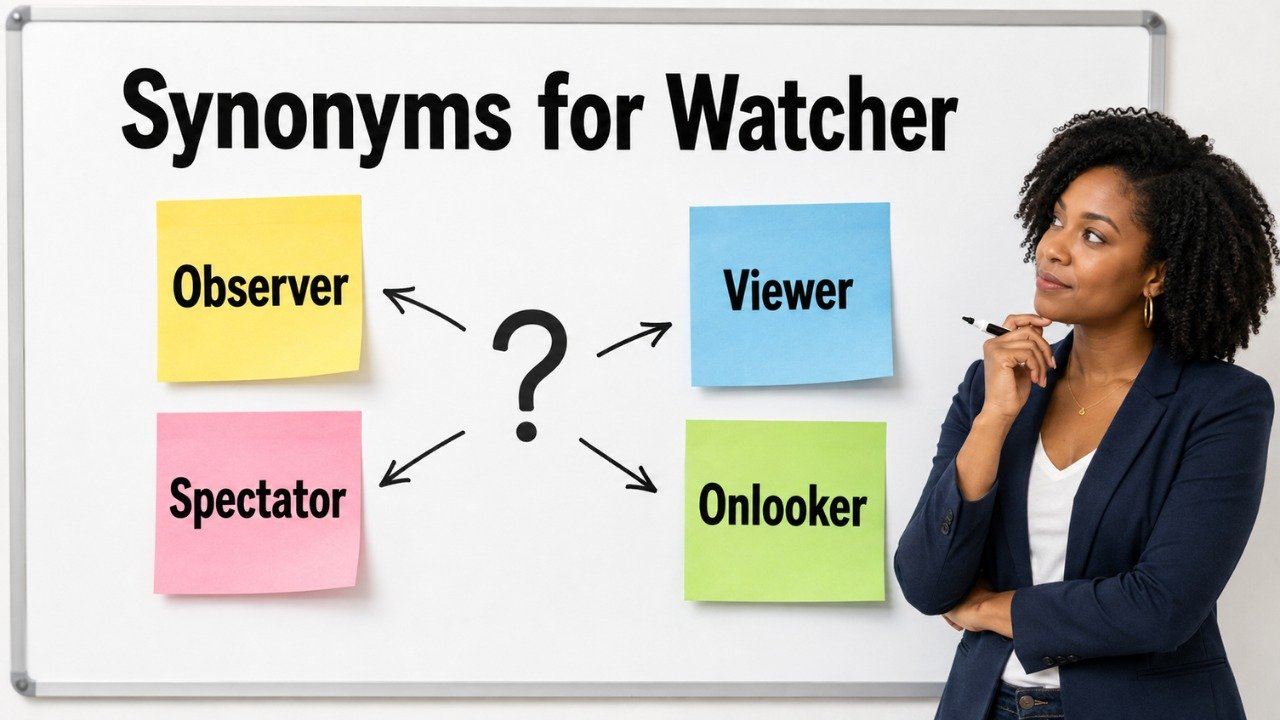
Quick Answer: Common synonyms for watcher include observer, viewer, spectator, onlooker, witness, monitor, guard, lookout, sentinel, and overseer. The best synonyms for watcher depend on context. Use observer in neutral or formal writing, viewer for someone watching visual content, spectator for sports or public events, witness for someone who sees an event happen, lookout or sentinel for protective watching, and monitor or overseer when supervision is involved.
Pronunciation and Word Details
Word: Watcher.
Pronunciation: /ˈwɒtʃər/
Part of Speech: Noun.
Meaning: A person who watches, observes, monitors, or keeps attention on someone, something, or an event.
US Pronunciation:
UK Pronunciation:
What Does “Watcher” Mean?
Watcher means a person who watches, observes, follows, or keeps attention on someone or something.
It is a noun formed from the verb watch. The word can describe someone casually looking at an event, someone carefully observing a situation, or someone responsible for monitoring, guarding, or supervising.
General Use: A watcher stood quietly near the entrance.
Event Use: The watchers followed every moment of the competition.
Monitoring Use: A watcher was assigned to observe the equipment.
Protective Use: The watcher remained alert throughout the night.
The meaning changes slightly according to context. A watcher may simply observe, actively monitor, provide security, or pay close attention to changes and developments.
Meaning, Tone, and Context of “Watcher”
Watcher is generally a neutral and understandable word, although its tone can change depending on the situation.
Neutral Tone: Watcher can simply mean someone who looks at or observes something.
Example: Several watchers gathered to see the birds near the lake.
Conversational Tone: The word is natural in everyday speech when the exact role of the person is not important.
Example: He is a regular watcher of local matches.
Formal Tone: In reports, essays, academic writing, or professional communication, observer, monitor, supervisor, or overseer may be more precise.
Example: An observer recorded changes in the participants’ behavior.
Protective Context: Watcher can refer to someone keeping guard, but guard, lookout, or sentinel often communicates the role more clearly.
Example: A lookout remained near the gate.
Literary Context: Watcher can sound descriptive or mysterious when referring to a person quietly observing from a distance.
Example: A silent watcher stood beneath the trees.
When and How to Use “Watcher”
For General Observation
Use watcher when referring broadly to someone who is looking at or following something.
Example: The watcher noticed movement across the field.
For Events and Performances
Watcher may describe someone observing an event, although spectator or viewer is often more precise.
Example: Every watcher remained focused on the final performance.
For Careful Monitoring
Use watcher when someone is keeping attention on changes, behavior, activity, or conditions.
Example: The watcher reported any unusual activity.
For Security
Watcher can describe a person who remains alert to danger or unwanted activity.
Example: A watcher stayed near the entrance throughout the night.
For Nature and Wildlife
Watcher is often useful when someone observes animals, birds, weather, or natural events.
Example: The bird watcher waited quietly beside the trees.
For Figurative Observation
Watcher can also describe someone who follows trends, behavior, politics, markets, or other developments.
Example: Experienced industry watchers noticed the change immediately.
Best Synonyms for Watcher
Observer: A person who watches or studies something carefully.
Example: The observer recorded every change in the experiment.
Viewer: A person who watches visual material, a performance, or a display.
Example: Each viewer could clearly see the presentation.
Spectator: A person who watches a sport, event, or public performance.
Example: Every spectator cheered during the final round.
Onlooker: A person who watches something happening without taking part.
Example: Curious onlookers gathered near the entrance.
Witness: A person who sees an event happen and may later describe it.
Example: The witness clearly remembered what happened.
Monitor: A person who watches a process, situation, or activity for changes or problems.
Example: The monitor checked the equipment throughout the test.
Lookout: A person who watches for danger or approaching activity.
Example: The lookout warned the group about movement ahead.
Guard: A person responsible for watching and protecting a place or person.
Example: The guard remained near the gate.
Sentinel: A person stationed to watch and protect an area.
Example: The sentinel remained alert during the night.
Overseer: A person who watches and supervises work or activity.
Example: The overseer checked the progress of the project.
50 Synonyms for Watcher with Short Meanings
- Observer: A person who watches carefully.
- Viewer: Someone who watches visual content or a display.
- Spectator: Someone watching an event or performance.
- Onlooker: Someone watching without participating.
- Witness: Someone who sees an event happen.
- Monitor: Someone who watches a situation for changes.
- Lookout: Someone watching for danger or approaching activity.
- Guard: Someone who watches and protects.
- Sentinel: A person stationed to keep watch.
- Overseer: Someone who watches and supervises activity.
- Supervisor: A person responsible for watching and directing work.
- Inspector: Someone who examines something carefully.
- Examiner: Someone who closely inspects or studies something.
- Surveyor: Someone who observes or assesses an area or condition.
- Spotter: Someone who watches closely to identify something.
- Scout: Someone who observes an area to gather information.
- Sentry: A guard positioned to watch for danger.
- Patrol: A person or group watching an area for security.
- Guardian: Someone who watches over and protects.
- Protector: Someone who keeps another person or thing safe.
- Custodian: Someone responsible for watching over property or resources.
- Keeper: Someone responsible for caring for or guarding something.
- Caretaker: Someone who watches over a person, place, or property.
- Attendant: Someone who watches, assists, or remains present.
- Chaperone: Someone who accompanies and supervises others.
- Warden: Someone responsible for supervising or guarding a place.
- Watchman: A person employed to guard or watch a location.
- Gatekeeper: Someone who controls and watches access.
- Doorkeeper: Someone who watches an entrance.
- Surveillant: A person who keeps someone or something under observation.
- Watcher Over: A person who keeps careful attention on something.
- Follower: Someone who regularly watches or follows developments.
- Tracker: Someone who follows movements, changes, or progress.
- Reviewer: Someone who watches or examines something before evaluating it.
- Evaluator: Someone who observes and judges performance or quality.
- Assessor: Someone who watches or examines before making a judgment.
- Analyst: Someone who observes information and studies patterns.
- Recorder: Someone who observes and documents events or details.
- Reporter: Someone who observes events and communicates what happened.
- Auditor: Someone who carefully examines activities, records, or processes.
- Examiner of Events: Someone who carefully watches what occurs.
- Bystander: Someone present and watching without direct involvement.
- Audience Member: A person watching a performance or presentation.
- Seer: A person who observes or perceives, especially in literary contexts.
- Beholder: A person who sees or observes something.
- Vigilant Observer: Someone who watches with close attention.
- Close Observer: Someone who studies details carefully.
- Silent Observer: Someone who watches without participating.
- Interested Observer: Someone who follows an event with attention.
- Casual Observer: Someone who watches without deep involvement.
Read Also:
Synonyms for Representation
Synonyms for Watcher by Context
When Watcher Means Observer
Observer, close observer, examiner, inspector, analyst, and surveyor work well when someone watches carefully to understand or study something.
Example: The watcher recorded changes in the participants’ behavior.
Alternative: The observer recorded changes in the participants’ behavior.
Observer is usually the strongest neutral replacement in formal writing.
When Watcher Means Viewer
Viewer, audience member, spectator, and onlooker are useful when someone watches a performance, display, game, or event.
Example: Every watcher enjoyed the final performance.
Alternative: Every viewer enjoyed the final performance.
Viewer works well for visual material, while spectator is more natural for public events and sports.
When Watcher Means Spectator
Spectator, onlooker, bystander, and audience member describe people who watch without participating directly.
Example: The watchers stood near the field.
Alternative: The spectators stood near the field.
Spectator is usually more precise when people are intentionally watching a competition or public event.
When Watcher Means Guard
Guard, sentinel, sentry, lookout, watchman, guardian, and gatekeeper fit situations involving safety or protection.
Example: A watcher remained outside the building.
Alternative: A guard remained outside the building.
Guard is clearer when protection is the person’s main responsibility.
When Watcher Means Monitor
Monitor, overseer, supervisor, tracker, inspector, and evaluator work when someone watches a process, activity, or performance.
Example: The watcher checked the system for unusual changes.
Alternative: The monitor checked the system for unusual changes.
Monitor emphasizes continued observation, while overseer and supervisor suggest authority as well.
Another Word for Watcher
The best general alternative to watcher is observer because it works naturally in many situations involving careful or neutral observation. However, the best replacement depends on context. Spectator is better for events, viewer for visual content, monitor for ongoing supervision, and guard for protection.
Original: A watcher stood near the entrance.
Better Option: An observer stood near the entrance.
Original: Every watcher enjoyed the game.
Better Option: Every spectator enjoyed the game.
Original: The watcher checked the equipment throughout the day.
Better Option: The monitor checked the equipment throughout the day.
Original: A watcher remained outside the gate overnight.
Better Option: A guard remained outside the gate overnight.
When Not to Use “Watcher”
Watcher can sometimes sound vague because it does not explain why a person is watching or what role that person has.
When the Role Is Professional
Weak: A watcher inspected the equipment.
Better: An inspector examined the equipment.
Inspector is more precise when the person has an official inspection role.
When Someone Is Watching a Sporting Event
Weak: Thousands of watchers attended the match.
Better: Thousands of spectators attended the match.
Spectator is more natural for organized sporting events.
When Someone Provides Security
Weak: A watcher stood at the gate.
Better: A guard stood at the gate.
Guard clearly communicates responsibility for safety.
When Someone Monitors a Process
Weak: The watcher recorded changes in the machine.
Better: The monitor recorded changes in the machine.
Monitor better describes systematic observation.
When Repetition Makes Writing Vague
Weak: The watcher spoke to another watcher while several watchers remained nearby.
Better: The observer spoke to a supervisor while several onlookers remained nearby.
Using context specific synonyms makes the sentence clearer and more natural.
Words Commonly Confused With Watcher
Watcher vs Observer: Watcher is broad and conversational. Observer often suggests careful, deliberate, or neutral observation.
Watcher vs Viewer: A viewer usually watches visual content, a display, or a performance. Watcher is broader and can describe many kinds of observation.
Watcher vs Spectator: A spectator intentionally watches an event, competition, or performance. A watcher may observe almost anything.
Watcher vs Witness: A witness sees an event happen and may be able to describe it afterward. A watcher simply observes and does not necessarily witness an important event.
Watcher vs Monitor: A monitor watches systematically for changes, problems, or compliance. Watcher does not necessarily imply a formal responsibility.
Watcher vs Guard: A guard watches in order to protect. A watcher may have no protective role.
Watcher vs Onlooker: An onlooker is usually a person who happens to watch an event without participating. Watcher has a broader meaning.
Which Synonym Should You Choose?
Choose observer for neutral, formal, academic, and descriptive writing.
Choose viewer when referring to someone watching visual content, a presentation, or a display.
Choose spectator when writing about sports, competitions, performances, or public events.
Choose onlooker when someone watches something happening nearby without taking part.
Choose witness when the person actually sees an event happen and may later describe it.
Choose monitor for reports, workplaces, systems, processes, and situations involving continued observation.
Choose overseer when the person watches and also has supervisory authority.
Choose guard when protection is the main responsibility.
Choose lookout when someone watches for danger or approaching people.
Choose sentinel or sentry in formal, historical, military, or literary contexts involving protective watch.
Choose watcher itself in general conversation when the exact type of observation does not need to be specified.
Real Life Examples of “Watcher” in Sentences
Original: The watcher carefully studied the birds.
Better Option: The observer carefully studied the birds.
Original: Every watcher enjoyed the final match.
Better Option: Every spectator enjoyed the final match.
Original: The watcher noticed smoke near the building.
Better Option: The lookout noticed smoke near the building.
Original: A watcher remained near the entrance all night.
Better Option: A guard remained near the entrance all night.
Original: The watcher recorded every change in the experiment.
Better Option: The observer recorded every change in the experiment.
Original: Several watchers gathered around the unusual display.
Better Option: Several onlookers gathered around the unusual display.
Original: The watcher checked the system for unusual activity.
Better Option: The monitor checked the system for unusual activity.
Original: The watcher saw the accident happen.
Better Option: The witness saw the accident happen.
Original: A watcher supervised the workers throughout the project.
Better Option: An overseer supervised the workers throughout the project.
Original: The watcher followed changes in the industry closely.
Better Option: The analyst followed changes in the industry closely.
Synonym Groups and Usage Differences
Observation Group
Observer, examiner, inspector, surveyor, and close observer belong to this group.
These words describe people who look carefully at something to understand, examine, or evaluate it.
Example: The observer carefully recorded the changes.
Audience Group
Viewer, spectator, audience member, onlooker, and bystander belong to this group.
These words describe people watching events, performances, displays, or situations.
Example: Every spectator watched the final minutes closely.
Security Group
Guard, lookout, sentinel, sentry, watchman, and guardian belong to this group.
These terms emphasize watching for safety, danger, or unwanted activity.
Example: The lookout remained alert throughout the night.
Supervision Group
Monitor, overseer, supervisor, warden, and custodian belong to this group.
These words describe someone responsible for watching people, processes, places, or activities.
Example: The supervisor checked each stage of the work.
Information Group
Analyst, tracker, recorder, reporter, and evaluator belong to this group.
These terms fit situations where observation is connected with gathering, recording, interpreting, or evaluating information.
Example: The analyst noticed an important change in the data.
Antonyms of Watcher
The opposite of watcher depends on whether the word means observer, spectator, supervisor, or guard.
Participant: A person who actively takes part rather than merely watching.
Performer: Someone who acts or performs for an audience.
Actor: Someone actively involved in an event or activity.
Competitor: Someone participating in a contest rather than observing it.
Player: Someone actively taking part in a game.
Doer: A person who acts instead of simply observing.
Contributor: Someone who actively adds to an activity or project.
Participant Observer’s Opposite: A person involved directly rather than watching from outside.
Subject: A person or thing being watched or studied.
Observed Person: Someone who is being watched rather than doing the watching.
Comparison: Watcher vs Related Words
Watcher vs Observer
Watcher is a broad term for someone who watches. Observer often suggests careful, purposeful, or formal observation.
Example With Watcher: A watcher stood quietly near the field.
Example With Observer: An observer recorded every change in the field conditions.
Watcher vs Viewer
Watcher can refer to almost any kind of watching. Viewer usually refers to someone watching visual material or a presentation.
Example With Watcher: The watcher followed the activity from a distance.
Example With Viewer: The viewer studied the image carefully.
Watcher vs Spectator
Watcher is general, while spectator usually describes someone attending or watching a public event, sport, or performance.
Example With Watcher: A watcher stood beside the track.
Example With Spectator: Every spectator cheered during the race.
Watcher vs Witness
A watcher may simply observe. A witness specifically sees an event occur and may later provide an account of it.
Example With Watcher: The watcher noticed people entering the building.
Example With Witness: The witness saw the incident happen.
Watcher vs Monitor
Watcher is informal and broad. Monitor usually suggests systematic, continued, or assigned observation.
Example With Watcher: The watcher kept an eye on the equipment.
Example With Monitor: The monitor recorded temperature changes every hour.
Watcher vs Guard
A watcher observes, while a guard watches mainly to protect a person, place, or property.
Example With Watcher: The watcher noticed movement outside.
Example With Guard: The guard checked everyone entering the building.
Common Phrases and Expressions With Watcher
Bird Watcher: A person who observes birds as an interest or activity.
People Watcher: Someone who enjoys observing people and their behavior.
Sky Watcher: Someone who regularly observes the sky or celestial events.
Weather Watcher: Someone who follows weather conditions closely.
Market Watcher: Someone who closely follows changes in markets.
Industry Watcher: A person who follows developments within an industry.
Close Watcher: Someone who observes events or changes very carefully.
Silent Watcher: Someone who observes without speaking or participating.
Interested Watcher: Someone who follows an event with particular attention.
Casual Watcher: Someone who observes occasionally without strong involvement.
Common Mistakes to Avoid
Mistake One: Using watcher when a more precise professional term is available.
Watcher may sound vague in formal writing. Use observer, monitor, inspector, supervisor, or guard when the role is specific.
Weak: A watcher checked the safety procedures.
Better: An inspector checked the safety procedures.
Mistake Two: Treating watcher and witness as exact synonyms.
A watcher may observe something generally. A witness specifically sees an event happen.
Mistake Three: Using viewer for every kind of watcher.
Viewer usually fits visual content or displays. It sounds unnatural for someone guarding a building or monitoring machinery.
Mistake Four: Using spectator for security contexts.
A spectator watches for interest or entertainment, while a guard or lookout watches for safety.
Mistake Five: Confusing monitor with observer.
Both involve watching, but monitor often suggests continued responsibility for detecting changes or problems.
Mistake Six: Repeating watcher throughout a paragraph.
Using observer, spectator, onlooker, monitor, or guard where appropriate can improve clarity and avoid repetition.
Mistake Seven: Choosing a synonym without checking context.
Always determine whether the person is simply observing, watching an event, supervising, protecting, gathering information, or witnessing an incident before replacing watcher.
Conclusion
The best synonyms for watcher depend on the purpose of the person doing the watching. Observer is the strongest general alternative, while viewer and spectator work well for visual content and events. Onlooker fits someone watching without participating, and witness is best for someone who sees an event happen. Monitor and overseer suit supervision, while guard, lookout, and sentinel fit protective roles. Understanding these differences makes synonyms for watcher easier to use naturally and accurately in conversation, essays, reports, descriptions, and everyday writing.
FAQs About Synonyms for Watcher
What is the best synonym for watcher?
Observer is usually the best general synonym for watcher because it naturally describes someone who watches or studies something.
What is another word for a person who watches?
Observer, viewer, spectator, onlooker, witness, and monitor are useful options. The right word depends on what the person is watching and why.
Is observer the same as watcher?
They are similar, but observer often suggests more careful or purposeful watching. Watcher is broader and more conversational.
What is a synonym for watcher at an event?
Spectator, viewer, audience member, and onlooker are useful choices. Spectator is especially natural for sports and public performances.
What is a synonym for a watcher who protects something?
Guard, lookout, sentinel, sentry, guardian, and watchman can describe someone whose watching has a protective purpose.
Can witness be a synonym for watcher?
Yes, but only when the watcher actually sees an event happen. Witness has a more specific meaning than watcher.
What is the difference between a watcher and a monitor?
A watcher simply observes, while a monitor usually watches systematically to detect changes, problems, or unusual activity.
