
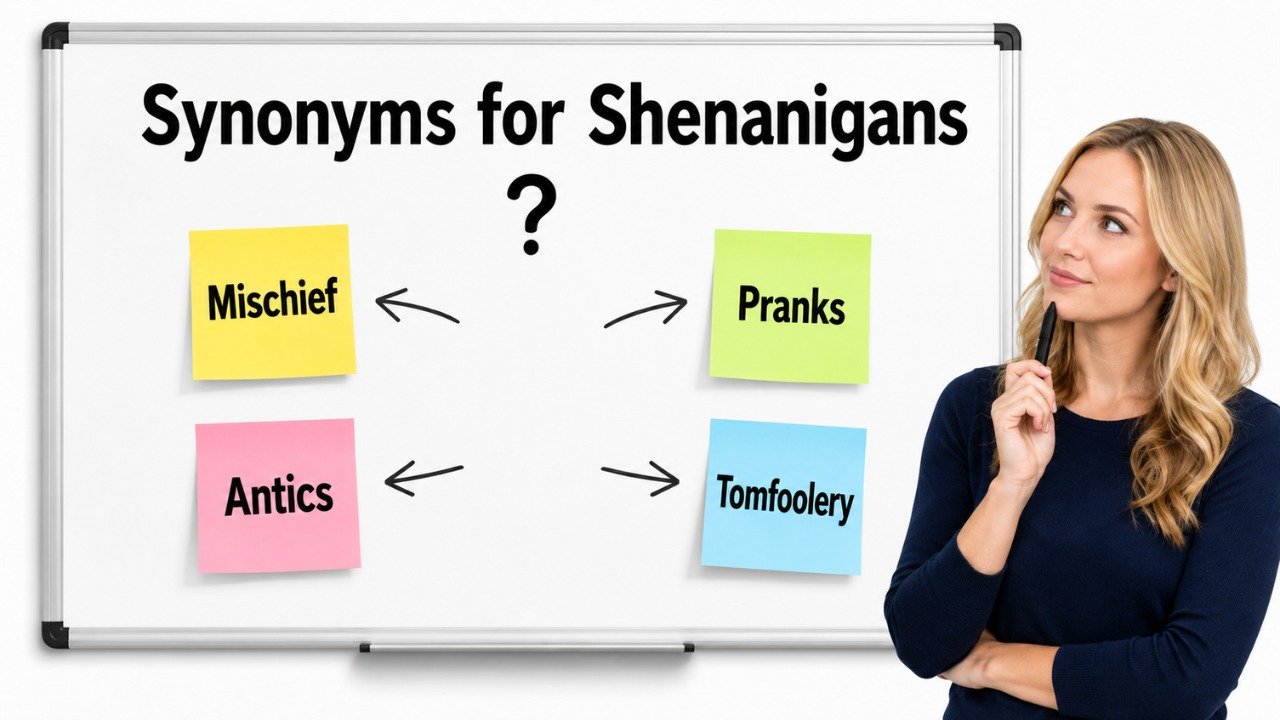
Quick Answer: Common synonyms for shenanigans include mischief, antics, trickery, tomfoolery, hijinks, monkey business, pranks, foolery, scheming, and skulduggery. The best synonyms for shenanigans depend on context. Use mischief for mildly troublesome behavior, antics for amusing actions, tomfoolery for silly behavior, trickery for deception, scheming for secret plans, skulduggery for dishonest conduct, and pranks for practical jokes. In casual conversation, hijinks and monkey business often sound especially natural.
Pronunciation and Word Details
Word: Shenanigans.
Pronunciation: /ʃɪˈnænɪɡənz/
Part of Speech: Plural noun.
Meaning: Silly, mischievous, troublesome, deceptive, or dishonest activities.
US Pronunciation:
UK Pronunciation:
What Does “Shenanigans” Mean?
Shenanigans means silly, mischievous, troublesome, or sometimes dishonest behavior. It is a plural noun commonly used to describe actions that involve fooling around, causing minor trouble, playing tricks, or behaving dishonestly.
The exact meaning depends heavily on context. In a lighthearted sentence, shenanigans may refer to amusing antics or harmless mischief.
Example: The children spent the afternoon getting into harmless shenanigans.
In a more serious context, the word can suggest suspicious, deceptive, or improper behavior.
Example: The investigation uncovered financial shenanigans within the organization.
Shenanigans can therefore range from innocent fun to questionable conduct. Tone and surrounding words help readers understand whether the behavior is amusing, annoying, deceptive, or serious.
Meaning, Tone, and Context of “Shenanigans”
Shenanigans is usually informal and conversational. It often carries a light, amusing, or mildly disapproving tone when describing silly behavior.
When friends, children, coworkers, or family members are involved, shenanigans commonly refers to energetic mischief, jokes, pranks, or amusing trouble.
Casual Context: Their weekend shenanigans kept everyone laughing.
The word can also have a stronger negative meaning. In discussions about money, rules, politics, business, or other serious matters, shenanigans may suggest deception, manipulation, or improper conduct.
Serious Context: The audit revealed several questionable accounting shenanigans.
In academic or highly formal writing, more precise words such as misconduct, deception, manipulation, fraud, irregularities, or improper conduct are usually preferable.
Shenanigans is not generally technical. It is expressive, flexible, and especially common in storytelling and conversation.
When and How to Use “Shenanigans”
For Mischievous Behavior
For Mischief: Use shenanigans when people are causing minor trouble without serious harm.
Example: The children were warned to stop their classroom shenanigans.
For Silly Actions
For Foolish Behavior: Use the word when people are acting ridiculous, energetic, or unserious.
Example: Their vacation shenanigans produced plenty of funny stories.
For Practical Jokes
For Pranks: Shenanigans can describe tricks or jokes played on other people.
Example: The office shenanigans included harmless surprises and practical jokes.
For Suspicious Conduct
For Dishonesty: The word can suggest questionable or deceptive activity when used in a serious context.
Example: Investigators began looking into possible financial shenanigans.
For Secret Schemes
For Scheming: Use shenanigans when people appear to be manipulating events behind the scenes.
Example: Everyone suspected some shenanigans were taking place during the negotiations.
For General Trouble
For Troublesome Activity: Shenanigans can describe behavior that causes confusion, disruption, or irritation.
Example: The manager had no patience for late night shenanigans at the hotel.
Best Synonyms for Shenanigans
Mischief
Synonym: Mildly troublesome or disobedient behavior.
Example: The children got into mischief while their parents were preparing dinner.
Antics
Synonym: Amusing, unusual, or attention seeking actions.
Example: His ridiculous antics made everyone in the room laugh.
Trickery
Synonym: The use of deceptive methods to fool someone.
Example: The agreement was obtained through trickery.
Tomfoolery
Synonym: Silly or foolish behavior.
Example: The teacher asked the students to stop their tomfoolery.
Hijinks
Synonym: Energetic, amusing, or mischievous activity.
Example: Their holiday hijinks became a favorite family story.
Monkey Business
Synonym: Foolish, suspicious, or dishonest activity.
Example: The supervisor warned everyone that no monkey business would be tolerated.
Pranks
Synonym: Tricks played on people for amusement.
Example: Their harmless pranks made the celebration more memorable.
Foolery
Synonym: Silly or foolish behavior.
Example: There was plenty of foolery during the informal gathering.
Scheming
Synonym: Secret planning intended to gain an advantage.
Example: Their constant scheming eventually became obvious.
Skulduggery
Synonym: Secret, dishonest, or deceitful behavior.
Example: The inquiry exposed years of financial skulduggery.
50 Synonyms for Shenanigans with Short Meanings
- Mischief: Playfully troublesome behavior.
- Antics: Amusing or unusual actions.
- Trickery: Behavior intended to deceive.
- Tomfoolery: Silly or foolish conduct.
- Hijinks: Energetic mischievous activity.
- Monkey Business: Foolish or suspicious behavior.
- Pranks: Tricks intended to amuse.
- Foolery: Silly and unserious behavior.
- Scheming: Secret planning for personal advantage.
- Skulduggery: Dishonest or deceptive activity.
- Chicanery: Clever deception used to gain an advantage.
- Deception: Behavior intended to make someone believe something false.
- Deceit: Deliberately dishonest behavior.
- Duplicity: Dishonesty involving contradictory behavior or intentions.
- Subterfuge: Deception used to hide an intention.
- Tricks: Actions designed to fool or surprise someone.
- Capers: Lively, unusual, or mischievous adventures.
- Nonsense: Foolish or unreasonable behavior.
- Horseplay: Rough and energetic joking.
- Clowning: Silly behavior intended to entertain.
- Joking Around: Behaving in a light and unserious way.
- Fooling Around: Acting playfully instead of seriously.
- Messing Around: Behaving casually, playfully, or irresponsibly.
- Mischief Making: Deliberately causing minor trouble.
- Practical Jokes: Tricks intended to surprise or amuse.
- Games: Manipulative or unserious behavior in some contexts.
- Funny Business: Suspicious, dishonest, or foolish activity.
- Tricks and Games: Deceptive or manipulative behavior.
- Schemes: Plans designed to achieve a hidden purpose.
- Plots: Secret plans, especially questionable ones.
- Machinations: Complicated secret plans for achieving an objective.
- Manipulation: Controlling situations unfairly or indirectly.
- Impropriety: Behavior that is inappropriate or unacceptable.
- Misbehavior: Conduct that breaks expected rules.
- Misconduct: Improper or unacceptable behavior.
- Wrongdoing: Behavior that is morally or legally wrong.
- Irregularities: Actions that do not follow normal rules or procedures.
- Improper Conduct: Behavior that violates accepted standards.
- Questionable Conduct: Behavior that raises doubts about honesty or fairness.
- Deviousness: Behavior involving dishonest or indirect methods.
- Sneakiness: Secretive behavior intended to avoid detection.
- Trick Playing: The act of deceiving or surprising someone for amusement.
- Maneuvering: Strategic actions intended to gain an advantage.
- Intrigue: Secret planning or complicated schemes.
- Conning: Deceiving someone to gain an advantage.
- Fraud: Deliberate deception for unfair or unlawful gain.
- Hanky Panky: Improper, suspicious, or questionable activity.
- Carryings On: Noisy, foolish, or troublesome behavior.
- High Spirits: Energetic behavior that may lead to mischief.
- Merry Making: Lively celebration that may involve playful behavior.
Read Also:
Synonyms for Watcher
Synonyms for Shenanigans by Context
When Shenanigans Means Mischief
Mischief is one of the closest alternatives when the behavior is troublesome but not seriously harmful.
Mischief: The children got into mischief after dinner.
Antics: Their amusing antics attracted everyone’s attention.
Hijinks: The group became known for its weekend hijinks.
Capers: Their holiday capers provided plenty of entertaining stories.
When Shenanigans Means Silly Behavior
Tomfoolery, foolery, clowning, nonsense, and fooling around work well when the actions are ridiculous rather than dishonest.
Tomfoolery: The coach told the players to save the tomfoolery until after practice.
Foolery: Their harmless foolery made the evening entertaining.
Clowning: His constant clowning distracted everyone from the lesson.
Fooling Around: They spent most of the afternoon fooling around instead of working.
When Shenanigans Means Tricks or Pranks
Pranks, tricks, practical jokes, and trick playing are useful when someone deliberately surprises or fools another person.
Pranks: The students planned a few harmless pranks for the final day.
Tricks: Nobody appreciated the tricks being played on the new employee.
Practical Jokes: Their practical jokes remained friendly and harmless.
When Shenanigans Means Dishonest Behavior
Trickery, deception, skulduggery, chicanery, and deceit are stronger alternatives when dishonesty is involved.
Trickery: The customer accused the seller of using trickery.
Deception: The investigation uncovered deliberate deception.
Skulduggery: Several examples of financial skulduggery were discovered.
Chicanery: The agreement was surrounded by accusations of chicanery.
When Shenanigans Means Secret Scheming
Scheming, machinations, plots, intrigue, and maneuvering work well for secret plans designed to gain an advantage.
Scheming: Their political scheming eventually became public.
Machinations: Nobody understood the complicated machinations happening behind closed doors.
Intrigue: The story is filled with intrigue and secret deals.
Maneuvering: Careful maneuvering allowed the group to gain control.
Another Word for Shenanigans
Mischief is often the best single replacement for shenanigans when describing playful or mildly troublesome behavior. However, the best alternative depends on the seriousness of the situation. Antics fits amusing actions, tomfoolery suits foolish behavior, and trickery is better when deception is involved.
Original: The children were involved in their usual shenanigans.
Better Option: The children were involved in their usual mischief.
Original: His shenanigans kept everyone laughing during the trip.
Better Option: His antics kept everyone laughing during the trip.
Original: The manager refused to tolerate workplace shenanigans.
Better Option: The manager refused to tolerate workplace foolery.
Original: Investigators suspected financial shenanigans.
Better Option: Investigators suspected financial misconduct.
When Not to Use “Shenanigans”
Shenanigans can sound too casual when discussing serious wrongdoing. More exact vocabulary is usually better in legal, academic, financial, professional, or technical writing.
When Describing Serious Misconduct
Weak: The report documented several safety shenanigans.
Better: The report documented several serious safety violations.
When Discussing Fraud
Calling fraud shenanigans can make serious behavior sound less severe than it really is.
Weak: The investigation uncovered fraudulent shenanigans.
Better: The investigation uncovered deliberate fraud.
When Precision Is Important
If you know exactly what occurred, name the behavior rather than using a broad informal term.
Weak: There were some shenanigans during the accounting process.
Better: There were several accounting irregularities during the process.
When Repetition Becomes Distracting
Repeated use can make writing sound vague or overly conversational.
Weak: Their shenanigans caused trouble, and more shenanigans happened later.
Better: Their mischief caused trouble, and further pranks followed later.
Words Commonly Confused With Shenanigans
Shenanigans vs Mischief: Shenanigans can describe a series of mischievous actions, while mischief is a broader word for playful trouble or minor wrongdoing.
Shenanigans vs Antics: Antics usually suggests amusing, unusual, or attention seeking behavior. Shenanigans can be amusing, but it may also suggest dishonesty.
Shenanigans vs Hijinks: Both can describe lively mischief. Hijinks generally sounds playful, while shenanigans can also have a suspicious or deceptive meaning.
Shenanigans vs Tomfoolery: Tomfoolery refers mainly to foolish or silly conduct. Shenanigans has a wider meaning that can include trickery or dishonesty.
Shenanigans vs Trickery: Trickery specifically involves deception. Shenanigans does not always involve dishonest intentions.
Shenanigans vs Skulduggery: Skulduggery strongly suggests secret dishonesty. Shenanigans may be completely harmless depending on context.
Shenanigans vs Pranks: Pranks are deliberate tricks performed for amusement. Shenanigans can include pranks but also many other forms of troublesome behavior.
Which Synonym Should You Choose?
Choose mischief for everyday situations involving harmless or mildly troublesome behavior.
Choose antics when describing funny, dramatic, unusual, or attention seeking actions.
Choose hijinks for lively, energetic, and entertaining mischief.
Choose tomfoolery for behavior that is foolish, ridiculous, or unserious.
Choose pranks when people are deliberately playing jokes or tricks on someone.
Choose trickery when deception is central to the situation.
Choose skulduggery when describing secret and dishonest conduct in a serious context.
Choose misconduct for professional reports, formal writing, workplace discussions, or institutional situations.
Choose irregularities when describing questionable procedures, records, finances, or administrative activity without making a stronger accusation.
Choose fraud only when deliberate deception for wrongful gain is genuinely meant.
Choose scheming or machinations when the focus is on secret planning rather than playful behavior.
Real Life Examples of “Shenanigans” in Sentences
Original: The children were involved in their usual shenanigans after school.
Better Option: The children were involved in their usual mischief after school.
Original: Everyone laughed at his ridiculous shenanigans.
Better Option: Everyone laughed at his ridiculous antics.
Original: The teacher quickly put an end to the classroom shenanigans.
Better Option: The teacher quickly put an end to the classroom tomfoolery.
Original: Their holiday shenanigans became memorable family stories.
Better Option: Their holiday hijinks became memorable family stories.
Original: Nobody wanted to deal with any more shenanigans during the meeting.
Better Option: Nobody wanted to deal with any more nonsense during the meeting.
Original: The investigation revealed questionable financial shenanigans.
Better Option: The investigation revealed questionable financial misconduct.
Original: The children admitted that the shenanigans were meant as a joke.
Better Option: The children admitted that the pranks were meant as a joke.
Original: The committee suspected shenanigans behind the sudden decision.
Better Option: The committee suspected scheming behind the sudden decision.
Original: Several suspicious shenanigans occurred during the negotiations.
Better Option: Several deceptive maneuvers occurred during the negotiations.
Original: Their harmless shenanigans kept the whole group entertained.
Better Option: Their harmless capers kept the whole group entertained.
Synonym Groups and Usage Differences
Mischief Group
Mischief, hijinks, capers, pranks, and high spirits describe playful behavior that may cause minor trouble.
Example: Their harmless hijinks continued until dinner.
Silly Behavior Group
Tomfoolery, foolery, clowning, nonsense, and fooling around emphasize foolish or unserious behavior.
Example: The teacher asked everyone to stop the clowning and concentrate.
Deception Group
Trickery, deceit, deception, chicanery, duplicity, and subterfuge involve misleading someone.
Example: The contract was obtained through deception.
Secret Scheme Group
Scheming, plots, machinations, intrigue, and maneuvering emphasize hidden planning.
Example: Months of scheming eventually became obvious.
Misconduct Group
Misbehavior, misconduct, wrongdoing, impropriety, and questionable conduct describe actions that violate rules or accepted standards.
Example: The employee received a warning for repeated misconduct.
Suspicious Activity Group
Funny business, monkey business, irregularities, and skulduggery suggest that something improper may be happening.
Example: Investigators suspected some funny business in the records.
Antonyms of Shenanigans
The opposite of shenanigans depends on whether the word means mischief, foolish behavior, dishonesty, or disorder.
Good Behavior: Conduct that follows expected rules.
Order: A calm and properly organized state.
Discipline: Controlled and responsible behavior.
Seriousness: Behavior showing careful and responsible attention.
Honesty: Truthful and sincere conduct.
Integrity: Strong adherence to moral and ethical principles.
Fairness: Behavior based on equal and reasonable treatment.
Propriety: Behavior that follows accepted standards.
Obedience: Willing compliance with instructions or rules.
Responsibility: Reliable and accountable behavior.
Transparency: Openness that prevents hidden or deceptive conduct.
Straightforwardness: Direct and honest behavior without tricks.
Comparison: Shenanigans vs Related Words
Shenanigans vs Mischief
Shenanigans often describes several playful or questionable actions, while mischief is a general term for troublesome behavior.
Example With Shenanigans: Their weekend shenanigans kept everyone entertained.
Example With Mischief: The puppy got into mischief while nobody was watching.
Shenanigans vs Antics
Antics usually refers to noticeable or amusing behavior. Shenanigans may be amusing, troublesome, or dishonest.
Example With Shenanigans: Their late night shenanigans annoyed the neighbors.
Example With Antics: His energetic antics amused the children.
Shenanigans vs Hijinks
Hijinks usually sounds cheerful and lively. Shenanigans is broader and can carry suspicion.
Example With Shenanigans: The manager wanted the workplace shenanigans to stop.
Example With Hijinks: Their holiday hijinks created plenty of funny memories.
Shenanigans vs Tomfoolery
Tomfoolery focuses on foolishness, while shenanigans can include mischief, deception, and secret activity.
Example With Shenanigans: Their shenanigans disrupted the event.
Example With Tomfoolery: The coach had no patience for tomfoolery during practice.
Shenanigans vs Trickery
Trickery always involves deception, while shenanigans can be completely harmless.
Example With Shenanigans: The children’s shenanigans made everyone laugh.
Example With Trickery: The dishonest deal depended on trickery.
Shenanigans vs Skulduggery
Skulduggery is much stronger and specifically suggests secret dishonesty.
Example With Shenanigans: People suspected some financial shenanigans.
Example With Skulduggery: The inquiry exposed extensive financial skulduggery.
Common Phrases and Expressions With Shenanigans
No Shenanigans: A warning against foolish, troublesome, or dishonest behavior.
Usual Shenanigans: Mischief that someone regularly gets involved in.
Harmless Shenanigans: Playful behavior that causes no serious damage.
Silly Shenanigans: Ridiculous or foolish activities.
Weekend Shenanigans: Mischievous or entertaining activities during the weekend.
Late Night Shenanigans: Playful, noisy, or troublesome activity occurring late at night.
Office Shenanigans: Informal jokes, pranks, or foolish behavior in a workplace.
Financial Shenanigans: Suspicious, misleading, or improper activity involving money.
Political Shenanigans: Questionable maneuvering, manipulation, or secret schemes involving political activity.
Behind the Scenes Shenanigans: Suspicious or mischievous actions occurring secretly.
Common Mistakes to Avoid
A common mistake is treating every use of shenanigans as lighthearted. The word can describe harmless fun, but it can also suggest deception or improper conduct. Always consider the context.
Another mistake is using shenanigans in writing that requires precise terminology. A formal report should usually identify misconduct, fraud, irregularities, or deception directly instead of relying on an informal word.
Do not assume antics and shenanigans are always interchangeable. Antics usually sounds amusing, while shenanigans can suggest suspicious behavior.
Similarly, skulduggery is stronger than shenanigans and should not be used for harmless childhood mischief.
Avoid vague sentences when the behavior is known.
Vague: There were shenanigans with the records.
Better: Several records had been improperly altered.
Writers should also avoid unnecessary repetition.
Repetitive: The group’s shenanigans continued, and their shenanigans became increasingly disruptive.
Better: The group’s shenanigans continued, and their misbehavior became increasingly disruptive.
Finally, remember that shenanigans is normally used as a plural noun. Phrases such as some shenanigans, their shenanigans, and no shenanigans sound natural in standard usage.
Conclusion
Synonyms for shenanigans include mischief, antics, hijinks, tomfoolery, pranks, trickery, scheming, and skulduggery. Mischief is a strong general choice for harmless trouble, while antics and hijinks fit entertaining behavior. Trickery and deception are better when dishonesty is involved, and misconduct works well in formal contexts. Because shenanigans can describe anything from innocent fooling around to suspicious activity, the most accurate synonym depends on the seriousness, tone, and purpose of the sentence.
FAQs About Synonyms for Shenanigans
What Is the Best Synonym for Shenanigans?
Mischief is one of the best general synonyms for shenanigans. Antics, hijinks, and tomfoolery are better when the behavior is silly or entertaining.
What Is a Formal Synonym for Shenanigans?
Misconduct, impropriety, irregularities, deception, and wrongdoing are more suitable in formal writing, depending on the specific behavior.
Does Shenanigans Mean Mischief?
Yes, shenanigans often means mischievous or troublesome behavior. However, it can also refer to deception, secret schemes, or questionable conduct.
What Is a Funny Synonym for Shenanigans?
Tomfoolery, hijinks, monkey business, foolery, and antics can describe amusing or silly shenanigans.
What Is a Synonym for Dishonest Shenanigans?
Trickery, deception, chicanery, skulduggery, deceit, and subterfuge are useful choices when dishonesty is involved.
Are Antics and Shenanigans the Same?
They overlap, but antics usually refers to amusing or unusual actions. Shenanigans has a broader meaning and can also suggest trouble or dishonesty.
Can Shenanigans Be Used in Formal Writing?
It can appear in informal commentary, but precise words such as misconduct, irregularities, deception, or manipulation are usually better for reports, essays, academic writing, and other formal contexts.
