
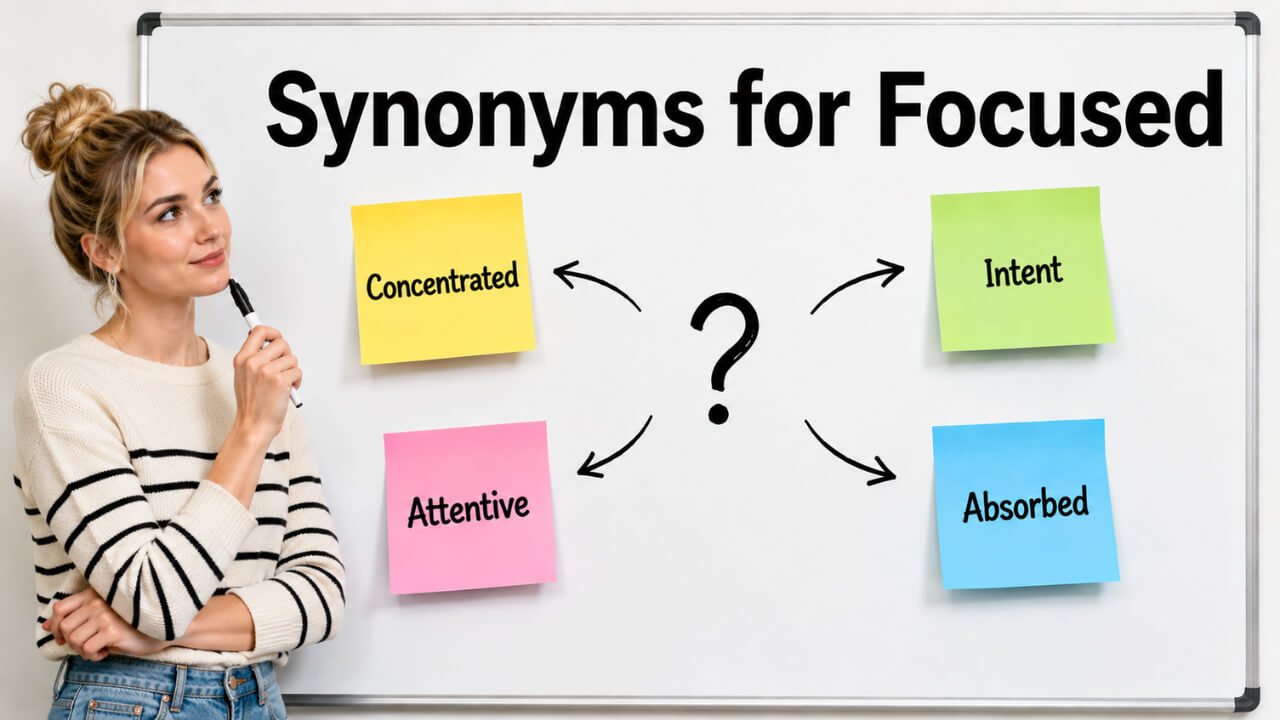
Quick Answer: The best synonyms for focused include concentrated, attentive, intent, absorbed, determined, dedicated, targeted, purposeful, disciplined, and engaged. Use concentrated when someone gives complete attention to a task. Choose attentive for careful listening or observation, determined for strong motivation, and targeted when an action is directed toward a specific goal or audience. Purposeful suits formal writing about clear intentions, while engaged works naturally in conversation, education, and workplace communication. The best synonym depends on whether focused describes attention, commitment, direction, clarity, or a limited subject.
Pronunciation and Word Details
Word: Focused.
Pronunciation: /ˈfoʊkəst/
Part of Speech: Adjective and past participle.
Meaning: Giving full attention to a particular task, goal, subject, or result.
US Pronunciation:
UK Pronunciation:
What Does “Focused” Mean?
Focused means giving close attention to one particular task, subject, goal, person, or result.
The word is commonly used as an adjective. It describes someone who is concentrating carefully and is not easily distracted.
Example: She remained focused during the difficult examination.
Focused can also describe an activity, plan, discussion, or effort that has a clear direction.
Example: The team developed a focused plan for improving customer service.
As the past participle of focus, it can describe the action of directing attention, energy, light, or effort toward something.
Example: He focused his attention on the most urgent problem.
In personal contexts, focused often means mentally attentive and determined.
Example: The athlete stayed focused on her training goals.
In professional or academic contexts, it may describe work that is organized around a specific objective.
Example: The report offers a focused analysis of workplace communication.
In technical or visual contexts, focused may describe an image, beam, lens, or sound that has been made clear or directed toward one point.
Example: The camera was focused on the speaker.
The exact meaning of focused depends on context. It can refer to concentration, determination, limited scope, clear direction, or visual sharpness.
Meaning, Tone, and Context of “Focused”
Focused usually has a positive and neutral tone. It suggests attention, self control, clarity, determination, and a clear sense of direction.
In casual conversation, focused often describes a person who is concentrating or working seriously.
Example: I need to stay focused and finish this assignment.
In professional writing, focused can describe a clear strategy, goal, effort, meeting, or approach.
Example: The manager introduced a focused strategy for reducing delays.
In academic writing, focused may describe a narrow research question, a detailed argument, or an analysis limited to a specific subject.
Example: The essay provides a focused discussion of language development.
In education, focused often refers to students who are attentive and actively engaged.
Example: The students remained focused throughout the lesson.
In personal development, the word can suggest discipline and commitment to long term goals.
Example: She became more focused after creating a clear daily routine.
Focused can also have a technical meaning. A focused image is clear rather than blurry, while focused light or energy is directed toward a particular point.
Example: The focused beam illuminated a small section of the wall.
The word may sound strong when it describes determination, but it is generally not emotional or dramatic. It works well in formal, casual, academic, technical, and conversational settings.
When and How to Use “Focused”
For Mental Concentration
Use focused when someone is paying full attention and avoiding distractions.
Example: He stayed focused while solving the complex problem.
For Careful Listening
Use focused when a person listens closely to instructions, explanations, or conversations.
Example: The audience remained focused during the presentation.
For Strong Determination
Use focused when someone is committed to achieving a particular goal.
Example: She is focused on completing her degree.
For Clear Goals
Use focused when a plan, action, or strategy is directed toward a specific result.
Example: The organization created a focused plan for improving safety.
For Limited Scope
Use focused when a discussion, report, study, or question concentrates on one defined subject.
Example: The article presents a focused examination of reading habits.
For Productive Work
Use focused to describe serious and organized effort.
Example: A quiet environment helped him remain focused on his work.
For Targeted Communication
Use focused when a message is designed for a particular purpose or audience.
Example: The campaign used a focused message to explain the new service.
For Visual Clarity
Use focused when an image, lens, or camera produces a clear picture.
Example: The photographer checked that the subject was properly focused.
For Directed Energy
Use focused when effort, attention, resources, or energy are concentrated on one point.
Example: The group focused its resources on the most urgent needs.
For Purposeful Discussion
Use focused when a conversation remains relevant and does not move into unrelated subjects.
Example: The chairperson kept the discussion focused on practical solutions.
Best Synonyms for Focused
Concentrated
Synonym: Giving complete attention or effort to one thing.
Example: She remained concentrated during the final stage of the experiment.
Concentrated is one of the closest synonyms for focused when describing mental effort. However, focused is usually more natural for describing a person.
Attentive
Synonym: Listening, watching, or thinking carefully.
Example: The attentive students asked several useful questions.
Attentive is best when focused means carefully noticing, listening, or responding to something.
Intent
Synonym: Giving serious and fixed attention to something.
Example: He was intent on understanding every part of the instructions.
Intent often appears in the phrase intent on. It suggests deep concentration or a strong determination to achieve something.
Absorbed
Synonym: Completely interested in or occupied with an activity.
Example: She was absorbed in the novel and did not hear the door open.
Absorbed suggests such deep attention that a person may not notice what is happening nearby.
Determined
Synonym: Firmly decided to achieve a goal despite difficulty.
Example: He remained determined to complete the project successfully.
Determined is the best choice when focused describes motivation, commitment, or persistence rather than attention alone.
Dedicated
Synonym: Giving serious time, energy, and effort to a purpose.
Example: She is dedicated to improving her writing skills.
Dedicated suggests lasting commitment rather than temporary concentration.
Targeted
Synonym: Directed toward a particular goal, group, subject, or result.
Example: The school introduced targeted support for struggling readers.
Targeted is useful for plans, assistance, communication, marketing, research, and improvement efforts.
Purposeful
Synonym: Done with a clear intention or useful aim.
Example: His purposeful approach helped the team make faster decisions.
Purposeful is a strong formal synonym when focused describes clear direction and deliberate action.
Disciplined
Synonym: Able to control attention, habits, and behavior in order to reach a goal.
Example: Her disciplined study routine produced steady progress.
Disciplined suggests that concentration is supported by self control and consistent habits.
Engaged
Synonym: Actively interested, involved, and attentive.
Example: The learners remained engaged throughout the discussion.
Engaged is especially useful in education, meetings, conversations, and activities that require active participation.
50 Synonyms for Focused with Short Meanings
- Concentrated: Giving full mental effort to one activity.
- Attentive: Carefully listening, watching, or noticing.
- Intent: Directing serious attention toward something.
- Absorbed: Completely occupied by an activity or thought.
- Engrossed: Giving complete attention to something interesting.
- Immersed: Deeply involved in a subject or activity.
- Engaged: Actively interested and involved.
- Alert: Mentally aware and ready to notice changes.
- Observant: Quick to notice important details.
- Mindful: Carefully aware of thoughts, actions, or surroundings.
- Watchful: Paying close attention to possible changes or problems.
- Vigilant: Remaining carefully alert to danger or difficulty.
- Heedful: Paying careful attention to advice or warnings.
- Riveted: Holding complete and intense attention.
- Fixed: Directed firmly toward one point or subject.
- Determined: Firmly committed to reaching a goal.
- Dedicated: Giving serious effort to a task or purpose.
- Committed: Willing to continue supporting a goal or responsibility.
- Disciplined: Showing strong control over attention and behavior.
- Driven: Strongly motivated to achieve something.
- Resolute: Firm and unlikely to change direction.
- Purposeful: Acting with a clear intention.
- Persistent: Continuing despite difficulty or delay.
- Diligent: Working carefully and consistently.
- Serious: Giving proper attention to an important matter.
- Motivated: Having a strong reason to take action.
- Devoted: Giving loyal attention, time, or effort.
- Steadfast: Remaining firm and reliable in purpose.
- Unwavering: Not losing determination or direction.
- Tenacious: Continuing strongly despite challenges.
- Single minded: Concentrating strongly on one purpose.
- Goal directed: Organized around achieving a particular result.
- Goal oriented: Mainly concerned with reaching clear objectives.
- Task centered: Giving primary attention to a particular duty.
- Targeted: Directed toward a specific result or group.
- Directed: Guided toward a particular point or purpose.
- Centered: Placed around one main idea or concern.
- Aimed: Intended to achieve a particular result.
- Specific: Clearly limited to one subject or purpose.
- Clear: Easy to understand and free from confusion.
- Defined: Having clear limits, meaning, or direction.
- Precise: Exact, careful, and clearly expressed.
- Narrow: Limited to a small range or subject.
- Selective: Concentrating only on chosen areas or details.
- Specialized: Limited to a particular field, purpose, or subject.
- Intentional: Done consciously for a clear reason.
- Organized: Arranged carefully to support effective action.
- Attuned: Aware of and responsive to particular details.
- Present: Giving full attention to the current moment.
- Undistracted: Free from interruptions or divided attention.
Read Also:
Synonyms for Creepy

Synonyms for Focused by Context
When Focused Means Concentrating
When focused describes mental attention, useful synonyms include concentrated, attentive, intent, absorbed, engrossed, immersed, and undistracted.
Concentrated is direct and neutral. Attentive suggests careful listening or observation. Absorbed and engrossed describe deeper involvement.
Example: She was focused on reading the final chapter.
Alternative: She was absorbed in reading the final chapter.
Absorbed suggests that her interest was so strong that she noticed little else.
When Focused Means Determined
When focused describes commitment to a goal, useful synonyms include determined, dedicated, committed, driven, resolute, steadfast, and tenacious.
Determined is the most flexible option. Dedicated suggests long term effort, while driven can suggest powerful personal ambition.
Example: He remained focused on becoming a skilled engineer.
Alternative: He remained determined to become a skilled engineer.
Determined emphasizes his decision to continue despite challenges.
When Focused Means Directed Toward a Goal
When focused describes a plan, strategy, activity, or resource, useful synonyms include targeted, directed, aimed, purposeful, goal directed, and intentional.
Targeted is common when assistance, communication, or action is designed for a particular group or need.
Example: The school created a focused support program.
Alternative: The school created a targeted support program.
Targeted clearly shows that the program serves a defined group or problem.
When Focused Means Limited in Scope
When focused describes a report, essay, study, discussion, or subject, useful synonyms include specific, narrow, defined, selective, specialized, and precise.
These words show that the content does not attempt to cover every possible topic.
Example: The researcher completed a focused study of reading difficulties.
Alternative: The researcher completed a specialized study of reading difficulties.
Specialized suggests expert attention to a particular area.
When Focused Means Actively Involved
When focused describes participation, useful synonyms include engaged, attentive, alert, mindful, and present.
Engaged suggests both interest and active involvement. Present often describes giving complete attention to the current experience.
Example: The children stayed focused during the activity.
Alternative: The children stayed engaged during the activity.
Engaged shows that they were interested and actively participating.
When Focused Means Clearly Organized
When focused describes writing, planning, or communication, useful synonyms include clear, organized, purposeful, defined, precise, and task centered.
Clear emphasizes easy understanding. Organized refers to a logical arrangement, while purposeful suggests deliberate direction.
Example: Her focused presentation covered only the essential information.
Alternative: Her well organized presentation covered only the essential information.
Organized emphasizes the logical order of the material.
When Focused Means Visually Clear
When focused describes a picture, image, lens, or view, useful alternatives include clear, sharp, defined, and precise.
Sharp is especially common for visual detail, although it is not always a direct substitute in every sentence.
Example: The photograph was properly focused.
Alternative: The photograph was clear and sharp.
Clear and sharp directly describe the quality of the image.
Another Word for Focused
The best general replacement for focused is concentrated when the sentence describes mental attention. However, attentive often sounds more natural when someone is listening or observing carefully.
The best alternative changes with the meaning. Use determined for commitment, targeted for a specific goal, engaged for active participation, and purposeful for clear direction.
Original: She stayed focused during the long lecture.
Better Option: She stayed attentive during the long lecture.
Original: He is focused on achieving his career goals.
Better Option: He is determined to achieve his career goals.
Original: The organization introduced a focused training program.
Better Option: The organization introduced a targeted training program.
Original: The group held a focused discussion about safety.
Better Option: The group held a purposeful discussion about safety.
When Not to Use “Focused”
Do not use focused when the sentence needs a more precise description of the person’s behavior.
Weak: She was focused during the conversation.
Better: She listened attentively during the conversation.
Attentively explains exactly how she behaved.
Avoid focused when describing strong commitment if determined or dedicated would communicate the meaning more clearly.
Weak: He was focused on completing the difficult course.
Better: He was determined to complete the difficult course.
Determined emphasizes persistence rather than simple concentration.
Do not use focused repeatedly within the same paragraph. Repetition can make the writing sound limited and unclear.
Weak: The focused employee used a focused plan to complete the focused task.
Better: The attentive employee used a clear plan to complete the demanding task.
Avoid focused when a plan or service is designed for a particular group. Targeted may be more accurate.
Weak: The clinic offered focused support for older patients.
Better: The clinic offered targeted support for older patients.
Do not use focused when discussing a very narrow academic subject if specialized or specific communicates the scope more effectively.
Weak: The book provides focused information about childhood language disorders.
Better: The book provides specialized information about childhood language disorders.
Avoid using focused as a vague compliment without explaining what makes someone focused.
Weak: She is a focused worker.
Better: She organizes her priorities and completes important tasks without becoming distracted.
Do not confuse focused with busy. A busy person may handle many activities at once, while a focused person directs attention toward a clear priority.
Weak: He answered messages, joined several conversations, and completed three tasks at once, so he was focused.
Better: He ignored unnecessary interruptions and completed the most important task first.
Words Commonly Confused With Focused
Focused vs Concentrated: Focused is the more natural adjective for a person directing attention toward a task. Concentrated often describes mental effort, substances, or something gathered into a small area.
Focused vs Attentive: Focused means concentrating on a goal or activity. Attentive means carefully listening, watching, or responding to someone or something.
Focused vs Determined: Focused emphasizes attention and direction. Determined emphasizes a firm decision to succeed despite difficulty.
Focused vs Dedicated: Focused can describe temporary concentration. Dedicated usually describes lasting commitment to a duty, cause, person, or goal.
Focused vs Engaged: Focused means giving close attention. Engaged means being interested, involved, and actively participating.
Focused vs Absorbed: Focused suggests controlled concentration. Absorbed suggests being so deeply involved that other surroundings may be ignored.
Focused vs Targeted: Focused can describe people, thoughts, plans, or attention. Targeted usually describes action directed toward a specific audience, problem, need, or result.
Focused vs Disciplined: Focused describes the current direction of attention. Disciplined describes the self control and habits that help someone remain focused.
Focused vs Alert: Focused means concentrating on a particular matter. Alert means being mentally awake and prepared to notice possible changes.
Focused vs Obsessed: Focused is usually positive and balanced. Obsessed suggests excessive or unhealthy attention that may be difficult to control.
Which Synonym Should You Choose?
Choose concentrated when describing strong mental attention to a task, problem, or activity.
Choose attentive when someone listens carefully, watches closely, or responds thoughtfully.
Choose intent when attention is serious, fixed, and directed toward one result.
Choose absorbed when someone becomes deeply interested and stops noticing nearby distractions.
Choose engaged when describing active participation in a lesson, meeting, discussion, or activity.
Choose determined when a person strongly intends to achieve a goal despite difficulty.
Choose dedicated when commitment continues over a long period.
Choose disciplined when concentration depends on self control, routine, and consistent habits.
Choose driven when someone has powerful motivation and ambition.
Choose purposeful in essays, reports, and formal writing when actions have a clear and deliberate aim.
Choose targeted when a plan, message, program, or service is designed for a specific need or audience.
Choose directed when attention, resources, or effort move toward one clear point.
Choose specific when a discussion, question, or request concerns one exact subject.
Choose specialized when information or work relates to a particular professional or academic field.
Choose narrow when the subject has a limited range. Be careful because narrow can sometimes sound critical.
Choose precise when writing must be exact, detailed, and free from unclear language.
Choose clear when the main idea is easy to understand.
Choose alert when someone must notice changing conditions, risks, or instructions.
Choose mindful when attention includes careful awareness of actions, feelings, or surroundings.
Choose single minded when someone concentrates strongly on one goal and gives little attention to anything else.
Real Life Examples of “Focused” in Sentences
Original: She remained focused while studying for the examination.
Better Option: She remained concentrated while studying for the examination.
Original: The manager stayed focused on the department’s main goal.
Better Option: The manager remained committed to the department’s main goal.
Original: The students were focused during the science lesson.
Better Option: The students were attentive during the science lesson.
Original: He became focused on improving his health.
Better Option: He became determined to improve his health.
Original: The group created a focused plan for reducing waste.
Better Option: The group created a targeted plan for reducing waste.
Original: Her focused attitude helped her finish the assignment.
Better Option: Her disciplined attitude helped her finish the assignment.
Original: The report offers a focused examination of communication problems.
Better Option: The report offers a specialized examination of communication problems.
Original: The children remained focused throughout the activity.
Better Option: The children remained engaged throughout the activity.
Original: His focused effort produced steady progress.
Better Option: His purposeful effort produced steady progress.
Original: The photographer made sure the image was focused.
Better Option: The photographer made sure the image was clear and sharp.
Synonym Groups and Usage Differences
Attention Group
This group includes concentrated, attentive, intent, alert, mindful, and observant.
These words describe different forms of mental attention. Concentrated suggests strong mental effort. Attentive refers to careful listening or watching. Alert emphasizes readiness to notice changes.
Example: The attentive nurse noticed a small change in the patient’s condition.
Deep Involvement Group
This group includes absorbed, engrossed, immersed, riveted, and engaged.
These words suggest strong interest and involvement. Absorbed and engrossed can imply that someone is unaware of nearby distractions. Engaged also includes active participation.
Example: The audience was riveted by the speaker’s explanation.
Determination Group
This group includes determined, driven, resolute, steadfast, persistent, tenacious, and unwavering.
These words describe commitment to a goal. Determined is the most flexible choice. Resolute and steadfast sound more formal, while driven can suggest strong ambition.
Example: She remained steadfast in her efforts to complete the training.
Commitment Group
This group includes dedicated, committed, devoted, diligent, and disciplined.
These words emphasize serious effort over time. Dedicated and committed describe loyalty to a goal. Diligent focuses on careful work, while disciplined emphasizes self control.
Example: His diligent preparation helped him answer every question confidently.
Direction Group
This group includes targeted, directed, aimed, purposeful, intentional, and goal directed.
These words describe effort or action that moves toward a defined result. Targeted is suitable for programs and messages. Purposeful describes deliberate action.
Example: The team made a targeted effort to improve response times.
Scope Group
This group includes specific, narrow, defined, selective, specialized, and task centered.
These words describe a limited subject or area of attention. Specialized is appropriate for expert knowledge, while defined emphasizes clear boundaries.
Example: The course provides specialized training in language assessment.
Clarity Group
This group includes clear, precise, organized, centered, and attuned.
These words relate to clear thought, structure, or awareness. Precise emphasizes exactness. Organized describes logical arrangement.
Example: Her organized explanation made the difficult topic easier to understand.
Antonyms of Focused
The opposite of focused depends on whether focused means attentive, determined, directed, organized, or visually clear.
Distracted: Unable to give full attention because of interruptions or competing thoughts.
Unfocused: Lacking clear attention, direction, or purpose.
Inattentive: Not listening, watching, or noticing carefully.
Absentminded: Often failing to notice things because the mind is elsewhere.
Scattered: Lacking organization or a single clear direction.
Confused: Unable to think or understand clearly.
Aimless: Having no clear goal, purpose, or direction.
Indecisive: Unable to make a firm decision.
Uncommitted: Not firmly dedicated to a goal or responsibility.
Careless: Not giving enough attention to accuracy or detail.
Disorganized: Lacking a clear or effective arrangement.
Vague: Not clearly expressed, defined, or directed.
Broad: Covering a wide range rather than one limited subject.
Blurred: Visually unclear or lacking sharp detail.
Passive: Not actively involved or engaged.
Distracted vs Focused: Distracted means attention is divided, while focused means attention is directed toward one priority.
Aimless vs Focused: Aimless describes action without a clear purpose, while focused describes action guided by a defined goal.
Vague vs Focused: Vague communication lacks clear detail, while focused communication stays relevant and specific.
Blurred vs Focused: A blurred image lacks visual sharpness, while a focused image appears clear.
Comparison of Focused and Related Words
Focused vs Concentrated
Focused is the most natural word for directing attention toward a task or goal. Concentrated emphasizes the mental effort required.
Example With Focused: She stayed focused on completing the report.
Example With Concentrated: She made a concentrated effort to complete the report.
Focused vs Attentive
Focused refers to general concentration. Attentive usually involves careful listening, watching, or responding.
Example With Focused: He remained focused on his assignment.
Example With Attentive: He was attentive while the teacher explained the assignment.
Focused vs Determined
Focused describes where attention or effort is directed. Determined describes a strong decision to succeed.
Example With Focused: She is focused on improving her grades.
Example With Determined: She is determined to improve her grades despite previous difficulties.
Focused vs Dedicated
Focused can describe attention during one moment or activity. Dedicated suggests continuing commitment over time.
Example With Focused: He was focused during today’s practice.
Example With Dedicated: He has been dedicated to daily practice for several years.
Focused vs Engaged
Focused describes attention. Engaged includes interest, involvement, and participation.
Example With Focused: The learners were focused on the instructions.
Example With Engaged: The learners were engaged in the group discussion.
Focused vs Absorbed
Focused often suggests deliberate control over attention. Absorbed suggests deep involvement that may cause someone to ignore the surroundings.
Example With Focused: She was focused on preparing her notes.
Example With Absorbed: She was so absorbed in the book that she forgot the time.
Focused vs Targeted
Focused is broad and can describe a person, discussion, plan, or effort. Targeted describes something designed for a specific group, problem, or result.
Example With Focused: The team used a focused approach to solve the issue.
Example With Targeted: The team provided targeted assistance to new employees.
Focused vs Disciplined
Focused describes attention directed toward something. Disciplined describes the control and habits needed to maintain that attention.
Example With Focused: He remained focused during the morning session.
Example With Disciplined: His disciplined routine helped him work consistently every morning.
Focused vs Single Minded
Focused is neutral and flexible. Single minded suggests very strong concentration on one goal, sometimes at the expense of other concerns.
Example With Focused: She is focused on finishing the project.
Example With Single Minded: She pursued the project with single minded determination.
Focused vs Obsessed
Focused usually describes healthy and controlled attention. Obsessed suggests excessive attention that may become unhealthy or unreasonable.
Example With Focused: He is focused on improving his performance.
Example With Obsessed: He became obsessed with comparing his performance to everyone else.
Common Phrases and Expressions With “Focused”
Stay Focused: Continue giving attention to the main task or goal.
Example: Stay focused on the instructions until the activity is complete.
Remain Focused: Continue concentrating despite difficulty or interruption.
Example: She remained focused even when the room became noisy.
Highly Focused: Giving an unusually strong level of attention to something.
Example: The team was highly focused during the final week of preparation.
Focused Attention: Mental effort directed toward one person, activity, or subject.
Example: The difficult task required focused attention.
Focused Approach: A method based on a clear goal or limited area.
Example: A focused approach helped the group solve the problem efficiently.
Focused Effort: Energy and work directed toward a specific result.
Example: Their focused effort improved the quality of the final report.
Focused on Results: Mainly concerned with achieving clear outcomes.
Example: The manager remained focused on results without ignoring employee needs.
Focused on a Goal: Giving primary attention to reaching a particular objective.
Example: She stayed focused on her goal throughout the training period.
Focused Discussion: A conversation limited to a clear subject or purpose.
Example: The meeting included a focused discussion about workplace safety.
Focused Mind: A mental state that is calm, attentive, and clearly directed.
Example: A quiet morning routine helped him develop a focused mind.
Common Mistakes to Avoid
A common mistake is treating every synonym for focused as interchangeable. Each alternative carries a different meaning. Attentive refers to careful listening or observation, while determined refers to commitment and persistence.
Avoid using focused repeatedly in the same paragraph. Replace it with precise alternatives that match each sentence.
Repetitive: The focused student followed a focused routine and used a focused method.
Improved: The attentive student followed a disciplined routine and used a clear method.
Do not use concentrated unnaturally to describe a person in every situation. Focused or attentive often sounds more natural.
Unnatural: The concentrated employee listened to the instructions.
Natural: The attentive employee listened to the instructions.
Avoid using determined when the sentence only describes temporary attention.
Incorrect: She was determined while reading the short notice.
Better: She was attentive while reading the short notice.
Do not confuse targeted with focused when describing a person. Targeted normally describes communication, assistance, action, or resources rather than a person’s mental state.
Incorrect: He was targeted while completing the assignment.
Better: He was focused while completing the assignment.
Avoid vague statements that do not identify the object of attention.
Vague: She became more focused.
Clear: She became more focused on completing her weekly priorities.
Remember that focused can be followed by on when identifying the main subject or goal.
Correct: The discussion focused on practical solutions.
Correct: She remained focused on her studies.
Do not confuse focused with focusing. Focused can describe a completed action or a state, while focusing usually describes an action in progress.
Focused: He focused on the most important question.
Focusing: He is focusing on the most important question.
Avoid using focused to describe an image when sharp or clear would be more direct for general readers.
Less Direct: The photograph looked focused.
Clearer: The photograph looked sharp and clear.
Conclusion
Understanding synonyms for focused helps you describe attention, determination, direction, and clarity more precisely. Use concentrated for strong mental effort, attentive for careful listening, and absorbed for deep involvement. Determined and dedicated suit commitment to a goal, while targeted and purposeful describe clearly directed actions. Engaged works well for active participation, and specialized suits a narrow subject. The most effective synonym depends on whether focused refers to a person, plan, discussion, task, goal, or visual image.
FAQs About Synonyms for Focused
What Is the Best Synonym for Focused?
Concentrated is a close general synonym. Attentive, determined, engaged, targeted, and purposeful may be better in specific contexts.
What Is Another Word for a Focused Person?
An attentive, determined, disciplined, dedicated, or single minded person may be described as focused. The best word depends on the person’s behavior.
Is Focused the Same as Determined?
No. Focused describes directed attention, while determined describes a firm decision to achieve something despite difficulty.
What Is a Formal Synonym for Focused?
Purposeful, attentive, concentrated, targeted, disciplined, and resolute are suitable formal alternatives.
What Is a Synonym for Focused Attention?
Concentration, attentiveness, mindfulness, alertness, and mental engagement can describe focused attention.
What Is the Opposite of Focused?
Common opposites include distracted, unfocused, inattentive, scattered, aimless, vague, and disorganized.
Can Focused Describe a Plan or Strategy?
Yes. A focused plan or strategy has a clear purpose, limited scope, and specific intended result.
