
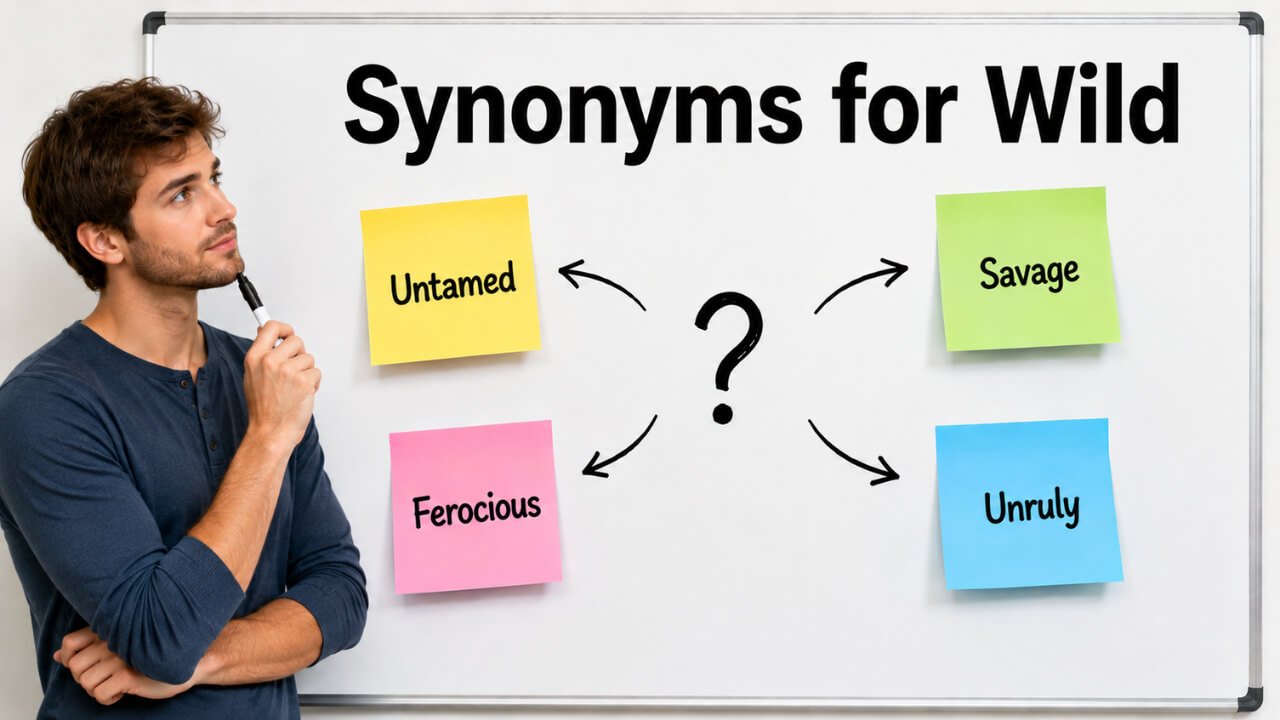
Quick Answer: Useful synonyms for wild include untamed, feral, uncontrolled, chaotic, reckless, extreme, outrageous, fierce, remote, and natural. Choose untamed when describing animals or land that has not been controlled. Use feral for a domesticated animal that now lives independently. Chaotic and uncontrolled describe disorderly situations, while reckless refers to dangerous behavior. Extreme, outrageous, and fierce suit strong actions or emotions. Remote and rugged work for isolated landscapes. The best synonyms for wild depend on whether you mean natural, uncontrolled, exciting, extreme, or difficult to believe.
Pronunciation and Word Details
Word: Wild
Pronunciation: /waɪld/
Part of Speech: Adjective, with some noun uses
Meaning: Not controlled, domesticated, ordinary, calm, or limited.
US Pronunciation:
UK Pronunciation:
What Does “Wild” Mean?
Wild means living or growing naturally without human control, or behaving in an uncontrolled, extreme, or excited way.
The word is mainly used as an adjective. A wild animal lives independently in nature rather than being kept by people. Wild land grows naturally without being cultivated. Wild behavior is energetic, reckless, noisy, or difficult to control.
Wild can also describe something surprising, unbelievable, or highly unusual. A wild idea may seem unrealistic, while a wild guess is made without enough information. The word can describe strong emotions, severe weather, an exciting event, or a remote natural place.
As a noun, wild appears in expressions such as “in the wild,” meaning in a natural environment.
Meaning, Tone, and Context of “Wild”
Wild is a common and flexible word that can have neutral, positive, or negative meanings.
In descriptions of nature, wild is usually neutral. A wild forest, wild flower, or wild animal exists naturally without being managed or domesticated.
In casual conversation, wild often means surprising, exciting, unbelievable, or extreme. Someone might describe an unexpected story as wild or call an exciting experience a wild ride.
When wild describes behavior, its tone may be negative. Wild behavior can suggest a lack of discipline, safety, or self control. However, it may sound positive when it refers to freedom, energy, creativity, or adventure.
In formal or academic writing, a more precise word such as uncontrolled, speculative, extreme, uncultivated, or unpredictable may communicate the intended meaning more clearly.
When and How to Use “Wild”
For Animals: Use wild for animals that live independently in their natural environments.
Example: Wild elephants travel across large areas in search of food and water.
For Natural Land: Use wild for places that have not been cultivated, developed, or heavily managed.
Example: The hikers crossed a wild and rugged landscape.
For Uncontrolled Behavior: Use wild when actions are noisy, disorderly, reckless, or difficult to manage.
Example: The celebration became wild after midnight.
For Strong Emotions: Use wild for intense excitement, anger, fear, or enthusiasm.
Example: The announcement sent the crowd wild with excitement.
For Extreme Situations: Use wild when something is unusually intense, dramatic, or excessive.
Example: The region experienced wild weather throughout the weekend.
For Unbelievable Ideas: Use wild for suggestions, claims, or guesses that appear unlikely or unsupported.
Example: His wild theory was based on very little evidence.
For Casual Emphasis: Use wild in conversation to show that something is surprising or extraordinary.
Example: That was one of the wildest stories I have ever heard.
Best Synonyms for Wild
Untamed
Synonym: Untamed means not controlled, trained, or domesticated.
Example: The photographer captured the untamed beauty of the valley.
Feral
Synonym: Feral describes a domesticated animal that has returned to living independently.
Example: A group of feral cats lived near the abandoned building.
Uncontrolled
Synonym: Uncontrolled means not limited, directed, or properly managed.
Example: Uncontrolled growth created serious problems for the organization.
Chaotic
Synonym: Chaotic means completely disorganized and difficult to control.
Example: The station became chaotic when several trains were delayed.
Reckless
Synonym: Reckless means acting without considering danger or consequences.
Example: His reckless driving placed everyone in danger.
Extreme
Synonym: Extreme means unusually great, severe, or intense.
Example: The team continued working despite the extreme conditions.
Outrageous
Synonym: Outrageous means shocking, excessive, unreasonable, or highly unusual.
Example: They rejected the outrageous demand immediately.
Fierce
Synonym: Fierce means powerful, intense, aggressive, or forceful.
Example: Fierce winds damaged several trees.
Remote
Synonym: Remote means far away from cities, communities, or developed areas.
Example: They spent the summer studying plants in a remote region.
Unpredictable
Synonym: Unpredictable means likely to change suddenly or behave unexpectedly.
Example: Mountain weather can be highly unpredictable.
50 Synonyms for Wild with Short Meanings
- Untamed: Not trained, controlled, or domesticated.
- Feral: Living independently after once being domesticated.
- Savage: Fierce, violent, or lacking restraint.
- Uncontrolled: Not properly managed or limited.
- Unrestrained: Not held back by rules or limits.
- Unruly: Difficult to control or discipline.
- Lawless: Not controlled by laws or accepted rules.
- Reckless: Careless about danger or consequences.
- Chaotic: Completely disorganized and confused.
- Disorderly: Lacking organization, control, or proper behavior.
- Turbulent: Unstable, disturbed, or full of conflict.
- Frantic: Extremely worried, hurried, or excited.
- Frenzied: Showing uncontrolled excitement or activity.
- Crazy: Extremely unusual, foolish, or uncontrolled.
- Mad: Highly excited, angry, or unreasonable.
- Outrageous: Shocking, excessive, or unreasonable.
- Extreme: Far beyond what is normal or moderate.
- Excessive: Greater than what is reasonable or necessary.
- Intense: Very strong, serious, or concentrated.
- Fierce: Powerful, aggressive, or strongly felt.
- Violent: Involving great physical force or aggression.
- Stormy: Violent, disturbed, or full of strong emotion.
- Rugged: Rough, uneven, and naturally difficult.
- Remote: Far from populated or developed places.
- Natural: Existing without artificial control or development.
- Uncultivated: Not prepared or used for growing crops.
- Overgrown: Covered with uncontrolled plant growth.
- Unspoiled: Remaining natural and undamaged.
- Uninhabited: Having no permanent human population.
- Desolate: Empty, isolated, and lacking activity.
- Primitive: Simple, undeveloped, or close to an early natural state.
- Free: Not controlled, restricted, or confined.
- Uninhibited: Expressing feelings without restraint.
- Spontaneous: Happening naturally without advance planning.
- Rowdy: Noisy, energetic, and difficult to control.
- Boisterous: Loud, lively, and full of energy.
- Rambunctious: Uncontrollably energetic and playful.
- Riotous: Extremely noisy, disorderly, or lively.
- Hectic: Full of rushed and confused activity.
- Unpredictable: Difficult to anticipate or control.
- Erratic: Changing suddenly without a clear pattern.
- Improbable: Unlikely to happen or be true.
- Incredible: Very difficult to believe or unusually impressive.
- Astonishing: Extremely surprising or remarkable.
- Absurd: Completely unreasonable or illogical.
- Speculative: Based on guesses rather than confirmed facts.
- Unfounded: Not supported by evidence or valid reasons.
- Random: Lacking a clear plan, pattern, or purpose.
- Unconventional: Different from normal customs or expectations.
- Unusual: Not common, ordinary, or expected.
Read Also:
Synonyms for Focused

Synonyms for Wild by Context
When Wild Means Untamed
Untamed is often the best general synonym when describing animals, landscapes, plants, or natural forces that have not been controlled.
Feral is more specific. It usually describes an animal that was domesticated, or whose ancestors were domesticated, but now lives independently.
Natural and unspoiled emphasize beauty or freedom from human development. Uncultivated and overgrown are more suitable for land and vegetation.
Example: The region contains large areas of untamed forest.
Example: Feral horses wandered freely across the island.
Example: Visitors admired the unspoiled coastline.
When Wild Means Uncontrolled
Uncontrolled, unruly, chaotic, and unrestrained describe situations or behavior that lack order.
Uncontrolled is neutral and suitable for formal writing. Unruly is often used for people, crowds, hair, or behavior. Chaotic emphasizes confusion and poor organization. Unrestrained suggests that no limits are being applied.
Example: Uncontrolled spending created a serious financial problem.
Example: The unruly crowd refused to leave the entrance.
Example: The emergency room became chaotic after the accident.
When Wild Means Reckless
Reckless is the strongest choice when wild behavior involves danger or a lack of concern for consequences.
Lawless suggests that people are ignoring rules or legal authority. Riotous and rowdy describe noisy, disorderly behavior. Uninhibited can be more positive because it suggests freedom from embarrassment or social restraint.
Example: The driver made a reckless attempt to pass the truck.
Example: The rowdy guests disturbed the entire building.
Example: Her uninhibited performance impressed the audience.
When Wild Means Extreme
Extreme, intense, fierce, excessive, and outrageous describe something far beyond an ordinary level.
Extreme is useful in formal and neutral writing. Intense focuses on strength. Fierce often describes competition, emotions, weather, or conflict. Excessive suggests that something is greater than necessary. Outrageous adds a sense of shock or disapproval.
Example: The workers faced extreme heat.
Example: Fierce competition encouraged both teams to improve.
Example: The company received criticism for its excessive fees.
When Wild Means Excited
Frenzied, frantic, boisterous, riotous, and rambunctious can replace wild when describing energetic activity.
Frenzied suggests uncontrolled excitement. Frantic often includes worry or urgency. Boisterous means lively and noisy. Rambunctious is commonly used for energetic children or animals.
Example: Fans gave the winners a frenzied welcome.
Example: The office was filled with frantic activity.
Example: The children became boisterous during the celebration.
When Wild Means Unbelievable
Incredible, improbable, absurd, astonishing, speculative, and unfounded work when wild describes an idea, claim, story, or prediction.
Incredible can be positive or doubtful. Improbable means unlikely. Absurd expresses strong disbelief. Speculative is appropriate for formal discussions based on uncertain information. Unfounded means there is no reliable evidence.
Example: She told an incredible story about her journey.
Example: The report rejected the improbable explanation.
Example: His accusations were completely unfounded.
When Wild Means Remote
Remote, rugged, desolate, uninhabited, and primitive describe isolated or undeveloped places.
Remote focuses on distance from populated areas. Rugged describes rough land. Desolate suggests emptiness and loneliness. Uninhabited means that no one permanently lives there.
Example: The research team visited a remote mountain village.
Example: Their route crossed rugged terrain.
Example: The island remained largely uninhabited.
Another Word for Wild
Untamed is often the best single replacement for wild when the word refers to nature, animals, landscapes, or something that has not been controlled. However, the strongest alternative always depends on the intended meaning.
Use chaotic for disorder, reckless for dangerous behavior, extreme for intensity, remote for isolated places, and improbable for unlikely ideas.
Original: The explorers entered a wild region.
Better Option: The explorers entered an untamed region.
Original: The meeting became wild after the announcement.
Better Option: The meeting became chaotic after the announcement.
Original: He made a wild decision without considering the risks.
Better Option: He made a reckless decision without considering the risks.
Original: She offered a wild explanation for the missing files.
Better Option: She offered an improbable explanation for the missing files.
When Not to Use “Wild”
Wild can be useful in casual language, but it may sound vague when a more exact description is needed.
Avoid using wild repeatedly in reports, essays, formal emails, or technical explanations. Select a synonym that clearly shows whether you mean uncontrolled, extreme, natural, remote, speculative, or reckless.
Wild can also sound judgmental when used to describe a person, culture, or community. A neutral and specific description is usually more respectful.
Weak: The project experienced wild changes.
Better: The project experienced unpredictable changes.
Weak: The report included several wild statements.
Better: The report included several unfounded statements.
Weak: The children were wild during the lesson.
Better: The children were restless and difficult to control during the lesson.
Weak: The company made a wild investment.
Better: The company made a highly speculative investment.
Weak: We faced wild conditions during the journey.
Better: We faced extreme weather and rugged terrain during the journey.
Words Commonly Confused With Wild
Wild vs Untamed: Wild has many meanings, including extreme, excited, or unbelievable. Untamed specifically means not trained, controlled, or domesticated.
Wild vs Feral: Wild animals naturally belong in an independent environment. Feral animals usually come from domesticated animals but now live without human care.
Wild vs Savage: Wild can be neutral or positive, especially in descriptions of nature. Savage is much stronger and often suggests cruelty, violence, or brutality.
Wild vs Chaotic: Wild may describe excitement, nature, or extreme behavior. Chaotic specifically refers to confusion and a lack of organization.
Wild vs Reckless: Wild can simply mean energetic or unusual. Reckless means acting carelessly despite possible danger.
Wild vs Natural: Natural means existing without artificial influence. Wild additionally suggests freedom from control, cultivation, training, or restraint.
Wild vs Unruly: Wild has a broad range of meanings. Unruly mainly describes people, animals, crowds, or things that are difficult to control.
Wild vs Extreme: Wild may express surprise or excitement. Extreme more precisely describes something that reaches an unusually high, severe, or distant level.
Which Synonym Should You Choose?
Choose untamed when describing natural beauty, animals, forests, rivers, or land that has not been controlled.
Choose feral when referring to a domesticated animal that now lives independently.
Choose uncontrolled when writing formally about growth, emotions, spending, movement, or situations that are not being managed.
Choose chaotic when a situation is confused, disorganized, and difficult to manage.
Choose reckless when someone ignores danger or consequences.
Choose unruly when describing people, crowds, hair, animals, or behavior that is difficult to control.
Choose extreme when discussing severe weather, temperatures, opinions, conditions, or actions.
Choose fierce when describing powerful competition, emotions, winds, resistance, or conflict.
Choose outrageous when something is shocking, excessive, unreasonable, or offensive.
Choose speculative when discussing uncertain investments, theories, claims, or predictions in formal writing.
Choose improbable when an idea or explanation is unlikely to be true.
Choose incredible or astonishing in casual conversation when something is highly surprising or impressive.
Choose remote or rugged when describing isolated and naturally difficult places.
Choose boisterous or rowdy for noisy and energetic social behavior.
Real Life Examples of “Wild” in Sentences
Original: Wild horses moved across the open grassland.
Better Option: Untamed horses moved across the open grassland.
Original: The party became wild after the music started.
Better Option: The party became rowdy after the music started.
Original: The office was wild on the final day of the project.
Better Option: The office was chaotic on the final day of the project.
Original: He took a wild risk with the company’s money.
Better Option: He took a reckless risk with the company’s money.
Original: The hikers experienced wild weather in the mountains.
Better Option: The hikers experienced extreme weather in the mountains.
Original: She made a wild claim without offering evidence.
Better Option: She made an unfounded claim without offering evidence.
Original: They developed a wild plan to finish everything overnight.
Better Option: They developed an unrealistic plan to finish everything overnight.
Original: The crowd went wild when the singer appeared.
Better Option: The crowd became frenzied when the singer appeared.
Original: We travelled through a wild part of the country.
Better Option: We travelled through a remote part of the country.
Original: His mood became wild and difficult to predict.
Better Option: His mood became erratic and difficult to predict.
Synonym Groups and Usage Differences
Nature Group
Untamed, natural, feral, uncultivated, overgrown, and unspoiled relate to nature without human control.
Untamed is broad and expressive. Natural emphasizes the absence of artificial influence. Feral is mainly used for animals. Uncultivated and overgrown describe land or plants. Unspoiled has a positive tone and suggests that a place remains beautiful and undamaged.
Example: The island is known for its unspoiled beaches and untamed forests.
Behavior Group
Uncontrolled, unruly, reckless, rowdy, lawless, and unrestrained describe behavior without proper limits.
Uncontrolled is the most neutral. Unruly suggests difficulty with discipline. Reckless emphasizes danger. Rowdy focuses on noisy behavior. Lawless suggests a rejection of rules or legal control.
Example: Officials struggled to calm the unruly crowd.
Disorder Group
Chaotic, disorderly, hectic, turbulent, frantic, and frenzied describe confused or unstable activity.
Chaotic suggests a complete lack of order. Hectic describes rushed activity. Turbulent refers to instability or conflict. Frantic often includes fear or urgency. Frenzied emphasizes uncontrolled excitement.
Example: The hospital remained hectic but organized during the emergency.
Intensity Group
Extreme, fierce, intense, excessive, outrageous, violent, and stormy describe strong conditions, actions, or emotions.
Extreme is formal and flexible. Fierce suggests force and aggression. Intense focuses on strength. Excessive expresses criticism because something has gone beyond a reasonable level. Outrageous adds shock or moral disapproval.
Example: Fierce winds caused extensive damage along the coast.
Excitement Group
Boisterous, rambunctious, riotous, uninhibited, spontaneous, and crazy can express lively energy.
Boisterous and rambunctious describe noisy activity. Uninhibited emphasizes confidence and freedom. Spontaneous describes something unplanned. Crazy is common in casual speech but may be too informal for professional writing.
Example: The spontaneous celebration continued for several hours.
Improbability Group
Improbable, incredible, absurd, speculative, and unfounded describe ideas or statements that may not be realistic or supported.
Improbable is neutral and means unlikely. Incredible may express admiration or disbelief. Absurd strongly rejects an idea as unreasonable. Speculative suits formal uncertainty. Unfounded means unsupported by evidence.
Example: Investigators dismissed the unfounded accusation.
Isolation Group
Remote, rugged, desolate, primitive, and uninhabited describe places far from modern development.
Remote emphasizes distance. Rugged focuses on difficult physical terrain. Desolate suggests emptiness. Primitive can describe basic conditions, but it should be used carefully because it can sound judgmental when applied to people or cultures.
Example: The team established a camp in a remote and rugged area.
Antonyms of Wild
The opposite of wild changes according to the intended meaning. An animal can be tame, behavior can be controlled, weather can be mild, and an idea can be reasonable.
Tame: Trained and comfortable around people.
Domesticated: Bred or adapted to live under human care.
Controlled: Properly managed, directed, or limited.
Restrained: Held back from excessive action or emotion.
Calm: Peaceful and free from strong excitement.
Orderly: Neat, organized, and well controlled.
Disciplined: Behaving according to rules and self control.
Mild: Not severe, intense, or extreme.
Reasonable: Sensible, fair, and supported by logic.
Likely: Expected to happen or be true.
Predictable: Easy to anticipate based on a clear pattern.
Cultivated: Prepared, developed, or managed by people.
Inhabited: Occupied by people or animals.
Conventional: Following accepted customs or normal expectations.
Comparison: Wild vs Related Words
Wild vs Untamed
Wild can describe nature, behavior, excitement, intensity, or an unlikely idea. Untamed mainly means not trained, controlled, or domesticated.
Example With Wild: The crowd became wild after the victory.
Example With Untamed: The valley was filled with untamed natural beauty.
Wild vs Feral
Wild refers to animals that naturally live independently. Feral usually refers to domesticated animals or their descendants that now live without human care.
Example With Wild: Wild deer regularly enter the forest clearing.
Example With Feral: Feral cats had formed a colony near the old warehouse.
Wild vs Chaotic
Wild may describe an energetic or surprising situation. Chaotic specifically means that the situation lacks order or effective control.
Example With Wild: The celebration became wild after midnight.
Example With Chaotic: The airport became chaotic after the computer system failed.
Wild vs Reckless
Wild may be energetic, unusual, or uncontrolled without necessarily being dangerous. Reckless always suggests a failure to consider risk or consequences.
Example With Wild: They spent a wild evening dancing and celebrating.
Example With Reckless: His reckless decision placed the entire team at risk.
Wild vs Unruly
Wild is broad and can refer to nature, ideas, emotions, or behavior. Unruly usually describes someone or something that is difficult to discipline or control.
Example With Wild: Her wild imagination produced an unusual story.
Example With Unruly: The teacher calmly managed the unruly class.
Wild vs Extreme
Wild is expressive and often conversational. Extreme is more precise and suitable for formal descriptions of severe or unusually high conditions.
Example With Wild: The area experienced wild weather overnight.
Example With Extreme: The area experienced extreme temperatures overnight.
Wild vs Outrageous
Wild can express surprise without criticism. Outrageous usually communicates shock, disapproval, or the belief that something is unreasonable.
Example With Wild: He suggested a wild idea for the event.
Example With Outrageous: The customer refused to pay the outrageous fee.
Wild vs Unpredictable
Wild can mean uncontrolled or unusual. Unpredictable specifically describes something that cannot be reliably anticipated.
Example With Wild: The market experienced a wild week.
Example With Unpredictable: The market remained unpredictable because of rapidly changing conditions.
Common Phrases and Expressions With “Wild”
Wild Animal: An animal that lives independently in nature.
Wild Imagination: A highly creative or unrealistic way of thinking.
Wild Guess: An answer given without enough information or evidence.
Wild Idea: An unusual, unrealistic, or daring suggestion.
Wild Night: An evening filled with intense excitement or uncontrolled activity.
Wild Ride: A difficult, exciting, or unpredictable experience.
Wild Card: An unpredictable person, factor, or possibility.
Wild Child: A young person known for rebellious or uncontrolled behavior.
Wild Side: The adventurous, rebellious, or uninhibited part of someone’s personality.
Run Wild: To behave, grow, or spread without control.
Common Mistakes to Avoid
Using Wild Too Often: Repeating wild can make writing sound vague. Replace it with untamed, chaotic, extreme, reckless, remote, or improbable when those words express the meaning more clearly.
Ignoring the Intended Meaning: Wild has several definitions. A synonym for a wild animal may not work for a wild idea. Identify the intended meaning before choosing an alternative.
Confusing Wild and Feral: Do not use feral for every animal living in nature. Feral usually refers to an animal connected to a domesticated species.
Using Savage Carelessly: Savage can sound harsh, insulting, or culturally insensitive. Use fierce, violent, brutal, or untamed when one of those words communicates the meaning more accurately.
Choosing Casual Words in Formal Writing: Crazy and mad may sound natural in conversation, but extreme, improbable, unreasonable, or chaotic are often more suitable in professional writing.
Using Wild as an Adverb: Wild is mainly an adjective. Use wildly when modifying most verbs.
Incorrect: The prices changed wild throughout the week.
Correct: The prices changed wildly throughout the week.
Making Vague Claims: Phrases such as wild results or wild changes do not explain what happened. Describe whether the results were unexpected, extreme, unstable, or inaccurate.
Forgetting Tone: Wild may sound positive when describing freedom or adventure, but negative when describing dangerous behavior. Consider how the reader may interpret it.
Conclusion
Synonyms for wild vary according to meaning and context. Untamed, natural, and feral work well for animals and nature. Chaotic, unruly, and uncontrolled describe disorder, while reckless suits dangerous behavior. Extreme, fierce, and outrageous express intensity. Remote and rugged describe isolated landscapes, while improbable, speculative, and unfounded suit doubtful ideas or claims. Choosing a precise alternative helps readers understand whether wild refers to freedom, excitement, danger, disorder, nature, or something difficult to believe.
FAQs About Synonyms for Wild
What is the best synonym for wild?
Untamed is the best general synonym when wild describes nature, land, or animals. For other meanings, chaotic, reckless, extreme, or improbable may be more accurate.
What is another word for a wild animal?
Untamed is a broad option. Feral is appropriate when the animal belongs to a domesticated species but now lives independently.
What is a formal synonym for wild?
Uncontrolled, extreme, speculative, unpredictable, uncultivated, and unrestrained are useful formal alternatives, depending on context.
What is a synonym for wild behavior?
Reckless, unruly, rowdy, uncontrolled, riotous, and unrestrained can describe wild behavior.
What is a synonym for a wild idea?
Improbable, unrealistic, absurd, speculative, unconventional, or outrageous may replace wild when describing an idea.
Can wild have a positive meaning?
Yes. Wild can positively describe freedom, natural beauty, creativity, excitement, adventure, or uninhibited expression.
What is the opposite of wild?
Common opposites include tame, domesticated, controlled, calm, orderly, restrained, mild, reasonable, and predictable.
