
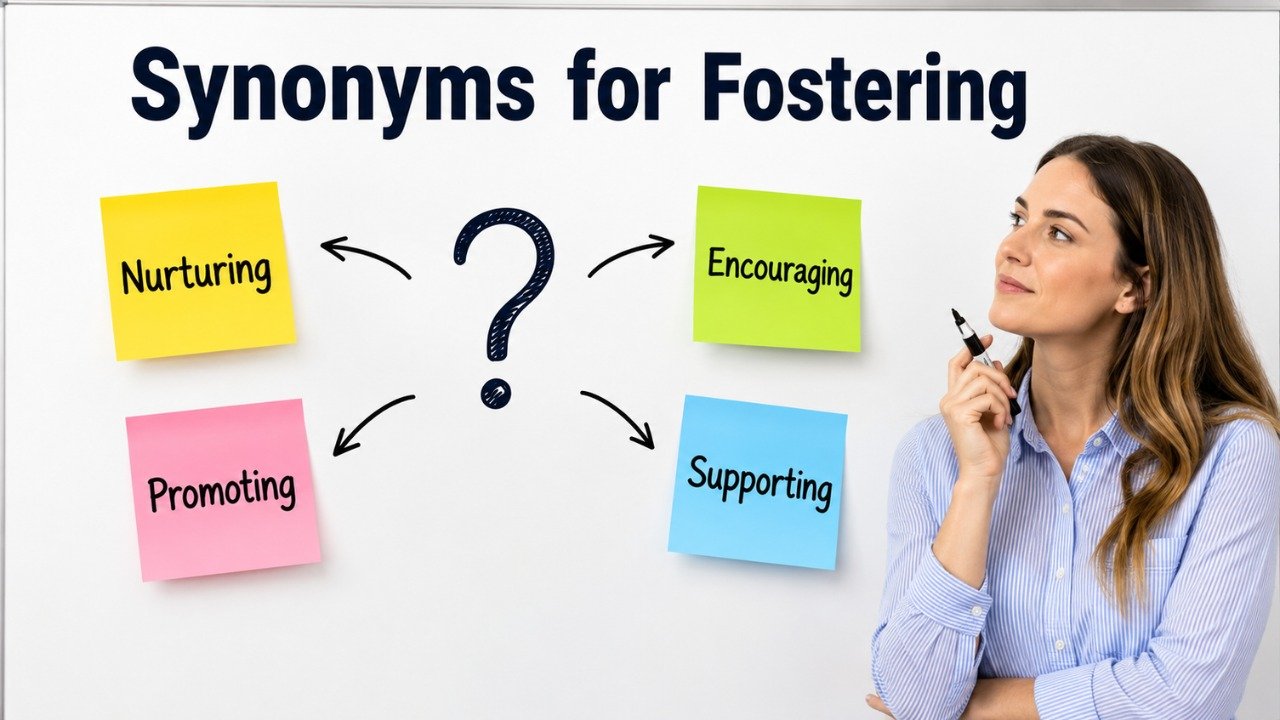
Quick Answer: The best synonyms for fostering include nurturing, encouraging, promoting, cultivating, supporting, developing, advancing, facilitating, strengthening, and enabling. Use nurturing for personal growth or care, promoting for formal writing about ideas or policies, cultivating for skills and relationships, encouraging for everyday speech, facilitating for processes, and enabling when providing the tools or conditions needed for progress. When fostering refers to temporary child care, providing foster care or caring for are more precise alternatives.
Pronunciation and Word Details
Word: Fostering.
Pronunciation: /ˈfɑːstərɪŋ/
Part of Speech: Verb, present participle, and gerund.
Meaning: Helping something develop, encouraging a condition, or temporarily caring for a child.
US Pronunciation:
UK Pronunciation:
What Does “Fostering” Mean?
Fostering means helping a person, idea, skill, relationship, feeling, or condition grow and develop.
Fostering is the present participle and gerund form of the verb foster. It can describe an action that is happening now, an ongoing activity, or the general process of supporting development.
The word has several related uses. It can mean encouraging growth, creating a positive environment, strengthening relationships, supporting a particular attitude, or temporarily caring for a child who cannot live with their birth family.
Growth Context: The teacher is fostering confidence among her students.
Workplace Context: Clear communication helps with fostering cooperation between departments.
Social Context: The program focuses on fostering stronger community relationships.
Emotional Context: Constant criticism may be fostering resentment.
Child Care Context: The family is fostering two children until permanent arrangements are made.
Fostering usually suggests active and continuing support. It does not simply mean allowing something to happen. It often implies that someone is creating the right conditions for growth, improvement, or development.
The word can describe positive or negative development. A leader may foster trust, creativity, and teamwork. Poor management may foster confusion, fear, or conflict.
Meaning, Tone, and Context of “Fostering”
Fostering usually has a positive, constructive, and supportive tone. It often suggests patience, care, encouragement, and gradual development.
The word is common in formal, professional, academic, educational, social, and organizational writing. It is frequently used when discussing relationships, learning, innovation, inclusion, collaboration, leadership, and personal growth.
Formal Tone: Fostering works well in reports, essays, policies, professional communication, and academic discussions.
Positive Tone: It often describes actions that help desirable qualities grow, such as trust, creativity, confidence, and cooperation.
Neutral Tone: The word can also describe the development of negative conditions, such as resentment, dependence, or hostility.
Educational Context: Teachers may focus on fostering curiosity, independence, and critical thinking.
Professional Context: Managers may work on fostering teamwork and open communication.
Social Context: Community programs may support fostering inclusion and mutual respect.
Psychological Context: A safe environment can help with fostering emotional security.
Child Care Context: Fostering has a specific meaning related to providing temporary family care for a child.
In casual conversation, encouraging, helping, or supporting may sound more natural. In formal writing, fostering often sounds polished because it emphasizes gradual and intentional development.
When and How to Use “Fostering”
Use fostering when an action helps something grow, improves a relationship, creates favorable conditions, or supports continuing development.
For Personal Growth: Use fostering when someone helps another person develop confidence, independence, resilience, or knowledge.
Example: The mentoring program is fostering confidence among young participants.
For Learning: Use fostering when an activity encourages curiosity, understanding, creativity, or critical thinking.
Example: Open discussions are useful for fostering critical thinking in the classroom.
For Relationships: Use fostering when people are building trust, cooperation, respect, or emotional connection.
Example: Honest communication is essential for fostering healthy relationships.
For Teamwork: Use fostering when leaders create conditions that support collaboration and shared responsibility.
Example: The manager introduced weekly meetings for fostering teamwork.
For Innovation: Use fostering when an organization supports new ideas, experimentation, and creative problem solving.
Example: Flexible working methods can help with fostering innovation.
For Inclusion: Use fostering when a group promotes respect, belonging, and equal participation.
Example: The policy aims at fostering inclusion across the organization.
For Positive Behavior: Use fostering when rules, habits, or examples encourage desirable actions.
Example: Consistent praise can help with fostering responsible behavior.
For Emotional Conditions: Use fostering when an environment encourages feelings such as trust, hope, fear, or resentment.
Example: Secrecy was fostering suspicion among the employees.
For Community Development: Use fostering when projects strengthen cooperation, participation, or shared identity.
Example: Local events are fostering a stronger sense of community.
For Temporary Child Care: Use fostering when a person or family provides temporary care for a child.
Example: They began fostering children after completing the required preparation.
Best Synonyms for Fostering
Nurturing
Synonym: Caring for and supporting gradual growth or development.
Example: The teacher is nurturing the creative abilities of her students.
Encouraging
Synonym: Giving support, confidence, or motivation to help something happen.
Example: The coach is encouraging greater participation from every player.
Promoting
Synonym: Actively supporting the growth, acceptance, or success of something.
Example: The campaign is promoting healthier eating habits.
Cultivating
Synonym: Developing a quality, skill, relationship, or attitude through steady effort.
Example: The workshops are cultivating stronger leadership skills.
Supporting
Synonym: Providing help, resources, or approval for growth or success.
Example: The organization is supporting local artists.
Developing
Synonym: Helping something become more advanced, effective, or complete.
Example: The course is developing practical communication skills.
Advancing
Synonym: Helping an idea, goal, or cause move forward.
Example: The project is advancing cooperation between neighboring communities.
Facilitating
Synonym: Making a process, activity, or development easier.
Example: Clear instructions are facilitating better communication.
Strengthening
Synonym: Making a quality, relationship, or system more effective and secure.
Example: Shared experiences are strengthening the bond between team members.
Enabling
Synonym: Giving someone the ability, opportunity, or resources to succeed.
Example: The scholarship is enabling more students to continue their education.
50 Synonyms for Fostering with Short Meanings
- Nurturing: Caring for and encouraging gradual development.
- Encouraging: Giving support or confidence for progress.
- Promoting: Actively helping something grow or become accepted.
- Cultivating: Developing a quality, skill, or relationship through steady effort.
- Supporting: Providing help, resources, or approval.
- Developing: Helping something become stronger or more advanced.
- Advancing: Moving a goal, idea, or cause forward.
- Facilitating: Making growth, progress, or action easier.
- Strengthening: Making something more effective, stable, or powerful.
- Enabling: Providing the means or opportunity for success.
- Inspiring: Creating motivation, enthusiasm, or positive action.
- Stimulating: Encouraging activity, interest, thought, or growth.
- Furthering: Helping something progress toward a goal.
- Enhancing: Improving the quality, value, or effectiveness of something.
- Building: Gradually creating or strengthening something.
- Growing: Increasing the size, strength, influence, or quality of something.
- Creating: Bringing a condition, feeling, or opportunity into existence.
- Establishing: Forming something that can continue or develop.
- Reinforcing: Making an idea, habit, or behavior stronger.
- Empowering: Giving confidence, authority, or ability to act.
- Motivating: Providing a reason or desire to take action.
- Mentoring: Guiding someone through advice and personal support.
- Guiding: Showing someone how to develop or make progress.
- Educating: Helping someone gain knowledge or understanding.
- Training: Teaching practical skills or suitable behavior.
- Coaching: Helping someone improve through guidance and practice.
- Helping: Providing assistance that supports progress.
- Assisting: Giving practical support to make something easier.
- Sponsoring: Providing resources or official support for an activity.
- Championing: Publicly and actively supporting a cause or idea.
- Sustaining: Helping something continue over time.
- Maintaining: Keeping a condition, relationship, or system active.
- Preserving: Protecting something so it can continue.
- Generating: Producing a feeling, condition, idea, or result.
- Producing: Causing something to develop or appear.
- Instilling: Gradually placing an attitude, value, or belief in someone.
- Planting: Introducing an idea, hope, or feeling that may grow.
- Kindling: Starting or increasing a feeling, interest, or activity.
- Fueling: Increasing the strength or continuation of something.
- Feeding: Supplying what allows a feeling or condition to grow.
- Breeding: Creating conditions in which a quality or problem develops.
- Harboring: Allowing a feeling, thought, or condition to remain and grow.
- Culturing: Supporting growth in a controlled scientific environment.
- Raising: Caring for and helping a child or young person develop.
- Caring For: Providing attention, protection, and practical support.
- Looking After: Taking responsibility for someone’s daily needs.
- Protecting: Keeping someone or something safe from harm.
- Providing Foster Care: Giving temporary family care to a child.
- Taking In: Allowing someone to live in a home and receive care.
- Providing Temporary Care: Looking after someone for a limited period.
Read Also:
Synonyms for Injustice
Synonyms for Fostering by Context
When Fostering Means Encouraging Growth
When fostering describes general development, nurturing, encouraging, supporting, and promoting are the strongest alternatives.
Useful Synonyms: Nurturing, encouraging, promoting, developing, supporting, growing.
Example: The program is nurturing the talents of young musicians.
Example: The new approach is encouraging greater student participation.
Example: The workshops are developing practical leadership abilities.
Nurturing suggests patient and caring support. Encouraging emphasizes confidence and motivation. Developing focuses on measurable improvement.
When Fostering Means Developing Skills
Use cultivating, developing, training, coaching, mentoring, or strengthening when discussing abilities and professional growth.
Useful Synonyms: Cultivating, developing, training, coaching, mentoring, strengthening.
Example: The course is cultivating strong analytical skills.
Example: The supervisor is mentoring several new employees.
Example: Regular practice is strengthening her presentation skills.
Cultivating works well for qualities that develop gradually. Training emphasizes structured instruction. Mentoring suggests personal guidance from someone with more experience.
When Fostering Means Supporting Relationships
Use building, strengthening, nurturing, cultivating, or maintaining when describing trust, friendship, cooperation, and connection.
Useful Synonyms: Building, strengthening, nurturing, cultivating, maintaining.
Example: Open communication is building trust between the two teams.
Example: Shared goals are strengthening professional relationships.
Example: Regular contact helps with maintaining close family connections.
Building suggests that a relationship is being created. Strengthening means an existing connection is becoming more secure. Maintaining means preventing it from becoming weaker.
When Fostering Means Promoting an Idea
Use promoting, advancing, championing, furthering, or supporting when someone actively helps an idea, policy, or cause gain attention and acceptance.
Useful Synonyms: Promoting, advancing, championing, furthering, supporting.
Example: The organization is promoting responsible water use.
Example: The committee is advancing a proposal for safer public spaces.
Example: Several community leaders are championing the new program.
Promoting is the broadest formal option. Advancing emphasizes progress. Championing suggests strong and visible support.
When Fostering Means Creating Conditions
Use facilitating, enabling, creating, establishing, or stimulating when someone provides the environment, opportunity, or resources needed for development.
Useful Synonyms: Facilitating, enabling, creating, establishing, stimulating.
Example: Flexible schedules are facilitating better cooperation.
Example: The grant is enabling researchers to continue their work.
Example: The new policy is creating opportunities for local businesses.
Facilitating makes a process easier. Enabling provides the ability or resources needed. Establishing suggests forming a stable foundation.
When Fostering Means Encouraging Feelings
Use inspiring, instilling, generating, kindling, or planting when an action causes a feeling, attitude, or belief to develop.
Useful Synonyms: Inspiring, instilling, generating, kindling, planting.
Example: Her speech inspired confidence among the volunteers.
Example: The lessons are instilling respect for the natural environment.
Example: Their success kindled hope throughout the community.
Inspiring usually refers to positive motivation. Instilling suggests gradual and intentional teaching. Kindling describes the beginning of a feeling or interest.
When Fostering Means Causing a Negative Condition
Fostering does not always describe something positive. Use fueling, feeding, breeding, generating, or harboring when an action increases conflict, fear, resentment, or confusion.
Useful Synonyms: Fueling, feeding, breeding, generating, harboring.
Example: The unclear announcement was fueling public confusion.
Example: Constant criticism can breed resentment.
Example: Refusing to explain the decision generated suspicion.
Fueling suggests increasing the strength of an existing problem. Breeding describes conditions that allow a problem to develop. Harboring usually refers to keeping a feeling or thought within oneself.
When Fostering Means Caring for a Child
When fostering refers to child care, use providing foster care, caring for, looking after, taking in, or providing temporary care.
Useful Synonyms: Providing foster care, caring for, looking after, taking in, providing temporary care.
Example: The couple has been providing foster care for several years.
Example: They are caring for a child who needs a safe temporary home.
Example: The family agreed to take in two siblings.
These alternatives are more precise when the meaning relates to family care rather than general development.
Another Word for Fostering
The best general replacement for fostering is encouraging. It is natural, clear, and suitable for personal, educational, and professional contexts.
However, the best alternative depends on what is being developed. Use nurturing for personal growth, cultivating for skills or relationships, promoting for ideas and causes, facilitating for processes, and providing foster care when discussing temporary child care.
Original: The teacher is fostering curiosity in the classroom.
Better Option: The teacher is encouraging curiosity in the classroom.
Original: The manager is fostering stronger relationships among employees.
Better Option: The manager is cultivating stronger relationships among employees.
Original: The campaign focuses on fostering environmental responsibility.
Better Option: The campaign focuses on promoting environmental responsibility.
Original: The family has experience fostering young children.
Better Option: The family has experience providing foster care for young children.
When Not to Use “Fostering”
Do not use fostering when a simpler verb would make the meaning more direct. In casual speech, helping, encouraging, or supporting may sound more natural.
Weak: She is fostering me to finish the assignment.
Better: She is encouraging me to finish the assignment.
Fostering does not normally take a person directly as its object when the intended meaning is giving verbal encouragement. It usually takes a quality, relationship, condition, or form of development.
Weak: The coach fostered the players before the match.
Better: The coach motivated the players before the match.
Avoid using fostering when referring to a quick or single action. The word usually suggests gradual or continuing development.
Weak: His brief comment fostered the door to open.
Better: His brief comment persuaded her to open the door.
Do not use fostering as a vague replacement for creating when describing a concrete object.
Weak: The workers are fostering a new bridge.
Better: The workers are building a new bridge.
Use more precise language when the sentence refers to temporary child care. General readers may misunderstand fostering if the context is unclear.
Weak: They have been fostering for three months.
Better: They have been providing foster care for three months.
Avoid fostering when the real meaning is financially supporting an event or person.
Weak: The business is fostering the local exhibition with money.
Better: The business is sponsoring the local exhibition.
Do not repeat fostering throughout a paragraph when several precise alternatives are available.
Weak: The program is fostering confidence, fostering skills, and fostering stronger relationships.
Better: The program is building confidence, developing skills, and strengthening relationships.
Words Commonly Confused With Fostering
Fostering vs Nurturing: Fostering means helping something develop by creating supportive conditions. Nurturing adds a stronger sense of care, attention, and protection.
Fostering vs Encouraging: Fostering usually describes gradual development over time. Encouraging may refer to a single statement, action, or expression of support.
Fostering vs Promoting: Fostering focuses on development and growth. Promoting often means actively supporting, publicizing, or increasing acceptance of something.
Fostering vs Cultivating: Both words suggest gradual development. Cultivating is especially suitable for skills, habits, relationships, qualities, and attitudes that require regular effort.
Fostering vs Facilitating: Fostering encourages growth. Facilitating makes an activity or process easier without necessarily causing the development itself.
Fostering vs Enabling: Fostering supports continued development. Enabling provides the ability, resources, permission, or opportunity needed for action.
Fostering vs Raising: Fostering may mean temporarily caring for a child. Raising usually means taking continuing responsibility for a child’s development over many years.
Fostering vs Adopting: Fostering usually involves temporary care without becoming the child’s permanent legal parent. Adopting involves becoming the child’s permanent legal parent.
Fostering vs Sponsoring: Fostering means encouraging development. Sponsoring normally means providing money, resources, or official support.
Fostering vs Breeding: Fostering can describe positive or negative development. Breeding is often used for negative conditions, such as resentment or conflict, and can also refer to animal reproduction.
Which Synonym Should You Choose?
Choose nurturing when writing about children, talents, creativity, confidence, emotional security, or personal development.
Choose encouraging in casual speech when someone gives support, confidence, or motivation.
Choose promoting in formal writing about ideas, values, policies, awareness, health, education, or social causes.
Choose cultivating when discussing habits, skills, relationships, attitudes, leadership, or professional qualities.
Choose developing for reports and educational writing about measurable abilities, systems, plans, or programs.
Choose supporting when the focus is on providing help, approval, resources, or assistance.
Choose facilitating when describing a process that becomes easier through planning, communication, technology, or organization.
Choose enabling when someone receives the tools, permission, opportunity, or ability needed to act.
Choose strengthening when an existing quality, relationship, system, or organization becomes more effective.
Choose advancing when an idea, project, goal, or cause is moving forward.
Choose inspiring when a person or experience creates enthusiasm, hope, creativity, or motivation.
Choose instilling when values, attitudes, habits, or beliefs are gradually taught.
Choose fueling when an action increases conflict, fear, anger, suspicion, or another negative condition.
Choose breeding when an environment allows a problem or feeling to develop over time.
Choose providing foster care when writing clearly and precisely about temporary care for a child.
Real Life Examples of “Fostering” in Sentences
Original: The teacher is fostering independence among her students.
Better Option: The teacher is encouraging independence among her students.
Original: The workshop focuses on fostering leadership skills.
Better Option: The workshop focuses on developing leadership skills.
Original: Regular meetings are fostering cooperation between the departments.
Better Option: Regular meetings are strengthening cooperation between the departments.
Original: The new policy is fostering greater participation.
Better Option: The new policy is promoting greater participation.
Original: The quiet study area is fostering concentration.
Better Option: The quiet study area is supporting concentration.
Original: The mentor is fostering confidence in the new employee.
Better Option: The mentor is nurturing confidence in the new employee.
Original: The online system is fostering faster communication.
Better Option: The online system is facilitating faster communication.
Original: The lack of information is fostering public concern.
Better Option: The lack of information is fueling public concern.
Original: The program is fostering closer relationships among neighbors.
Better Option: The program is building closer relationships among neighbors.
Original: The family has been fostering children for several years.
Better Option: The family has been providing foster care for children for several years.
Synonym Groups and Usage Differences
Growth and Development Group
This group includes words that describe helping a person, skill, idea, or quality become stronger.
Synonyms: Nurturing, developing, growing, enhancing, strengthening.
Nurturing emphasizes care. Developing focuses on progress. Enhancing means improving something that already exists. Strengthening means making it more effective or secure.
Example: The course is developing the practical abilities students need for employment.
Encouragement and Motivation Group
These synonyms describe actions that create confidence, enthusiasm, or willingness.
Synonyms: Encouraging, inspiring, motivating, stimulating, empowering.
Encouraging provides support. Inspiring creates enthusiasm or admiration. Motivating gives someone a reason to act. Empowering gives confidence or authority.
Example: The speaker inspired volunteers to become more involved in the community.
Promotion and Support Group
These words are useful when an individual or organization actively supports an idea, cause, policy, or goal.
Synonyms: Promoting, supporting, championing, sponsoring, furthering, advancing.
Promoting increases awareness or acceptance. Championing shows strong public support. Sponsoring provides resources. Advancing moves a goal forward.
Example: The organization is championing equal access to education.
Skills and Relationship Group
These words describe development that requires patience, practice, and repeated attention.
Synonyms: Cultivating, mentoring, coaching, guiding, training, educating.
Cultivating works well for qualities and relationships. Mentoring offers personal advice. Coaching focuses on improved performance. Training teaches practical skills.
Example: Experienced employees are mentoring new members of the team.
Process and Opportunity Group
These alternatives describe creating conditions that make action or progress possible.
Synonyms: Facilitating, enabling, creating, establishing, assisting, helping.
Facilitating makes a process easier. Enabling provides ability or opportunity. Establishing creates a stable structure or foundation.
Example: Clear procedures are facilitating faster decisions.
Positive Condition Group
These words describe bringing a desirable feeling, habit, environment, or result into existence.
Synonyms: Generating, producing, instilling, planting, kindling, reinforcing.
Generating means causing something to appear. Instilling suggests gradual teaching. Kindling describes the beginning of interest or emotion. Reinforcing makes an existing quality stronger.
Example: The lessons are instilling a sense of responsibility in students.
Negative Development Group
These alternatives are useful when fostering refers to increasing a harmful feeling or condition.
Synonyms: Fueling, feeding, breeding, harboring, generating.
Fueling increases a problem. Feeding allows it to continue. Breeding creates conditions in which it grows. Harboring means keeping a feeling or thought within oneself.
Example: Unclear rules were breeding frustration among employees.
Care and Protection Group
These synonyms relate to meeting another person’s needs and keeping them safe.
Synonyms: Caring for, looking after, protecting, raising, taking in, providing temporary care.
Caring for is broad. Looking after sounds conversational. Raising usually involves continuing parental responsibility. Taking in emphasizes offering someone a home.
Example: The relatives agreed to look after the children during the emergency.
Antonyms of Fostering
The opposite of fostering depends on whether the word refers to growth, support, relationships, feelings, or care.
Discouraging: Reducing someone’s confidence or desire to continue.
Hindering: Making progress or development more difficult.
Obstructing: Deliberately blocking movement, action, or progress.
Preventing: Stopping something from happening or developing.
Suppressing: Controlling or stopping an idea, feeling, or activity.
Neglecting: Failing to provide necessary care or attention.
Ignoring: Giving no attention or consideration to something.
Weakening: Making a quality, relationship, or system less effective.
Undermining: Gradually damaging confidence, authority, progress, or stability.
Restricting: Limiting freedom, opportunity, movement, or development.
Inhibiting: Preventing natural growth, action, or expression.
Damaging: Causing physical, emotional, or practical harm.
Destroying: Causing something to stop existing or functioning.
Stifling: Preventing creativity, expression, discussion, or development.
Abandoning: Leaving someone or something without care or support.
Comparison: Fostering vs Related Words
Fostering vs Nurturing
Fostering means supporting development by creating suitable conditions. Nurturing suggests closer care, attention, patience, and protection.
Example With Fostering: The school is fostering creativity through flexible projects.
Example With Nurturing: The teacher is nurturing the artistic talent of a gifted student.
Fostering vs Encouraging
Fostering usually describes gradual and continuing development. Encouraging may describe a single supportive action or statement.
Example With Fostering: The program is fostering confidence over several months.
Example With Encouraging: Her teacher encouraged her to enter the competition.
Fostering vs Promoting
Fostering emphasizes helping something grow. Promoting emphasizes active support, increased awareness, or greater acceptance.
Example With Fostering: The meetings are fostering cooperation among residents.
Example With Promoting: The campaign is promoting cooperation throughout the community.
Fostering vs Cultivating
Both words describe gradual development. Cultivating often suggests regular effort directed toward skills, relationships, habits, or qualities.
Example With Fostering: The manager is fostering a respectful workplace.
Example With Cultivating: The manager is cultivating respectful communication among employees.
Fostering vs Developing
Fostering focuses on support and favorable conditions. Developing focuses on the process of becoming more advanced, complete, or effective.
Example With Fostering: The club is fostering an interest in science.
Example With Developing: The club is developing students’ scientific knowledge.
Fostering vs Facilitating
Fostering encourages growth or development. Facilitating makes an activity or process easier to complete.
Example With Fostering: The new structure is fostering collaboration.
Example With Facilitating: The shared workspace is facilitating collaboration.
Fostering vs Enabling
Fostering provides continuing support for growth. Enabling gives the ability, opportunity, permission, or resources needed for action.
Example With Fostering: The course is fostering independent learning.
Example With Enabling: The new tools are enabling students to learn independently.
Fostering vs Fueling
Fostering can describe positive or negative development. Fueling usually suggests increasing the strength of an existing feeling, conflict, or problem.
Example With Fostering: The open discussion is fostering mutual respect.
Example With Fueling: The false claims are fueling public anger.
Fostering vs Raising
Fostering can mean providing temporary care for a child. Raising usually refers to the continuing process of caring for and guiding a child through development.
Example With Fostering: The family is fostering a child who needs temporary care.
Example With Raising: They are raising their children in a supportive home.
Fostering vs Adopting
Fostering generally provides temporary care. Adopting creates a permanent legal parent and child relationship.
Example With Fostering: They are fostering the child while a permanent home is found.
Example With Adopting: They are adopting the child and becoming the permanent legal parents.
Common Phrases and Expressions With Fostering
Fostering Growth: Supporting gradual personal, professional, social, or economic development.
Fostering Innovation: Creating conditions that encourage new ideas and creative solutions.
Fostering Collaboration: Helping people work together successfully.
Fostering Communication: Encouraging clear, open, and useful exchanges of information.
Fostering Relationships: Building and strengthening connections between people or groups.
Fostering Inclusion: Creating an environment where people feel respected and involved.
Fostering Trust: Developing confidence in another person, group, or institution.
Fostering Independence: Helping someone become more confident and self reliant.
Fostering Creativity: Encouraging imagination, experimentation, and original thinking.
Fostering a Sense of Community: Strengthening belonging, cooperation, and shared responsibility.
Common Mistakes to Avoid
Using Fostering Without a Clear Object
Fostering should usually be followed by the quality, condition, relationship, or development being encouraged.
Unclear: The program is fostering.
Better: The program is fostering confidence and teamwork.
Using Fostering for Direct Verbal Encouragement
Fostering is usually too formal when someone simply tells another person to continue.
Incorrect: She fostered him to apply for the position.
Better: She encouraged him to apply for the position.
Confusing Fostering With Adopting
Fostering and adopting are not interchangeable in child care contexts. Fostering usually involves temporary care, while adoption creates a permanent legal relationship.
Incorrect: They permanently fostered the child and became the legal parents.
Better: They adopted the child and became the legal parents.
Choosing a Vague Synonym
A precise synonym can make formal writing stronger.
Vague: The report discusses fostering good things in the workplace.
Better: The report discusses promoting cooperation and cultivating employee trust.
Repeating Fostering Too Often
Use alternatives when several different forms of development appear in one paragraph.
Repetitive: The workshop is fostering confidence, fostering communication, and fostering leadership.
Improved: The workshop is building confidence, strengthening communication, and developing leadership.
Using Fostering for Physical Construction
Fostering normally refers to growth, attitudes, relationships, conditions, or care. It does not mean physically constructing an object.
Incorrect: The company is fostering a new office building.
Better: The company is constructing a new office building.
Ignoring Negative Contexts
Fostering can describe harmful development as well as positive growth.
Incorrect Assumption: Fostering always describes something beneficial.
Correct Use: The lack of transparency was fostering distrust.
Confusing Facilitating With Fostering
Facilitating means making something easier. Fostering means actively supporting its development.
Less Precise: The software is fostering faster document transfers.
Better: The software is facilitating faster document transfers.
Using the Wrong Grammatical Form
Fostering can function as part of a continuous verb or as a gerund.
Continuous Verb: The teacher is fostering curiosity.
Gerund: Fostering curiosity is an important educational goal.
Do not use fostering when the base verb foster is required after a modal verb.
Incorrect: The policy can fostering cooperation.
Better: The policy can foster cooperation.
Conclusion
The best synonyms for fostering depend on what is being encouraged or developed. Use nurturing for personal growth, cultivating for skills and relationships, promoting for ideas, facilitating for processes, and enabling for opportunity. Encouraging sounds natural in conversation, while developing and advancing suit formal reports. For negative conditions, fueling or breeding may be more precise. When the meaning involves temporary child care, providing foster care is clearest. Understanding these synonyms for fostering helps you choose accurate, natural, and context appropriate language.
FAQs About Synonyms for Fostering
What is the closest synonym for fostering?
Encouraging is the closest general synonym. Nurturing, promoting, cultivating, and supporting are also strong choices depending on the context.
What is a formal synonym for fostering?
Promoting, cultivating, facilitating, advancing, and developing are effective formal alternatives for essays, reports, and professional communication.
Is nurturing the same as fostering?
The meanings are similar, but nurturing emphasizes personal care and attention. Fostering focuses more broadly on creating conditions that support growth.
What is another word for fostering relationships?
Cultivating, building, strengthening, nurturing, and maintaining are useful alternatives for fostering relationships.
What is another word for fostering growth?
Nurturing, encouraging, supporting, developing, stimulating, and promoting can all replace fostering growth.
Can fostering describe something negative?
Yes. Fostering can describe the development of fear, resentment, distrust, conflict, or dependence. Fueling, feeding, or breeding may be more precise in these situations.
What does fostering mean in child care?
In child care, fostering means providing a safe temporary home and daily care for a child who cannot currently live with their birth family.
