
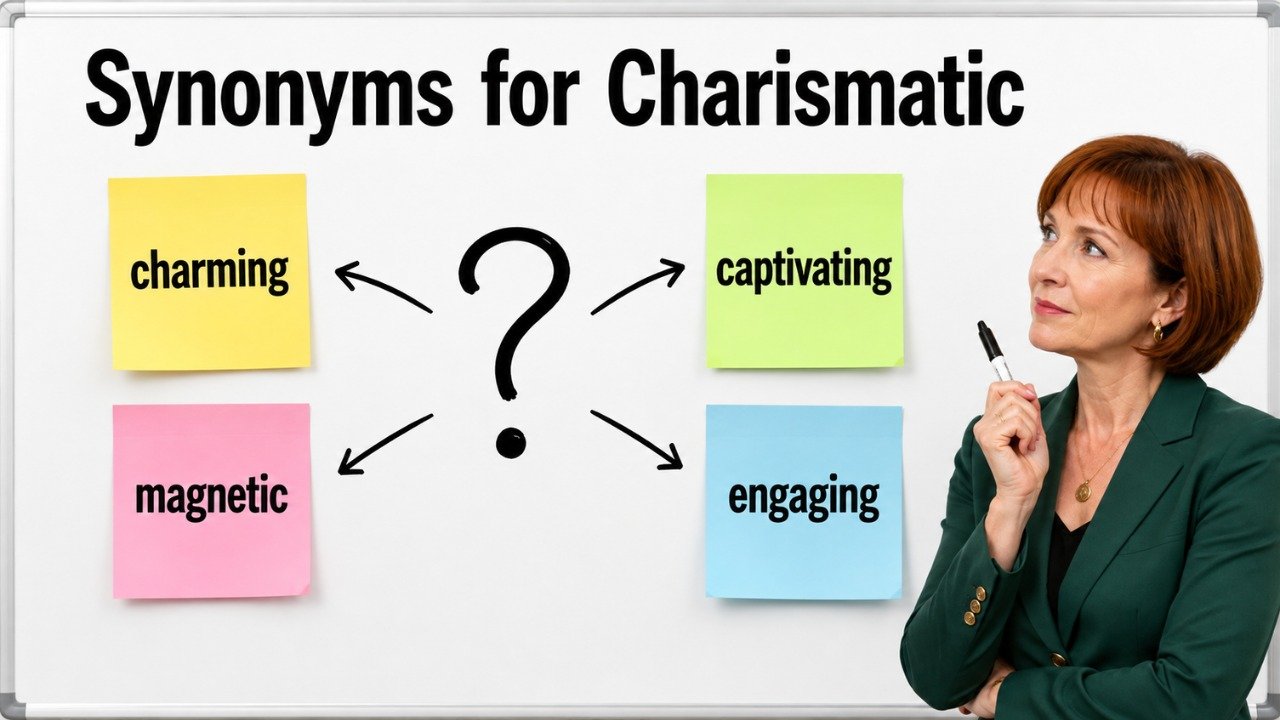
Quick Answer: The best synonyms for charismatic include charming, captivating, magnetic, compelling, engaging, personable, persuasive, inspiring, dynamic, and commanding. Use charming for someone pleasant and socially attractive. Magnetic describes a person who naturally draws attention, while captivating and compelling emphasize a strong ability to hold interest. Personable suits professional descriptions, persuasive fits influential speakers, inspiring works for motivating leaders, and commanding describes a powerful presence. The most suitable choice among synonyms for charismatic depends on whether you want to emphasize personality, leadership, communication, popularity, confidence, or personal appeal.
Pronunciation and Word Details
Word: Charismatic.
Pronunciation: /ˌkærɪzˈmætɪk/.
Part of Speech: Adjective.
Meaning: Having a powerful personal quality that attracts, influences, or inspires other people.
US Pronunciation:
UK Pronunciation:
What Does “Charismatic” Mean?
Charismatic means possessing a naturally attractive, confident, and influential personality that draws people in.
The word is an adjective. It commonly describes a person who gains attention, admiration, loyalty, or trust through personal presence and communication. A charismatic person may appear confident, expressive, engaging, persuasive, or inspiring.
Charismatic is often used for leaders, speakers, performers, teachers, public figures, managers, and socially confident individuals. It can describe someone who makes other people feel interested, motivated, or emotionally connected.
The word does not refer only to physical attractiveness. A person can be charismatic because of a warm voice, memorable storytelling, emotional intelligence, humor, confidence, or ability to understand an audience.
In a leadership context, charismatic suggests that a person inspires support through personality and vision. In a social context, it describes someone who is charming and easy to notice. In public speaking, it refers to a speaker whose delivery holds attention and creates enthusiasm.
The word may also describe a style, presence, performance, or manner.
Example: Her charismatic speaking style kept the audience fully engaged.
Meaning, Tone, and Context of “Charismatic”
Charismatic usually has a positive and approving tone. It suggests that someone has an attractive personal presence and can influence others naturally.
The word is suitable for both formal and conversational English. It appears in essays, biographies, professional profiles, leadership discussions, performance reviews, news writing, interviews, and ordinary conversation.
In formal writing, charismatic often describes leadership, communication, influence, or public appeal. A charismatic leader may inspire loyalty and enthusiasm through confidence, vision, and emotional connection.
In casual conversation, charismatic may simply mean charming, likable, interesting, or socially impressive.
The word is strong because it suggests more than friendliness. A friendly person is pleasant, but a charismatic person actively attracts attention and influences the mood of a group.
Charismatic can also carry a neutral or slightly cautious meaning. Personal charm does not always prove that someone is honest, capable, or responsible. A charismatic person may be persuasive without necessarily being correct.
The word is not usually technical, although it appears in discussions of psychology, leadership, communication, religion, sociology, and human behavior.
When and How to Use “Charismatic”
For Leadership: Use charismatic for a leader who inspires enthusiasm, loyalty, or confidence through personality and communication.
Example: The charismatic director united the team around a clear vision.
For Public Speaking: Use charismatic for a speaker whose confidence, voice, and delivery hold the audience’s attention.
Example: She was a charismatic speaker who made complex ideas feel exciting.
For Social Appeal: Use charismatic for someone who naturally attracts people in social situations.
Example: His charismatic personality made him popular at every gathering.
For Professional Communication: Use charismatic when describing a person who builds trust and interest during meetings, interviews, or presentations.
Example: The charismatic candidate connected easily with the interview panel.
For Performance: Use charismatic for a performer whose presence is powerful and memorable.
Example: The charismatic actor commanded attention throughout the play.
For Persuasion: Use charismatic when a person influences others through confidence, warmth, or expressive communication.
Example: Her charismatic manner helped her gain support for the proposal.
For Personal Description: Use charismatic when charm, confidence, energy, and influence are all important qualities.
Example: He is intelligent, charismatic, and easy to remember.
For Strong Presence: Use charismatic when someone changes the energy of a room simply by entering or speaking.
Example: The host had a charismatic presence that made the event feel lively.
Best Synonyms for Charismatic
Charming: Pleasant and attractive in a way that makes people like someone.
Example: The charming host made every guest feel welcome.
Captivating: So interesting or attractive that people give complete attention.
Example: Her captivating personality held everyone’s interest.
Magnetic: Naturally able to attract attention, admiration, or interest.
Example: He had a magnetic presence that drew people toward him.
Compelling: Powerful enough to gain and maintain attention.
Example: The candidate gave a compelling presentation.
Engaging: Pleasant, interesting, and able to involve other people.
Example: Her engaging manner encouraged everyone to participate.
Personable: Friendly, pleasant, and easy to communicate with.
Example: The new manager was professional and personable.
Persuasive: Skilled at influencing people’s thoughts or decisions.
Example: He was a persuasive speaker with a confident delivery.
Inspiring: Able to encourage motivation, hope, or admiration.
Example: The inspiring teacher helped students believe in their abilities.
Dynamic: Energetic, active, confident, and capable of creating change.
Example: The organization needed a dynamic leader.
Commanding: Having a powerful presence that naturally receives attention or respect.
Example: Her commanding voice immediately quieted the room.
50 Synonyms for Charismatic With Short Meanings
- Charming: Pleasant and socially attractive.
- Captivating: Able to hold complete attention.
- Magnetic: Naturally attracting people or interest.
- Compelling: Powerful and difficult to ignore.
- Engaging: Interesting, pleasant, and socially appealing.
- Enchanting: Delightfully attractive or pleasing.
- Alluring: Strongly attractive or tempting.
- Appealing: Pleasant and attractive to others.
- Attractive: Having qualities that draw interest or admiration.
- Fascinating: Extremely interesting and attention holding.
- Mesmerizing: Holding attention in an almost irresistible way.
- Spellbinding: Completely capturing someone’s interest.
- Entrancing: Attracting and holding attention deeply.
- Personable: Friendly, pleasant, and easy to approach.
- Likable: Easy to like or appreciate.
- Winning: Pleasant and able to gain approval.
- Amiable: Friendly, agreeable, and pleasant.
- Affable: Warm, approachable, and easy to talk to.
- Congenial: Pleasant and compatible with other people.
- Genial: Cheerful, friendly, and welcoming.
- Sociable: Comfortable and friendly around others.
- Outgoing: Confident and eager to communicate socially.
- Warm: Showing kindness, openness, and emotional friendliness.
- Friendly: Kind, pleasant, and approachable.
- Persuasive: Able to influence opinions or decisions.
- Convincing: Effective at making people believe or agree.
- Influential: Able to affect people’s ideas or actions.
- Inspiring: Able to motivate or encourage others.
- Commanding: Powerful enough to attract attention and respect.
- Dynamic: Energetic, active, and impressive.
- Energetic: Full of enthusiasm and active strength.
- Vibrant: Full of life, energy, and personality.
- Confident: Showing belief in personal ability and judgment.
- Authoritative: Confident, knowledgeable, and deserving of respect.
- Eloquent: Fluent, expressive, and persuasive in speech.
- Expressive: Clearly communicating feelings and ideas.
- Animated: Lively and visibly enthusiastic.
- Spirited: Full of energy, courage, and enthusiasm.
- Radiant: Showing happiness, confidence, or personal brightness.
- Dazzling: Extremely impressive or attractive.
- Glamorous: Exciting, attractive, and admired.
- Beguiling: Attracting interest through charm or mystery.
- Irresistible: So attractive that resistance is difficult.
- Intriguing: Interesting because of unusual or mysterious qualities.
- Impressive: Creating admiration through ability or presence.
- Memorable: Likely to remain in people’s minds.
- Distinctive: Noticeably different and easy to recognize.
- Remarkable: Unusually impressive or worthy of attention.
- Admired: Respected or viewed with approval.
- Popular: Widely liked, supported, or appreciated.
Read Also:
Synonyms for Catastrophic

Synonyms for Charismatic by Context
When Charismatic Means Charming
Charming, personable, likable, winning, amiable, affable, congenial, genial, warm, and friendly describe someone who creates a pleasant social impression.
Charming is the strongest general choice when someone attracts others through good manners, warmth, humor, or personality. Personable is especially useful in professional descriptions because it sounds positive without being overly emotional.
Example: The personable consultant made clients feel comfortable immediately.
Affable and amiable emphasize friendliness and approachability. Winning suggests a manner that gains approval or affection.
Example: Her winning smile helped create a relaxed atmosphere.
When Charismatic Means Attention Holding
Captivating, compelling, fascinating, mesmerizing, spellbinding, entrancing, and intriguing describe someone who holds attention strongly.
Captivating is suitable for a personality, voice, performance, or speaking style. Compelling often emphasizes the power of an argument, message, or presentation.
Example: His captivating storytelling kept the children completely silent.
Mesmerizing and spellbinding are stronger and more dramatic. They suggest that people find it difficult to look away or stop listening.
Example: The performer gave a spellbinding interpretation of the character.
When Charismatic Means Naturally Attractive
Magnetic, alluring, appealing, attractive, enchanting, beguiling, irresistible, radiant, dazzling, and glamorous emphasize personal appeal.
Magnetic is one of the closest synonyms for charismatic because it describes someone who draws attention naturally.
Example: Her magnetic presence changed the mood of the entire room.
Alluring and irresistible can suggest physical or romantic attraction, so they should be used carefully. Radiant often describes visible confidence, happiness, or warmth.
Example: He appeared radiant and confident during the ceremony.
When Charismatic Means Persuasive
Persuasive, convincing, influential, eloquent, compelling, and authoritative describe someone who affects beliefs, opinions, or decisions.
Persuasive focuses directly on the ability to influence. Eloquent emphasizes clear and powerful expression. Authoritative suggests knowledge, confidence, and credibility.
Example: The persuasive speaker gained support for the community project.
Influential is broader. It may describe a person whose ideas or reputation affect others, even without direct communication.
Example: She became an influential voice in the organization.
When Charismatic Means Inspiring
Inspiring, motivational, uplifting, influential, dynamic, and spirited describe someone who encourages action, hope, or enthusiasm.
Inspiring is the best choice when a person makes others feel more confident, hopeful, or determined.
Example: The inspiring coach encouraged the team to keep improving.
Dynamic emphasizes energy and action. Spirited suggests enthusiasm, courage, and liveliness.
Example: The dynamic instructor made every lesson feel important.
When Charismatic Means Confident
Confident, commanding, authoritative, impressive, distinctive, and remarkable describe strength of presence.
Commanding works well for a leader, speaker, performer, or professional who naturally receives attention and respect.
Example: Her commanding presence gave the presentation greater authority.
Confident is more general and does not always imply charm. Authoritative suggests expertise and control rather than social attraction.
Example: He gave an authoritative explanation of the new procedure.
When Charismatic Means Energetic
Dynamic, energetic, vibrant, animated, spirited, expressive, and lively describe visible enthusiasm and activity.
Dynamic is particularly useful for leaders, teachers, speakers, and performers. Animated describes lively facial expressions, gestures, or speech.
Example: Her animated storytelling made the experience easy to imagine.
Vibrant suggests a lively personality filled with enthusiasm and positive energy.
Example: His vibrant personality brought excitement to the group.
When Charismatic Means Memorable
Memorable, distinctive, remarkable, impressive, intriguing, and fascinating describe someone who leaves a lasting impression.
Memorable emphasizes the effect a person has on the mind. Distinctive means that someone has unusual or recognizable qualities.
Example: The presenter had a distinctive voice and memorable delivery.
Remarkable is suitable when the person’s abilities or presence are unusually impressive.
Example: She was a remarkable leader with a clear sense of purpose.
Another Word for Charismatic
Charming is the best general replacement for charismatic when describing a pleasant and attractive personality. However, it does not express the full idea of influence as strongly as charismatic.
Magnetic is better when someone naturally draws attention. Persuasive suits someone who influences decisions. Inspiring is appropriate for a person who motivates others. Commanding works when the main quality is confidence and authority.
Original: The company appointed a charismatic leader.
Better Option: The company appointed an inspiring and dynamic leader.
Original: She is a charismatic speaker.
Better Option: She is a captivating and persuasive speaker.
Original: His charismatic personality attracted many supporters.
Better Option: His magnetic personality attracted many supporters.
Original: The teacher had a charismatic manner.
Better Option: The teacher had an engaging and personable manner.
When Not to Use “Charismatic”
Do not use charismatic when you only mean friendly. Charisma suggests a stronger ability to attract, influence, or inspire people.
Weak: The receptionist was charismatic and answered my question politely.
Better: The receptionist was friendly and helpful.
Avoid charismatic when the important quality is technical knowledge rather than personal appeal.
Weak: She gave a charismatic explanation of the laboratory results.
Better: She gave an authoritative and accurate explanation of the laboratory results.
Do not use charismatic repeatedly in a biography or professional profile. More specific words can show exactly why the person is impressive.
Weak: He was a charismatic leader, a charismatic speaker, and a charismatic host.
Better: He was an inspiring leader, a persuasive speaker, and a charming host.
Avoid the word when you need to describe physical beauty only. Attractive, handsome, beautiful, elegant, or glamorous may be more accurate.
Weak: The model had a charismatic face.
Better: The model had a striking and attractive appearance.
Do not use charismatic as automatic proof of honesty or competence. Personal charm and professional ability are different qualities.
Weak: The candidate was charismatic, so she was clearly the most qualified.
Better: The candidate was charismatic, but her qualifications still required careful evaluation.
Avoid using alluring or seductive as replacements in professional settings unless romantic attraction is genuinely relevant. These words may create an unintended meaning.
Weak: He was an alluring department manager.
Better: He was a personable and influential department manager.
Words Commonly Confused With Charismatic
Charismatic vs Charming: Charismatic suggests charm combined with influence, confidence, or leadership. Charming mainly means pleasant and attractive.
Charismatic vs Attractive: Charismatic refers mainly to personality and presence. Attractive often refers to appearance, although it can also describe appealing qualities.
Charismatic vs Friendly: A friendly person is kind and approachable. A charismatic person attracts attention and may influence the emotions or actions of others.
Charismatic vs Confident: Confidence means believing in one’s abilities. Charisma includes the effect that a confident personality has on other people.
Charismatic vs Persuasive: Persuasive describes the ability to influence a decision or opinion. Charismatic describes broader personal appeal that may make persuasion easier.
Charismatic vs Popular: Popular means liked or supported by many people. A person may be popular without having a particularly powerful presence.
Charismatic vs Influential: Influential means capable of affecting ideas, behavior, or decisions. Influence may come from knowledge, authority, wealth, experience, or charisma.
Charismatic vs Dynamic: Dynamic suggests energy, activity, and change. Charismatic emphasizes personal attraction and emotional influence.
Charismatic vs Eloquent: Eloquent refers to fluent and powerful expression. A person may speak eloquently without having a magnetic personality.
Charismatic vs Commanding: Commanding describes a strong and authoritative presence. Charismatic includes attraction and emotional connection, not only authority.
Which Synonym Should You Choose?
Choose charming when describing someone who is pleasant, polite, and socially attractive.
Choose magnetic when a person naturally draws attention without appearing to make an effort.
Choose captivating when someone holds an audience’s interest through personality, voice, storytelling, or performance.
Choose compelling when describing a powerful speech, argument, presentation, or message.
Choose engaging for a friendly speaker, teacher, writer, presenter, or conversational partner.
Choose personable in professional profiles, recommendations, interviews, emails, and workplace descriptions.
Choose persuasive when the person is skilled at changing opinions or encouraging action.
Choose influential when someone affects decisions, attitudes, trends, or group behavior.
Choose inspiring when a leader, teacher, coach, or speaker motivates people to improve or act.
Choose dynamic when someone combines energy, confidence, and active leadership.
Choose commanding when describing a strong presence that receives immediate attention or respect.
Choose eloquent for formal writing about someone who communicates ideas beautifully and effectively.
Choose affable or amiable in polite descriptions of a friendly and approachable person.
Choose sociable or outgoing in casual speech when the main idea is comfort around other people.
Choose radiant when confidence, happiness, and warmth are visible in someone’s appearance.
Choose memorable or distinctive when a person leaves a lasting impression.
Choose mesmerizing or spellbinding for a dramatic performance that completely captures attention.
Choose popular when you only mean widely liked. Do not use it as an exact replacement for personal magnetism.
Real Life Examples of “Charismatic” in Sentences
Original: The charismatic teacher made history feel exciting.
Better Option: The engaging teacher made history feel exciting.
Original: The organization hired a charismatic director.
Better Option: The organization hired a dynamic and inspiring director.
Original: She gave a charismatic presentation to the clients.
Better Option: She gave a compelling presentation to the clients.
Original: His charismatic personality attracted new supporters.
Better Option: His magnetic personality attracted new supporters.
Original: The charismatic host welcomed every guest warmly.
Better Option: The charming host welcomed every guest warmly.
Original: The actor delivered a charismatic performance.
Better Option: The actor delivered a captivating performance.
Original: Our manager is intelligent and charismatic.
Better Option: Our manager is intelligent, personable, and influential.
Original: The charismatic speaker changed several opinions.
Better Option: The persuasive speaker changed several opinions.
Original: Her charismatic presence filled the stage.
Better Option: Her commanding presence filled the stage.
Original: He became known as a charismatic community leader.
Better Option: He became known as an inspiring and widely admired community leader.
Synonym Groups and Usage Differences
Charm Group
Charming, personable, likable, winning, amiable, affable, congenial, genial, warm, and friendly focus on pleasant social qualities.
Charming is broader and more expressive than friendly. Personable sounds professional. Affable suggests someone who is easy to approach and talk with.
Example: The affable professor encouraged students to ask questions.
Attraction Group
Magnetic, alluring, appealing, attractive, enchanting, beguiling, irresistible, radiant, dazzling, and glamorous focus on attraction and admiration.
Magnetic is closest to the idea of natural personal pull. Alluring and irresistible can carry romantic meanings. Radiant often connects attractiveness with warmth or happiness.
Example: The performer’s magnetic energy attracted immediate attention.
Attention Group
Captivating, compelling, fascinating, mesmerizing, spellbinding, entrancing, and intriguing describe the power to hold interest.
Captivating suits people and performances. Compelling often suits messages and arguments. Mesmerizing and spellbinding are more intense.
Example: Her fascinating account of the expedition kept everyone listening.
Leadership Group
Inspiring, commanding, dynamic, authoritative, influential, persuasive, confident, and impressive relate to leadership and impact.
Inspiring creates motivation. Commanding receives attention. Authoritative earns trust through confidence or expertise.
Example: The commanding leader remained calm during the emergency.
Communication Group
Eloquent, expressive, persuasive, engaging, convincing, animated, and articulate describe effective communication.
Eloquent focuses on beautiful and fluent expression. Persuasive focuses on influence. Animated emphasizes energy in voice, expression, or movement.
Example: His eloquent speech clearly explained the purpose of the campaign.
Energy Group
Dynamic, energetic, vibrant, spirited, animated, lively, and radiant describe enthusiasm and visible vitality.
Dynamic is useful in professional writing. Vibrant suggests positive life and color. Spirited can also suggest determination or independence.
Example: The vibrant presenter encouraged active participation.
Social Group
Sociable, outgoing, friendly, warm, genial, congenial, affable, and personable describe comfort and skill in social interaction.
Outgoing emphasizes willingness to meet and speak with people. Sociable emphasizes enjoyment of company.
Example: The outgoing student quickly formed new friendships.
Distinction Group
Distinctive, memorable, remarkable, impressive, fascinating, intriguing, admired, and popular describe reputation or lasting impact.
Distinctive emphasizes uniqueness. Memorable focuses on lasting mental effect. Remarkable suggests unusual ability or character.
Example: Her distinctive speaking style made every presentation memorable.
Antonyms of Charismatic
The opposite of charismatic may refer to a lack of charm, confidence, energy, influence, or social appeal.
Uncharismatic: Lacking personal magnetism or influential charm.
Dull: Lacking energy, excitement, or interest.
Boring: Unable to maintain attention or interest.
Unappealing: Not attractive or pleasing.
Uninspiring: Failing to create motivation or enthusiasm.
Unpersuasive: Unable to influence opinions or decisions effectively.
Awkward: Uncomfortable or lacking ease in social situations.
Reserved: Quiet and restrained in expressing thoughts or emotions.
Shy: Nervous or uncomfortable around other people.
Timid: Lacking courage, confidence, or assertiveness.
Cold: Emotionally distant or unfriendly.
Aloof: Distant and unwilling to become socially involved.
Unfriendly: Not warm, kind, or welcoming.
Withdrawn: Avoiding communication or social participation.
Unremarkable: Not unusual, memorable, or impressive.
Forgettable: Unlikely to remain in people’s minds.
Passive: Not energetic, forceful, or actively influential.
Monotonous: Lacking variation, expression, or energy.
Inexpressive: Showing little emotion or personality.
Ineffective: Unable to produce the intended influence or result.
Comparison: Charismatic vs Related Words
Charismatic vs Charming
Charismatic suggests charm combined with confidence, influence, energy, or leadership. Charming simply means pleasantly attractive or likable.
Example With Charismatic: The charismatic leader inspired hundreds of volunteers.
Example With Charming: The charming host remembered every guest’s name.
Charismatic vs Magnetic
Charismatic is a broad description of influential personal appeal. Magnetic specifically emphasizes the ability to draw people or attention naturally.
Example With Charismatic: She was a charismatic speaker with a clear vision.
Example With Magnetic: She had a magnetic presence that attracted immediate interest.
Charismatic vs Captivating
Charismatic describes a person’s overall personality or presence. Captivating focuses on the effect of holding someone’s attention.
Example With Charismatic: The charismatic teacher motivated the entire class.
Example With Captivating: The teacher gave a captivating account of the discovery.
Charismatic vs Engaging
Charismatic is stronger and may imply leadership or influence. Engaging means pleasant and interesting enough to involve people.
Example With Charismatic: The charismatic director inspired strong loyalty.
Example With Engaging: The engaging presenter invited questions from the audience.
Charismatic vs Persuasive
Charismatic describes attractive personal presence. Persuasive describes the specific ability to change beliefs or decisions.
Example With Charismatic: His charismatic manner made people eager to listen.
Example With Persuasive: His persuasive evidence convinced the committee.
Charismatic vs Confident
Charismatic describes how a personality affects other people. Confident describes belief in personal ability or judgment.
Example With Charismatic: The charismatic candidate connected with every group.
Example With Confident: The confident candidate answered each question calmly.
Charismatic vs Dynamic
Charismatic emphasizes attraction and influence. Dynamic emphasizes energy, activity, progress, and change.
Example With Charismatic: The charismatic manager gained the trust of the staff.
Example With Dynamic: The dynamic manager introduced several successful improvements.
Charismatic vs Commanding
Charismatic suggests attraction, warmth, or emotional connection. Commanding emphasizes authority, control, and powerful presence.
Example With Charismatic: The charismatic coach inspired affection and loyalty.
Example With Commanding: The commanding coach immediately gained everyone’s attention.
Charismatic vs Influential
Charismatic describes a quality of personality. Influential describes the ability to affect people, decisions, or events.
Example With Charismatic: She was charismatic and easy to approach.
Example With Influential: She became influential in shaping the organization’s policies.
Charismatic vs Popular
Charismatic means personally magnetic and influential. Popular means liked, admired, or supported by many people.
Example With Charismatic: The charismatic performer energized the audience.
Example With Popular: The popular performer sold every available ticket.
Common Phrases and Expressions With Charismatic
Charismatic Leader: A leader who inspires loyalty and enthusiasm through personal presence.
Charismatic Personality: A personality that naturally attracts attention and admiration.
Charismatic Speaker: A speaker who holds attention and influences listeners.
Charismatic Presence: A powerful personal quality that is immediately noticeable.
Charismatic Figure: A well known person admired for charm and influence.
Charismatic Performer: A performer whose personality strongly connects with an audience.
Charismatic Host: A host who makes an event lively, welcoming, and memorable.
Charismatic Style: A confident and engaging way of speaking, acting, or presenting oneself.
Naturally Charismatic: Possessing charm and personal magnetism without apparent effort.
Highly Charismatic: Having an unusually strong ability to attract and influence people.
Common Mistakes to Avoid
A common mistake is using charismatic as a synonym for physically attractive. Charisma usually comes from personality, confidence, communication, energy, or influence rather than appearance alone.
Incorrect: The building has a charismatic design.
Better: The building has a striking and distinctive design.
Another mistake is treating friendly and charismatic as exact synonyms. Friendly means kind and pleasant, while charismatic suggests a stronger ability to attract attention or influence people.
Avoid using charismatic for every successful leader. Some leaders are effective because they are organized, knowledgeable, disciplined, or strategic rather than personally magnetic.
Writers should also avoid repeating charismatic throughout a paragraph. Replace it with specific words that explain the person’s strengths.
Repetitive: The charismatic teacher gave a charismatic lesson with a charismatic speaking style.
Improved: The engaging teacher gave an inspiring lesson with a captivating speaking style.
Do not assume that charisma proves honesty, intelligence, or competence. A person can be charming and persuasive while still lacking knowledge or good judgment.
Use romantic alternatives carefully. Alluring, seductive, and irresistible may sound inappropriate in professional profiles, recommendations, reports, or workplace communication.
Avoid unnatural combinations such as very magnetic personality when a simpler expression sounds better.
Awkward: She has a very magnetic type of personality.
Natural: She has a magnetic personality.
Remember that charismatic is an adjective. Charisma is the related noun.
Adjective: He is a charismatic leader.
Noun: His charisma attracted a large audience.
Do not write charism or charismaticness in standard general writing. Charisma is the natural noun.
The adverb charismatically exists, but it is uncommon and may sound awkward. A clearer sentence often works better.
Awkward: She spoke charismatically during the event.
Better: She spoke with confidence and charm during the event.
Conclusion
Understanding synonyms for charismatic allows you to describe personal appeal with greater accuracy. Charming and personable suit friendly personalities, while magnetic and captivating emphasize natural attraction. Persuasive and influential work for communication, inspiring and dynamic fit leadership, and commanding describes a powerful presence. Engaging is useful in professional and conversational writing, while memorable highlights lasting impact. The best alternative depends on whether you want to emphasize charm, confidence, social warmth, energy, leadership, persuasion, or the ability to hold attention.
FAQs About Synonyms for Charismatic
What Is the Best Synonym for Charismatic?
Charming is the best general synonym, while magnetic is often the closest choice for someone who naturally attracts attention and admiration.
What Is a Formal Synonym for Charismatic?
Personable, compelling, influential, inspiring, and commanding are suitable formal alternatives. The best choice depends on the person’s specific quality.
Is Magnetic a Synonym for Charismatic?
Yes. Magnetic describes someone whose personality or presence naturally draws people and attention.
Are Charming and Charismatic the Same?
They are similar, but charismatic is stronger. Charming means pleasant and attractive, while charismatic also suggests confidence, influence, or leadership.
What Is a Synonym for a Charismatic Leader?
Inspiring, dynamic, influential, commanding, persuasive, and motivational are useful alternatives for a charismatic leader.
Can Attractive Replace Charismatic?
Attractive can work when describing general appeal, but it may focus more on appearance. Charismatic usually refers to personality, presence, and influence.
What Is the Opposite of Charismatic?
Uncharismatic is the direct opposite. Dull, uninspiring, awkward, cold, withdrawn, unpersuasive, and forgettable may also work depending on the context.
