
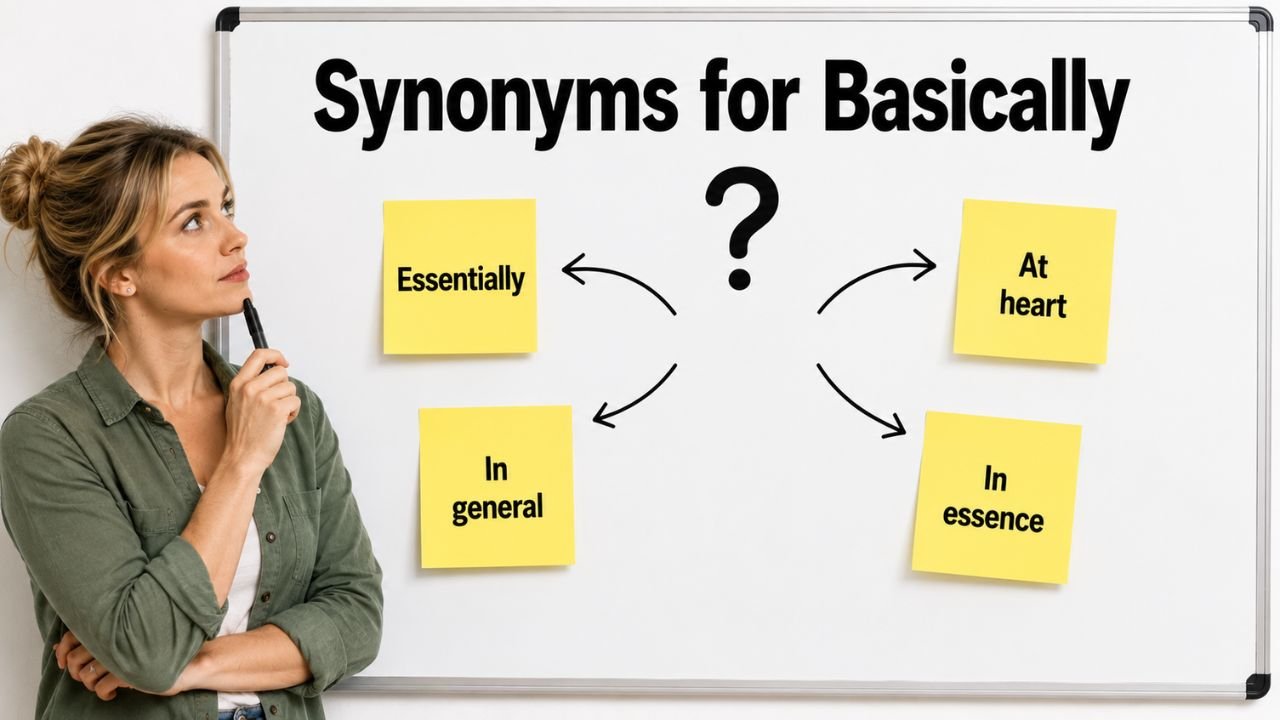
Quick Answer: The best synonyms for basically include essentially, fundamentally, mainly, primarily, generally, largely, in essence, simply put, in short, and in effect. Use essentially when describing the central meaning of something, fundamentally when discussing its foundation, and mainly or primarily when identifying its most important part. Generally works for broad statements, while largely describes something that is mostly true. Use simply put in casual explanations, in short for summaries, and in effect when describing a practical result.
Pronunciation and Word Details
Word: Basically.
Pronunciation: /ˈbeɪ.sɪ.kli/.
Part of Speech: Adverb.
Meaning: Basically means in the most important, essential, general, or simple sense.
US Pronunciation:
UK Pronunciation:
What Does “Basically” Mean?
Basically means when the unnecessary details are removed and only the main meaning, central fact, or general situation remains. It is an adverb commonly used to simplify an explanation, summarize information, or describe what is mostly true.
The word can introduce the essential meaning of an idea.
Example: The plan is basically a simpler version of our original proposal.
It can also summarize a long explanation.
Example: Basically, we need more time to complete the work.
In other sentences, basically shows that something is generally or mostly true, although small exceptions may exist.
Example: The two designs are basically the same.
Basically sometimes describes the practical result of an action or situation.
Example: Refusing the offer basically ended the discussion.
The exact meaning depends on where the word appears and what the speaker wants to emphasize.
Meaning, Tone, and Context of “Basically”
Basically usually has a neutral and conversational tone. It is common in everyday speech because it helps speakers explain complicated information in a simple and direct way.
In casual conversation, basically often appears at the beginning of a sentence.
Example: Basically, the meeting has been moved to Friday.
This use signals that the speaker is about to provide the main point rather than every detail.
In professional writing, basically can sometimes sound vague or informal. A more precise alternative such as essentially, fundamentally, primarily, or in summary may communicate the intended meaning more clearly.
Casual: Basically, the new process saves time.
More Formal: Essentially, the new process reduces the time required.
Basically can also soften a statement. It allows the speaker to make a general observation without claiming that every detail is identical.
Example: The two approaches are basically similar.
The word is not usually emotional, technical, or strongly academic. Its tone depends mainly on the surrounding sentence. In explanations, it sounds helpful and simplifying. When overused, however, it may sound repetitive, uncertain, or unnecessary.
When and How to Use “Basically”
Basically is most useful when you need to express a central meaning, provide a simple explanation, summarize information, or make a broad comparison.
For Core Meaning: Use basically when identifying the essential nature of something.
Example: The device is basically a small computer.
For Simple Explanation: Use it before explaining a complicated subject in easier words.
Example: Basically, the system collects information and organizes it automatically.
For a General Summary: Use basically to present the main conclusion after several details.
Example: Basically, the project succeeded because everyone communicated clearly.
For Broad Similarity: Use it when two things are very similar but not completely identical.
Example: These two recipes are basically the same.
For a Majority: Use basically when most parts of a statement are true, even if a few exceptions exist.
Example: The work is basically complete, apart from a final review.
For a Practical Result: Use it to describe what an action effectively causes.
Example: Ignoring the warning basically guaranteed another delay.
For Restating an Idea: Use basically when expressing the same information in simpler language.
Example: Basically, she wants the instructions to be clearer.
Avoid placing basically in every sentence. It works best when it serves a clear purpose, such as simplifying, summarizing, or identifying the central point.
Best Synonyms for Basically
The strongest synonym depends on whether basically refers to an essential meaning, a main purpose, a general truth, a simple explanation, or a practical result.
- Essentially: In the most important or fundamental sense.
Example: The two proposals are essentially identical. - Fundamentally: At the deepest or most basic level.
Example: The disagreement is fundamentally about responsibility. - Mainly: More than anything else.
Example: The event was mainly organized for new students. - Primarily: For the most important reason or purpose.
Example: The course is primarily designed for beginners. - Generally: In most cases or as a broad rule.
Example: The instructions are generally easy to follow. - Largely: To a great extent, although not completely.
Example: The decision was largely influenced by cost. - In Essence: When only the central meaning is considered.
Example: In essence, the proposal asks for more flexibility. - Simply Put: Used to introduce a clear and uncomplicated explanation.
Example: Simply put, the machine needs more power. - In Short: Used to summarize the main point briefly.
Example: In short, the results were better than expected. - In Effect: In practical terms or as an actual result.
Example: The new requirement will, in effect, delay the entire process.
50 Synonyms for Basically with Short Meanings
- Essentially: In the most important sense.
- Fundamentally: At the deepest or most basic level.
- Mainly: More than anything else.
- Primarily: For the chief purpose or reason.
- Principally: Mainly or most importantly.
- Chiefly: Above all other considerations.
- Largely: To a great extent.
- Mostly: For the greatest part.
- Generally: In most situations or cases.
- Broadly: Without focusing on small details.
- Overall: Considering everything together.
- Predominantly: Mainly or for the most part.
- Substantially: To a considerable degree.
- In Essence: In the central or most important sense.
- At Heart: In the deepest or truest sense.
- At Its Core: In the most central part or meaning.
- In Simple Terms: Explained with easy language.
- Simply Put: Expressed clearly and briefly.
- Put Simply: Stated without unnecessary detail.
- In Plain Terms: Explained in direct and understandable language.
- In Other Words: Restated in a different and clearer way.
- To Put It Plainly: To express something directly.
- To Put It Simply: To remove complexity from an explanation.
- In Short: Used to introduce a brief summary.
- In Brief: Expressed with only the main details.
- Briefly: In a short and direct manner.
- In Summary: Used to present the main conclusion.
- To Summarize: Used before restating the main points.
- To Sum Up: Used to give a final short explanation.
- All in All: Considering every important part.
- On the Whole: Looking at the complete situation.
- By and Large: Generally or for the most part.
- For the Most Part: Mostly, with a few exceptions.
- In General: Considering the usual situation.
- Generally Speaking: True in most cases.
- Broadly Speaking: True when minor details are ignored.
- As a Rule: Usually or under normal conditions.
- In Effect: In actual or practical result.
- Effectively: In practice, even if not officially.
- Practically: Almost or in a practical sense.
- Virtually: Almost completely.
- Almost: Very nearly but not entirely.
- Nearly: Close to being completely true.
- More or Less: Approximately or mostly.
- In Practical Terms: Considering the real result or effect.
- In Reality: Considering what is actually true.
- In Substance: In the most meaningful or important respects.
- In Principle: According to the main idea or general rule.
- At Bottom: When the deepest reason is considered.
- The Main Point Is: Used to introduce the central message.
Read Also:
Synonyms for Drunk
Synonyms for Basically by Context
The meaning of basically changes slightly according to the sentence. Choosing a context specific synonym makes writing clearer and more precise.
When Basically Means Essentially
Use these alternatives when describing the true nature or central meaning of something.
Essentially: Focuses on the most important quality.
Example: The two methods are essentially the same.
Fundamentally: Focuses on the underlying basis.
Example: The problem is fundamentally about poor communication.
In Essence: Introduces the central meaning after details are removed.
Example: In essence, the agreement gives both sides equal control.
At Heart: Describes the deepest character or motivation.
Example: At heart, the story is about friendship.
At Its Core: Identifies the central idea or function.
Example: At its core, the program teaches practical communication.
When Basically Simplifies an Explanation
Use these alternatives when restating complicated information in clearer language.
Simply Put: Introduces a direct explanation.
Example: Simply put, the process turns waste into usable material.
Put Simply: Makes an idea easier to understand.
Example: Put simply, demand is greater than supply.
In Simple Terms: Signals that technical details are being removed.
Example: In simple terms, the system protects your information.
In Plain Terms: Introduces an honest and direct explanation.
Example: In plain terms, the plan costs too much.
In Other Words: Restates an idea using different wording.
Example: In other words, every participant must complete the form.
When Basically Means Mostly or Generally
Use these alternatives when a statement is broadly true but may have minor exceptions.
Mostly: Refers to the greatest part.
Example: The audience was mostly supportive.
Generally: Describes what is normally true.
Example: The process is generally reliable.
Largely: Means true to a considerable extent.
Example: The improvement was largely due to better planning.
For the Most Part: Shows that small exceptions exist.
Example: The instructions were clear for the most part.
By and Large: Gives a broad judgment of the whole situation.
Example: By and large, the changes were successful.
When Basically Summarizes a Main Point
Use these expressions when presenting a short conclusion or final message.
In Short: Introduces a concise conclusion.
Example: In short, the proposal needs further revision.
In Summary: Restates the most important information.
Example: In summary, the results support the original idea.
To Sum Up: Introduces the final main point.
Example: To sum up, the team completed every major objective.
All in All: Gives an overall judgment.
Example: All in all, the event was well organized.
Overall: Considers the complete situation.
Example: Overall, the response was positive.
When Basically Means In Effect
Use these alternatives when describing the real or practical result of something.
In Effect: Describes an actual consequence.
Example: The restriction will, in effect, prevent further development.
Effectively: Means that something produces the same practical outcome.
Example: The rule effectively excludes smaller organizations.
Practically: Refers to what is true in real circumstances.
Example: The road was practically empty.
Virtually: Means almost completely.
Example: The original structure remained virtually unchanged.
In Practical Terms: Focuses on how something works in reality.
Example: In practical terms, the change gives managers more authority.
Another Word for Basically
The best single replacement for basically is often essentially. Both words can identify the central meaning of an idea while leaving out minor details. However, the best alternative still depends on context.
Use fundamentally for a deep cause, mainly for the largest part, generally for a broad truth, and simply put for an easy explanation.
Original: The two options are basically identical.
Better Option: The two options are essentially identical.
Original: The problem is basically caused by poor planning.
Better Option: The problem is fundamentally caused by poor planning.
Original: The guide is basically intended for beginners.
Better Option: The guide is primarily intended for beginners.
Original: Basically, the system stores and organizes information.
Better Option: Simply put, the system stores and organizes information.
When Not to Use “Basically”
Basically can be useful, but it may weaken a sentence when the reader needs precision, formality, or complete certainty.
When Exact Information Is Required
Avoid basically when discussing precise measurements, dates, totals, or technical facts. The word can make exact information sound approximate.
Weak: The container basically holds ten liters.
Better: The container holds exactly ten liters.
When the Meaning Is Already Clear
Basically may be unnecessary when the sentence is already simple and direct.
Weak: Basically, the door is locked.
Better: The door is locked.
When Writing Formally
In reports, essays, policies, or professional explanations, a more specific synonym may sound clearer.
Weak: The research basically supports the original argument.
Better: The research largely supports the original argument.
When Describing a Fundamental Difference
Basically may sound too casual when the sentence discusses an important underlying issue.
Weak: The two theories are basically different.
Better: The two theories are fundamentally different.
When You Mean Literally
Basically and literally do not have the same meaning. Basically simplifies or generalizes, while literally indicates that words are true in their exact sense.
Weak: The building was basically destroyed when nothing remained standing.
Better: The building was completely destroyed.
When It Becomes a Filler Word
Repeatedly beginning sentences with basically can make writing sound uncertain or unplanned.
Weak: Basically, we reviewed the plan. Basically, we found several problems. Basically, we decided to revise it.
Better: We reviewed the plan, identified several problems, and decided to revise it.
Words Commonly Confused With Basically
Several words resemble basically but express different levels of precision, certainty, or emphasis.
Basically vs Essentially: Basically often sounds conversational and simplifying. Essentially sounds more formal and focuses on the central nature of something.
Basically vs Fundamentally: Basically presents a general or simplified meaning. Fundamentally refers to the foundation, cause, or deepest principle.
Basically vs Generally: Basically identifies the main point. Generally describes what is true in most cases.
Basically vs Mostly: Basically can summarize an entire idea. Mostly refers specifically to the largest part or amount.
Basically vs Actually: Basically simplifies or generalizes. Actually introduces a real fact, correction, or contrast.
Basically vs Literally: Basically gives an approximate or central meaning. Literally states that something is true in the exact sense of the words.
Basically vs Technically: Basically describes the broad practical meaning. Technically describes what is correct under exact rules or definitions.
Basically vs Simply: Basically focuses on the main idea. Simply may mean clearly, easily, merely, or without complexity.
Which Synonym Should You Choose?
Choose the synonym that matches the exact purpose of your sentence.
Choose essentially when you are describing the central nature or meaning of something.
Choose fundamentally when discussing an underlying principle, cause, structure, or belief.
Choose mainly when one part, reason, or group is more important than the others.
Choose primarily when describing the chief purpose, function, audience, or reason.
Choose generally when making a broad statement that is true in most cases.
Choose largely when something is true to a great extent but not completely.
Choose mostly when referring to the greatest part of a group, amount, or situation.
Choose in essence when summarizing the central meaning in formal or thoughtful writing.
Choose simply put when explaining a difficult subject in clear everyday language.
Choose in short when summarizing several details in one final statement.
Choose overall when giving a complete judgment after considering different factors.
Choose in effect when describing the real consequence of a rule, choice, or action.
Choose effectively when an action produces a practical result, even if that result was not officially stated.
Choose virtually when something is almost completely true.
Choose for the most part when acknowledging that a few exceptions exist.
In essays and reports, essentially, fundamentally, primarily, largely, and overall are often stronger choices. In conversation, simply put, in short, more or less, and for the most part usually sound natural.
Real Life Examples of “Basically” in Sentences
Original: Basically, the class teaches students how to communicate clearly.
Better Option: Simply put, the class teaches students how to communicate clearly.
Original: The two apartments are basically the same size.
Better Option: The two apartments are approximately the same size.
Original: Her argument is basically correct.
Better Option: Her argument is essentially correct.
Original: The problem is basically a lack of communication.
Better Option: The problem is fundamentally a lack of communication.
Original: The service is basically intended for small teams.
Better Option: The service is primarily intended for small teams.
Original: The work is basically finished.
Better Option: The work is nearly finished.
Original: The audience was basically supportive of the proposal.
Better Option: The audience was largely supportive of the proposal.
Original: Basically, we need to reduce unnecessary spending.
Better Option: In short, we need to reduce unnecessary spending.
Original: The new rule basically prevents late applications.
Better Option: The new rule effectively prevents late applications.
Original: The instructions are basically easy to understand.
Better Option: The instructions are generally easy to understand.
Synonym Groups and Usage Differences
Synonyms for basically can be organized according to the meaning they express. Understanding these groups helps writers choose more accurate replacements.
Core Meaning Group
This group includes essentially, fundamentally, in essence, at heart, and at its core.
These words describe the deepest, central, or most important nature of something. Fundamentally is especially useful for causes and principles, while essentially works well for similarities and definitions.
Example: At its core, the discussion concerns fairness.
Main Purpose Group
This group includes mainly, primarily, principally, chiefly, and predominantly.
These words show that one purpose, reason, quality, or group is more important than the others. Primarily is common when discussing purpose or audience.
Example: The workshop is primarily designed for new employees.
General Truth Group
This group includes generally, broadly, in general, generally speaking, and broadly speaking.
These alternatives indicate that a statement is true in most situations but may not cover every exception.
Example: Generally speaking, shorter sentences are easier to understand.
Majority Group
This group includes mostly, largely, for the most part, on the whole, and by and large.
These expressions show that a statement applies to the greatest part of something. For the most part makes the possibility of exceptions especially clear.
Example: The feedback was positive for the most part.
Simplification Group
This group includes simply put, put simply, in simple terms, in plain terms, and in other words.
These phrases introduce an easier explanation or restatement. They are especially useful when explaining technical or complicated ideas to a general audience.
Example: In simple terms, the device converts sunlight into electricity.
Summary Group
This group includes in short, in brief, in summary, to summarize, and to sum up.
These alternatives reduce a longer explanation to its main conclusion. In summary is suitable for formal writing, while in short works well in both writing and conversation.
Example: In summary, the evidence supports the proposed change.
Practical Result Group
This group includes in effect, effectively, practically, virtually, and in practical terms.
These expressions focus on what actually happens rather than what is officially stated or intended.
Example: The additional requirement effectively delays the entire process.
Approximation Group
This group includes almost, nearly, more or less, practically, and virtually.
These alternatives suggest that something is close to being completely true but may not be exact.
Example: The hall was virtually empty by the end of the event.
Antonyms of Basically
The opposite of basically depends on its meaning in a particular sentence. When basically refers to the central meaning, its opposite may describe a surface detail. When it gives a broad summary, its opposite may focus on precise information.
Superficially: In a way that concerns only the surface.
Secondarily: In a less important position or role.
Incidentally: As a minor or unrelated detail.
Marginally: Only to a small degree.
Minimally: To the smallest possible extent.
Partially: Only in part rather than mostly.
Exceptionally: In a way that differs from the general pattern.
Specifically: With attention to a particular detail.
Precisely: With exact detail and accuracy.
In Detail: With complete supporting information rather than a simple summary.
Completely: Fully rather than approximately or mostly.
Technically: According to exact definitions, rules, or facts rather than a broad practical understanding.
Comparison: Basically vs Related Words
Basically vs Essentially
Basically often introduces a simple, broad, or conversational explanation. Essentially focuses more directly on the central nature of something and usually sounds more formal.
Example With Basically: The two plans are basically the same.
Example With Essentially: The two plans are essentially the same in purpose and structure.
Basically vs Fundamentally
Basically removes minor details to show the main point. Fundamentally refers to the deepest foundation, cause, principle, or structure.
Example With Basically: Basically, the plan needs better organization.
Example With Fundamentally: The plan is fundamentally flawed because its goals are unclear.
Basically vs Generally
Basically explains the central idea. Generally describes what is usual or true in most cases.
Example With Basically: Basically, the program teaches practical skills.
Example With Generally: The program is generally suitable for beginners.
Basically vs Mainly
Basically summarizes the overall nature of something. Mainly identifies the largest part, strongest reason, or chief purpose.
Example With Basically: The book is basically an introduction to grammar.
Example With Mainly: The book is mainly used by students.
Basically vs Actually
Basically simplifies a situation or gives its main meaning. Actually introduces a fact, correction, surprise, or contrast.
Example With Basically: Basically, the schedule has not changed much.
Example With Actually: The schedule has actually changed three times.
Basically vs Literally
Basically presents an approximate, broad, or central meaning. Literally means that the words are true in their exact and nonfigurative sense.
Example With Basically: The room was basically empty.
Example With Literally: The room was literally empty, with no furniture or people inside.
Basically vs Technically
Basically describes the practical or general truth. Technically describes what is correct according to strict facts, definitions, or rules.
Example With Basically: Basically, the task is finished.
Example With Technically: Technically, the task remains incomplete until the final form is signed.
Basically vs Simply
Basically identifies the main idea after details are removed. Simply can mean clearly, easily, only, or without complication.
Example With Basically: Basically, the machine separates the materials.
Example With Simply: The machine is simple to operate.
Common Phrases and Expressions With “Basically”
Basically the Same: Very similar in all important ways.
Example: The two versions are basically the same.
Basically Correct: Correct in the main sense, although minor details may be wrong.
Example: Your explanation is basically correct.
Basically True: Generally accurate despite possible exceptions.
Example: The statement is basically true.
Basically Complete: Almost finished apart from small remaining tasks.
Example: The report is basically complete.
Basically Finished: Nearly done or completed in all important respects.
Example: We are basically finished with the preparation.
Basically Unchanged: Still similar to its previous form.
Example: The original design remained basically unchanged.
Basically Means: Introduces a simple definition.
Example: The term basically means working together toward one goal.
Basically Saying: Restates the central message of another statement.
Example: She is basically saying that the deadline is unrealistic.
What It Basically Comes Down To: Introduces the central issue or deciding factor.
Example: What it basically comes down to is whether the plan is affordable.
Basically Impossible: So difficult that success is extremely unlikely.
Example: Completing the entire project in one hour is basically impossible.
Common Mistakes to Avoid
Overusing Basically
Using basically too frequently makes writing repetitive and can weaken otherwise clear statements.
Repetitive: Basically, we reviewed the proposal. Basically, we found errors. Basically, we made corrections.
Improved: We reviewed the proposal, found several errors, and made the necessary corrections.
Using Basically Before Exact Facts
Basically suggests simplification or approximation. Do not use it when a fact must be exact.
Unclear: The journey basically takes four hours.
Clear: The journey usually takes about four hours.
Confusing Basically With Literally
Basically does not mean that something is true in the exact sense of the words.
Incorrect: The audience basically disappeared after the announcement.
Better: Most of the audience left after the announcement.
Choosing a Synonym With the Wrong Meaning
Essentially, mostly, generally, and fundamentally are not interchangeable in every sentence.
Incorrect: The course is fundamentally attended by beginners.
Better: The course is mainly attended by beginners.
Fundamentally refers to an underlying basis, while mainly identifies the largest group or part.
Using Basically as an Empty Opener
Do not begin a sentence with basically unless it helps simplify or summarize information.
Weak: Basically, I completed the form yesterday.
Better: I completed the form yesterday.
Making the Scope Unclear
The position of basically can affect which part of the sentence it modifies.
Unclear: She basically explained the entire process.
This sentence may mean that her explanation was simple, incomplete, or general.
Clear: She explained the basic steps of the process.
Using Basically in Highly Formal Writing
Basically may sound conversational in academic, legal, technical, or official writing. Replace it with a more exact term when precision matters.
Casual: The evidence basically confirms the theory.
Formal: The evidence largely supports the theory.
Treating Basically as Complete Certainty
Basically often leaves room for minor differences or exceptions. Do not use it when you mean exactly, completely, or without exception.
Unclear: The copies are basically identical.
Exact: The copies are identical in every detail.
Conclusion
The best synonyms for basically depend on the intended meaning. Use essentially or in essence for a central idea, fundamentally for an underlying cause, mainly or primarily for a chief purpose, and generally or largely for broad truths. Simply put is useful for clear explanations, while in short introduces a concise summary. In effect works best for practical results. Understanding these differences will help you use synonyms for basically naturally, avoid vague wording, and choose language that matches both the context and tone of your sentence.
FAQs About Synonyms for Basically
What Is the Best Synonym for Basically?
Essentially is often the best general synonym because it expresses the central or most important meaning of something.
Is Basically a Formal Word?
Basically is neutral but often sounds conversational. In formal writing, essentially, fundamentally, primarily, or in summary may be more precise.
Can Basically Mean Mostly?
Yes. Basically can mean mostly or for the most part when a statement is broadly true but has minor exceptions.
What Can I Use Instead of Basically in an Essay?
Use essentially, fundamentally, primarily, largely, generally, in essence, or in summary, depending on the intended meaning.
Is Basically the Same as Literally?
No. Basically gives a simplified or general meaning, while literally means that something is true in the exact sense of the words.
Can Basically and Essentially Be Used Interchangeably?
They can replace each other in many sentences about central meaning. However, essentially is usually more formal, while basically sounds more conversational.
Why Should Writers Avoid Overusing Basically?
Repeated use can make writing sound vague, informal, or uncertain. A precise synonym often communicates the intended meaning more clearly.
