
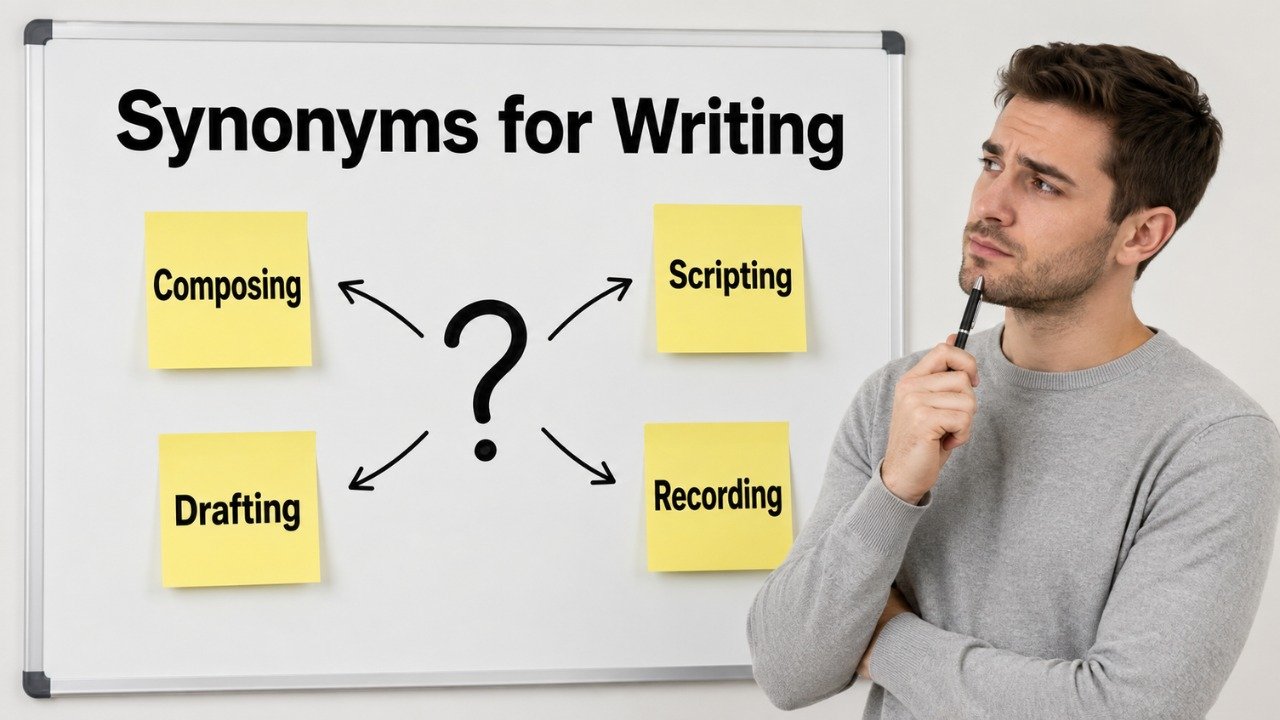
Quick Answer: The best synonyms for writing include composition, authorship, prose, text, copy, drafting, handwriting, documentation, correspondence, and inscription. Use composition for a written work or the process of creating one, authorship for producing books or articles, prose for ordinary written language, and text for words appearing in a document. Copy suits promotional material, drafting describes the creation process, handwriting refers to words formed by hand, documentation fits formal records, correspondence suits letters and messages, and inscription describes words written or carved on a surface.
Pronunciation and Word Details
Word: Writing.
Pronunciation: /ˈraɪtɪŋ/
Part of Speech: Noun, gerund, and present participle.
Meaning: The activity of creating written language or the words produced through that activity.
US Pronunciation:
UK Pronunciation:
What Does “Writing” Mean?
Writing means producing words, sentences, or symbols on paper, a screen, or another surface to communicate information, ideas, experiences, or emotions. It can describe both the activity of creating language and the finished material that results from that activity.
As a noun, writing may refer to a particular text, a style of expression, a profession, or written material in general.
Example: Her writing is clear, thoughtful, and easy to follow.
Writing can also be the gerund or present participle form of the verb write.
Example: She is writing an article about language development.
The word applies to many forms of communication. These include essays, reports, stories, poems, letters, messages, instructions, records, and professional documents.
Writing may also refer specifically to handwriting.
Example: I could not read the writing on the envelope.
In literary discussions, writing can describe an author’s style, creative work, or complete body of work.
Example: His early writing focused on family and memory.
The exact meaning depends on whether the sentence refers to the process, the finished words, the physical appearance of letters, or a type of professional or creative work.
Meaning, Tone, and Context of “Writing”
Writing is a neutral and widely used word. It appears naturally in casual conversation, academic discussion, business communication, literary analysis, education, journalism, and technical work.
In everyday speech, writing may describe any activity involving written words.
Example: Writing in a journal can help organize your thoughts.
In an academic context, writing often refers to essays, research papers, arguments, explanations, and other structured assignments.
Example: Academic writing requires clear reasoning and reliable evidence.
In professional settings, writing may include reports, emails, proposals, instructions, advertisements, records, and official correspondence.
Example: Clear business writing can prevent confusion.
In creative contexts, the word covers stories, novels, scripts, poetry, personal essays, and other imaginative forms.
Example: Creative writing allows people to explore experiences through language.
Writing can also have an evaluative tone when it describes quality or style. Someone may call writing clear, persuasive, elegant, confusing, formal, emotional, or technical.
The word itself is broad rather than emotional. More specific alternatives such as prose, copy, documentation, penmanship, or authorship can make a sentence more precise.
When and How to Use “Writing”
For the Activity of Creating Text
Use writing when referring to the general process of forming sentences, paragraphs, or longer written works.
Example: Writing requires planning, drafting, and revision.
For a Finished Written Work
Use writing when discussing words that have already been produced.
Example: Her writing presents a clear argument.
For Academic Work
Use writing for essays, research papers, assignments, analyses, and formal explanations.
Example: Strong academic writing connects evidence to a central claim.
For Creative Work
Use writing for stories, poems, novels, scripts, and personal narratives.
Example: His creative writing often includes vivid descriptions of nature.
For Professional Communication
Use writing for reports, proposals, instructions, messages, and workplace correspondence.
Example: Professional writing should be direct and respectful.
For Handwriting
Use writing when referring to the physical appearance of words created by hand.
Example: The writing in the notebook was small but readable.
For an Author’s Style
Use writing when describing the way an author organizes ideas and chooses words.
Example: Her writing is known for its humor and emotional depth.
For Recorded Information
Use writing when information has been preserved in a visible form.
Example: The agreement must be confirmed in writing.
For Communication Skills
Use writing when discussing the ability to express ideas through written language.
Example: Regular practice can improve your writing skills.
For a Profession
Use writing when referring to work that involves producing articles, books, scripts, reports, or other material.
Example: He chose writing as a full time profession.
Best Synonyms for Writing
Composition: The process of creating a written work or the work itself.
Example: Her composition presented a clear and balanced argument.
Authorship: The act, profession, or responsibility of creating a written work.
Example: The course explores authorship and literary identity.
Prose: Ordinary written language that is not arranged as poetry.
Example: The novel is admired for its graceful prose.
Text: Written words considered as a complete piece or body of language.
Example: The text explains the process in simple terms.
Copy: Written material prepared for publication, information, or promotion.
Example: The editor reviewed the copy before publication.
Drafting: The process of creating an initial version of a document.
Example: Drafting the proposal took several days.
Handwriting: Words and letters formed by hand.
Example: Her handwriting became clearer with regular practice.
Documentation: Written information that records, explains, or supports something.
Example: Complete documentation is required before the application can be approved.
Correspondence: Written communication exchanged between people or organizations.
Example: The correspondence included several formal letters.
Inscription: Words written, printed, or carved on a surface.
Example: The inscription included the owner’s name and the date.
50 Synonyms for Writing with Short Meanings
- Composition: The creation of a written work or the work produced.
- Authorship: The activity or responsibility of creating written material.
- Written Work: A complete piece created through written language.
- Prose: Ordinary written language without poetic structure.
- Text: Words presented in written or printed form.
- Copy: Written material prepared for readers or publication.
- Drafting: The process of preparing an initial written version.
- Handwriting: Words and letters formed by hand.
- Penmanship: The skill or style of writing by hand.
- Documentation: Written records that explain or confirm information.
- Correspondence: Letters and written messages exchanged between people.
- Inscription: Words written or carved on a surface.
- Script: Written words prepared for performance or presentation.
- Manuscript: A written work before final publication.
- Literature: Written works valued for information or artistic expression.
- Wording: The particular words used to express an idea.
- Written Expression: The communication of ideas through written language.
- Written Communication: Information shared through visible words or symbols.
- Record: Written information preserved for future use.
- Account: A written description of an event or experience.
- Narrative: A written presentation of connected events.
- Description: Writing that explains how something looks, feels, or works.
- Exposition: Writing that explains or develops a subject.
- Commentary: Written discussion, interpretation, or opinion.
- Essay: A structured piece that explores a subject or argument.
- Article: A written piece prepared for a publication or audience.
- Report: An organized written presentation of facts or findings.
- Paper: A formal academic or professional written work.
- Memorandum: A written message used within an organization.
- Note: A short written record or message.
- Letter: A written message addressed to a person or group.
- Message: A brief piece of written communication.
- Statement: A written declaration, explanation, or position.
- Entry: A written item added to a journal, record, or collection.
- Publication: A written work made available to readers.
- Document: A written file containing information or evidence.
- Material: Written information prepared for a particular purpose.
- Content: Information or ideas presented in written form.
- Draft: An early version of a written work.
- Transcription: A written version of spoken or recorded language.
- Notation: A system of written symbols used to record information.
- Lettering: The design or creation of written letters.
- Calligraphy: Decorative and artistic handwriting.
- Journalism: The professional creation of reports and articles.
- Copywriting: Writing created to inform, persuade, or encourage action.
- Storytelling: The presentation of events through a written narrative.
- Verse: Writing arranged with poetic rhythm or structure.
- Poetry: Literary writing that uses rhythm, imagery, and concentrated language.
- Fiction: Imaginative writing about invented people or events.
- Nonfiction: Writing based on real people, facts, and events.
Read Also:
Synonyms for Wisdom

Synonyms for Writing by Context
When Writing Means Composition
Composition, drafting, authorship, written expression, and written work describe the creation of organized language.
Composition may refer to both the process and the finished result. Drafting emphasizes the early stage of development. Authorship focuses on the person responsible for creating the material.
Example: Careful drafting helped her organize the report.
When Writing Means Written Text
Text, copy, content, material, wording, document, and publication describe words prepared for readers.
Text is broad and neutral. Copy is common in professional publishing and promotional contexts. Wording refers to the exact choice and arrangement of words.
Example: The editor revised the wording to make the instructions clearer.
When Writing Means Handwriting
Handwriting, penmanship, lettering, calligraphy, and inscription relate to the physical formation or appearance of written words.
Handwriting is the general term. Penmanship emphasizes skill and neatness. Calligraphy describes artistic and decorative letter formation.
Example: Her neat penmanship made the note easy to read.
When Writing Means Academic Work
Essay, paper, report, exposition, commentary, and analysis are useful alternatives in educational settings.
Essay is appropriate for a structured discussion of a subject. Paper is common for formal assignments. Exposition explains a topic clearly and logically.
Example: The student submitted a detailed paper on language change.
When Writing Means Creative Work
Prose, literature, narrative, storytelling, fiction, poetry, verse, manuscript, and script describe creative forms of written expression.
Prose refers to ordinary sentence and paragraph structure. Narrative focuses on connected events. Script is used for words prepared for performance.
Example: The author used descriptive prose to establish the setting.
When Writing Means Professional Communication
Copy, correspondence, memorandum, report, statement, letter, message, and documentation fit workplace communication.
Correspondence refers to messages exchanged between people or organizations. Documentation records procedures, decisions, or evidence. Copy is written for readers, customers, or the public.
Example: The manager reviewed the correspondence before sending a response.
When Writing Means a Record
Record, documentation, entry, note, account, statement, and transcription describe information preserved in written form.
Record is the broadest choice. Transcription converts spoken language into text. An entry is one item within a journal, log, or database.
Example: The assistant created a written record of the discussion.
When Writing Means an Author’s Style
Prose, wording, expression, voice, composition, and language can describe the way an author communicates.
Prose focuses on sentence level style. Wording refers to specific word choices. Expression describes how thoughts and emotions are communicated.
Example: The writer’s prose is simple, direct, and memorable.
Another Word for Writing
Composition is one of the best general replacements for writing when referring to the process of creating a piece or to the completed work. However, the strongest alternative depends on the context.
Use prose for literary style, handwriting for words formed by hand, copy for professional material, documentation for formal records, and authorship for the creation of published work.
Original: Her writing was selected for the school collection.
Better Option: Her composition was selected for the school collection.
Original: The writing in this novel is vivid and controlled.
Better Option: The prose in this novel is vivid and controlled.
Original: I could not understand the writing on the form.
Better Option: I could not understand the handwriting on the form.
Original: The team reviewed the writing for the new information page.
Better Option: The team reviewed the copy for the new information page.
When Not to Use “Writing”
Writing is broad and useful, but it can sound vague when the sentence requires a more precise term.
When Referring Specifically to Handwriting
Use handwriting or penmanship when the physical appearance of letters matters.
Weak: Your writing is difficult to read.
Better: Your handwriting is difficult to read.
When Referring to Literary Style
Use prose when describing the quality, rhythm, or style of sentences in fiction or nonfiction.
Weak: The writing of the novel is elegant.
Better: The prose of the novel is elegant.
When Referring to Formal Records
Use documentation when written material provides evidence, instructions, or an official record.
Weak: The application requires additional writing.
Better: The application requires additional documentation.
When Referring to Professional Promotional Material
Use copy when the words are prepared to inform readers or encourage a response.
Weak: The editor improved the writing on the product page.
Better: The editor improved the copy on the product page.
When Referring to an Academic Assignment
Essay, paper, report, or analysis may communicate the type of work more clearly.
Weak: I submitted my writing to the instructor.
Better: I submitted my research paper to the instructor.
When Referring to the Creative Process
Drafting or composition may be more specific when discussing how a piece is developed.
Weak: The writing of the proposal began on Monday.
Better: The drafting of the proposal began on Monday.
When Repetition Makes the Meaning Unclear
Using writing repeatedly can make a paragraph sound general and monotonous.
Weak: Her writing improved after she studied writing and practiced writing every evening.
Better: Her prose improved after she studied composition and practiced drafting every evening.
Words Commonly Confused With Writing
Writing vs Handwriting: Writing includes the process and product of written communication. Handwriting refers specifically to letters and words formed by hand.
Writing vs Composition: Writing is a broad term for creating written language. Composition suggests an organized piece or the process of arranging ideas into a complete work.
Writing vs Authorship: Writing is the general activity. Authorship emphasizes creating and taking responsibility for a published or substantial work.
Writing vs Text: Writing may describe the activity or style. Text refers to the actual words that appear in a document, book, message, or screen.
Writing vs Prose: Writing includes many forms, including poetry and scripts. Prose refers to ordinary language arranged in sentences and paragraphs.
Writing vs Copy: Writing is general. Copy usually means material prepared for publication, information, advertising, or promotion.
Writing vs Documentation: Writing can be creative, personal, or informal. Documentation is written material that records facts, processes, evidence, or instructions.
Writing vs Transcription: Writing creates or expresses ideas. Transcription converts existing speech, audio, or symbols into written form.
Writing vs Wording: Writing describes the complete activity or material. Wording refers to the exact words chosen for a particular sentence or statement.
Which Synonym Should You Choose?
Choose composition when discussing the general process of creating a structured written work.
Choose authorship when focusing on who created a book, article, essay, or other publication.
Choose prose when describing sentence style in novels, essays, stories, or other nonpoetic material.
Choose text when referring to the actual words appearing in a document, message, or passage.
Choose copy when discussing professional, informational, editorial, or promotional material.
Choose drafting when referring to the early process of planning and producing a document.
Choose handwriting when describing words physically formed by hand.
Choose penmanship when evaluating the neatness, skill, or appearance of handwriting.
Choose documentation when referring to official records, evidence, procedures, instructions, or technical information.
Choose correspondence when discussing letters, emails, or formal messages exchanged between people.
Choose essay or paper for academic assignments.
Choose report for an organized presentation of facts, findings, or progress.
Choose narrative for writing that presents a connected series of events.
Choose script for material written to be spoken or performed.
Choose transcription when speech or recorded language is converted into text.
Real Life Examples of “Writing” in Sentences
Original: Her writing is clear and persuasive.
Better Option: Her prose is clear and persuasive.
Original: The writing on the package was too small to read.
Better Option: The lettering on the package was too small to read.
Original: He is responsible for writing the final report.
Better Option: He is responsible for drafting the final report.
Original: The writing for the information page needs revision.
Better Option: The copy for the information page needs revision.
Original: The office requested more writing about the incident.
Better Option: The office requested more documentation about the incident.
Original: Her writing appeared in several literary collections.
Better Option: Her work appeared in several literary collections.
Original: The writing between the two departments remained formal.
Better Option: The correspondence between the two departments remained formal.
Original: The writing tells the story of a family moving to a new city.
Better Option: The narrative tells the story of a family moving to a new city.
Original: I recognized his writing immediately.
Better Option: I recognized his handwriting immediately.
Original: The writing contains the speaker’s exact words.
Better Option: The transcription contains the speaker’s exact words.
Synonym Groups and Usage Differences
Creation Group
Composition, drafting, authorship, copywriting, and written expression describe the production of written material.
Composition emphasizes organization. Drafting focuses on the early version. Authorship connects the creator to the finished work. Copywriting usually serves an informational or persuasive purpose.
Example: Drafting helped the team identify weaknesses in the proposal.
Finished Work Group
Written work, text, document, content, material, publication, and piece refer to something readers can examine.
Text emphasizes the words themselves. Document suggests a complete file or official record. Content is broad and may include information created for a particular audience.
Example: The document contains all the required information.
Literary Group
Prose, literature, narrative, fiction, nonfiction, poetry, verse, and manuscript relate to artistic or published writing.
Prose describes ordinary sentence structure. Literature refers to a broad collection of written works. A manuscript is a work prepared for review or publication.
Example: The manuscript includes twelve connected stories.
Academic Group
Essay, paper, report, exposition, commentary, and analysis describe formal educational writing.
An essay develops an idea or argument. A report presents organized information. Exposition explains a topic, while commentary offers interpretation or opinion.
Example: The report summarizes the main findings of the study.
Handwriting Group
Handwriting, penmanship, lettering, calligraphy, and inscription concern visible letter formation.
Handwriting is neutral and general. Penmanship refers to skill. Lettering focuses on the visual design of letters, and calligraphy is decorative.
Example: The invitation featured elegant calligraphy.
Communication Group
Correspondence, letter, message, memorandum, note, statement, and written communication involve sharing information with others.
Correspondence usually includes an exchange. A memorandum is commonly used within an organization. A statement presents a clear position or official explanation.
Example: The memorandum explained the new procedure.
Record Group
Documentation, record, entry, account, transcription, and notation preserve information for later use.
Documentation may include several related records. An account describes events. Transcription creates a written version of spoken words.
Example: Accurate documentation helped the team review the decision.
Word Choice Group
Wording, expression, language, text, and phrasing focus on how ideas are stated.
Wording refers to exact words. Expression describes the communication of thought or emotion. Language can refer to the overall vocabulary and style.
Example: The wording of the notice was polite but firm.
Antonyms of Writing
Writing does not have one exact opposite because it can refer to an activity, a product, a profession, or handwriting. Its opposites depend on the intended meaning.
Speech: Communication through spoken rather than written words.
Speaking: The activity of expressing ideas aloud.
Oral Communication: Information exchanged through speech.
Silence: The absence of spoken or written expression.
Reading: Receiving and interpreting text rather than producing it.
Erasure: The removal of written marks or words.
Deletion: The act of removing written or stored text.
Removal: Taking written material away from a document or surface.
Blankness: The condition of containing no writing or visible information.
Unwritten Material: Ideas, rules, or information that have not been recorded in words.
Abstention: A decision not to write or communicate a position.
Omission: The act of leaving information out of a written work.
Comparison: Writing vs Related Words
Writing vs Composition
Writing is the broad activity of producing written language. Composition suggests arranging ideas into an organized and complete work.
Example With Writing: Writing every morning helped her develop confidence.
Example With Composition: Her composition presents three carefully connected arguments.
Writing vs Authorship
Writing describes the act or result of creating text. Authorship focuses on the identity, role, or responsibility of the creator.
Example With Writing: His writing appeared in the monthly journal.
Example With Authorship: The authorship of the anonymous letter remains uncertain.
Writing vs Text
Writing can refer to an activity, style, or body of work. Text refers to the actual words within a document or passage.
Example With Writing: Her writing has become more concise.
Example With Text: The text contains several useful examples.
Writing vs Prose
Writing includes poetry, scripts, notes, reports, and many other forms. Prose is language arranged in ordinary sentences and paragraphs.
Example With Writing: His writing includes essays, poems, and scripts.
Example With Prose: His prose uses short sentences and precise descriptions.
Writing vs Handwriting
Writing includes all forms of written communication. Handwriting refers only to words formed by hand.
Example With Writing: Writing reports is part of her job.
Example With Handwriting: Her handwriting is neat and evenly spaced.
Writing vs Copy
Writing is a general term. Copy is written material prepared for a specific audience, publication, informational purpose, or persuasive goal.
Example With Writing: The writing explains how the service works.
Example With Copy: The copy explains the service in a clear and engaging way.
Writing vs Documentation
Writing may be creative, personal, academic, or professional. Documentation records facts, procedures, evidence, or technical details.
Example With Writing: His writing explores memories from childhood.
Example With Documentation: The documentation explains how to operate the equipment safely.
Writing vs Drafting
Writing covers the complete process and finished result. Drafting refers mainly to creating and shaping an early version.
Example With Writing: Writing the report required careful research.
Example With Drafting: Drafting the report helped the team organize its findings.
Writing vs Transcription
Writing often creates new language or ideas. Transcription records language that already exists in spoken or recorded form.
Example With Writing: She is writing an original interview article.
Example With Transcription: She is preparing a transcription of the recorded interview.
Writing vs Wording
Writing refers to a complete activity or product. Wording focuses on the particular words chosen for a sentence or message.
Example With Writing: The writing is clear and professional.
Example With Wording: The wording of the final sentence sounds too informal.
Common Phrases and Expressions With “Writing”
Creative Writing: Imaginative work such as fiction, poetry, scripts, and personal narratives.
Academic Writing: Formal work that presents research, evidence, explanation, or argument.
Business Writing: Professional communication used in reports, proposals, messages, and workplace documents.
Technical Writing: Clear material that explains specialized information, systems, or procedures.
Formal Writing: Structured language that follows professional or academic conventions.
Informal Writing: Relaxed written communication used in personal or conversational contexts.
Writing Style: The distinctive way a person chooses words and structures sentences.
Writing Process: The stages of planning, drafting, revising, editing, and completing a work.
Writing Skills: The abilities required to communicate effectively through written language.
Writing Sample: A piece provided to demonstrate a person’s written communication ability.
Common Mistakes to Avoid
Treating Writing and Handwriting as Identical
Writing covers the creation of written language, while handwriting describes its physical appearance when formed by hand.
Incorrect: Her writing is difficult to read because the letters are crowded.
Better: Her handwriting is difficult to read because the letters are crowded.
Using Writing When a Specific Form Is Known
Name the exact type of material whenever that detail helps the reader.
Vague: She completed her writing for the class.
Better: She completed her research paper for the class.
Using Content as an Exact Replacement in Every Context
Content refers to information presented to an audience. It does not always replace writing when discussing style, handwriting, or authorship.
Incorrect: I recognized his content on the envelope.
Better: I recognized his handwriting on the envelope.
Confusing Prose With All Writing
Prose does not include every kind of writing. Poetry and some scripts use structures that differ from ordinary prose.
Incorrect: The collection contains prose written in rhyming lines.
Better: The collection contains poetry written in rhyming lines.
Confusing Authorship With Handwriting
Authorship identifies or describes the creator of a work. It does not refer to the appearance of letters.
Incorrect: The authorship on the note was difficult to read.
Better: The handwriting on the note was difficult to read.
Using “A Writing” Unnaturally
Writing is usually uncountable when describing the activity or written material in general. Use a piece of writing for one individual work.
Unnatural: She submitted a writing about her hometown.
Better: She submitted a piece of writing about her hometown.
The plural writings is acceptable when referring to a collection or body of work.
Example: The scholar studied the early writings of several poets.
Repeating Writing Too Often
Repeated use can make a paragraph sound vague.
Repetitive: Her writing improved because she studied writing and completed more writing assignments.
Improved: Her prose improved because she studied composition and completed more written assignments.
Choosing an Overly Formal Synonym
Authorship, exposition, and documentation may sound unnatural in casual situations.
Unnatural: I enjoyed the authorship in your birthday card.
Better: I enjoyed the message in your birthday card.
Focusing Only on Length
Strong writing is not simply long or short. It should be clear, relevant, organized, and appropriate for its purpose.
Weak: The paragraph needs more writing.
Better: The paragraph needs a clear example and further explanation.
Conclusion
The best synonyms for writing depend on whether you mean the creative process, a finished text, handwriting, professional copy, or a formal record. Composition is a strong general alternative, while prose suits literary style and authorship emphasizes the creator. Use handwriting or penmanship for words formed by hand, documentation for official records, correspondence for exchanged messages, and drafting for an early version. Understanding these distinctions makes synonyms for writing more precise in essays, reports, conversations, and professional communication.
FAQs About Synonyms for Writing
What Is the Best Synonym for Writing?
Composition is one of the best general synonyms. Prose, text, authorship, copy, handwriting, and documentation may be more accurate in specific contexts.
What Is a Formal Synonym for Writing?
Composition, authorship, documentation, exposition, and written communication are useful formal alternatives. The best choice depends on the type of material.
What Is Another Word for Creative Writing?
Fiction, storytelling, literature, prose, poetry, narrative, and creative composition can describe different forms of creative writing.
What Is a Synonym for Academic Writing?
Scholarly composition, essay, paper, report, analysis, exposition, and academic work are useful alternatives.
Are Writing and Handwriting the Same?
No. Writing is the broad process of creating written language. Handwriting refers specifically to words and letters formed by hand.
Is Prose a Synonym for Writing?
Prose is a synonym when writing refers to ordinary language arranged in sentences and paragraphs. It does not include every form of poetry or verse.
Can Writing Be Plural?
Yes. Writings refers to a collection or body of written works. For one work, a piece of writing is usually more natural than a writing.
